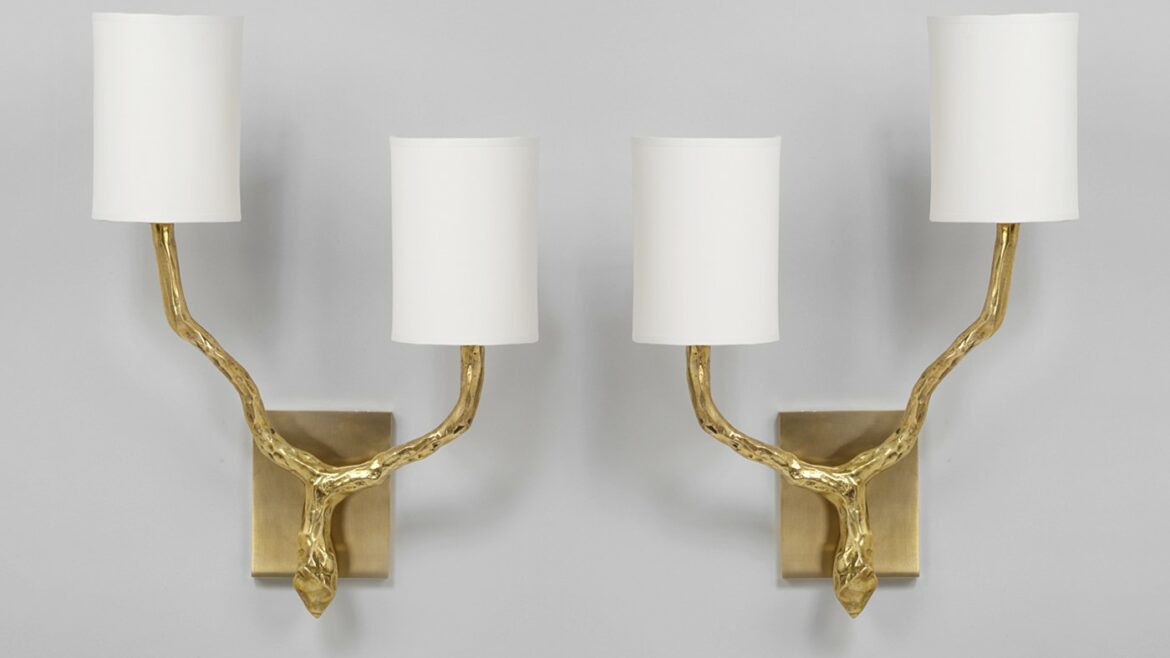
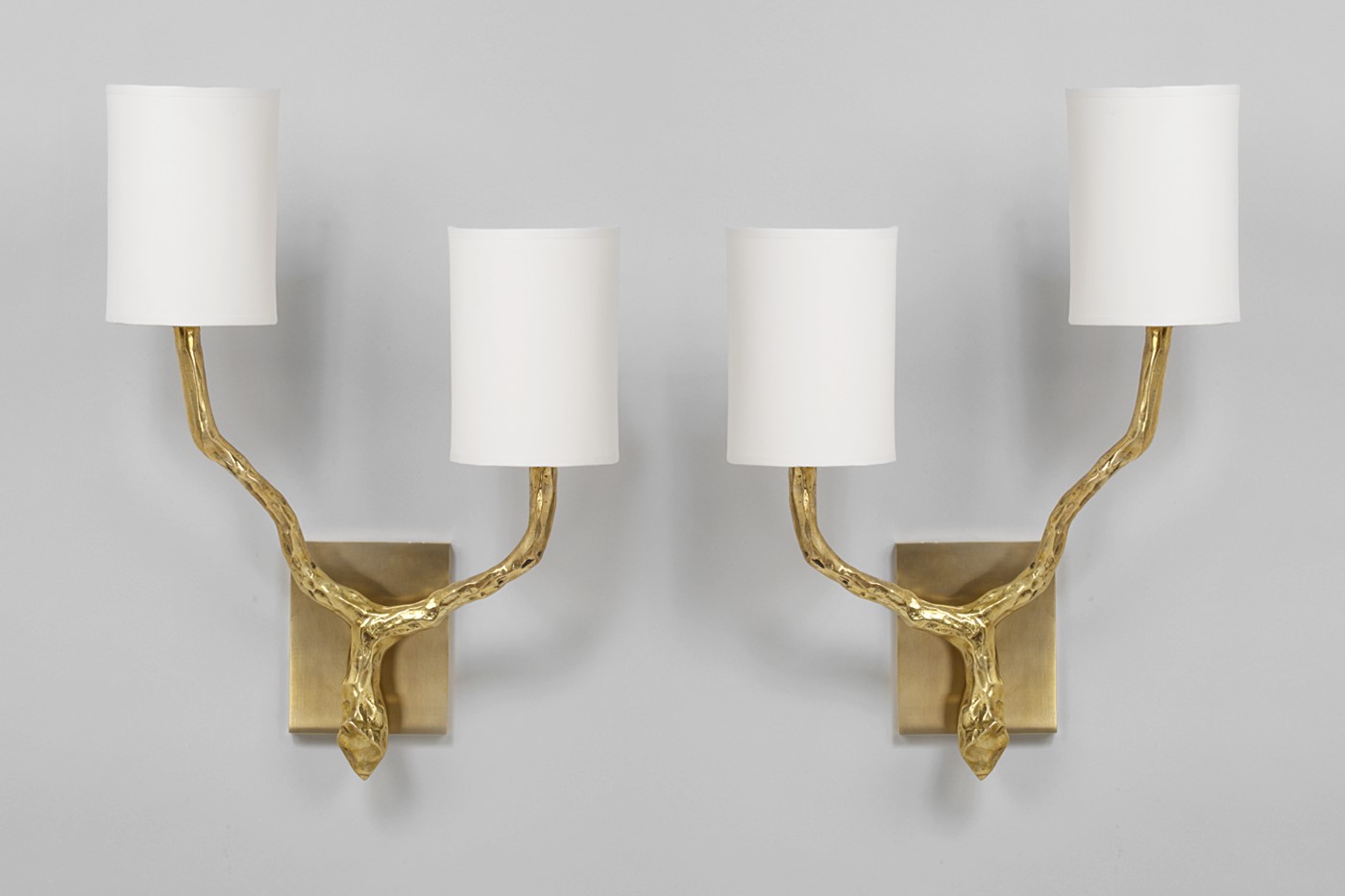
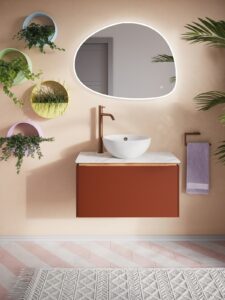
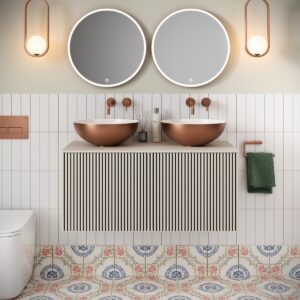
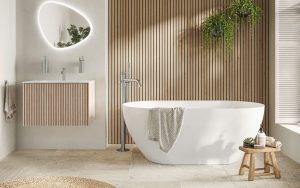
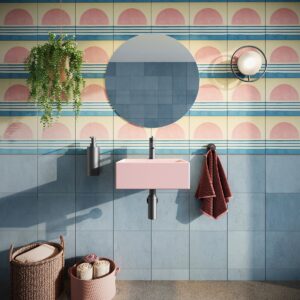
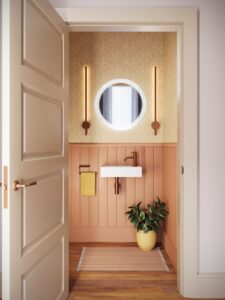
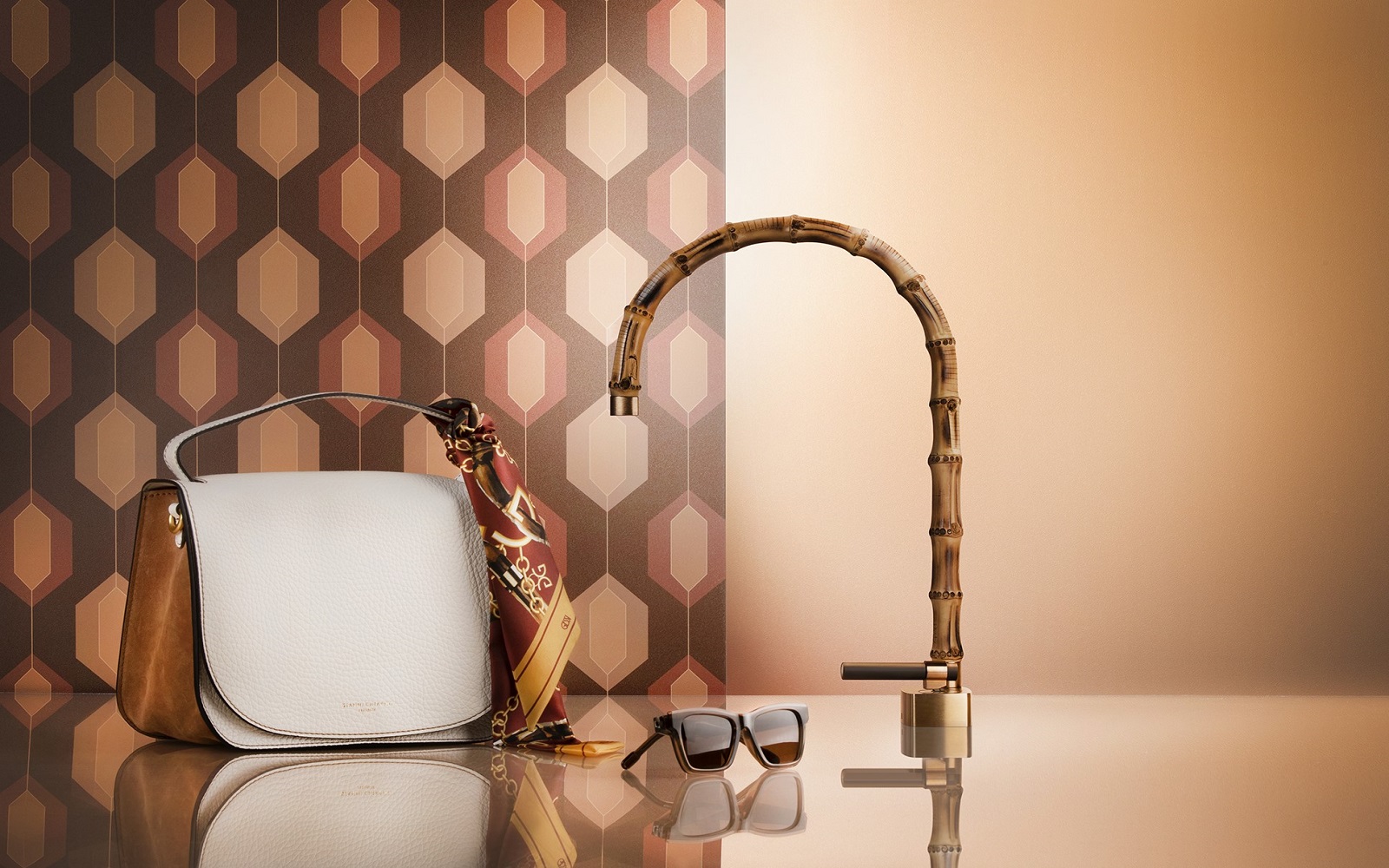
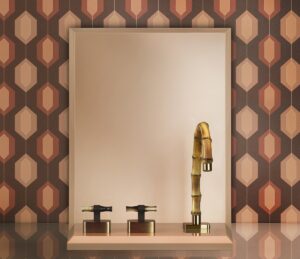
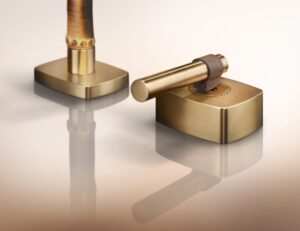
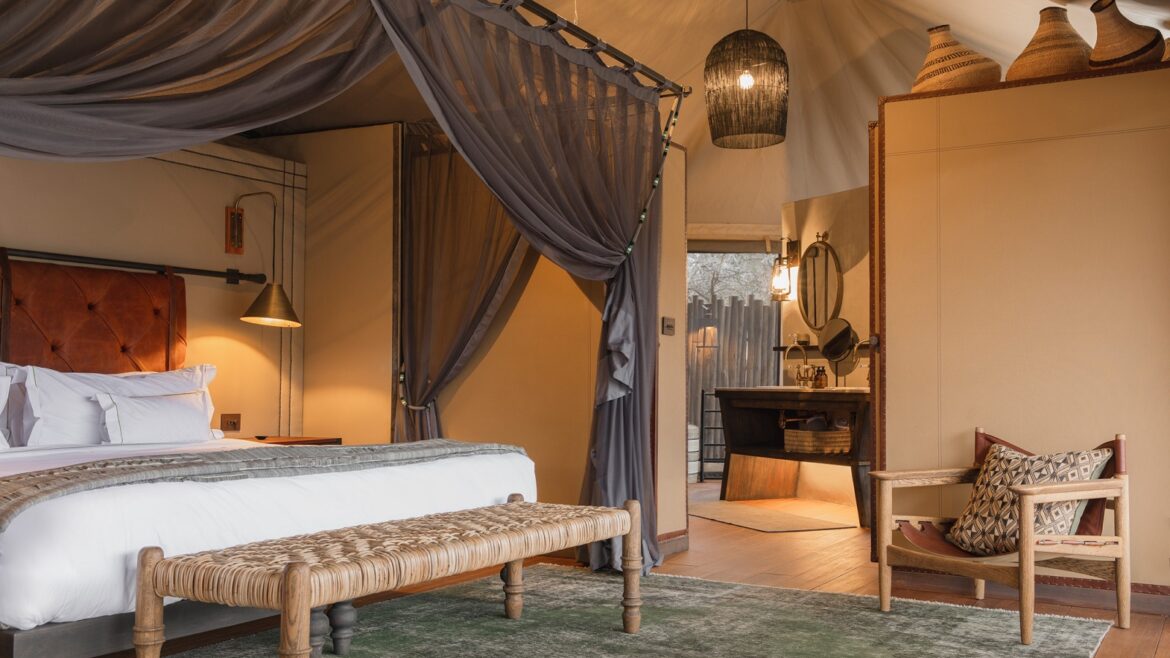
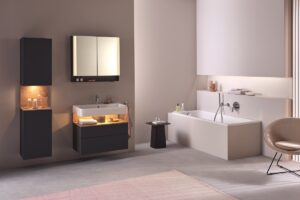
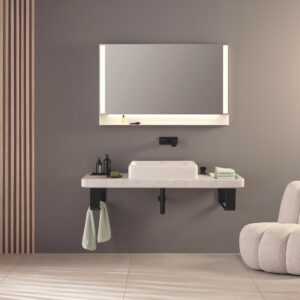
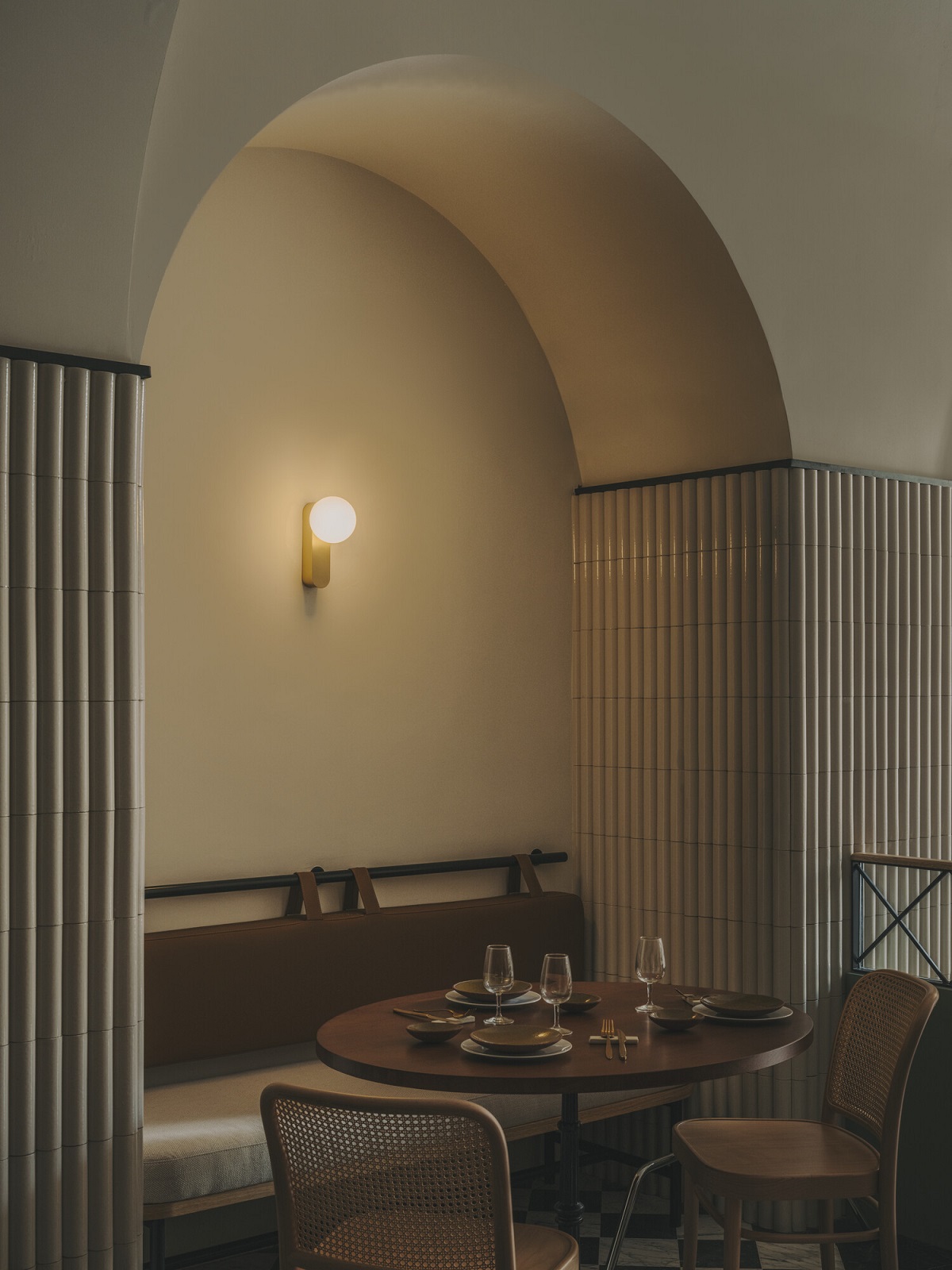
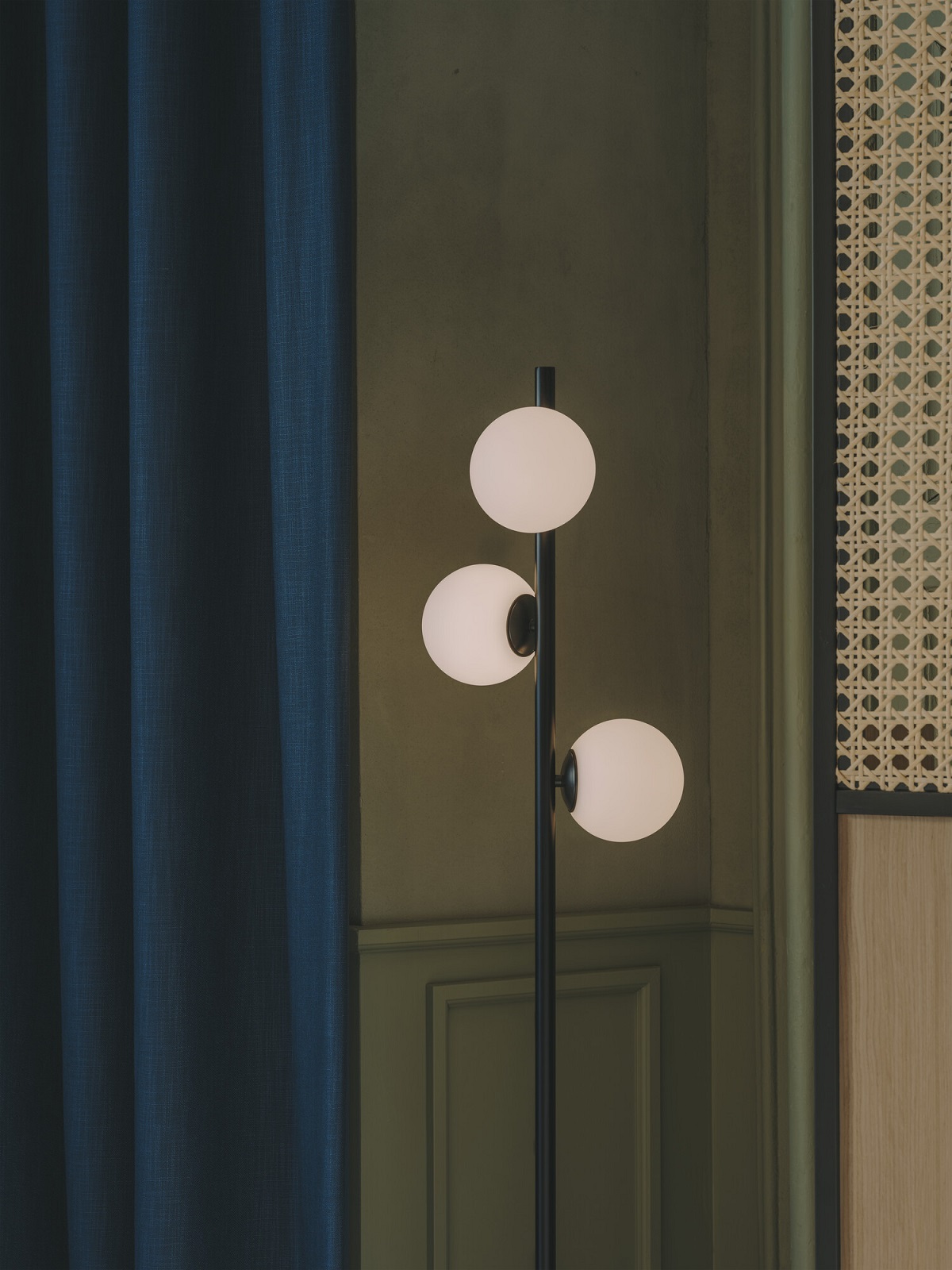
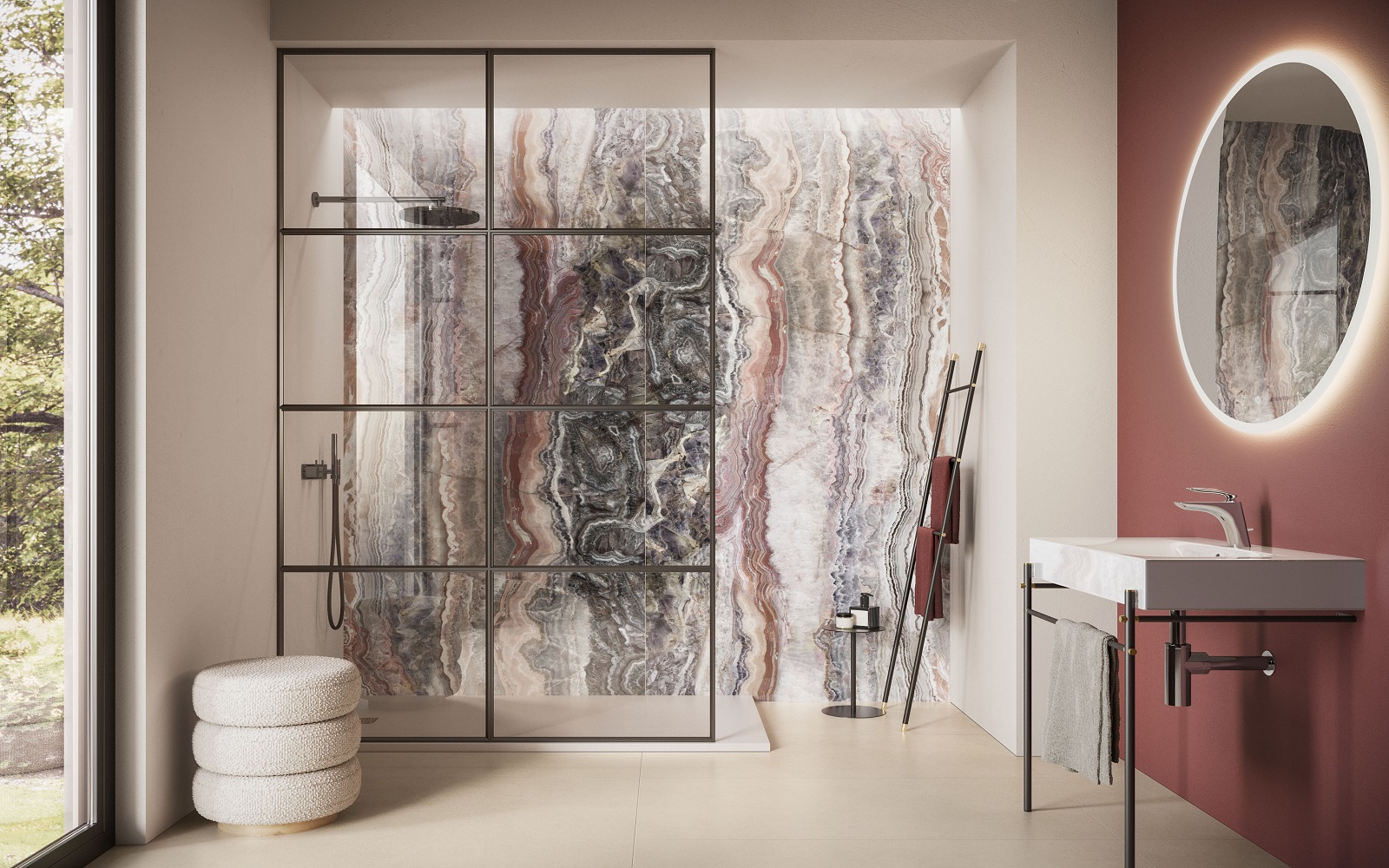
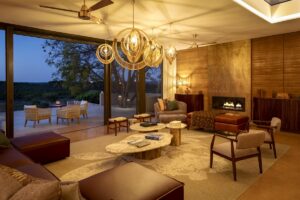
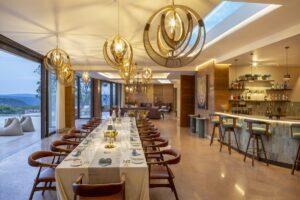
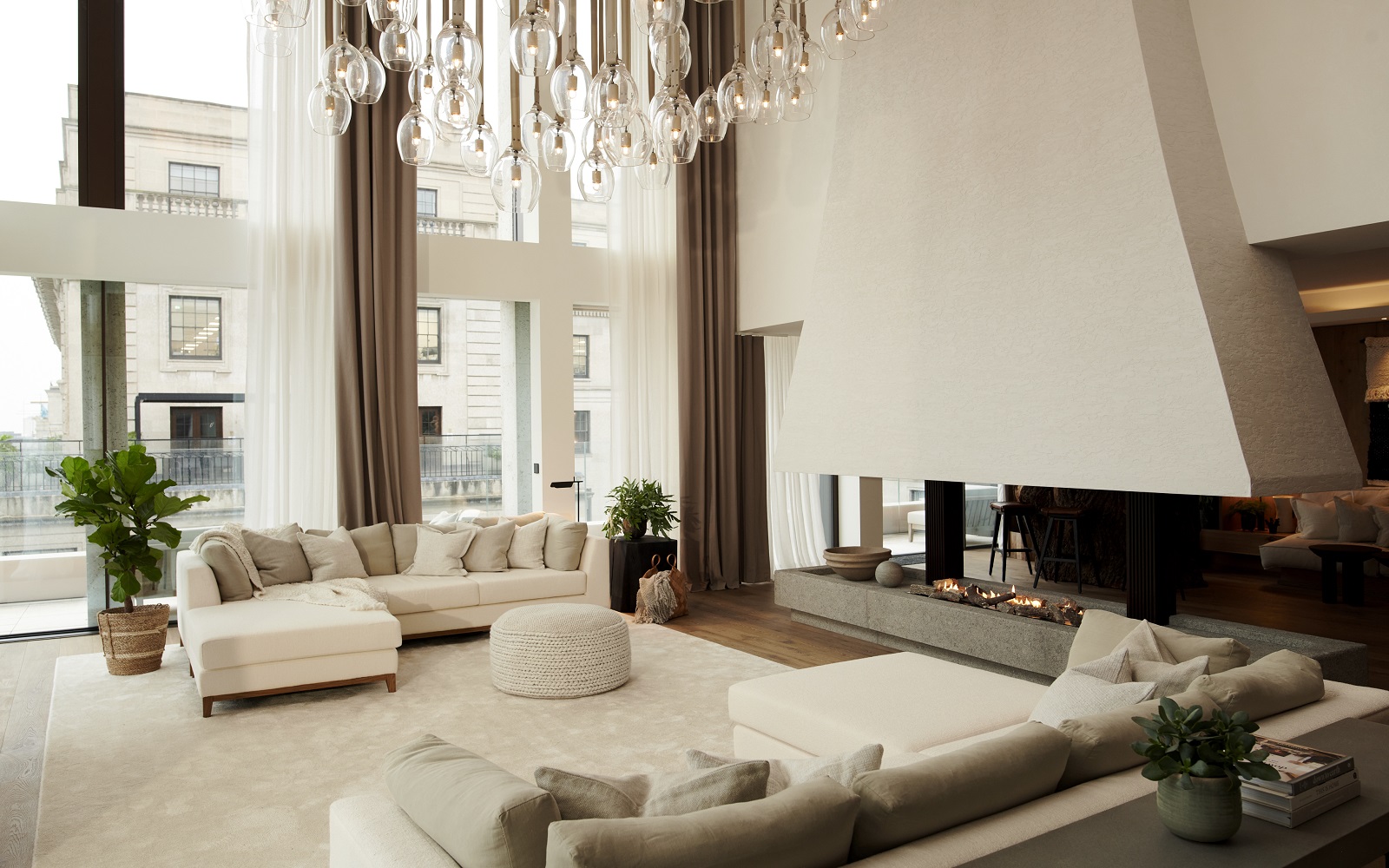
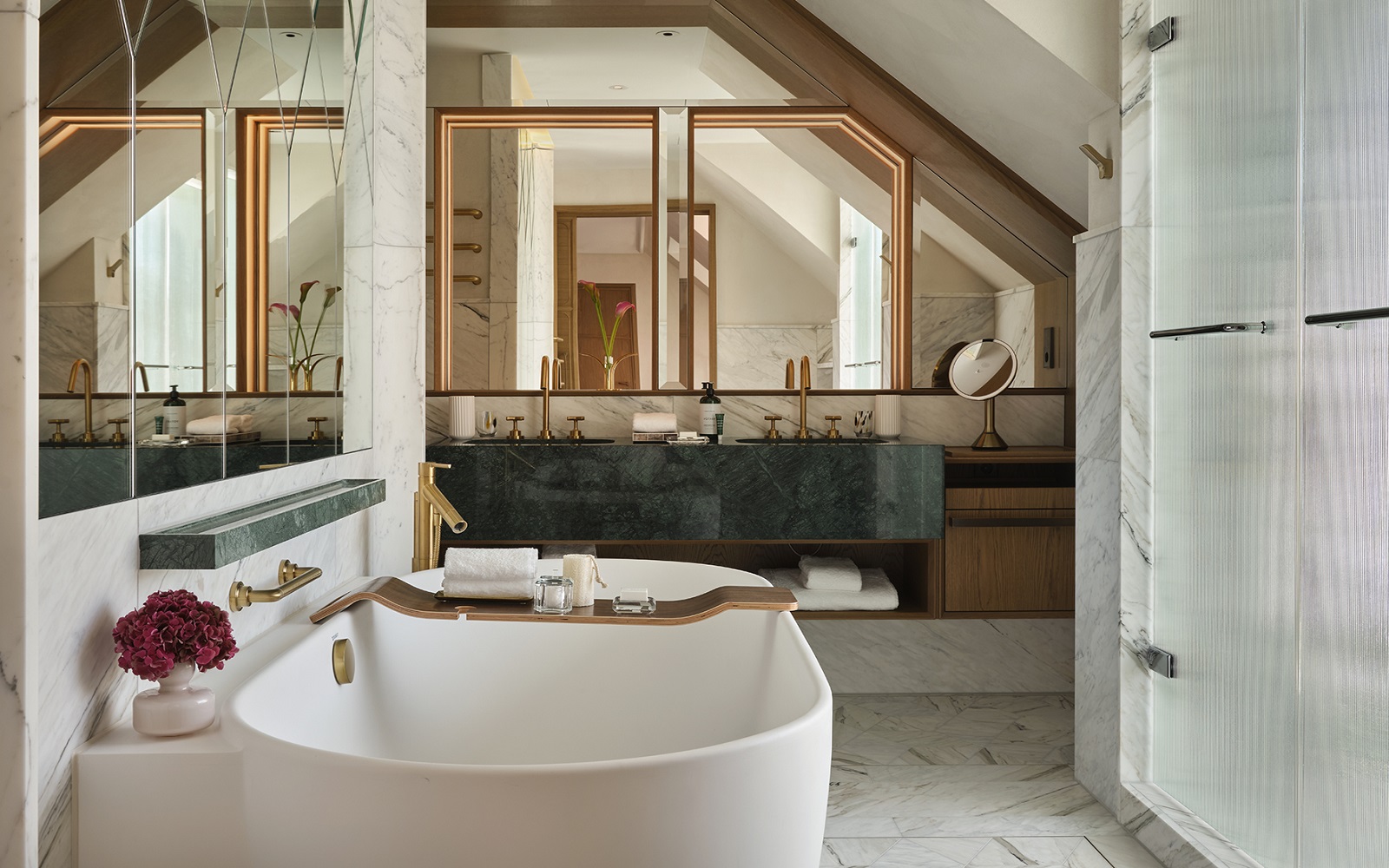
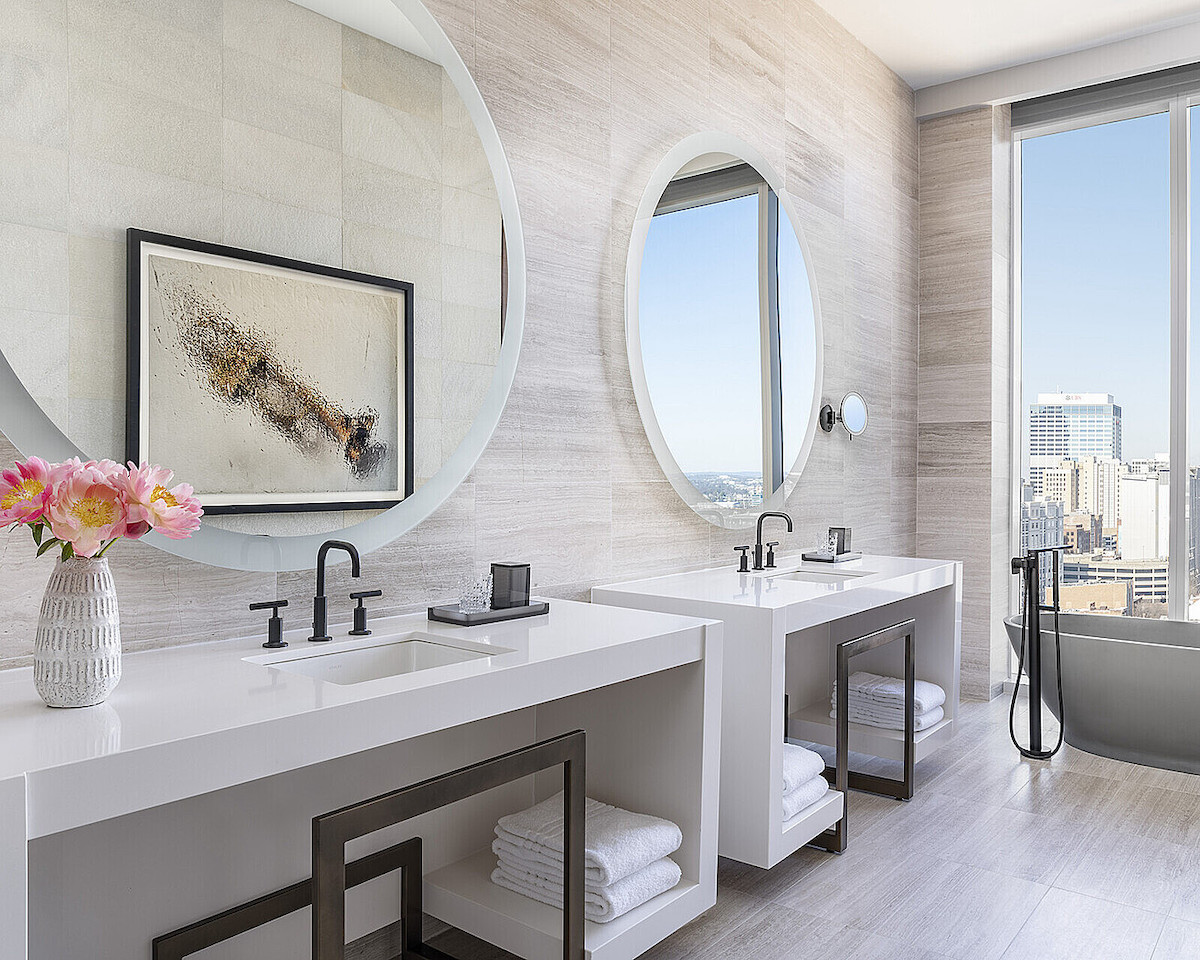
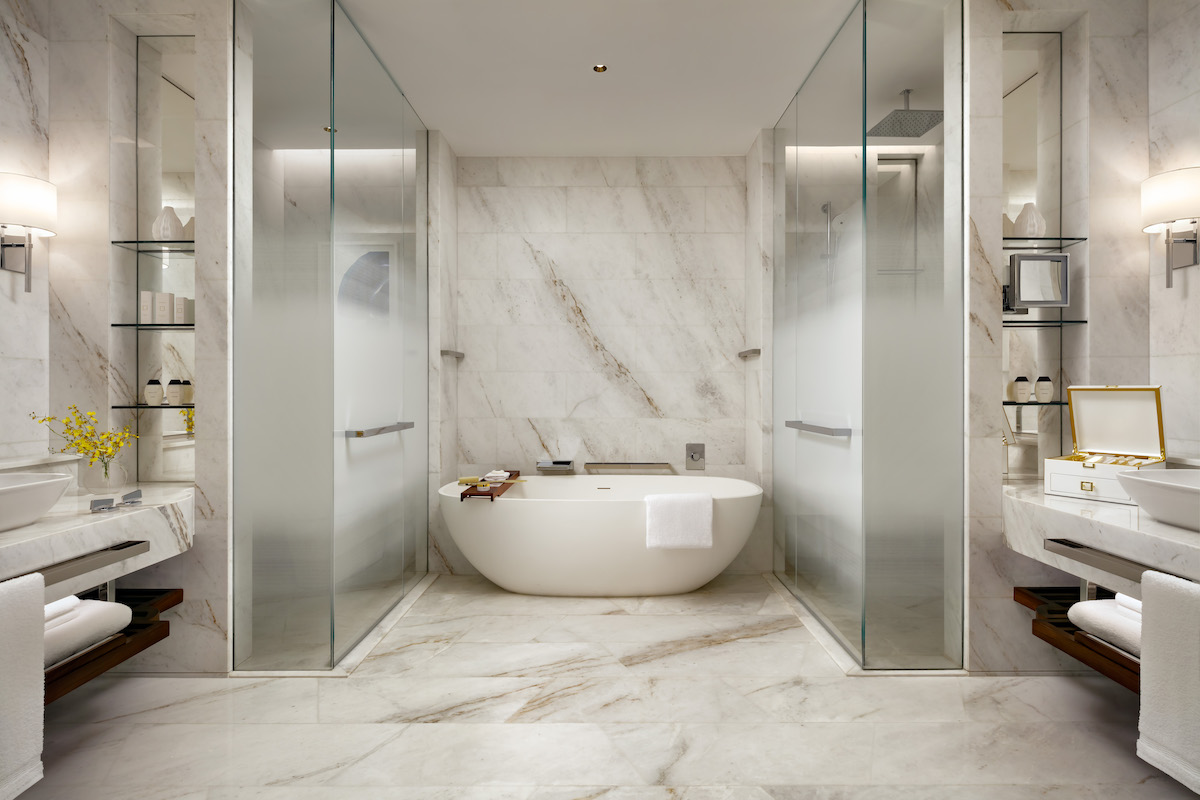
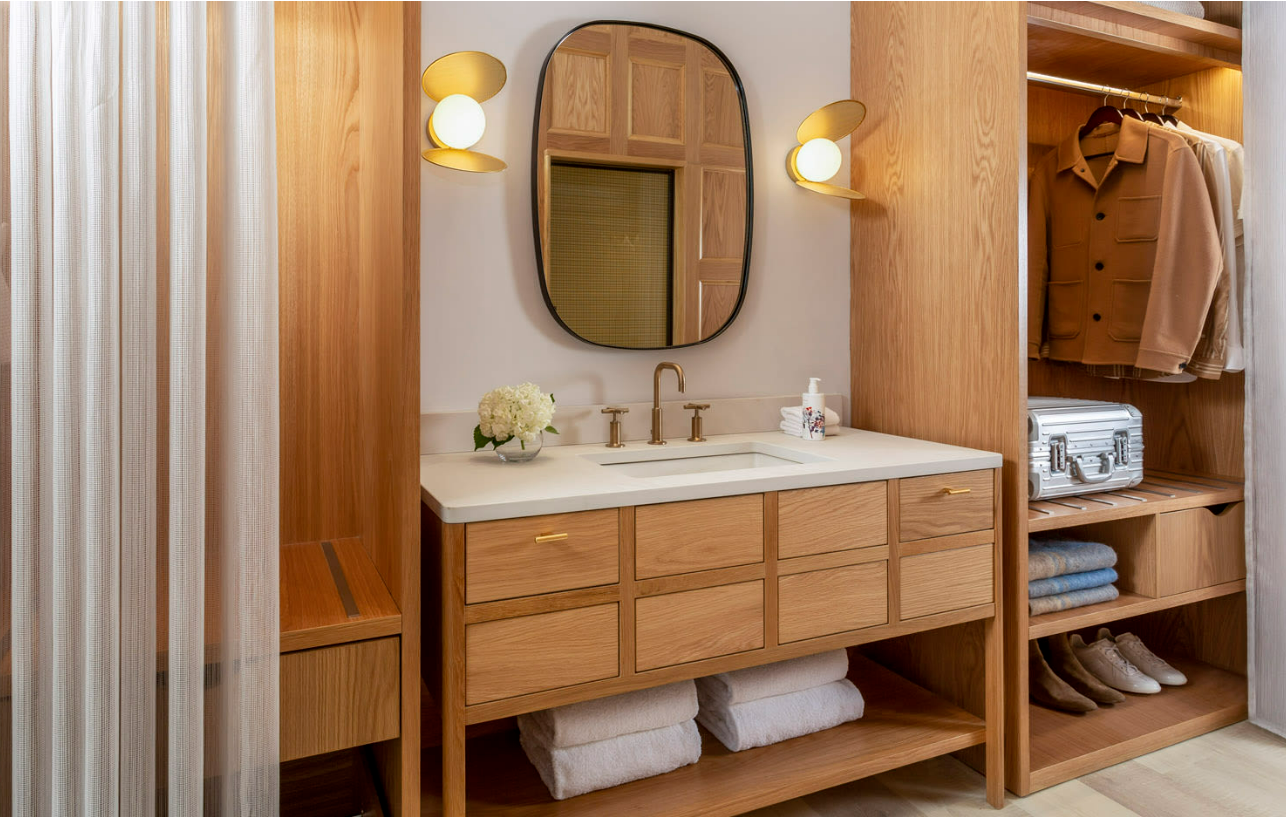
Inspired by naturalistic tree forms, these lights from Vaughan function as both sculptural artwork and a practical lighting solution…
Designs by Vaughan are brought to life using some of the finest and most durable traditional materials. Every material adds its own qualities to the design and the traditional manufacturing methods give a rare depth and beauty to the finishes. Highly skilled craftspeople, some of whom have supplied Vaughan for over 30 years, work closely with the in-house design team, translating these designs, often involving complex engineering, into beautiful, finished products.
Image credit: Vaughan
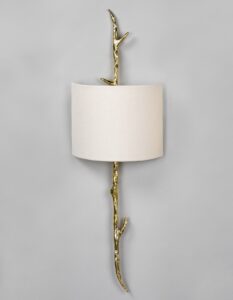
The Amiens Bathroom Wall Light is made from a base material of solid cast brass, ensuring a high standard of quality and durability. The sculptural central stem is beautifully cast in brass.
The Twig Bathroom Wall Lights are Inspired by 20th century sculptor, Giacometti. The textural detailing of the fixture is based on naturalistic tree forms. Both wall lights are IP44 rated for bathroom use.
Image credit: Vaughan
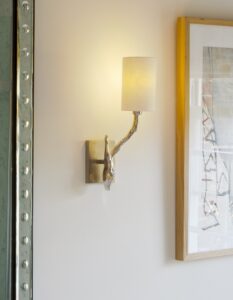
Master craftsmen use the art of lost wax casting to produce the textured detailing that reinterprets natural tree-like forms in cast brass. The close up shows the rectangular backplate, the arms and the sculptural textured finish of the cast brass created by using the lost wax process. An appreciation of traditional and authentic manufacturing is fundamental to each and every Vaughan product.
Vaughan’s lighting can be found in some of the world’s most beautiful residential interiors, leading hotels and restaurants around the world. Today Vaughan continues as it started 40 years ago, designing beautiful, handcrafted lighting, as well as furniture and textiles, for the international design community. Many of the earliest lights designed and manufactured by Lucy and Michael are still being made and form a valuable part of the current collection, their longevity is testament to the enduring and timeless quality of their design.
Vaughan is one of our Recommended Suppliers and regularly features in our Supplier News section of the website. If you are interested in becoming one of our Recommended Suppliers, please email Katy Phillips.
Zel prepares to open its second hotel in Spain this summer
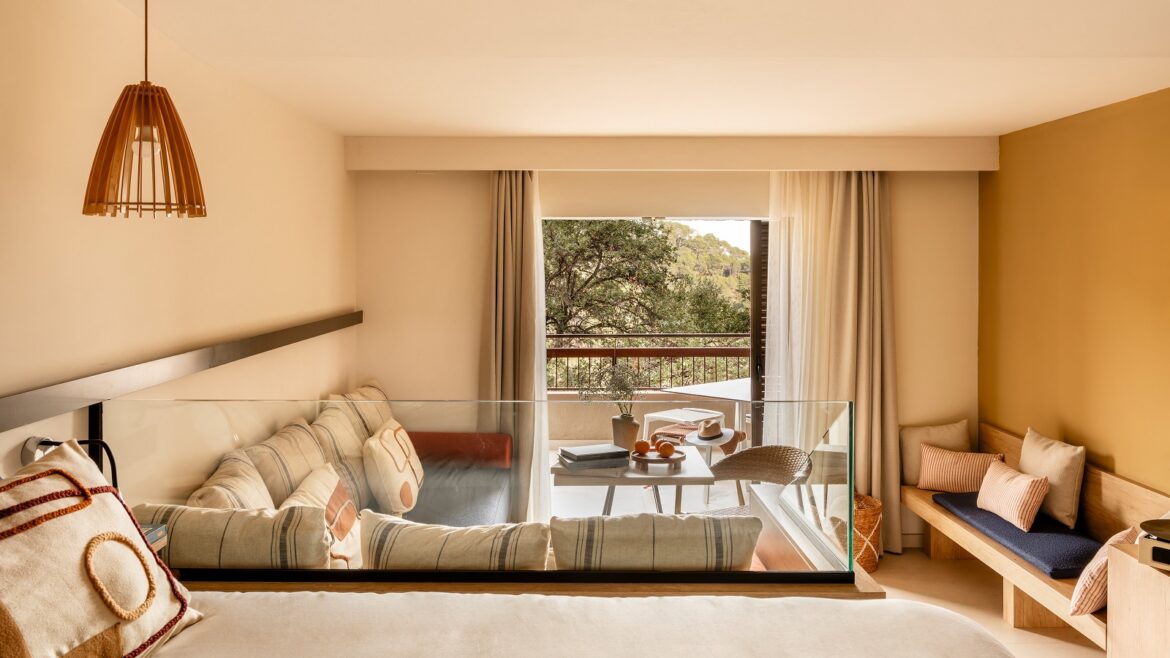
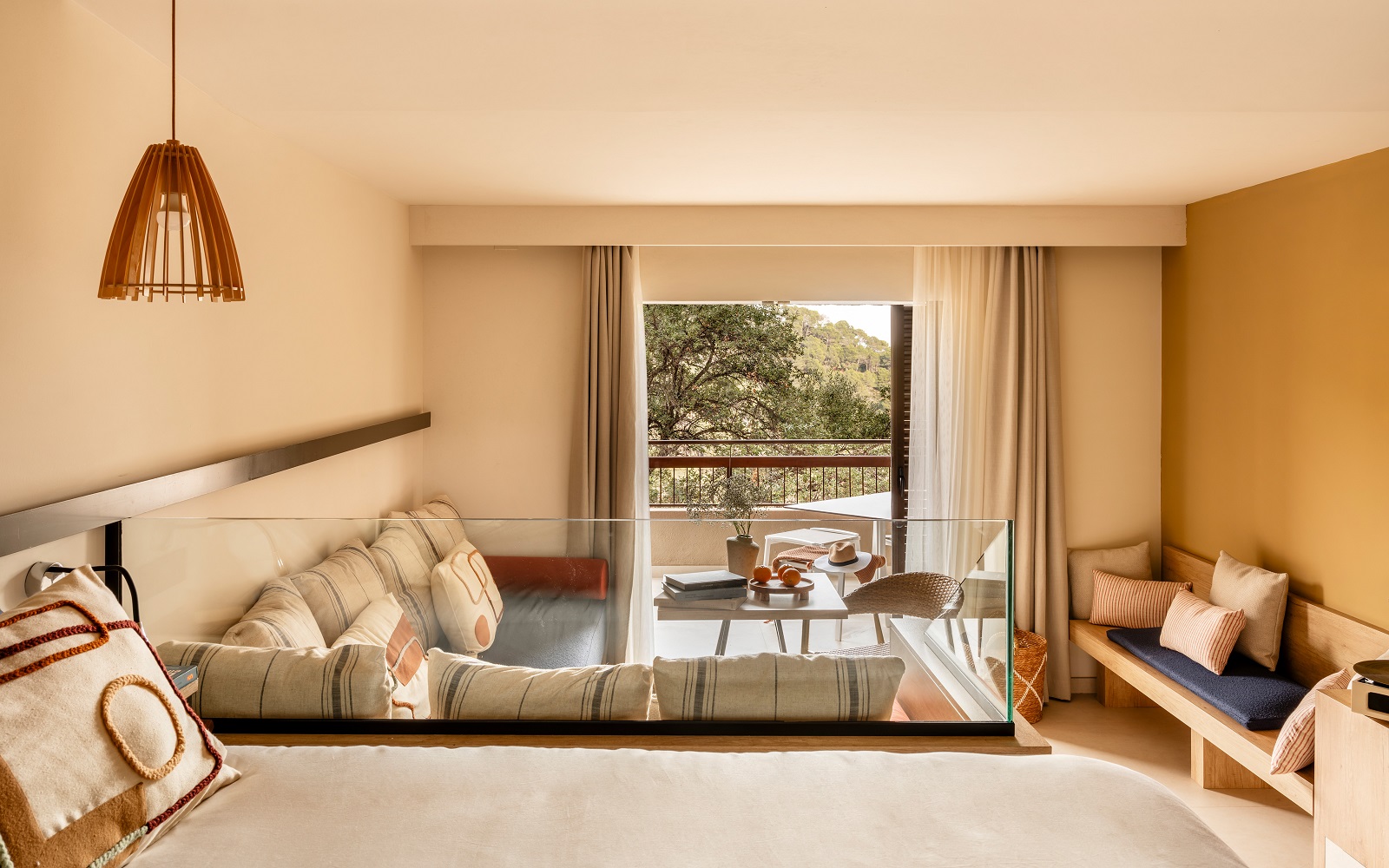
The brand created by Meliá Hotels International and Rafa Nadal plans to bring its innovative ‘Mediterranean House’ concept to the crystal-clear waters of Tossa de Mar as part of its ambitious pipeline…
Zel has commenced the year with new expansion projects, as announced at Fitur by Meliá’s Chairman and CEO, Gabriel Escarrer, who disclosed the brand’s upcoming destinations, with the second Zel project set to open on the Costa Brava this summer, followed by new hotels in Madrid, Sayulita (Mexico) and Punta Cana (Dominican Republic) in 2025.
Image credit: Zel
Zel launched its first hotel in Mallorca in 2023, establishing the unmistakable Mediterranean lifestyle as its hallmark. The success of this hotel has propelled the brand’s growth, and it is currently underway with preparations for its next opening: Zel Costa Brava. The hotel, owned by Azora and formerly the Pola Giverola Resort, is situated amidst 35 hectares of nature, excellently located between Cala Pola and Cala Giverola, just minutes away from Tossa de Mar—an emblematic town in the Costa Brava where visitors can connect with the essence of the Mare Nostrum.
“Our alliance with Rafael Nadal continues to progress and is embodied in this energetic hotel located in front of one of the most spectacular coastlines of the Mediterranean—Tossa de Mar,” said Escarrer . ” This, along with the values of this asset and our collaboration with Rafa and partners like Azora, fills us with pride, affirming our belief that Zel Costa Brava will become an essential hotel-destination for quality tourism in this area.”
“A new Zel hotel in the Costa Brava, a Mediterranean area with many similarities to Mallorca, where the Zel concept originated,” added Nadal. “We are aware of the demands that this brand represents, and that is why we value moving forward with the expansion hand in hand with Meliá. Zel Costa Brava in a destination like Tossa de Mar offers everything the Zel customer expects in terms of nature and surroundings, authentic experiences and impeccable service”.
Featuring 214 guestrooms, the hotel is undergoing refurbishment to align with the brand’s attributes and architecture, inspired by outdoor living. It will showcase dynamic outdoor spaces and biophilic design, expressing the concept of ‘al fresco’. Consistent with the brand’s characteristics, the entrance to the resort will transform into an energetic patio, serving as the heart of the hotel—a meeting place for guests.
In addition, it will house a specialty coffee corner, a concept store with products from local and international brands, a modern supermarket, lounges with reading and relaxation areas, and self-check-in kiosks. The hotel will also focus on providing a distinctive gastronomic experience and will feature renovated leisure, sports, and wellness facilities.
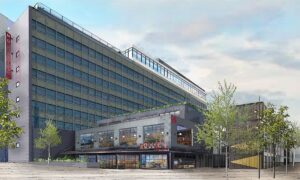
Award-winning German hotel group Ruby has marked its debut in the Scandinavian market by securing its first project in Sweden.
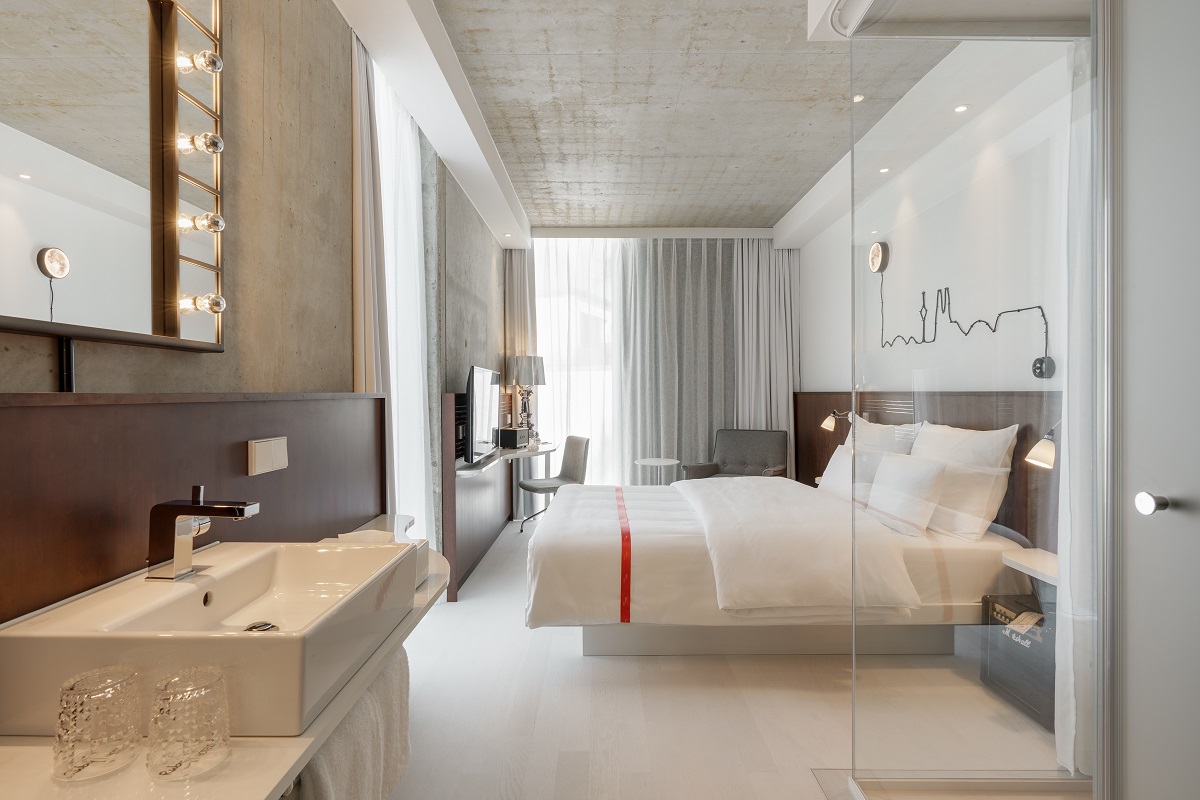
The Munich-based hotel brand was founded in 2013 and has seen success in its structure and appeal to young professionals looking for an affordable and contemporary form of luxury hospitality.
With the expansion of Ruby Hotels into the Asia market and 16 hotels already in operation across Europe with a further 20 hotels under construction or in planning phases, the brand seems to be going from strength to strength. Having also tapped into the flexible work space, and now offering Ruby Workspaces in Munich, Hamburg, and Dusseldorf, the new hotel offering in Sweden is simply the latest addition to the group’s rapidly growing portfolio.
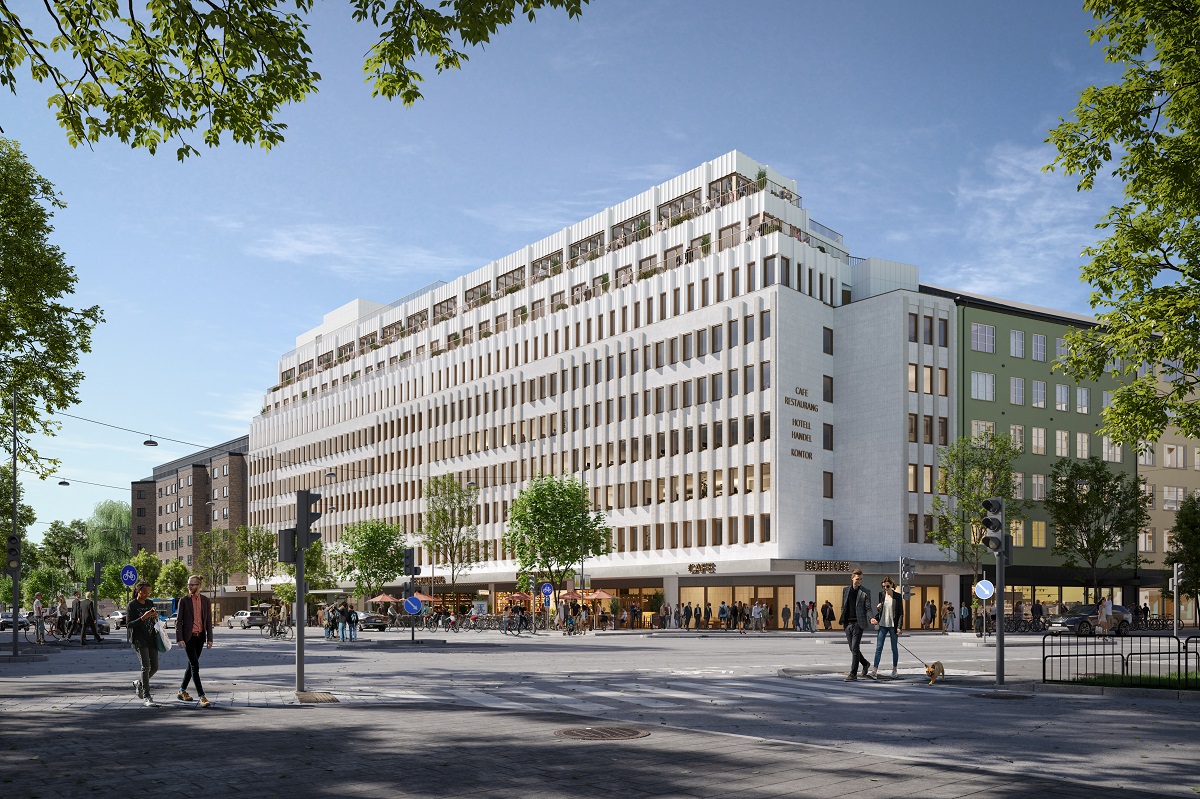
Located in the heart of the island of Kungsholmen in Stockholm, famously known for holding the annual Nobel Prize ceremony, Ruby Group is set to develop a 187-room hotel. This venture is in partnership with Alecta Fastigheter, a real estate company owned by Sweden´s largest pension fund Alecta.
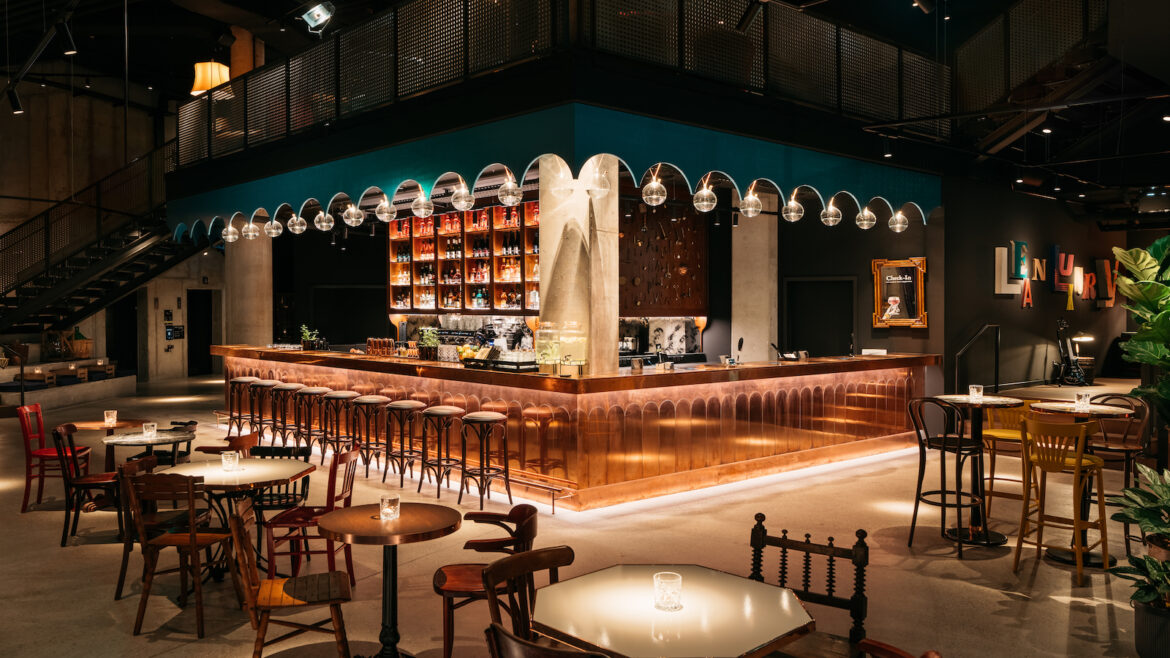
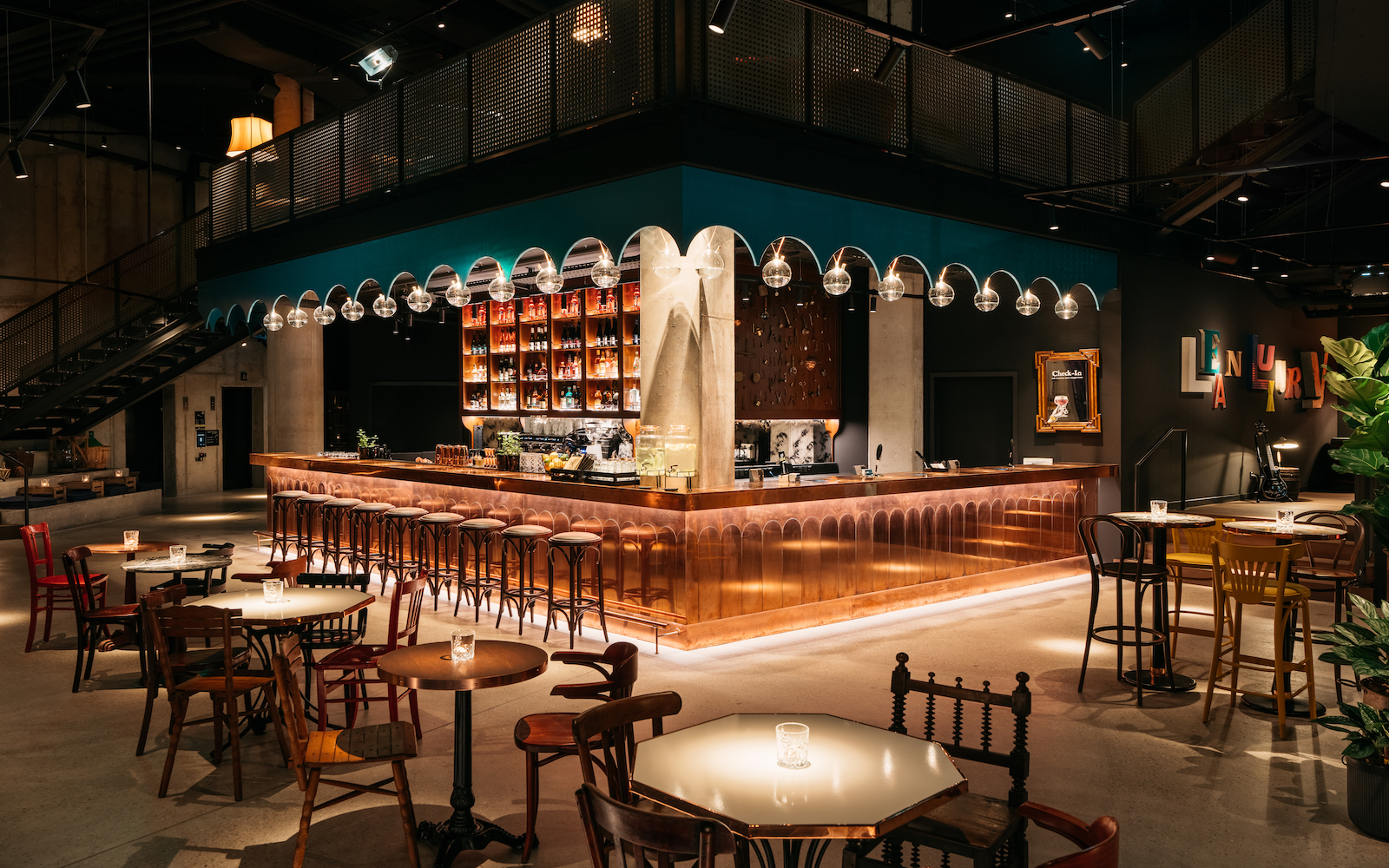
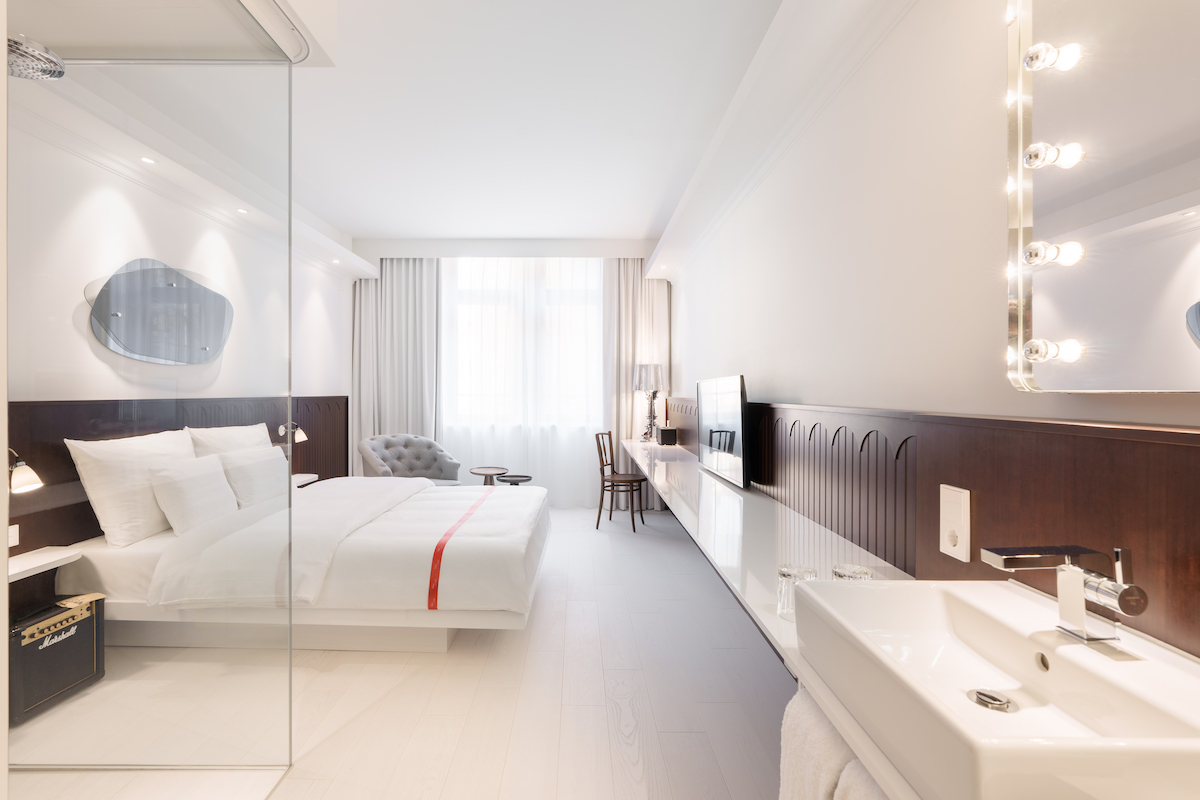
Ruby Hotels, led by founder and CEO Michael Struck (one of our Brit Listtop hoteliers of 2020), continues its successful expansion, introducing its ‘Lean Luxury’ concept to Northern Europe for the first time. The brand’s inaugural project in Sweden represents a significant milestone, with entry into the Scandinavian market recognised as a formidable challenge due to the strong presence of local operators and a competitive office market.
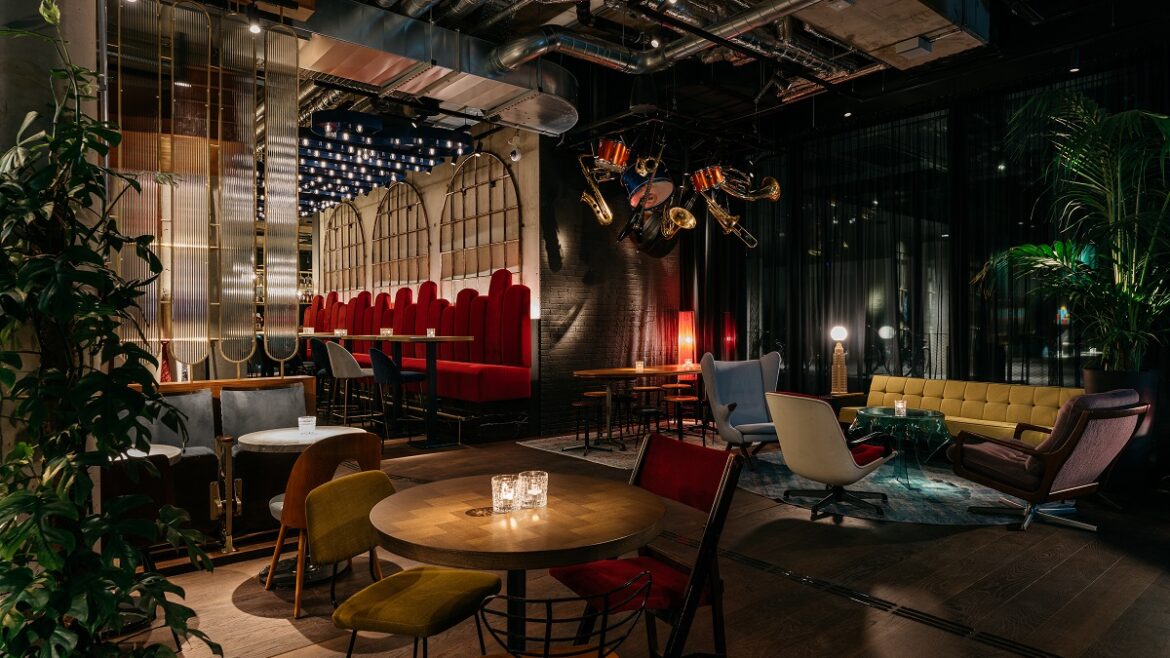
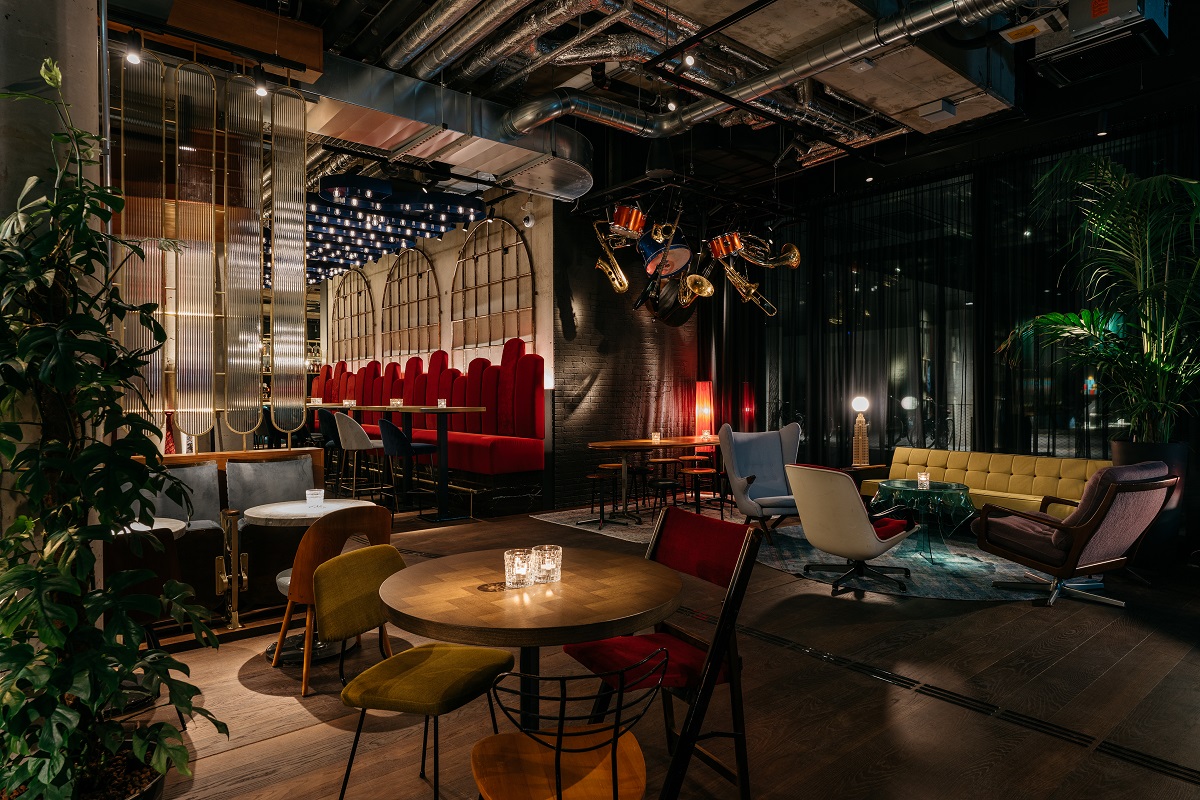
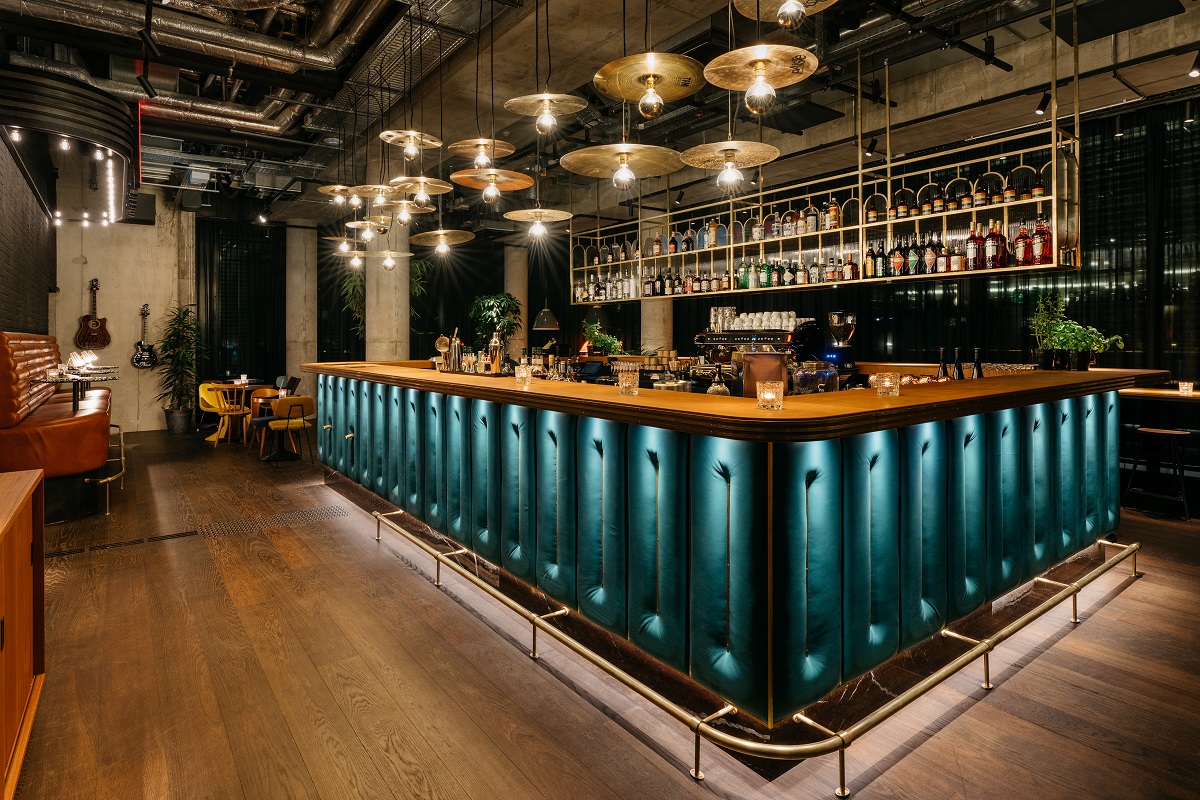
Ruby’s upcoming hotel, has been repurposed from a former office space, and will feature engaging public areas on the ground level, including a round-the-clock bar and café. Additionally, the hotel will include a restaurant located on the 11th-floor which will be managed by a third-party restaurant operator positioned to join forces with the hotel, creating the city’s newest hotspot.
Stockholm, a vibrant and continuously evolving city, offers an irresistible blend of history, nature, and culture. With its strategic location in Kungsholmen, near Fridhemsplan underground station, the hotel ensures excellent access to public transportation, including an express airport link. Guests visiting the property will find themselves in close proximity to major tourist attractions, a plethora of dining options, and the city’s bustling café culture as well as the water and green park amenities.
“We are very excited to enter the Scandinavian market with this unique project and bring our Lean Luxury philosophy to Stockholm,” says Elena Guenther-Jakobs, Senior Manager Development at Ruby. “By designing and building modularly, centralising more and automating consistently behind the scenes, we are making luxurious and unique hotel experiences affordable for our guests, while creating a leaner and more adaptable cost structure, which in turn means lower risks for our property partners. Entering the Swedish market marks a significant milestone for us. We are thankful for our partner Alecta Fastigheter’s trust and great cooperation. Our focus is now on growth and establishing a strong presence in Sweden and across Scandinavia.”
“We are proud and thrilled that Ruby Hotels has selected Alecta Fastigheter and our premises as their entry point into the Scandinavian market. With this collaboration, the selection of hotels in Stockholm becomes even more appealing for guests. Together with Ruby, we have the opportunity to pioneer something completely new in Kungsholmen, an emerging area in Stockholm,” says Helena Ågren, Business Manager Urban Development at Alecta Fastigheter.
The conversion of the former office building is being carried out under the management of Alecta Fastigheter as project developer and investor, and the interior design by Ruby’s own design team led by Matthew Balon. The new Ruby Hotel is scheduled to open in spring 2026.
Product watch: Naturalmat launches new organic hemp and linen bedding
This month, award-winning mattress and bed makers, Naturalmat, will launch two new collections of GOTS (Global Organic Textile Standard) certified bed linen, including its first range crafted entirely from hemp…
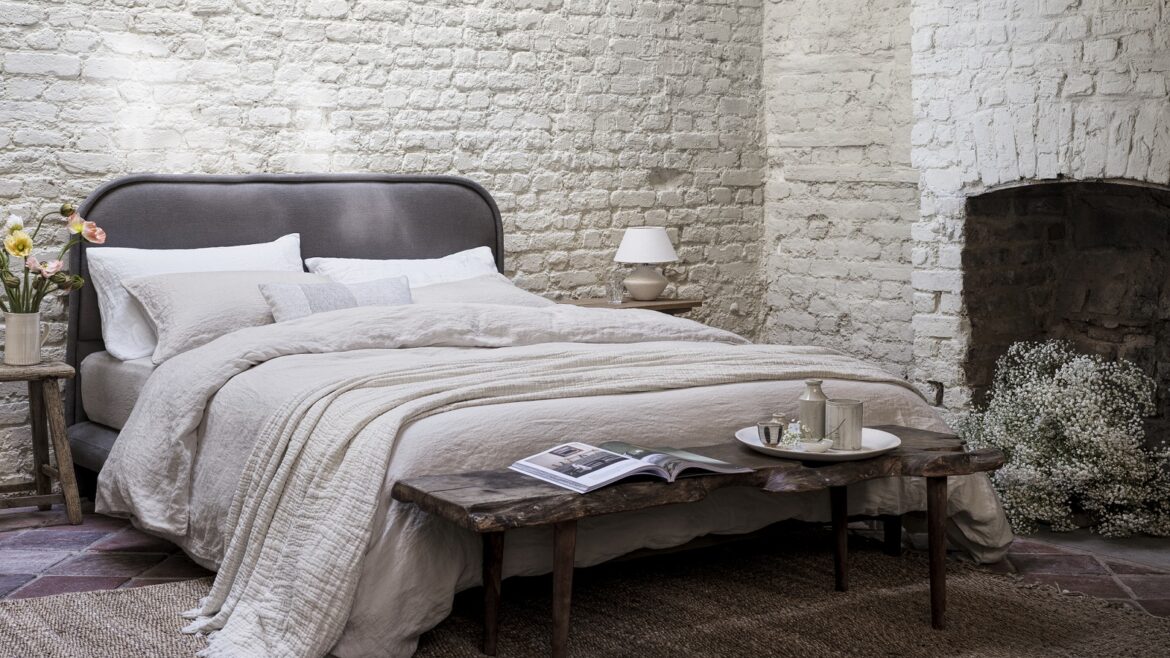
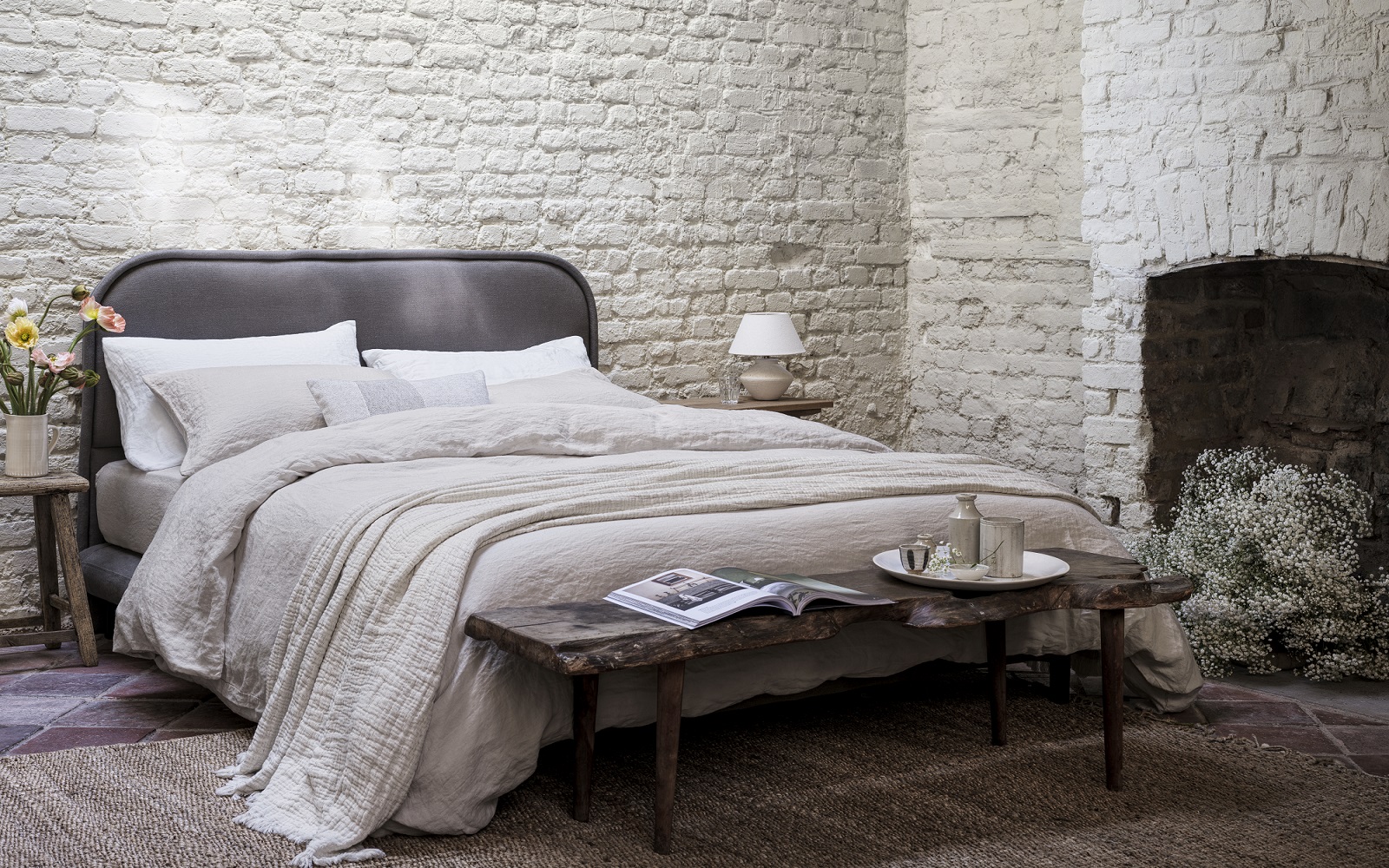
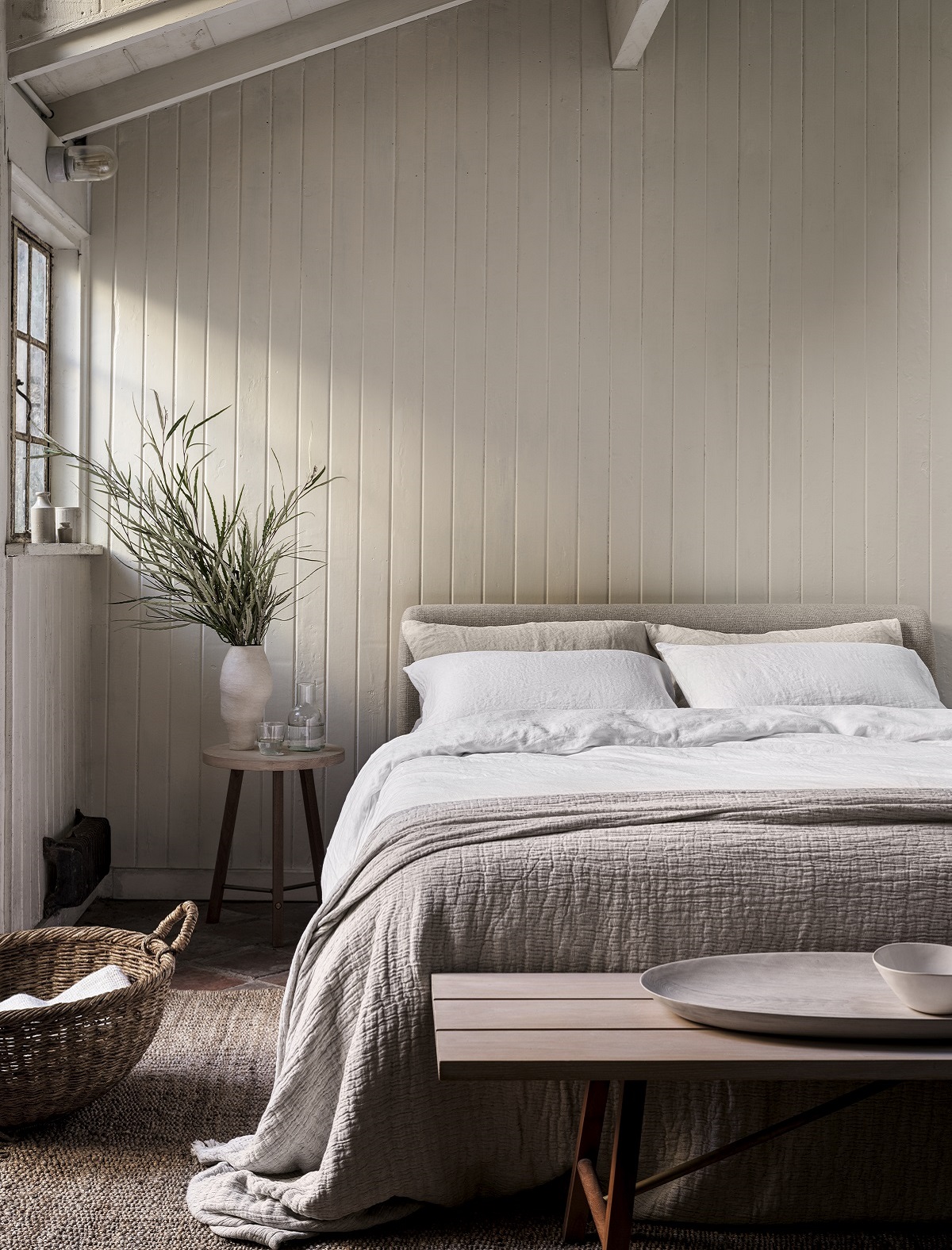
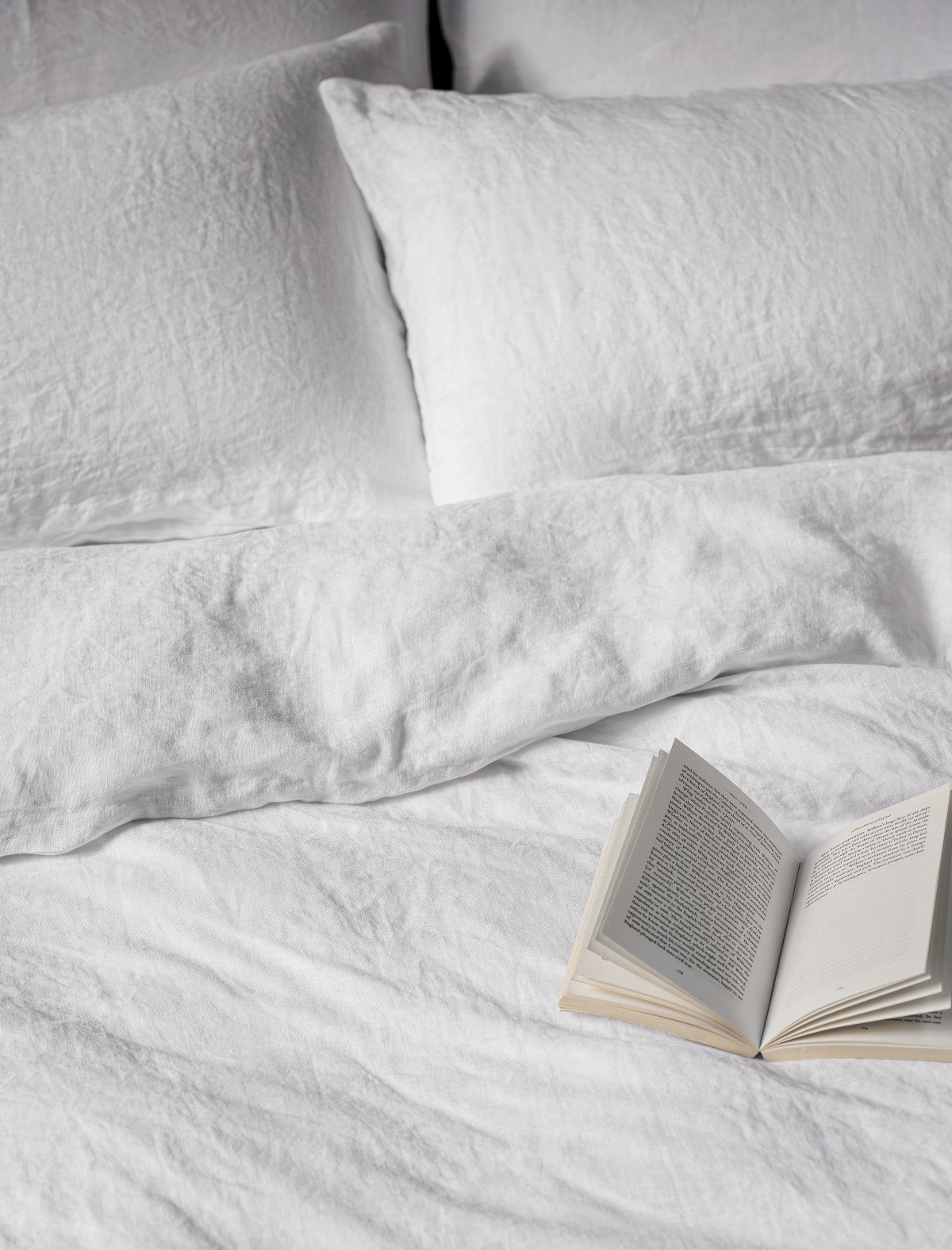
In its ongoing exploration of innovative and sustainable materials, Naturalmat has chosen organic hemp and the eco-friendly staple, organic linen, as the foundation for its latest bed linen collections. Crafted with a meticulous blend of form, function and sustainability, both ranges further enhance the sleep experience, keeping sleepers cool during the summer months and warm when temperatures dip, due to the fabrics’ naturally breathable qualities.
Image credit: Jon Day
As part of Naturalmat’s on-going commitment to eco-friendly practices, both collections are Global Organic Textile Standard (GOTS) certified, meaning that all materials have been grown sustainably without the use of harmful chemicals or pesticides, as well as assuring that farmers are paid correctly and have good working conditions. The new organic hemp and linen bedding will form part of Naturalmat’s existing organic bedding range which includes organic cotton flat and fitted sheets, along with standard and king-sized pillowcases and duvet covers, making Naturalmat’s entire bed linen range GOTScertified – something no one else can claim.
“Our goal is to establish ourselves as the destination for GOTS-certified organic bed linen,”commented Naturalmat Founder, Mark Tremlett, “and the introduction of these new ranges marks a significant stride towards realising that vision”.
Image credit: Jon Day
Washed Organic Hemp Once a maritime staple of the 18th century, Naturalmat is proudly introducing this incredibly sustainable fibre as the basis of its latest bedding range. Hemp’s extraordinary ecological advantages, such as thriving with minimal water and without pesticides, contribute to soil health by returning nutrients through its deep roots. Notably, it absorbs twice the amount of CO₂ per hectare compared to a forest, solidifying its position as an unparalleled eco-friendly fibre.
Available in a creamy ecru colour, the inherent qualities of hemp, with its long fibres, offer breathability and a softly structured feel, resulting in bedding that is not only comfortable but also exudes a relaxed, casual charm.
Image credit: Jon Day
Image credit: Jon Day
Washed Organic Linen Remarkably light, airy, and with a laid-back elegance, Naturalmat’s new bed linen collection offers unparalleled breathability, ensuring the body maintains the perfect temperature throughout the night, regardless of the season. The fabric’s natural moth-resistant properties also make it an ideal choice for allergy sufferers. The brand’s commitment to sustainability is woven into every thread.
Consumers can be assured that the organic linen throughout the collection is cultivated without the use of harmful chemicals or pesticides, providing a sleep solution that aligns with Naturalmat’s values. Derived from the flax plant, linen emerges as an inherently eco-friendly fabric, demanding significantly less water for cultivation compared to other fibres. Each part of the flax plant is utilised, minimising wastage, and contributing to a more sustainable and responsible approach to bedding, prioritising the health and wellbeing of both the consumer and the planet we live on.
Naturalmat is one of our Recommended Suppliers and regularly features in our Supplier News section of the website. If you are interested in becoming one of our Recommended Suppliers, please email Katy Phillips.
Four Seasons Resort and Residences at The Pearl-Qatar opens its doors
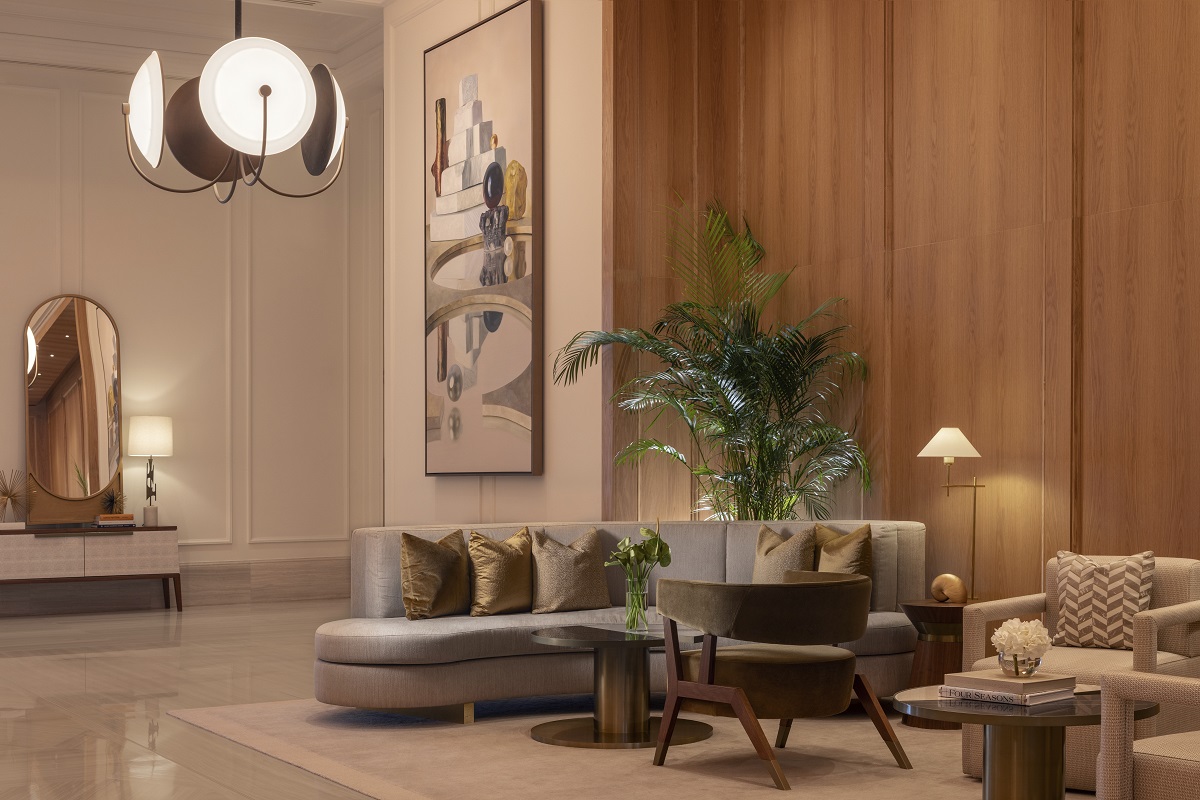
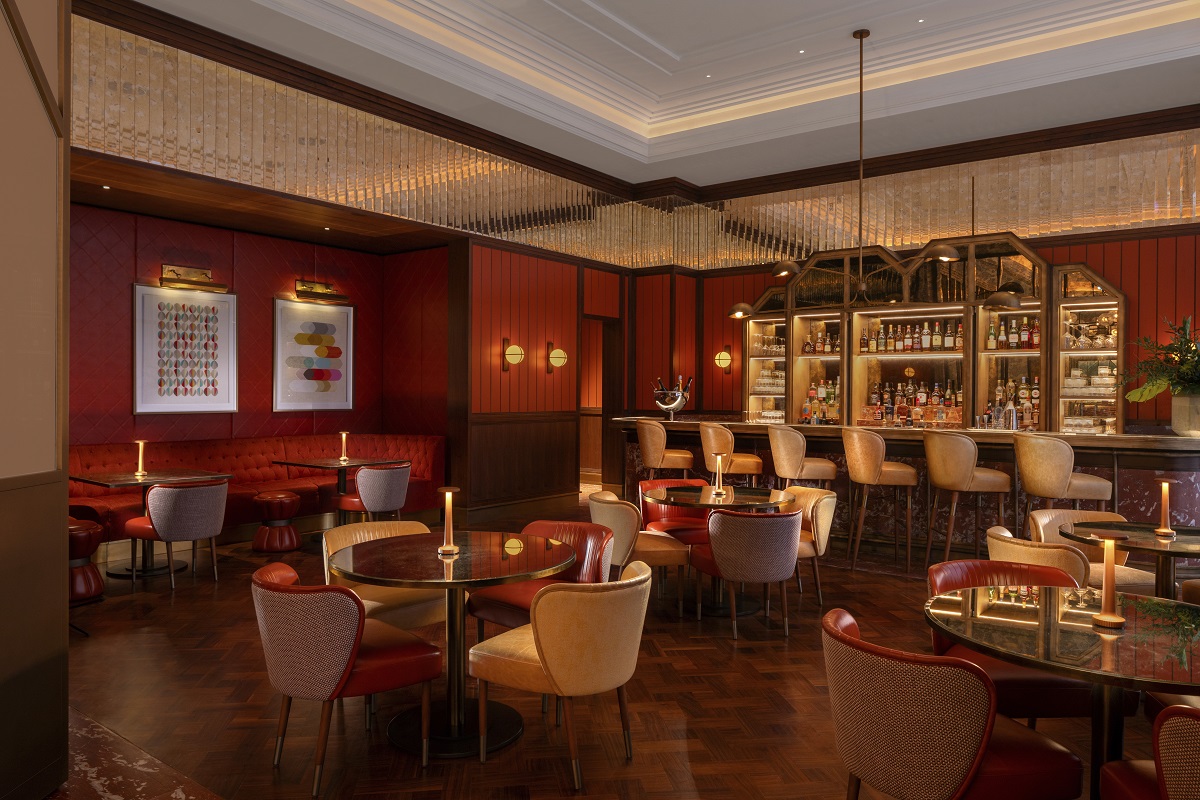
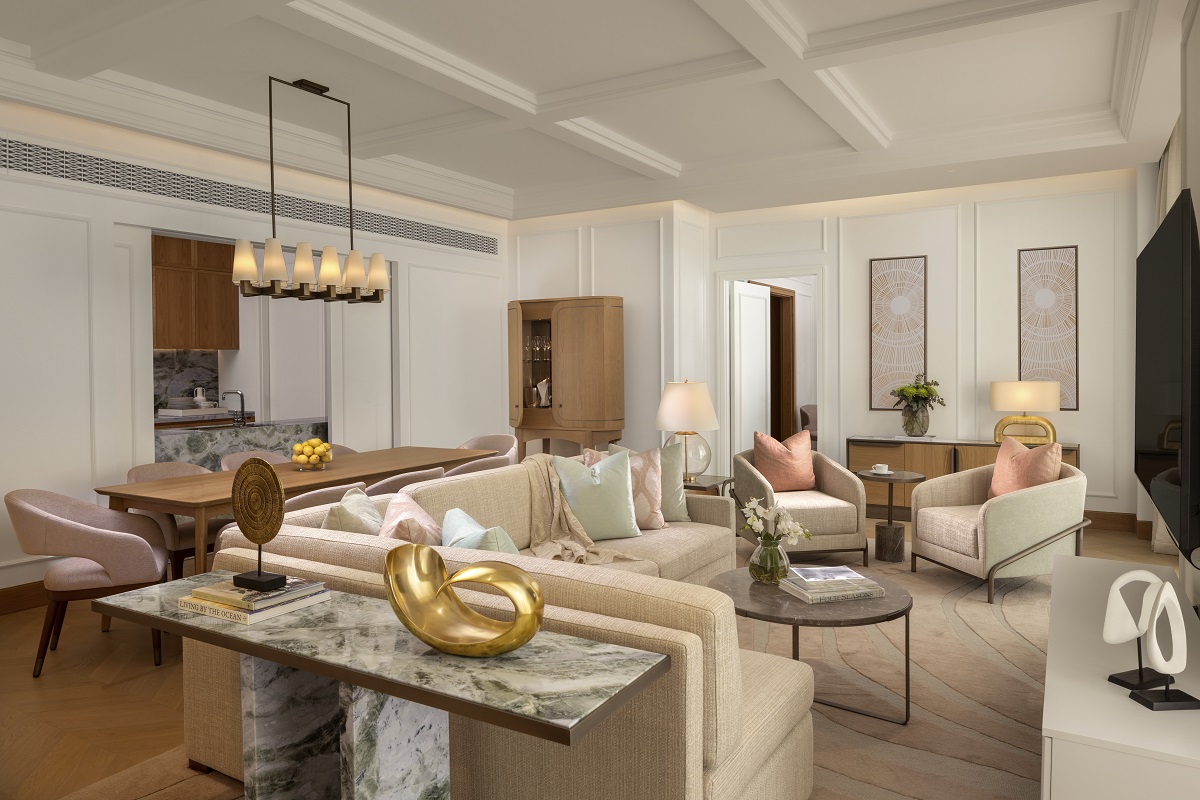
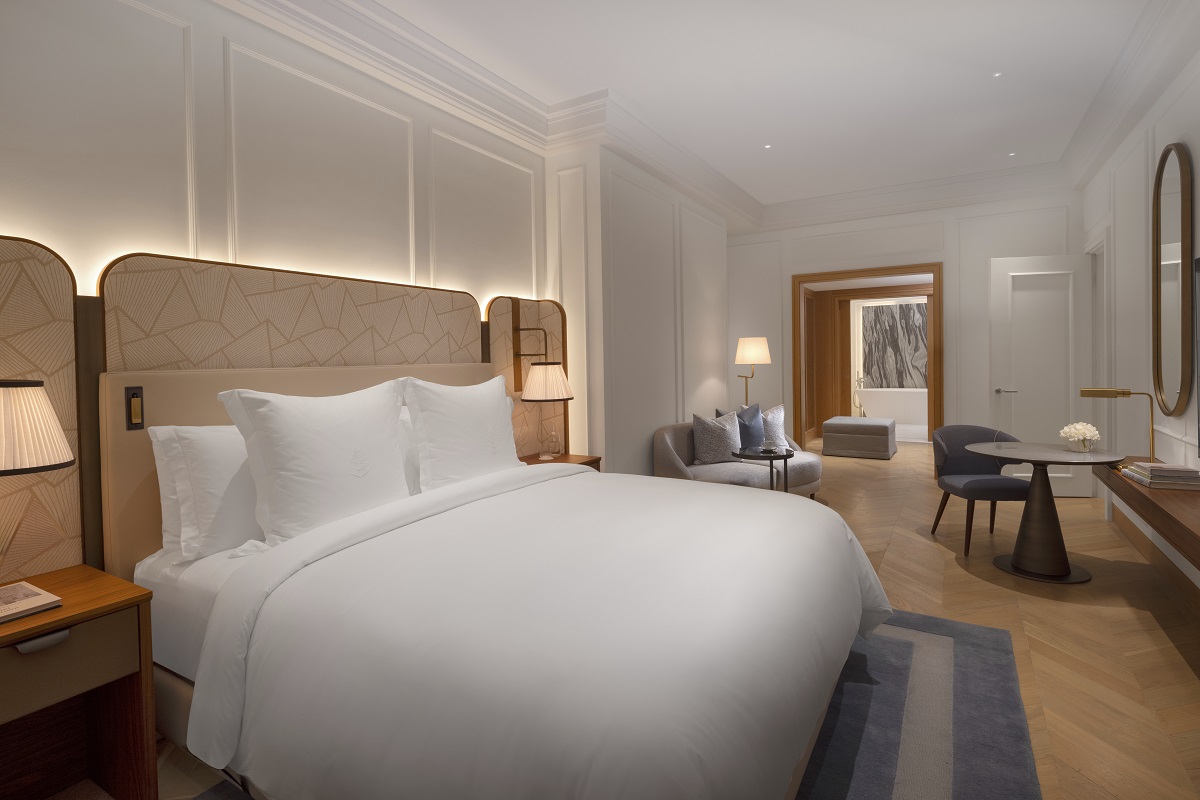
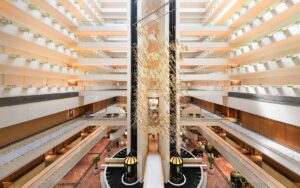
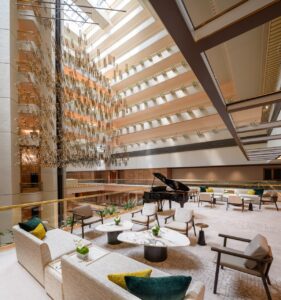
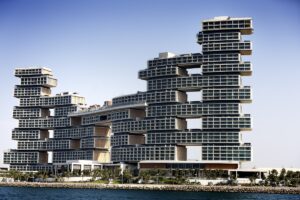
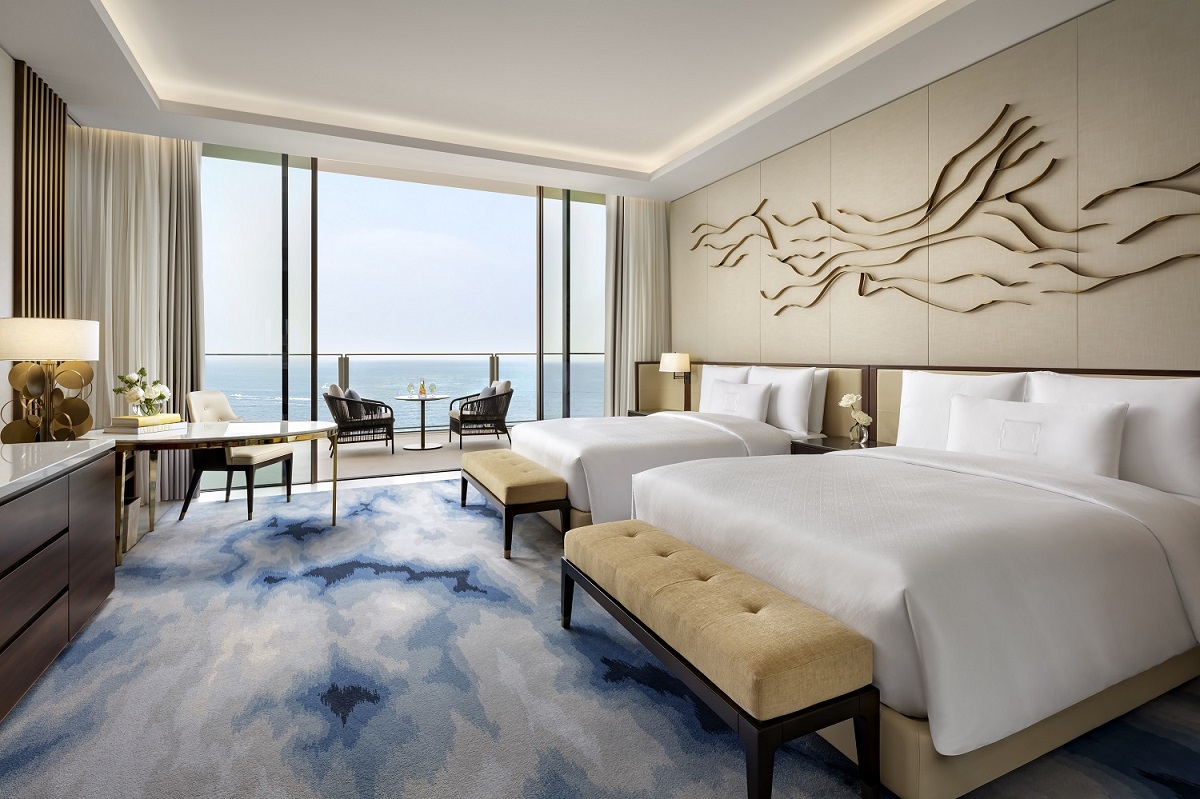
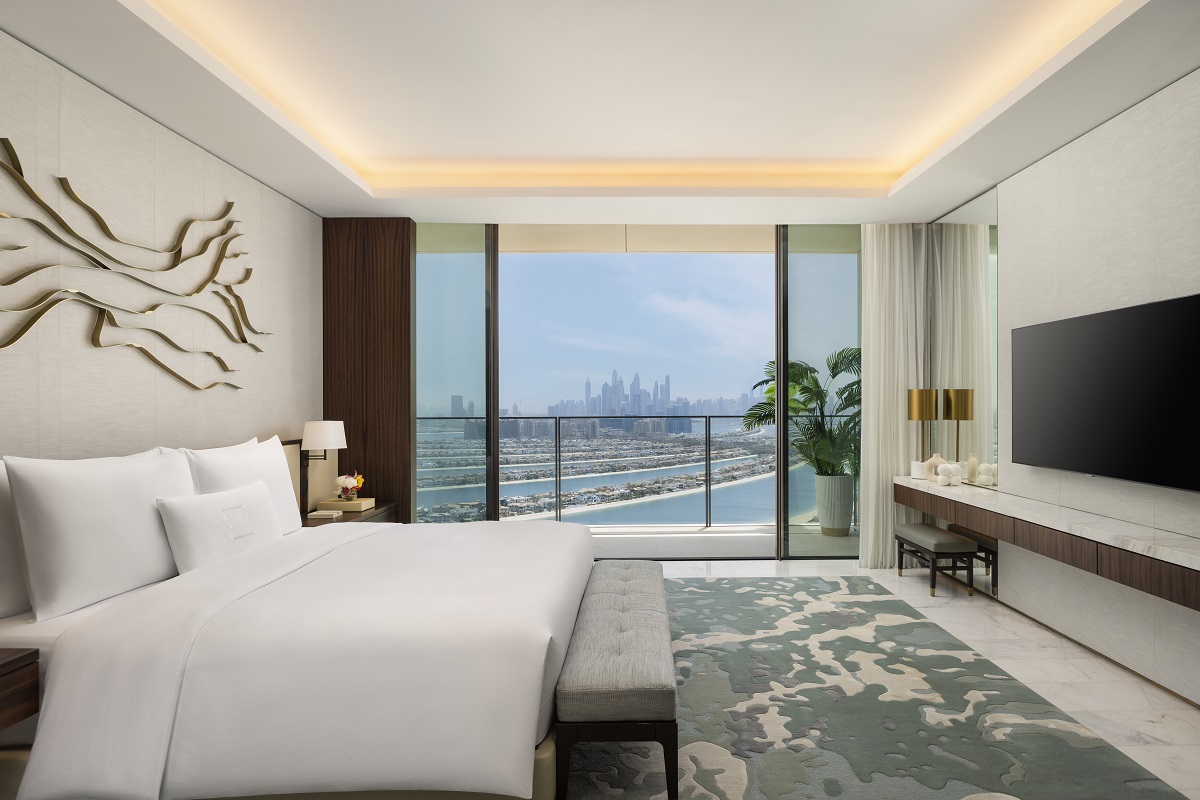
Four Seasons Resort and Residences at The Pearl – Qatar recently opened its doors to guests, revealing a contemporary yet elegant interior design by global hospitality interior design studio, Wimberly Interiors, part of WATG.
Located at the most prestigious position on The Pearl Island in Qatar, the Four Seasons Resort and Residences is an eclectic balance of modern and traditional elements grounded within a timeless interior architecture. The property captures a special glamour that is both subtle and elegant, setting a new benchmark for Doha.
The client’s original brief requested interiors that celebrated the residential nature of the project using contemporary lines but retaining a timeless quality. Wimberly Interiors therefore focused on enriching the clean lines of the architectural interior with soft colours drawn from the Qatari landscape, supported by touches of opulence through the selection of art and accessories.
The design concept has been inspired by the flora and fauna of Doha, and the surrounding Qatari landscape, with a particular draw from the shells, sand the sea.
Upon arrival to a glamorous lobby reception, guests enter a grand pied-a-terre, featuring hand woven wool rugs, bespoke Italian-made furniture, paired with museum-like artwork and sculpture. This area is a celebration of space, where the interior design has enhanced the welcome experience, propelling the guests’ vision through to the sea and the skyline of Doha and beyond. The central focus here is the bespoke glass table that appears to float in the space.
Four Seasons wanted to celebrate arts and culture through this new location, carefully curating a number of artworks and sculptures from around the world. As part of this, and as a way of further celebrating the region’s cultural heritage, the hotel also collaborated with renowned Qatari contemporary artist, Shouq Al-Mana.
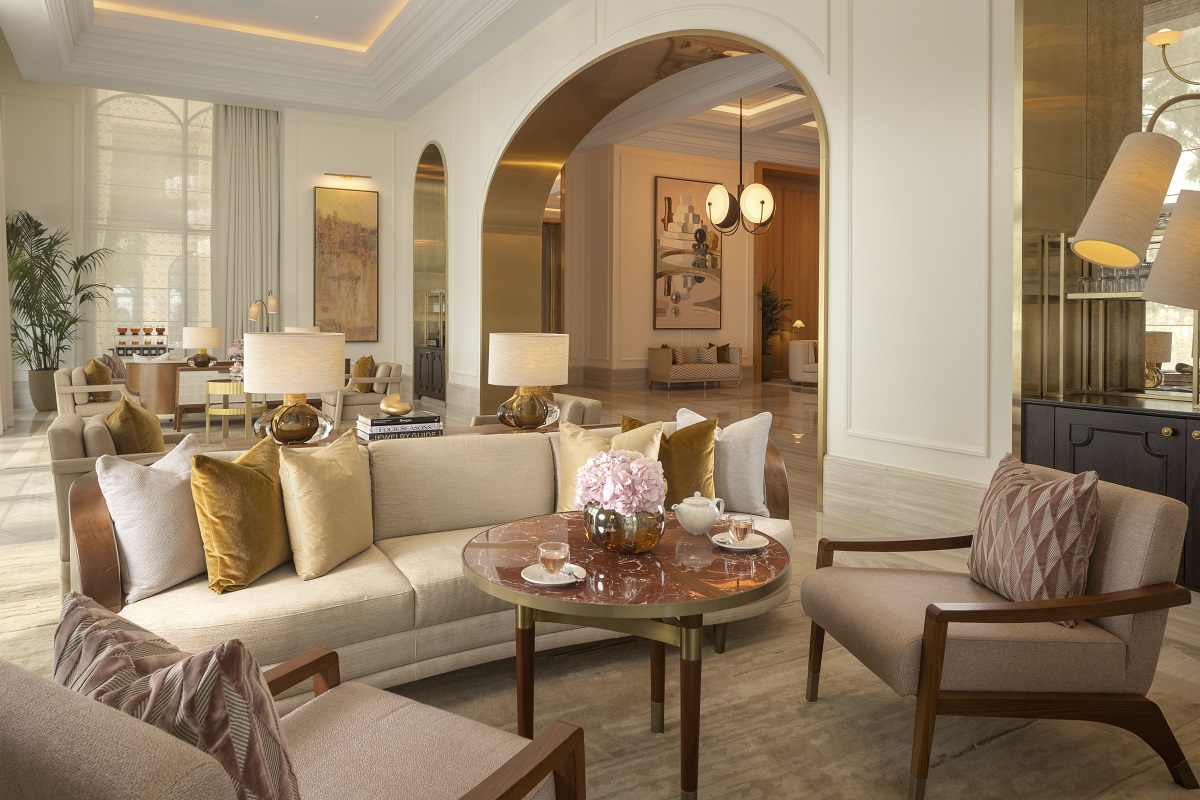
Leading on from the lobby, the tearoom pulls from a more residential context – echoing the concept of ‘gracious living’. Comfortable elegant seating is composed of elements drawn from a variety of sources and styles to reaffirm the residential feel of the property.
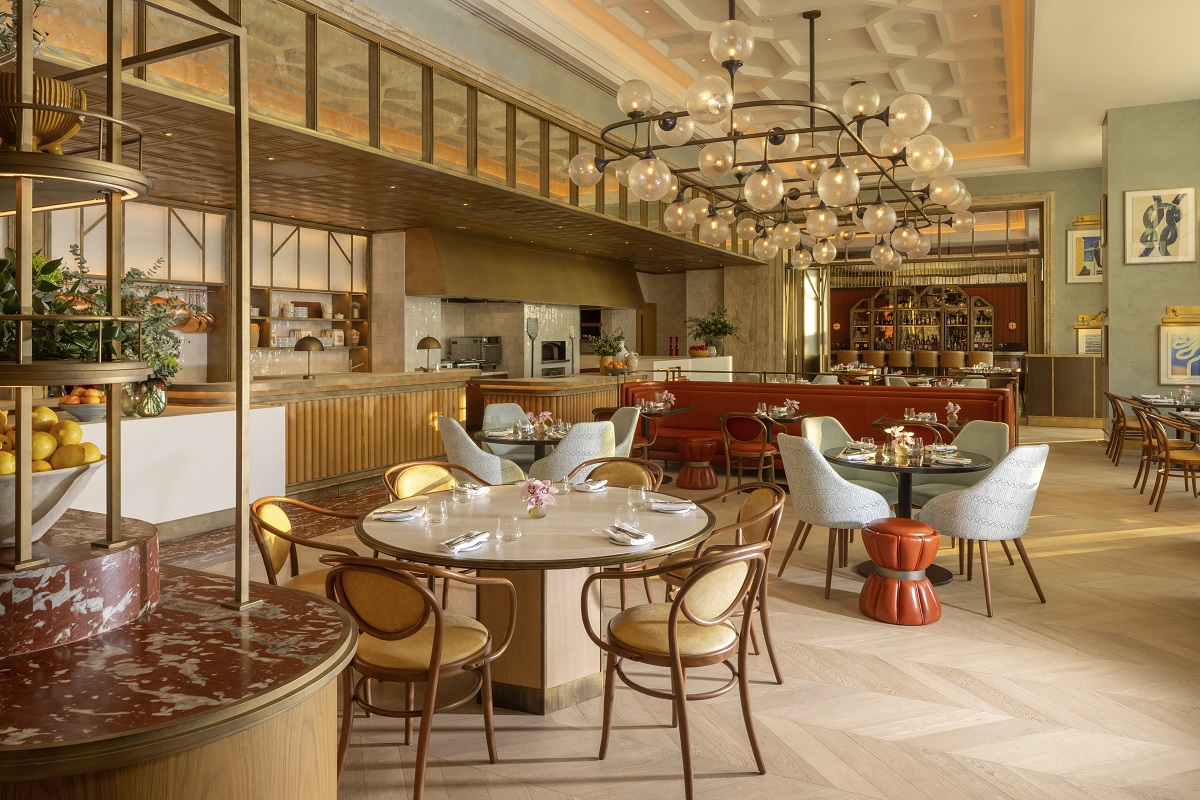
The all-day dining restaurant, Spuntino, spills onto the sprawling terraces, pools, and secluded beach. Spuntino is a celebration of Italy, from Naples to Sicily, with a contemporary twist. The walls are delicately rippled in a soft green polished plaster finish, giving the effect of sculpted curtains lining the walls.
An entire floor has been dedicated to leisure and well-being, with a state-of-the-art spa adorned in intricately patterned marble mosaic walls, plunge pools and sumptuous treatment suites. At this level, a sleek lap pool sits under a bespoke, romantically lit, coffered ceiling.
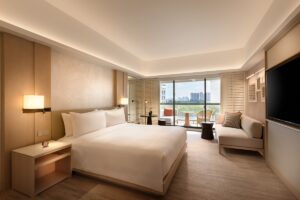
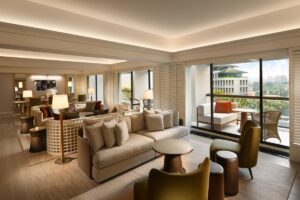
The guest suites and apartments are grounded with a European flair, featuring contemporary furniture and bespoke timber parquet floors, with a neutral palette on the walls and ceilings. The layouts are open and airy, allowing for families to gather and be together. These layouts allow the guest to ease into each space for long periods of time, moving freely through the more communal areas while maintaining moments of surprise.
The open-plan living and kitchen areas come with full-height sliding wall panels that follow the wall designs. This gives a seamless effect to the lounge and dining areas when closed, giving the guest a choice to screen off the kitchen. Being a hybrid apartment-hotel, where Four Seasons guests can have long stays, it was also important to incorporate storage wherever possible, concealing it within the wall panelling.
Thanks to the limitless horizons and 360-degree views of the Arabian Peninsula and beyond, turquoise blues and the sand-tones of the desert inspire the soft furnishings. With an array of one, two, three and four bed accommodations, the interior design showcases refined details, with a layering of luxury.
The penthouse suites, all unique and bespoke in conception, allow guests to enjoy the pinnacle of artisanship and detail. The Qatari desert inspires bespoke gold and amber toned hand-blown glass chandeliers, velvet sofas and luxurious marble bathroom and dressing rooms, flowing through to private terraces with plunge pools and al fresco dining.
The landscape concept for this hotel was inspired by nature tactility and biophilia. The design has been influenced by the sea creatures and the corals of the gulf, while also being responsive to touch and movement.
To frame this motion and to create a sense of formality that matches the more traditional elements of the hotel, the hardscape was reinforced through a strong delineation of space.
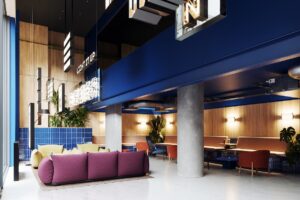
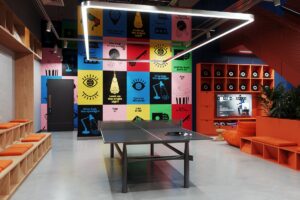
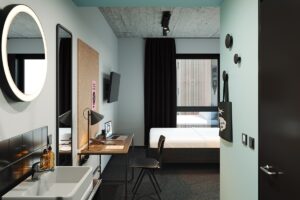
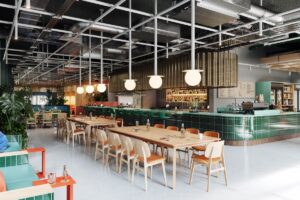
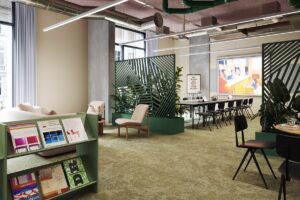
The Social Hub, with hotels located across Europe’s most dynamic cities, is about to make its mark in the UK, with the highly-awaited opening of a four star hotel in Glasgow this April – here’s what we know…
The Social Hub Glasgow will be the 18th property to open in Europe for the Amsterdam-based company, with other locations currently operating in Austria, France, Germany, Italy, the Netherlands and Spain where a diverse community – including travellers, students, business people, neighbours and more – come to learn, stay, work and play.
Image credit: The Social Hub
Founded by entrepreneur Charlie MacGregor, who grew up in Edinburgh, The Social Hub believes a better society is created when people with vision and talent come together from all walks of life. The organisation works towards achieving this social impact objective and generating concrete value to the communities in which it operates by designing unique spaces that foster community building, coupled by an unparalleled programme of community experiences, and an ongoing commitment to monitoring the impact of its business operations.
“I am so proud to be launching The Social Hub in the country I grew up in and where I began my professional career, getting hands-on experience and inspiring a business model that evolved into what is now The Social Hub,” said Charlie MacGregor, CEO & Founder of The Social Hub. “As pioneers in the hybrid hospitality industry, I am excited to be back home and to see the impact our Glasgow Hub will bring to the community through our spaces and experiences, ones that blur the boundaries of traditional hospitality offerings through our relentless ambition to create a better society, together with all those who walk through our doors.”
Image credit: The Social Hub
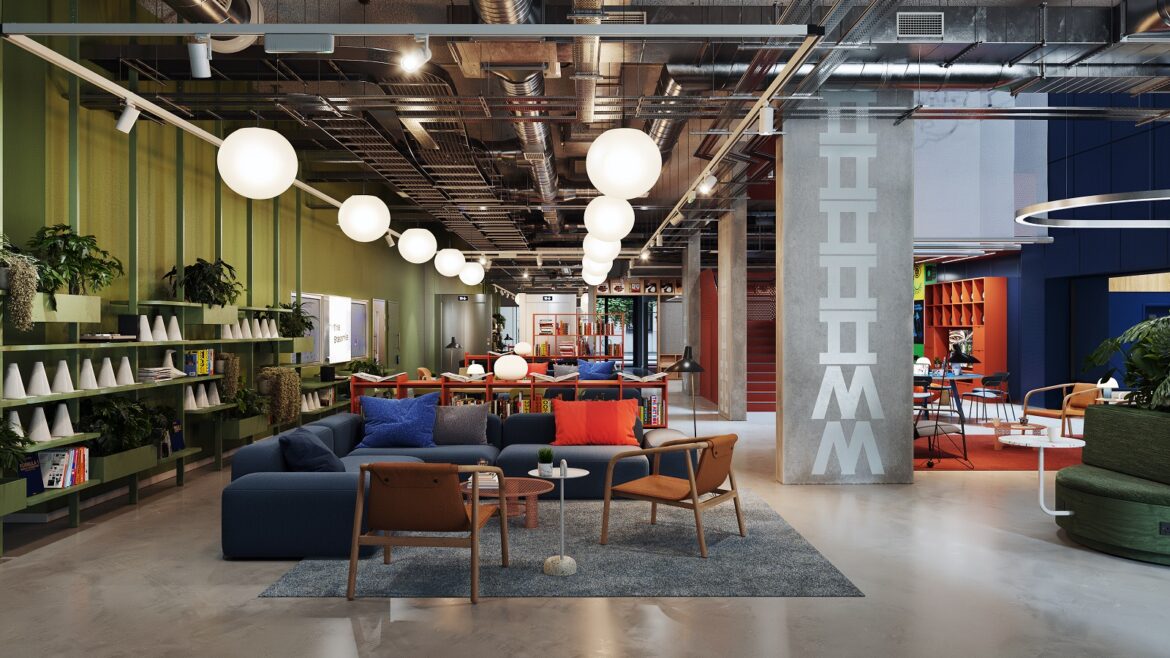
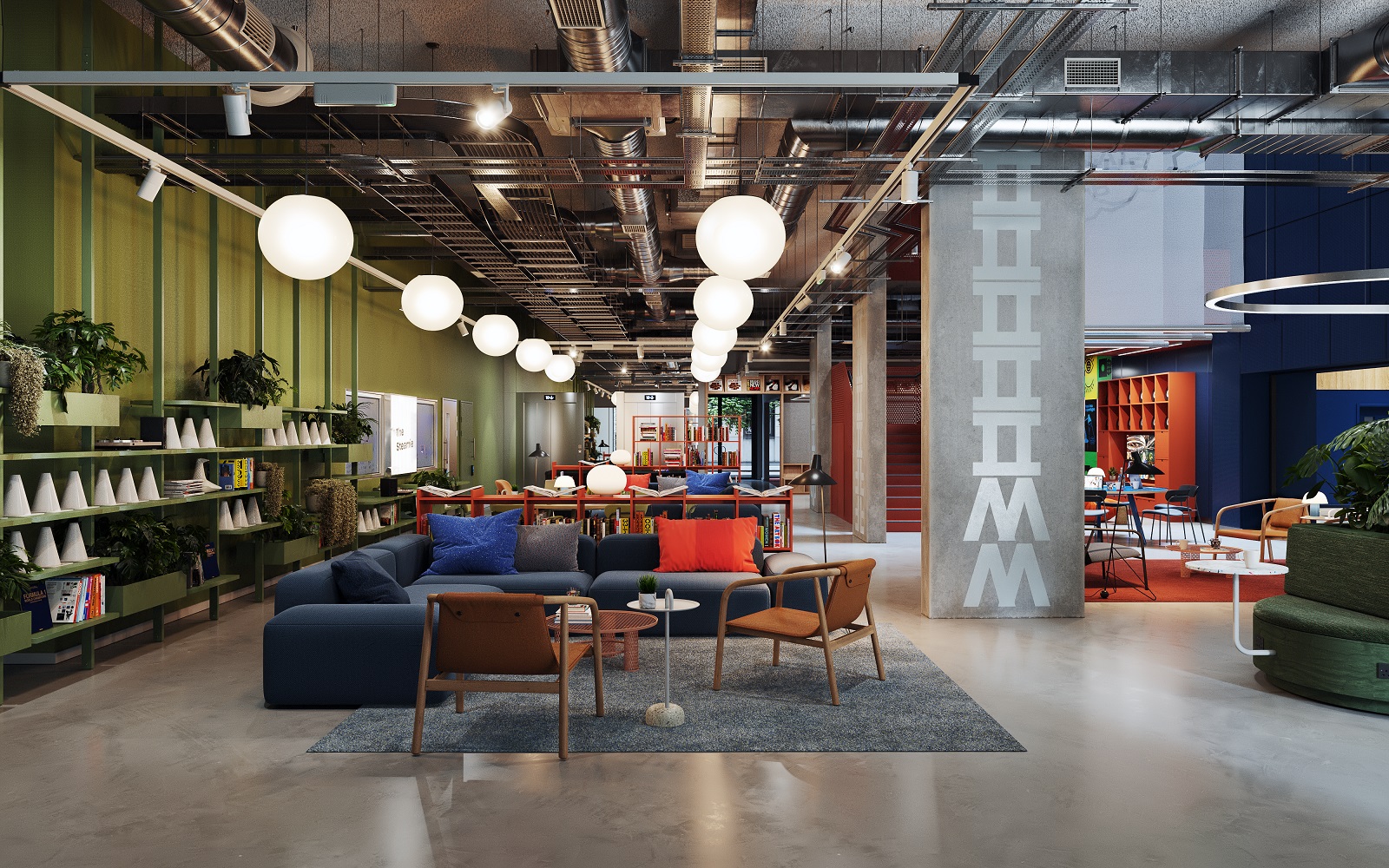
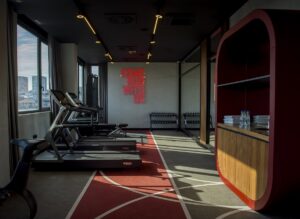
This unique and award-winning hybrid hospitality concept features hotel, extended stay, and student rooms through to spaces to work and meet, such as large co-working facilities, dynamic meeting and event spaces, a large community kitchen, restaurants, bars, and gyms alongside a bustling schedule of curated purpose-driven events, workshops, and social moments.
With an investment of over £90 million and employing more than 80 locals, the highly anticipated new property is located in Merchant City, one of Glasgow’s most storied and stylish districts. Known for its cafés on cobbled streets and thriving music scene, The Social Hub makes an ideal base from which to explore and draw inspiration from this historic city and the surrounding region.
Image credit: The Social Hub
Image credit: The Social Hub
With 494 rooms, the newly built 20,000 square-metre hub has been specially created to inspire and connect creative minds through curated spaces designed to capture the city’s gritty material with the well-known Glaswegian strength of character and quick-witted humour. The Social Hub Glasgow will feature one of the city’s largest rooftop bars as well as a stylish, laid-back restaurant and bar serving a range of international and locally-inspired food and drink options throughout the day. A shop will also offer grab-and-go food options as well as essentials, and curated local and The Social Hub products.
Image credit: The Social Hub
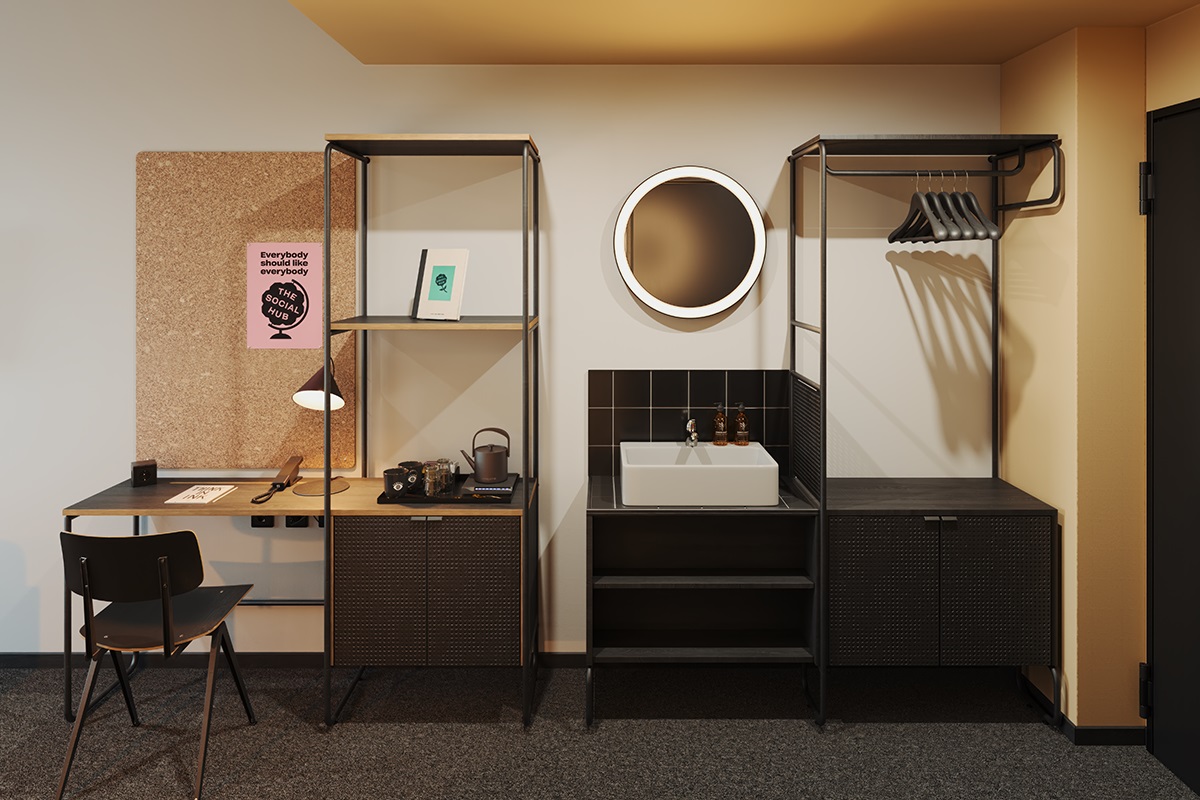
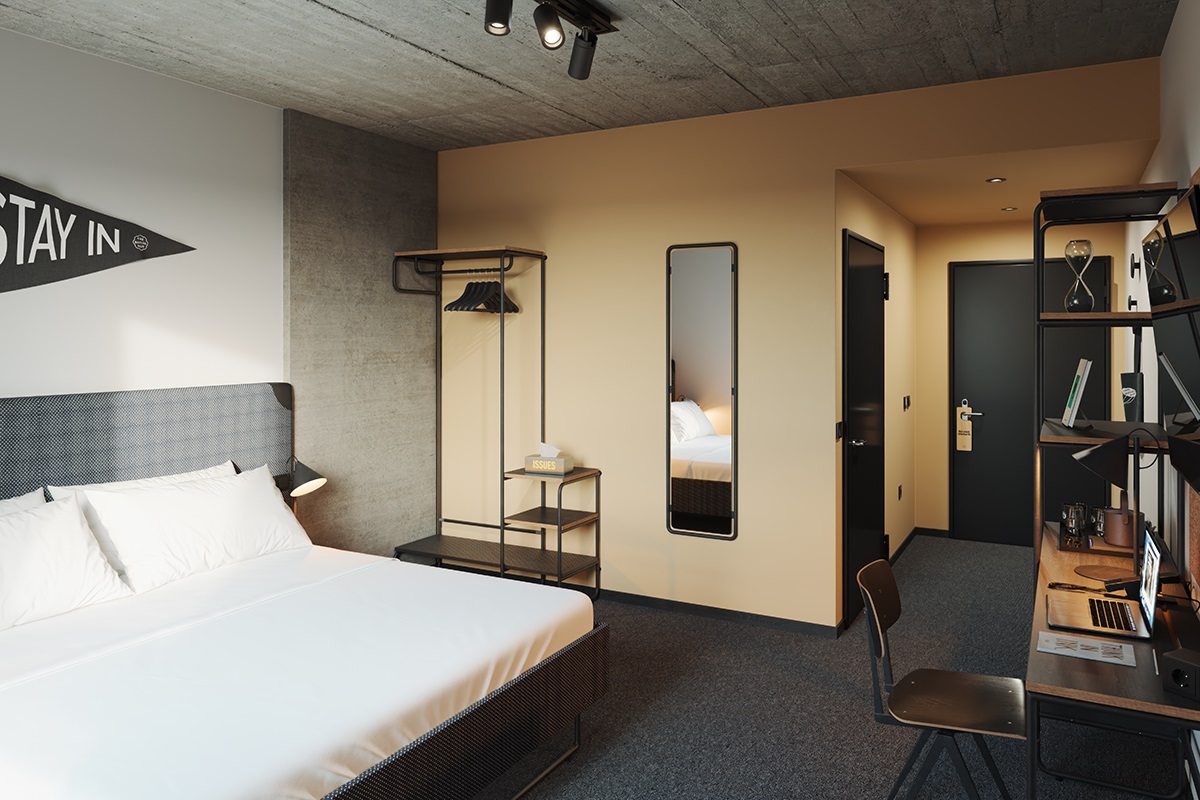
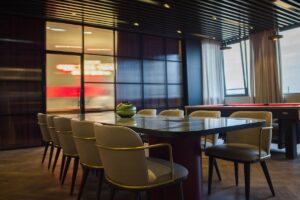
With comfy beds, inspiring workspaces, laundry and ironing facilities and daily cleaning services, rooms at The Social Hub Glasgow are the ideal spot to recharge or work on goals and dreams. Hotel guests will revel in the energy and community of The Social Hub, where everyone has the freedom to be themselves. Surrounded by like-minded curious people, guests will benefit from all the above facilities (excluding the communal kitchens). However, there are also a number of extended stay studios featuring in-room kitchenettes, ideal for digital nomads and extended business travellers, who may fancy a quiet night in once in a while.
Image credit: The Social Hub
Students can book a variety of rooms available, offering an unforgettable, full-service experience, benefiting from: a diverse program of community events tailored for the mind, body and soul, access to a community kitchen with all utensils, onsite laundry, study spaces, gym membership, monthly linen and room cleaning services, high-speed Wi-Fi utilities and maintenance, free bike rentals. They can of course take advantage of the bar, restaurant, and shop with special discounts.
Image credit: The Social Hub
With room for up to 222 co-workers daily, The Social Hub Glasgow offers flexible memberships, to dedicated desks, through to 20 private offices. Members of The Social Hub become part of a global community of ambitious creatives, digital nomads, entrepreneurs, and start-ups changing the world. They will have the option to work in quiet and flexible spaces or brainstorm in private, expandable meeting rooms. Membership also includes use of the gym and the ability to join in a range of networking events and workshops ensuring an inspiring space where connections grow, ideas spark and change happens.
In addition, eight flexible meeting and event spaces totalling 1,500 square-metres are also available to hire – from small brainstorms to larger scale conferences in an auditorium.
GROHE SPA returns to Milan with a transformative experience
GROHE is preparing to showcase pieces of its premium sub-brand GROHE SPA at Milan Design week scheduled for next month, where it will be crafting a sanctuary of well-being in the heart of Milan…
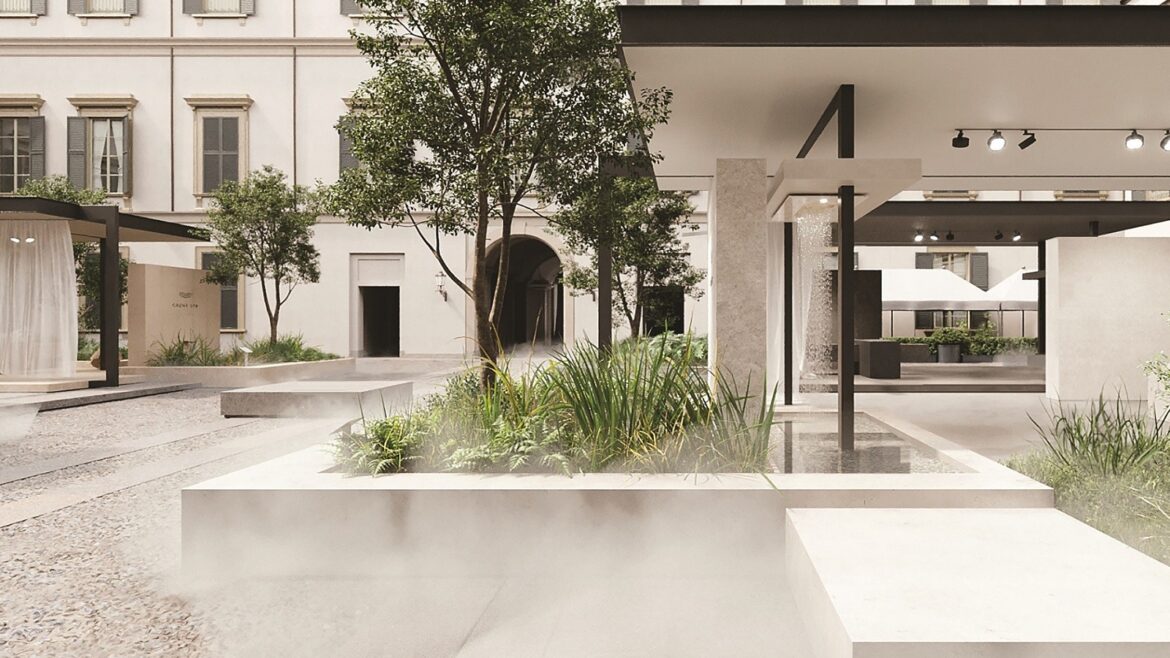
With over 30,000 visitors, the Red Dot ‘Best of the Best’ awarded GROHE SPA installation at the Pinacoteca di Brera left a lasting impression on Milan Design Week 2023. Building on this success, GROHE is returning this year with a new immersive experience in one of Milan’s most prestigious locations: The Palazzo Reale. The former royal palace near the Duomo serves as a cultural nexus and is home to international art exhibitions – the ideal scenery for GROHE SPA’s celebration of the revitalising power of water.
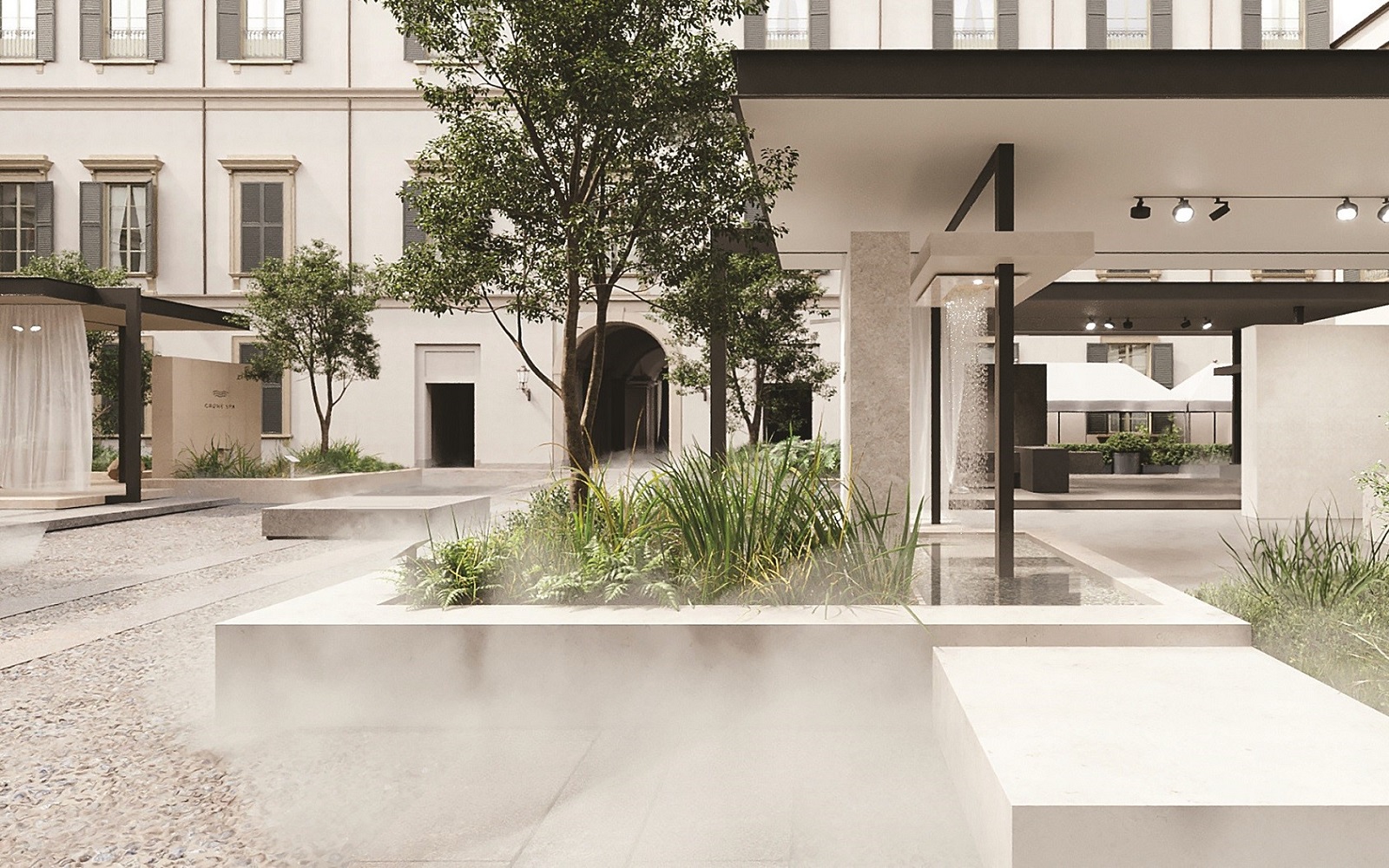
The immersive experience envisaged for Milan Design Week, based on ‘Aquatectures’, fuses water and architecture to bring the GROHE SPA ‘Health through Water’ concept to life. From April 16th-21st, the courtyard of the Palazzo Reale itself will undergo a metamorphosis into an exhibition space. Conceived by the in-house LIXIL Global Design and Brand Identity team, the installation pays tribute to the history of the building by evoking its past and interweaving it with the contemporary GROHE SPA ‘Salus per aquam’ concept.
“We are proud to be a part of Milan Design Week once again,” said Karl Lennon, Leader GROHE SPA, LIXIL EMENA. “This occasion offers us an ideal platform for meaningful engagement and exchange with architects and designers, fostering mutual inspiration. Our objective transcends a mere product presentation; rather, we aspire to cultivate a holistic experience that underlines the essence of GROHE SPA: the belief that water is the source of vital energy.”
“Inspired by the former courtyard garden and in line with the motto of the Fuorisalone ‘Materia Natura’, we are aiming to blend nature and architecture to create a sensory journey focusing on the element of water,” commented Patrick Speck, Leader, LIXIL Global Design EMENA. “Visitors will be taken through our innovative concept of ‘Aquatecture’ spaces, experiencing the essence of our brand and our carefully curated bathroom solutions. We intend to elevate the significance and importance of water in architecture and the health and well-being benefits this infusion can bring. Each ‘Aquatecture’ represents one of the four tiers that bring GROHE SPA to life. From tier one the most exclusive and customisable solution utilising 3D metal-printing to create bespoke designs, to luxury material collaborations and trend setting colours, materials and finishes.”
GROHE is one of our Recommended Suppliers and regularly features in our Supplier News section of the website. If you are interested in becoming one of our Recommended Suppliers, please email Katy Phillips.
Pitch perfect for the House of Rohl WOW!House installation
Earlier this week, after a considered and much-debated judging process, House of Rohl announced the design studio it will be collaborating with on this years WOW!House. It was fascinating to be part of this process, and to now showcase the designs of all four studios who were on the final shortlist…
The judging panel, covering a wide range of industry and product knowledge, gathered in the House of Rohl London showroom to sift through the detailed specifications, inspiring renders and thought-provoking proposals from four leading design and architecture practices. The design from last year’s Studio Mica collaboration was one of the stand-out rooms at the 2023 WOW!house, setting the bar high.
WOW!house 2023 House of Rohl Bathroom, designed by Studio Mica. | Image credit: James McDonald
All the designs touched on different aspects of bathroom design and wellness more broadly, highlighting concepts through use of material and a considered division of space. Each brought something unique to the table, which resulted in an interesting conversation, sometimes divided , other times in agreement, but as they say, there can only be one winner – although I suspect and hope that some of these designs might see the light of day regardless.
Image credit: 1508 London
1508 London
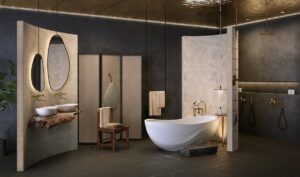
The design from 1508 London highlighted the studios take on an Italian renaissance. Inspired by juxtaposing futurism with the traditional, encapsulating a journey, the visit from the Italian countryside to the Italian Riviera; the design begins with the external envelope of traditional Roman architectural detailing and finishes with the internal glittering jewellery box like the soft Mediterranean sun dancing across the great lakes.
Image credit: 1508 London
With materials such as: lime plasters overlaid onto hand painted mural wallpapers to create texture, glass mosaic tiles, natural stone flooring including a feature marble, and Japanning lacquer to ceilings and coffer reminiscent of a velvet lining, the design exudes luxury. The positioning of the double vanities offer the opportunity for private shower and dressing spaces behind, and the bath summit forms the central core of the design, draped with an asymmetrical sheer over a polished nickel ring. The Riobel – Momenti & Victoria + Albert collections were the perfect contemporary fittings to compliment the design.
The space was designed as a transversable route that flows around the room, encouraging guests to discover new elements of House of Rohl sanitary ware as they explored.
Image credit: GA Group
The G.A Group In crafting this proposal, G.A Group aimed to create a rejuvenating sanctuary that evokes tranquillity and harmony, parallel to a spa-like experience. Its approach involved incorporating natural colours and formations, as well as integrating sounds and elements of movement to enhance the overall ambience. Meticulous attention was paid to texture, through textured stones and smell in the form of Cocoa waste offering a fully immersive relaxation experience for the user.
Image credit: G.A Designs
Using screening to highlight the transitional zones and structural elements to accentuate the bathtub as the focal point. Additionally, the design focusses on utilising sustainable materials and innovative finishing techniques challenged conventional notions of luxury, resulting in a truly indulgent retreat, whilst prioritising quality craftsmanship throughout.
Image credit: Studio Jill
Studio Jill
The Studio Jill scheme brings together the principles of wabi-sabi into an elevated bathroom interior: celebrating the attraction of the new, but with a curatorial eye to the past. As frequently explored in the practice, there is a focus on the beauty and imperfection of materials and a celebration of their inherent natural properties. Studio Jill combines this with a selection of unique vintage pieces and contemporary bathwares to create a mix of finishes and textures.
A single piece, live-edge cantilevered vanity creates a feature surface on which the latest House of Rohl Seros basin is showcased. Continuing the theme, we have introduced a rough cut basalt plinth as a contrasting step into a gloss white bathtub. Contrasting the old and new, a freestanding antique screen forms the back drop to the bath tub where an upholstered vintage chair sits alongside. The ceiling is crafted with reflective bronze hammered metal of which a bespoke blackened steel towel rail hangs – a rail also hammered in texture reinforcing the hand treated process. Finally, the room is grounded by a cracked stone floor repaired with gold lacquer in reference to the traditional Japanese practice of Kintsugi. The design introduces this technique recognising that the built environment is constantly evolving and what could be considered flawed can be embraced.
Image credit: Michaelis Boyd
Michaelis Boyd
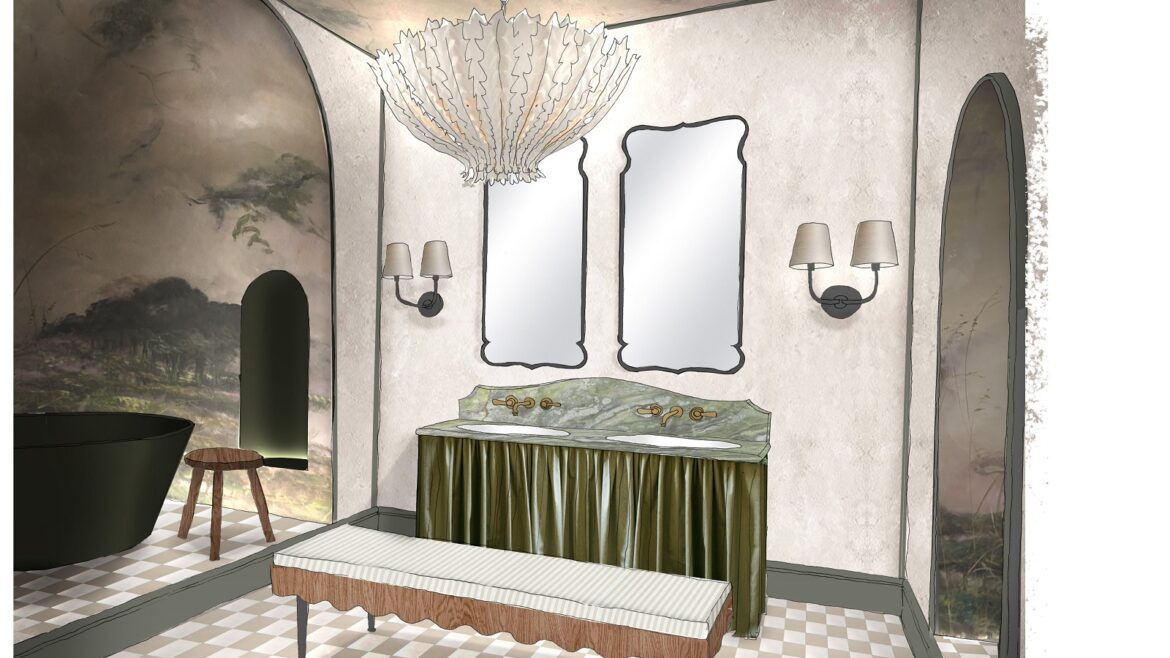
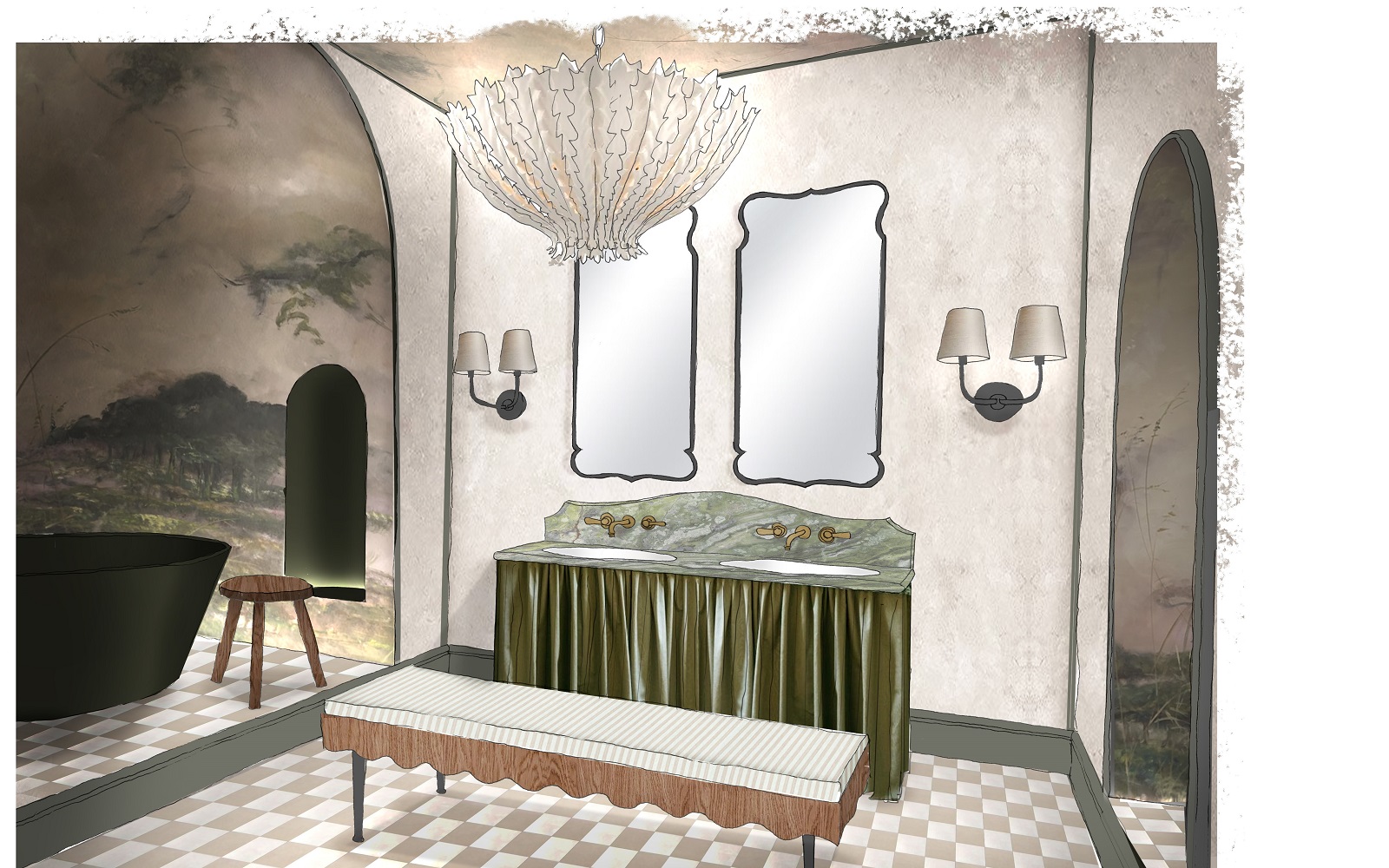
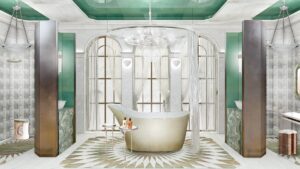
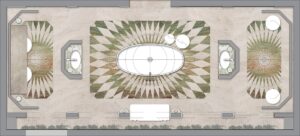
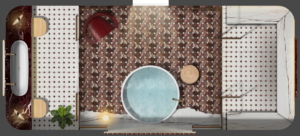
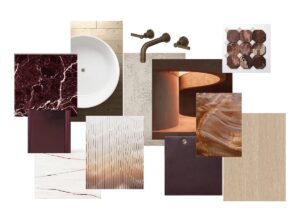
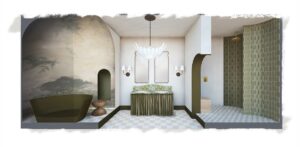
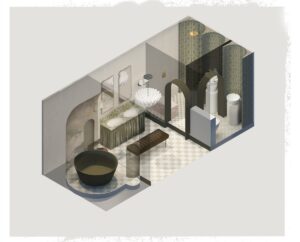
And finally…with a drumroll echoing in the background, the winning design came from the Michaelis Boyd studio! The concept for this design is based on a playful and whimsical journey through the bathroom. A raised platform for the feature bathtub has been created, encircled by a hand-painted mural niche within an up-lit cave. The space is designed for the occupier to navigate through each area with it becoming more intricate and increasingly dramatic as the space becomes more intimate. Playing on the macro-micro, an open entrance leads seamlessly into a small, yet punchy powder room.
Image credit: Michaelis Boyd
The starting point and inspiration for this design was by creating a focal point, a theatrical standalone piece with the most important element of the bathroom, in this case, being the bath itself. Once the baths location on a raised platform had been agreed on, it inspired the planning of the remaining layout, sanitary-ware and the general spatial flow.
This design is all about the user, someone who enjoys to bathe and takes the sensory side of wellness seriously. this bathroom is a sanctuary for relaxation and the discovery of the senses. It is a place of serenity and stillness, a place to recharge.
Emily Hunt, House of Rohl’s Head of Hospitality for UK & Ireland was thrilled with the process and the result. “We were overwhelmed by the response to our WOW!House room last Summer, especially from the design community,” commented Hunt. “Having been approached by a number of practices about the 2024 event, we felt the fairest approach to choosing a partner was an open competition. Hotel Designs kindly agreed to help evaluate to entries, along with the Design Centre event organisers. The proposals were – without exception – fantastic, and we could easily have chosen any of the them. We had to have a winner, however, and Michaelis Boyd’s fully realised vision wasonvincing, showing clever and original thinking, and we had a just-about unanimous decision!”
House of Rohl is one of our Recommended Suppliers and regularly features in our Supplier News section of the website. If you are interested in becoming one of our Recommended Suppliers, please email Katy Phillips.
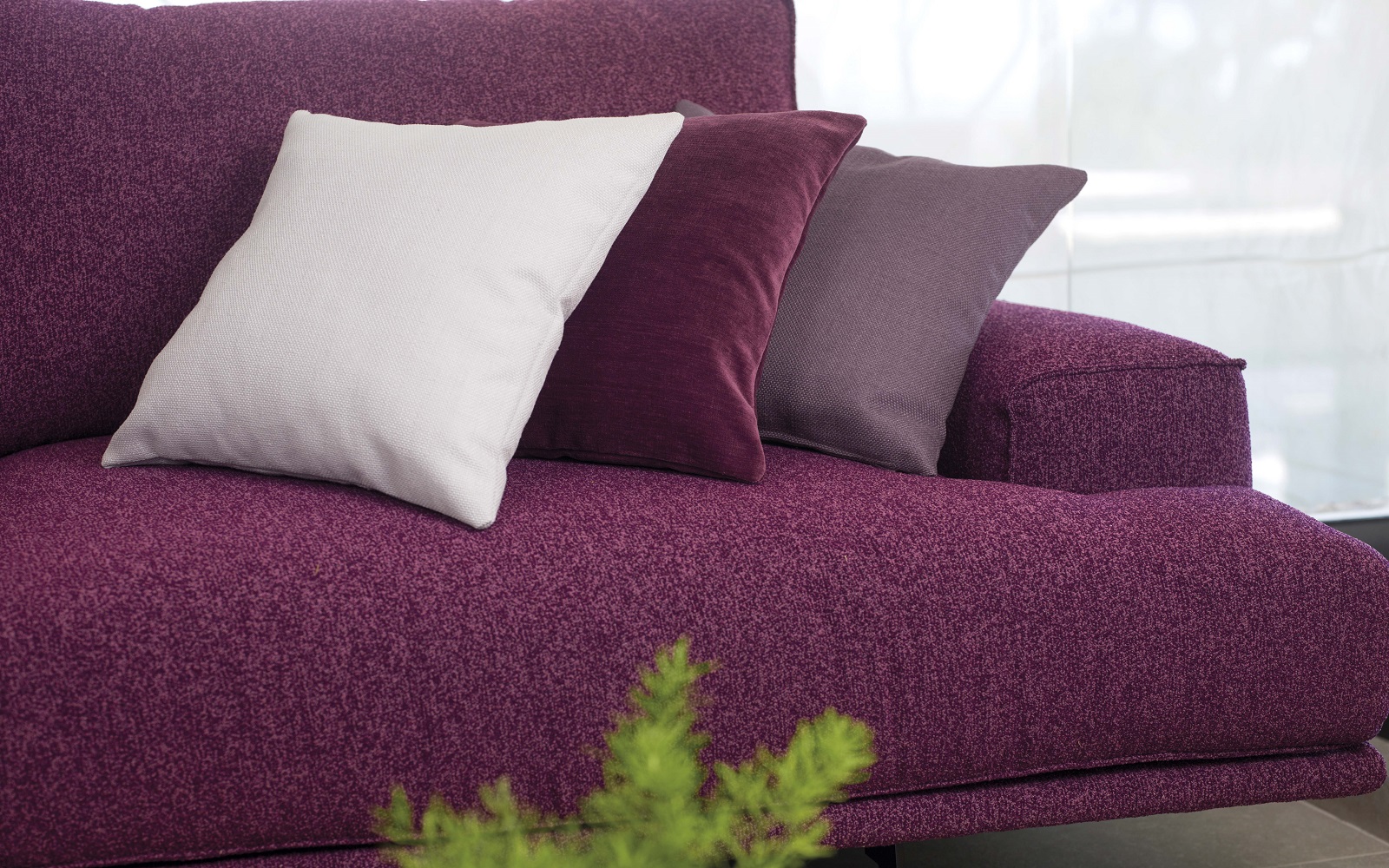
As Spring approaches, Sekers Fabrics is thrilled to announce the launch of four fresh collections to its vast portfolio of products. Introducing Garcia, Manero, Yellowstone and Zavian, each offering luxury, durability, and style for the contract market…
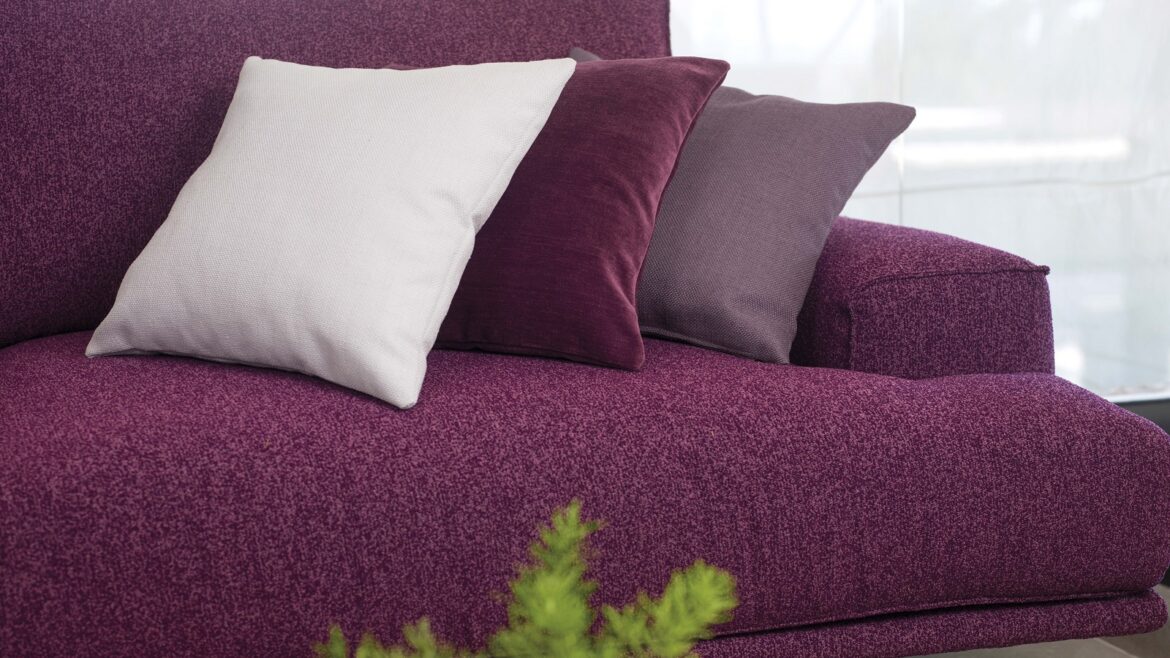
First to be welcomed into the Sekers fold, Garcia is a remarkable collection featuring two complementary semi-plains: Ambiente, a striking two-tone bouclé and Selva, a luxurious soft chenille. What sets Garcia apart is its commitment to sustainability, as it is made from recycled polyester, fully aligning with the Global Recycled Standards.
In the spirit of its Spanish namesakes, Ambiente meaning ‘environment’ and Selva translating to ‘forest’, both designs cater to environmentally conscious designers seeking the perfect fit for the hospitality and leisure markets. Available in a versatile palette of 14 colours each, ranging from bright jewel tones to soft neutrals creating a coordinated and flexible collection for upholstery and accessory application.
Incorporating Aquaclean, an advanced nano technology finish, Garcia ensures maximum protection against even the toughest spills and stains, from red wine to marker pen, without having to resort to specialist cleaning. Plus, with its added anti-bacterial and anti-microbial properties, it maintains freshness and cleanliness.
Image credit: Sekers
Next up is Manero, a luxuriously durable faux-leather collection. Manero stands as a testament to sophistication, offering a palette of 25 sumptuous colours from deep blues to earthy naturals. Crafted for contact upholstery and accessories, Manero is FR inherent and complies with all relevant UK, USA, and IMO standards for upholstery.
Engineered to withstand the elements, it provides waterproof protection alongside chemical resistant, antibacterial properties, and UV resistance for lasting durability. With an impressive Martindale abrasion rating of 200,000 rubs, it’s the perfect choice for adding elegance, style, and resilience into high-traffic environments such as leisure, hospitality, marine and healthcare settings.
Image credit: Sekers
Take in the beauty of Yellowstone, a luxurious faux-suede collection capturing the breath-taking beauty and rugged textures of Yellowstone National Park. Embrace nature’s vibrant palette through 24 stunning colours, echoing the tones found in the Grand Prismatic Springs and the park’s earthy landscapes. From deep cerulean blues and fierce orange to vivid yellow and soft browns, each shade narrates a story of the park’s distinct beauty.
Crafted with Aquaclean advanced nano technology, Yellowstone brings both beauty and practicality to interiors. Its innovative finish ensures protection against the toughest stains and spills, ideal for high-traffic environments within the contract market. Suitable for upholstery and accessories, Yellowstone boasts a Martindale abrasion rating of 50,000 rubs and is supplied crib 5. Compliant with all relevant UK, USA and IMO standards, Yellowstone ensures both quality and safety. Additionally, Yellowstone’s waterproof feature enhances its durability, making it well-suited for busy hospitality, leisure, and marine markets.
Image credit: Sekers
Lastly, unveiling Zavian, Sekers latest 4-pass FR blackout drapery collection designed for the hospitality, marine, leisure and healthcare markets. With a rich and vibrant colour palette ranging from deep emerald and red to soft champagne and fresh mint, Zavian’s unique design adds modern elegance to every room. This striking collection is meticulously designed to effectively control and block unwanted light, creating privacy and a peaceful environment.
Crafted from 100 per cent polyester, Zavian ensures durability and easy maintenance, being washable at 71 degrees. Beyond its functionality, the name Zavian holds cultural significance, translating to ‘new home’ in Basque and ‘bright light’ in Arabic, echoing the fresh beginnings and radiant ambiance it brings to the room. Discover the beauty of Zavian and add a timeless drapery design to your interior projects.
Sekers is one of our Recommended Suppliers and regularly features in our Supplier News section of the website. If you are interested in becoming one of our Recommended Suppliers, please email Katy Phillips.
The successful European value-for-money hotel chain, B&B HOTELS, has taken a significant step towards fulfilling its ambitious growth plans in the United Kingdom with the takeover of a hotel located at Heathrow, London. Here’s what we know…
Founded in Brest in 1990, B&B HOTELS is one of the most important economic hotel groups in Europe. It has a network with more than 770 hotels in 17 countries in Europe, Brazil and the U.S. Having announced its expansion into the United Kingdom in late 2022, the takeover represents a milestone in the group’s growth strategy, setting the stage for further investment in the UK market. The brand’s ambition is to become a key player in the British hospitality sector, specifically in the economy/budget hotel segment.
Image credit: B&B HOTELS
“Our successful growth model and commitment to value for our guests have made us a beloved brand across Europe, and we’re excited to bring that same experience to guests in the UK,” commented Fabrice Collet, President & Chief Executive Officer of B&B HOTELS. “We are accelerating our development in all the countries we are already in while continuing to establish ourselves in new markets. We aim to become the leader in sustainable value-for-money hotels with an ambition of 3,000 hotels within 10 years.”
Image credit: B&B HOTELS
“Looking ahead, the UK team remains committed to forging partnerships with existing hotel owners, developers, landowners, funds and real estate owners to realise its expansion plans,” said Patrick O’Connell, Chief Executive of B&B HOTELS UK, commenting on the deal. “By leveraging local expertise and strategic collaborations, we aim to establish a robust presence in the UK hospitality market and create memorable experiences for guests nationwide.”
“We are delighted to confirm that B&B HOTELS have agreed a long-term lease for one of our Heathrow properties,” added Sanjay Arora, Chief Operating Officer and Head of Property at the Arora Group. “Arora Park Hotel was originally built and operated as a British Airways crew accommodation hotel before converting to a hotel serving all market segments. The building, facilities and its proximity to Heathrow Airport, lends itself as an ideal economy hotel and we are confident that B&B HOTELS will do a fantastic job in repositioning the property as one of the best value for money accommodation offering in Heathrow. We have enjoyed our interaction with the brand and look forward to working with them on possible future projects.”
Positioned in the value-for-money segment, B&B HOTELS is recognised for its ability to deliver exceptional value to guests while maintaining operational excellence.
Independent Hotel Show Amsterdam – Welcome to Dreamland
This year visitors to The Independent Hotel Show Amsterdam are encouraged to take a respite from the ordinary and experience a dreamland of trend exploration, product innovation and networking…
The Independent Hotel Show Amsterdam – the business event for boutique, luxury and independent hotel sector – returns for March 12th and 13th, for the fourth and most extensive edition in the Dutch capital. This year, the theme chosen was Dreamland, a theme that fits well with current hotel trends.
Image credit: IHSA
“Today’s hotel guest wants to be surprised by a combination of luxury and creativity,” commented Tess Suters, Event Manager. “And that naturally also applies to the visitors to our event. We asked our designers to create a dreamworld where hoteliers are taken out of their daily reality for a moment and can be inspired. In any case, we live in a world where fantasy and reality are increasingly merging, partly due to artificial intelligence. This is a subject that will certainly also be covered in our extensive seminar programme, which is a hot topic hoteliers and designers want to explore further”.
Image credit: IHSA
Alongside the 200 premium suppliers showing their latest innovations across design and décor, hospitality tech, amenities and F&B, there is an extensive seminar programme taking place, led by over 40 industry pioneers. Expect to experience a programme covering a variety of trending topics that are currently impacting the hotel industry. Two stages will host a plethora of key-note presentations, panel discussions and exclusive interviews where we see innovators explore topics such as sustainability, technology, marketing, staffing & HR and revenue-management. Trend predictions will be given on the changing travel and spending behaviour of the hotel guest of the future.
Image credit: IHSA
Aside from our unparalleled complimentary seminar programme, there will be plenty of space and opportunity for visitors to network and form new connections to enhance their business. “We recognise how important networking is to our visitors” continued Suters. “Meeting over a glass of wine and exchanging knowledge and experiences. We make enough special areas and occasions for this throughout the two-day show”.
These opportunities include the returning Independent Hotel Show Awards sponsored by Hotek, and dedicated networking sessions for HR professionals, designers and for hoteliers specifically from Germany and Belgium.
Hotel Avante – A budget-conscious design with high impact results
Hotel Designs caught up with Dan Mazzarini, Principal and Creative Director of BHDM Design, to discuss the balancing act of marrying budget and good design in the JDV by Hyatt’s Hotel Avante in Mountain View, California…
Dramatic transformation with a limited budget is a balancing act when it comes to designing hospitality spaces. It requires critical assessment of existing conditions, a decisive directive on the goals for the property, diligent attention to selections and costs, and a trusting client to believe in the vision. The team at BHDM Design employed this approach to our work for JDV by Hyatt’s Hotel Avante in Mountain View, California.
Image credit: BHDM Design / Adam Kane Macchia
We tackled the challenge of marrying budget and good design head-on, employing a strategic approach to which elements we could repurpose, reimagine, or replace while injecting a distinct narrative into each design move. Through repurposing millwork, reimaging unused spaces into new experiences, and refreshing interiors with carefully curated furnishings, we breathed new life into the hotel, creating a new ambiance that resonates with its business and leisure guests alike.
Image credit: BHDM Design / Adam Kane Macchia
Assessment to Action: Creating a playbook and narrative JDV by Hyatt turned to the BHDM Design team to transform the 36,000-square-foot 80’s Spanish-style hotel in the heart of Silicon Valley from a tech-maker destination to a wellness-minded getaway. We began the process with a judicious assessment of the property, to determine where the budget would yield the greatest impact. The balancing act was a scope study in public spaces versus guest rooms. To unify all spaces and tie the entire property together, our team crafted a local narrative, focusing on the natural beauty and bounty of the Santa Clara Valley. From architecture to art, the colours, textures and bounty of the valley became the touchstone to bring a sense of biophilic relaxation to the design.
Image credit: BHDM Design / Adam Kane Macchia
Image credit: BHDM Design / Adam Kane Macchia
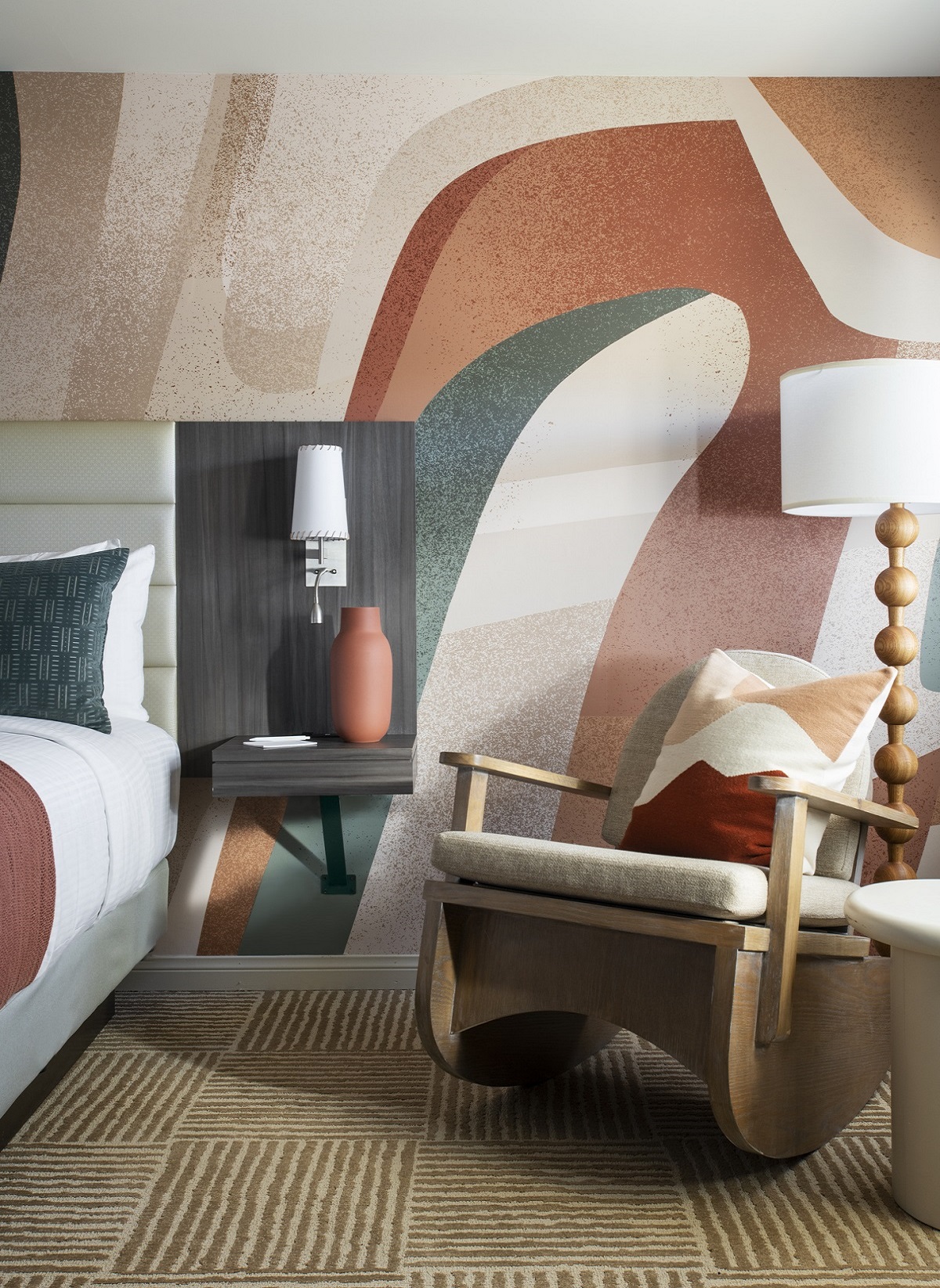
We determined guestroom updates in the form of new soft goods and select furniture could blend with existing millwork to create a new overall look. Meaningful changes in the public spaces would yield a stronger first impression and brand essence, and optimise programming and activation of previously underutilised spaces. Stepping out with both a logistical and narrative roadmap was paramount to syncing up the design and budget for all decisions in the process.
Image credit: BHDM Design / Adam Kane Macchia
Investing in the Experience We assessed that the strongest impact to guest experience would be in dramatically affecting the hotel’s common spaces. As such, the lobby was reimagined as a blended form and function; Challenges like adding more meaningful food and beverage and celebrating daily rituals like breakfast and happy hour were addressed with new millwork and equipment. Architectural finishes like flooring, lighting and millwork were places to spend for the ‘wow factor’ and softer goods like furniture and art could feel more residential, to meet the evolving sensibility of the guest. Luxurious touches like a pieced leather wall create key design elements, enriching the guest experience and optimising the overall budget. Throughout, local character was incorporated into finishing touches big and small: from custom art and accessories, to the curation of the food and beverage menu and in-room OS&E. Good design is total design, and we were here to make sure this happened, even on a budget.
From the form to the function, we further enriched the guest experience by creating new useful spaces for the guest. We transformed unused storage rooms into dynamic work lounges for ‘bleisure’ travellers, offering guests a place to work, eat, relax, and mingle for a sense of community. These spaces function as a ‘third place’ locales for socialisation and productivity outside their rooms.
Image credit: BHDM Design / Adam Kane Macchia
Image credit: BHDM Design / Adam Kane Macchia
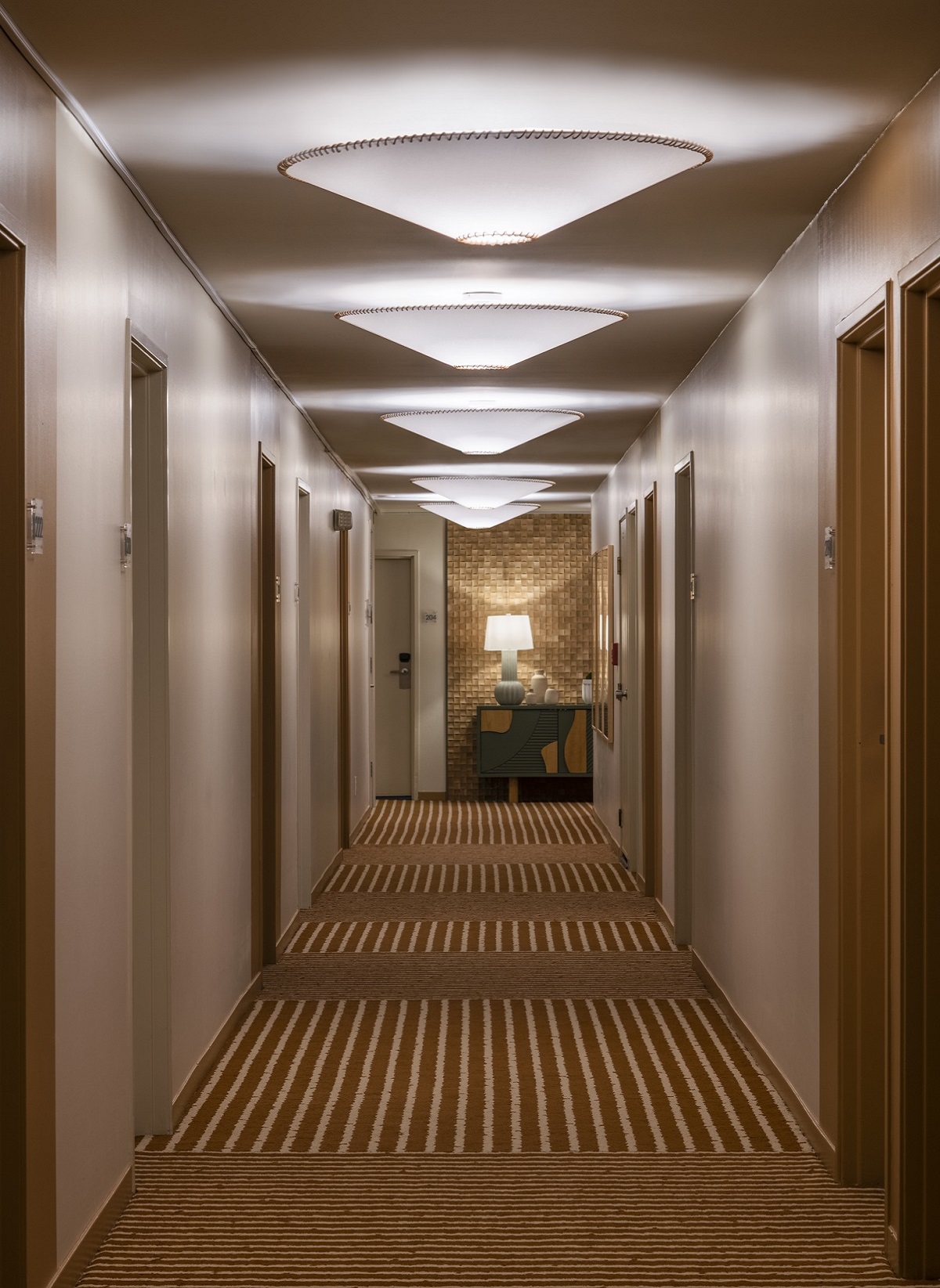
Resourceful Revitalisation Not all spaces needed a complete overhaul, and instead were redecorated (yes, decoration for the win!). We saw corridors as a low-touch, high-impact opportunity; here, we leveraged the pre-existing electrical infrastructure and created custom shades to cover existing lights, transforming standard fixtures into bespoke features. Carpet became an overscaled pattern underfoot, where the use of “hand painted” stripes was installed with a quarter-turned to add further dimension to the floor. Key areas at elevator landings were decorated with off-the-shelf wood millwork panels, and layered with custom signage, chosen to compliment existing room number signage. Paint was our friend, and we used contrasting colors strategically to add architectural impact throughout corridors. The pool deck was also reimaged into a more lounge-like oasis – new furniture with a focus on fire pit and poolside loungers and cleaning up landscaping went a long way to reinvigorate the outdoor space.
Image credit: BHDM Design / Adam Kane Macchia
A Balanced and Impactful Design Getting the most from a budget requires a strong editorial approach. Spending less does not mean a project has to look or function as less. Often for the designer it also requires additional time and effort to keep all trains moving toward the collective goal. Creativity, innovation, and out of the box opportunities are all required to maximize value within given limitations. By focusing on high-impact, low-budget changes and embracing a strong sense of narrative, we were able to create not just a new look, but a new set of experiences to anticipate the needs and exceed expectations of guests.
Hotel Avante stands as a testament to the power of meaningful assessment, strategic design and judicious implementation to maximize cost-effectiveness. By leaning on opportunities for repurposing, reimagining, and replacing elements, we’ve crafted a space that authentically embodies the essence of the Santa Clara Valley while meeting the evolving preferences of modern guests. Helping our client decide where to spend and where to reimagine resulted in enhancing the guest experience, and infusing all touch points at the property with a stronger sense of narrative, place, and joie de vivre, creating value for both Hotel Avante’s owners and travellers alike.
Main image credit: BHDM Design / Adam Kane Macchia
Rockwell Group completes design for Bathhouse Flatiron
Rockwell Group has completed the design for Bathhouse Flatiron, a 35,000 square foot/3,252 square metre luxury spa and banya in Manhattan, New York.
Aiming to redefine what an American spa experience can be, Bathhouse incorporates the best of contemporary recovery practices in a socially engaging environment, offering guests an elevated experience with a sleek and modern design focus.
Rockwell Group’s design concept for Bathhouse’s first Manhattan location was the idea of the Hero’s Journey, a common trope from mythology that involves a hero who embarks on an epic journey or quest, encounters challenges with a decisive apex and returns home transformed by the adventure of personal growth. Each component of the guest’s experience, from reception to treatment rooms, plays on this narrative, helping visitors on their road to ‘recovery’. To achieve this, Rockwell Group created a new architectural language through dramatic use of light and shadow, incorporating a muted, moody material palette including travertine, fluted glass, stone, concrete, tile, and metals with a patina finish.
Image credit: Adrian Gaut and Emily Andrews
As guests enter Bathhouse through the ground floor lobby, they are welcomed by a boulder-like reception desk made of two types of travertine. Portals of illuminated fluted glass emphasise the guests’ journeys and transition, and a heavy black stone back wall with a vertical beacon of light in the centre resembles a ‘light at the end of the tunnel’. Guests descend a compact black stair, the first of several thresholds guiding them on their journey into the unknown. Visitors emerge into the locker rooms at the first of two subterranean levels.
Image credit: Adrian Gaut and Emily Andrews
Black portals create rhythm and intimate clusters of changing areas, while stone benches build on the notion of a journey. As guests emerge from the locker rooms, they enter the lounge and café for a moment of respite or engage in an intimate chat with a friend. This non-traditional restaurant features low lounge furniture, including custom banquette seating, with seats at a travertine and limestone bar. A cluster of organic, pebble-shaped decorative pendants inspired by river rocks provide a dynamic focal point, as do green ceramic pendants.
Image credit: Adrian Gaut and Emily Andrews
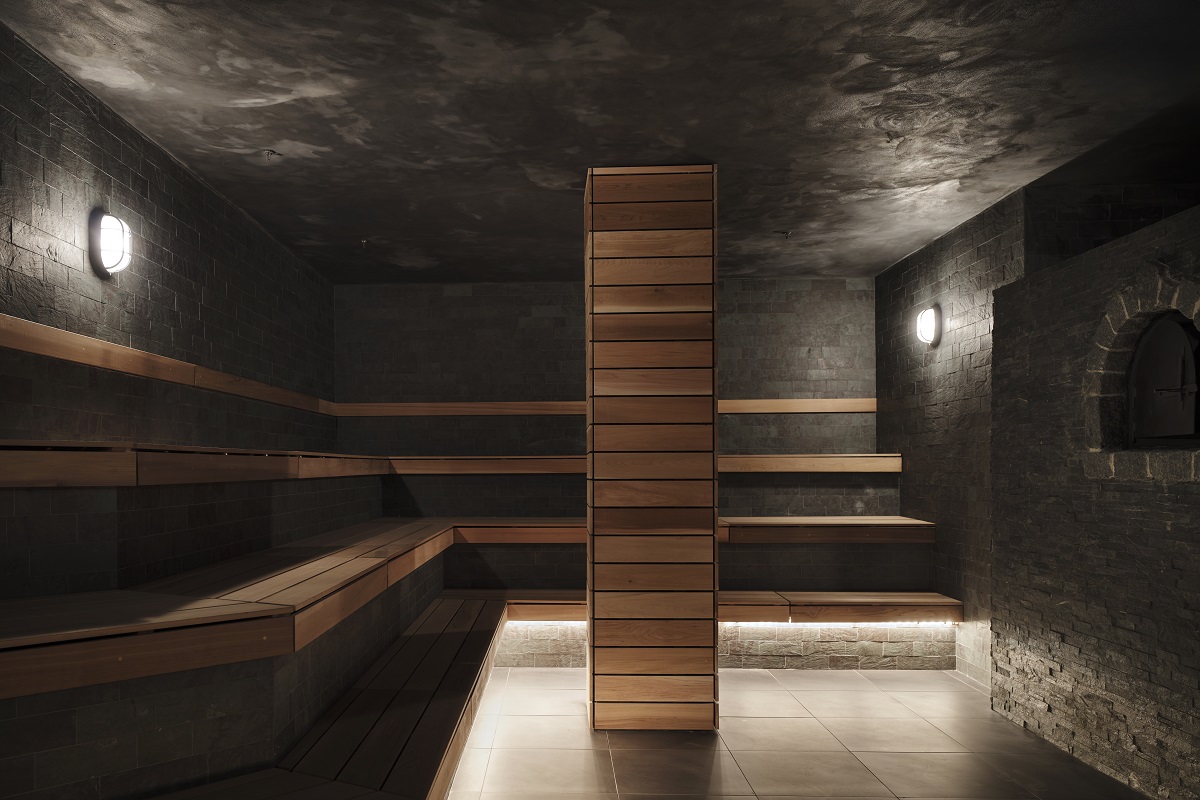
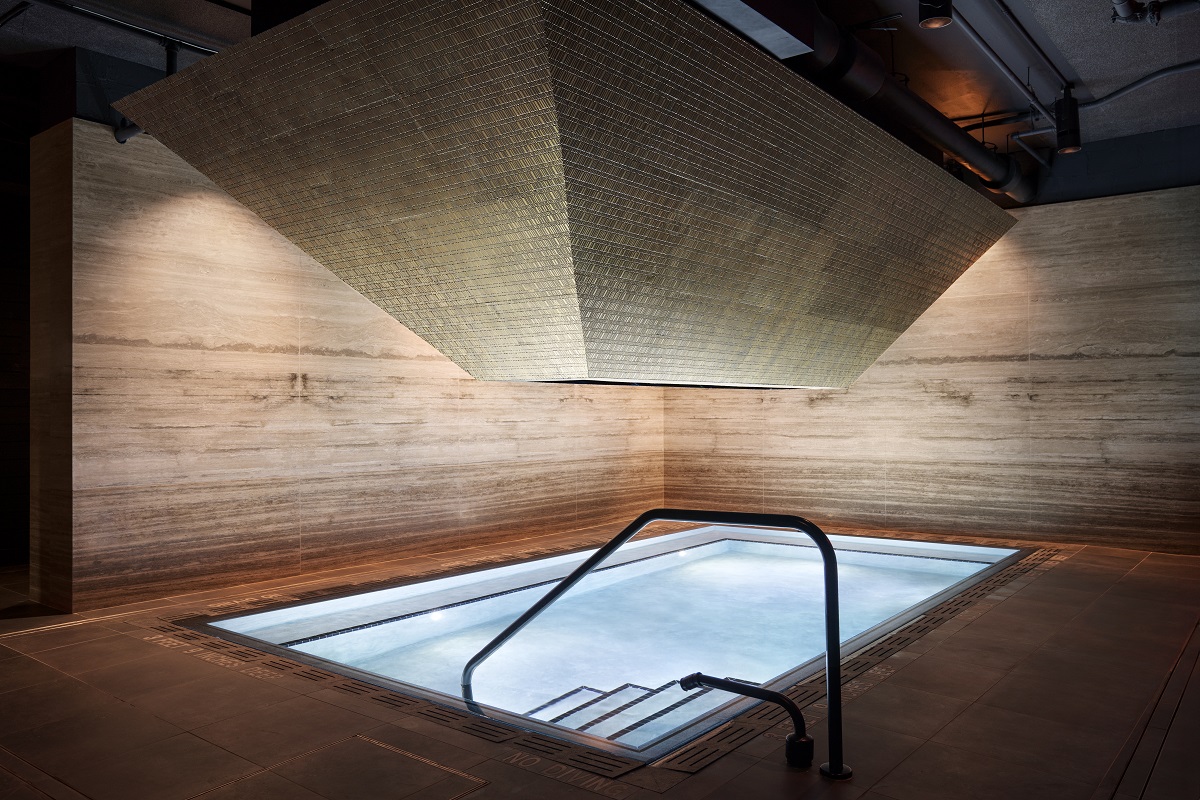
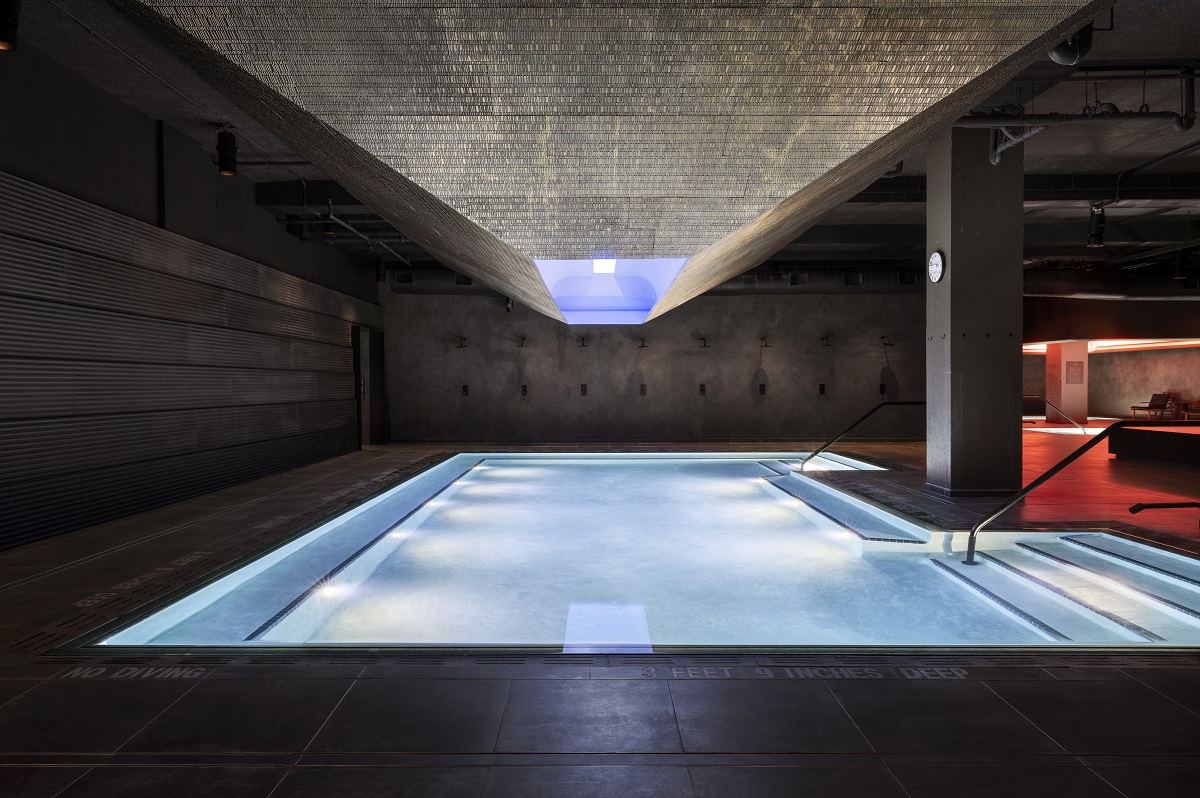
The second subterranean level contains the pools and treatment rooms. Plunge pools of various temperatures are lit in different tones of blue (cooler to warmer), and many sit underneath large, pyramidal volumes which appear to have a mottled, metal sheen. The space has a black tiled floor and heated black stone hammam benches surrounding the perimeter of the pools. The Saunas and the steam room on the periphery of this space are designed to look like stepped pyramids clad in horizontal black, fluted concrete panels. Combined with the pools, these small building objects create the feel of the remnants of a rediscovered civilisation.
Image credit: Adrian Gaut and Emily Andrews
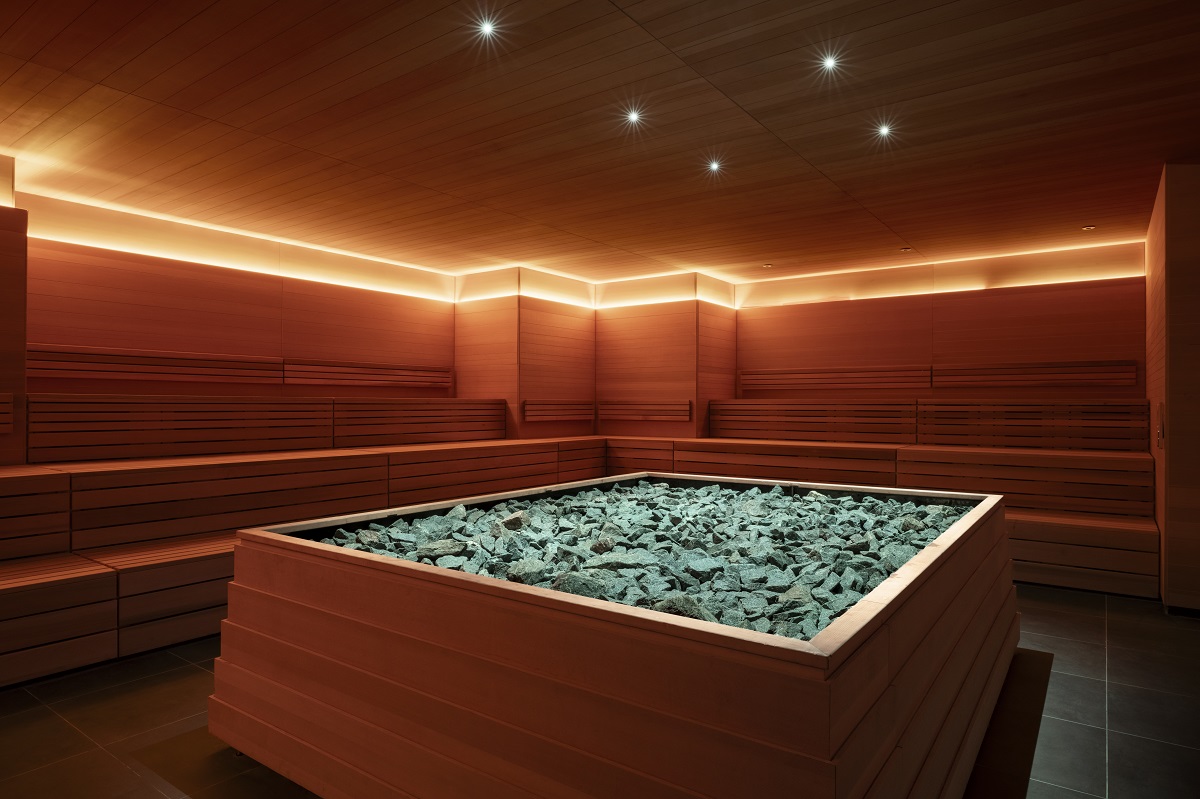
A ceremonial sauna is lined in cedar with stepped bench seating. Cove lights and down lights in the ceiling illuminate the heaters. The central heater is shrouded in cedar and resembles an altar. Here, Sauna Masters perform Aufguss, a sensory experience featuring scented oils, music, and heat. The steam room is clad in a Danish three-dimensional tile called DTILE, a modular system that wraps the space and creates rounded edges and corners. Strips of light in the walls of the blue-grey tile create a mysterious focal point to the space. The Banya is the hottest Russian-style sauna, clad in horizontal green-purple slate tiles and features a black stone-encased furnace. The bottom bench contains glowing strips of light. Finally, an infrared sauna is lined in vertical hemlock wood panels to evoke the height of a forest environment, with a glowing window giving a silhouetted view of lush plants.
Image credit: Adrian Gaut and Emily Andrews
A darkened, compressed corridor on the way to the treatment rooms evokes a sense of anticipation. Guests emerge into a small lounge area with another pyramid hovering over a salt pool and a travertine gradient feature wall. The room is wrapped in black-stained wood, with benches and soft seating. This pyramid also features a surprising lighting element visible only to those floating underneath. The underside is clad in black mirrors with 150 fibre optic cables, creating an infinity experience. A scrub room, meant to be the inner sanctum of the Bathhouse experience, is like a cave within a cave. Lilac marble tables float under a ceiling with cove lights gently bathing the walls. Showerheads offer a chance to rinse off, while the adjacent massage rooms are clad in a warm brown clay lime finish to provide a back-to-nature and cocooning aesthetic.
Elsie de Wolfe – the design inspiration behind JW Marriott Essex Hotel’s Meadow Terrace Suite
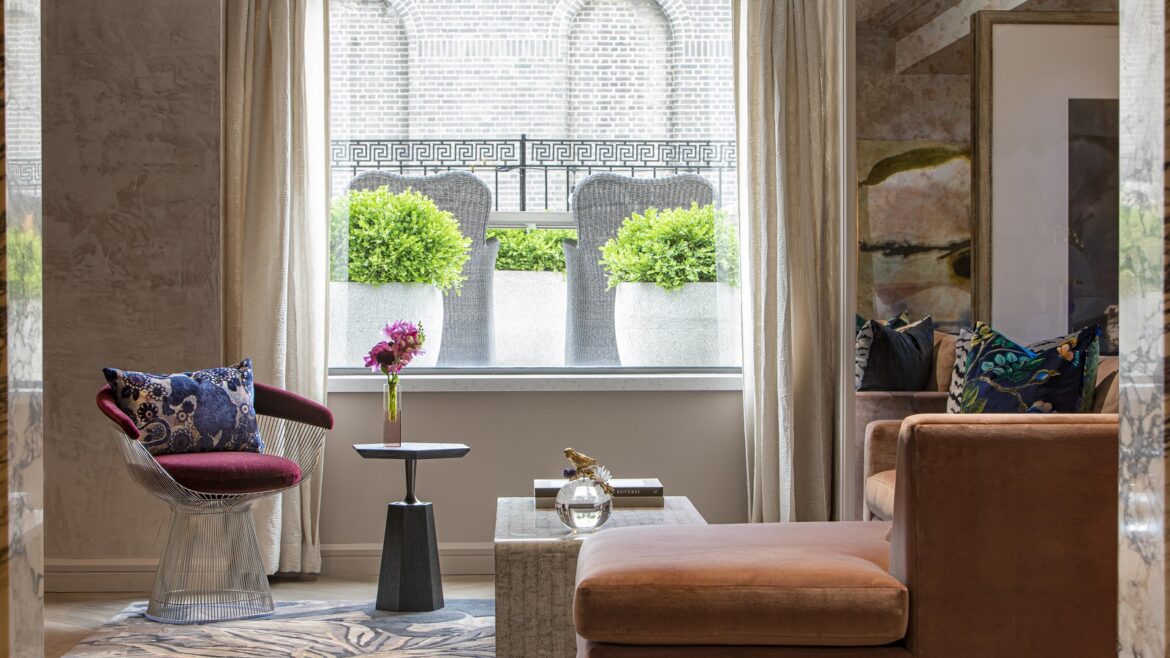
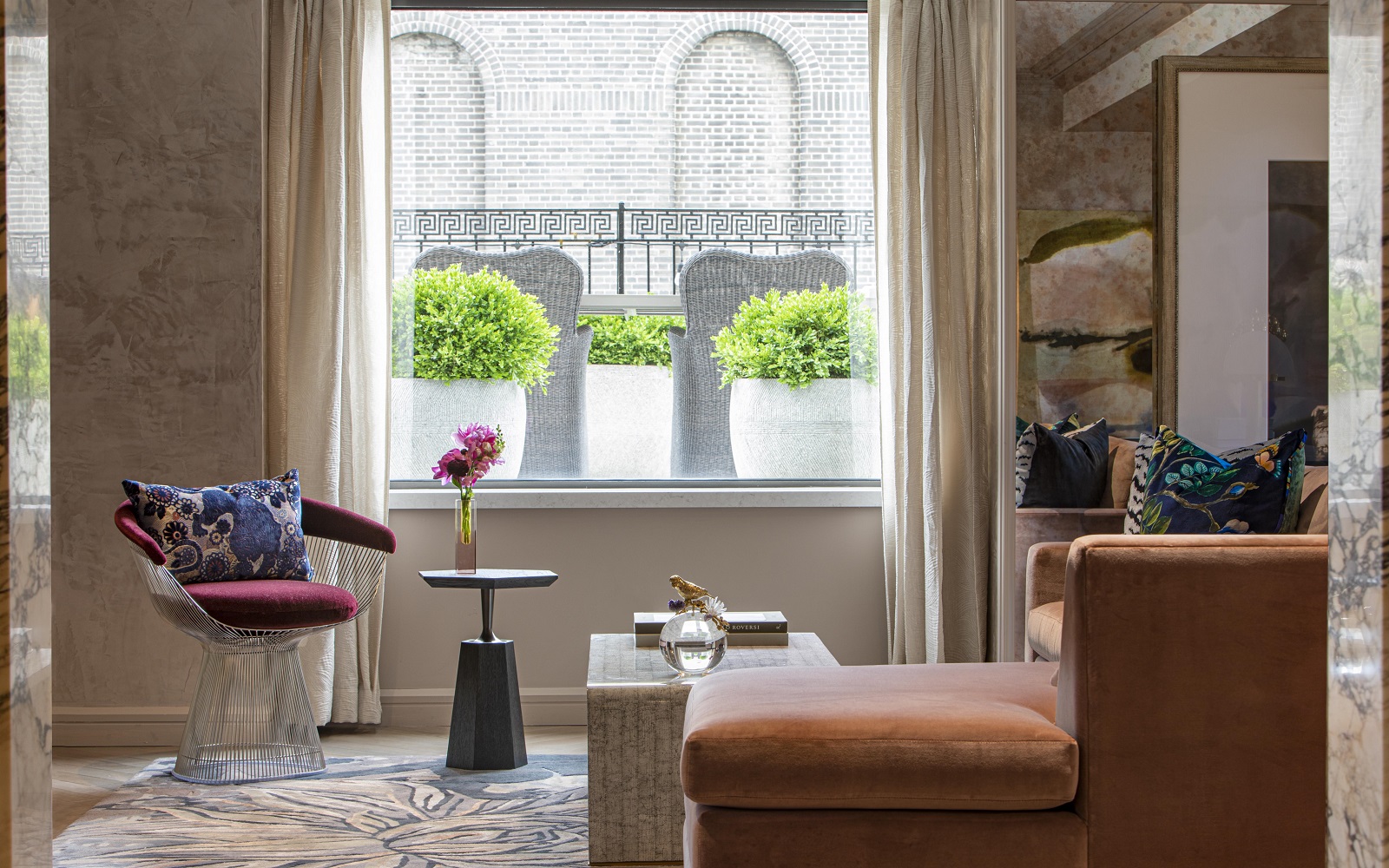
Designed by Whitespace Interiors, each fully reimagined suite in the hotel tells a distinct story through design, artwork and other touches inspired by personalities who helped shape the cultural landscape of New York City – we step inside the Meadow Terrace Suite, inspired by Elsie de Wolfe, who has been broadly given the title of ‘America’s first interior decorator’…
De Wolfe, honoured as the design inspiration behind JW Marriott Essex Hotel’s renovated Meadow Terrace Suite, is known for her roles as trailblazer for women in arts and business throughout the early 1900s. Born in New York in 1865, she first embarked on an acting career, later being redirected to her main interest of design, starting with her first project: New York’s Colony Club, an exclusive new club for women. She also went on to work on Villa Trianon in Versailles and the homes of members of the Royal Family.
Image credit: Marriott International
Understanding the impact of Elsie’s career on the design industry, Essex House selected her as the design inspiration behind the recent renovation of its luxury, two thousand square foot, Central Park-facing Meadow Terrace Suite.
“Our historic hotel has many stories to tell, and the Central Park Suite Collection is our latest chapter,” said John Rieman, General Manager. “As we reimagined these suites for today’s luxury traveller we also looked to the past for inspiration, drawing upon the storied history of our most beautiful neighbour Central Park. The result is three unique interpretations of our beloved Art Deco hotel that offer something for everyone.”
Image credit: Marriott International
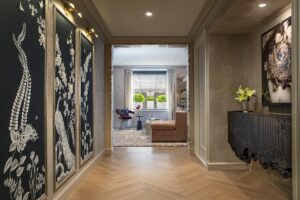
An embodiment of sophisticated, decorative, and feminine design, the classic yet contemporary Meadow Terrace Suite, inspired by de Wolfe, who was known for her opulent, sumptuous eye. Embracing natural light with large windows and a terrace offering mesmerizing views of Central Park and Columbus Circle, the expansive vistas invite the beauty of the outdoors to merge seamlessly with the luxe interior.
Image credit: Marriott International
Image credit: Marriott International
Every aspect of the suite reflects de Wolfe’s commitment to tasteful indulgence and meticulous attention to detail, beginning in the foyer with a three-dimensional, hand-crafted bas relief, triptych adorned with florals and peacocks.
Image credit: Marriott International
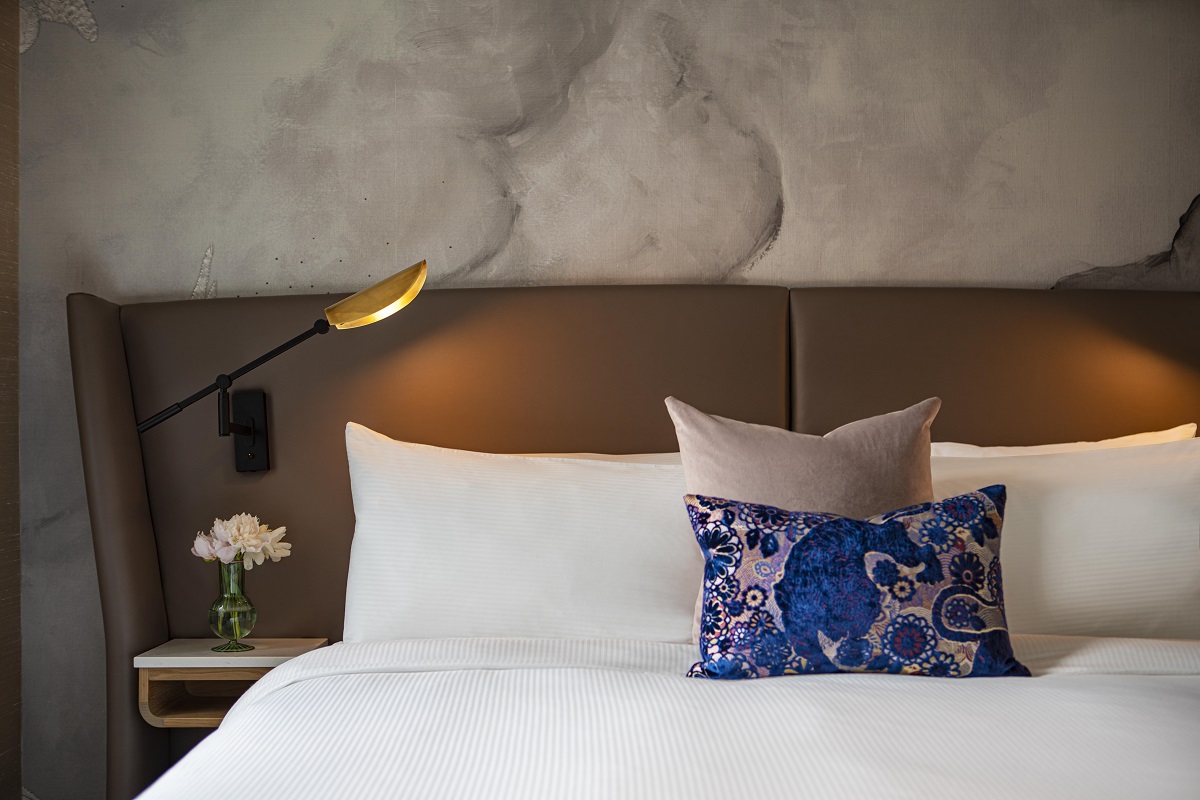
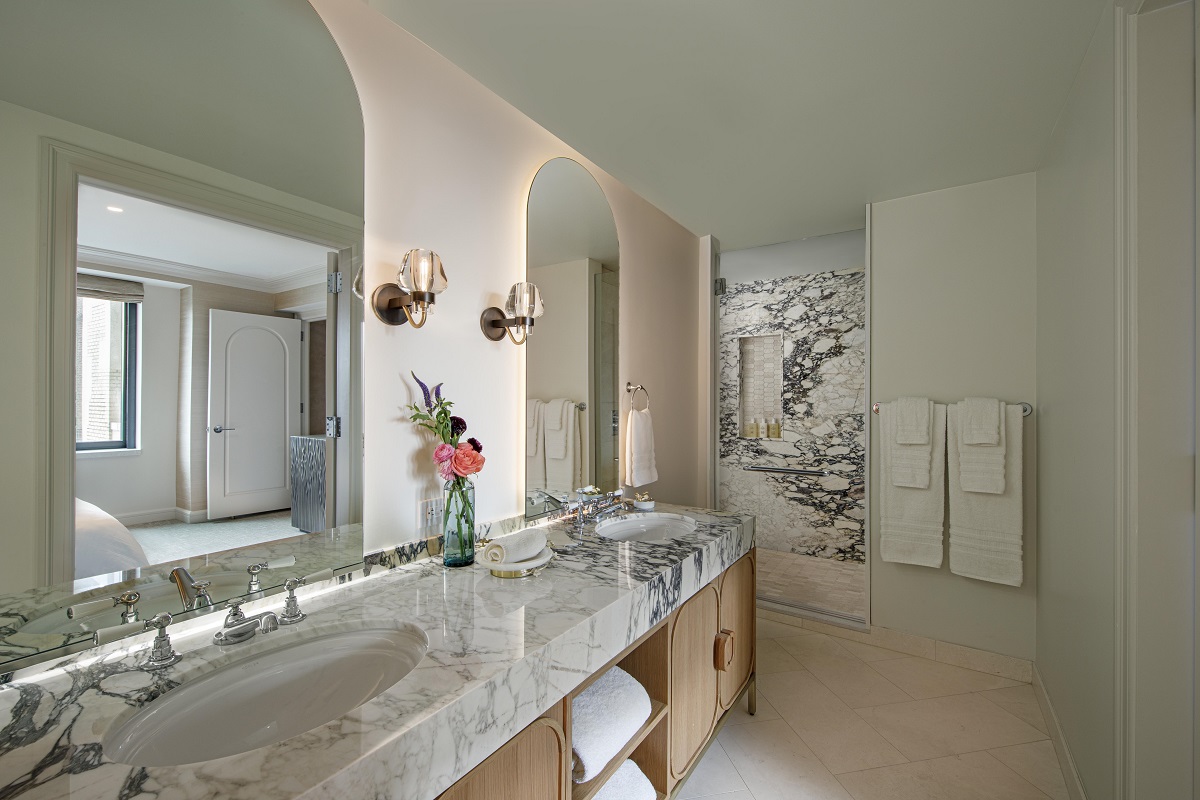
Other design highlights include intricately designed marble casing, second bedroom with a pair of queen beds and a full kitchenette with private entrance. Gracious terrace views overlooking Central Park’s Sheep Meadow provide an inviting space for guests to unwind, bask in the tranquillity of nature, and savour the iconic view.
International Women’s Day is a significant marker in many people’s calendars as a day of reflection, change, and hope for the future. Hotel Designs Editor Sophie Harper ponders on what the day means to her and other women in the hotel design industry.
In 1976, American historian Laurel Thatcher Ulrich wrote in a scholarly article, “well-behaved women seldom make history” – a quote that has been repeated exponentially in recent years. I have personally quoted it more times than I care to admit, drumming up amusing mental imagery of all those scandalous, outlandish women making waves and wreaking havoc throughout history. Great, but what about all the women who weren’t raising hell? These days I’m just as much, if not more, interested in the women who were meticulous, passionate, and wanted to change the world through science, medicine, and technology, who honed their craft and gave back to the world.
We have a way to go yet, but acknowledging the progression towards a more equitable, inclusive, and diverse culture is important, and suggesting that good behaviour will ultimately be unrecognised, or that the women who did so much to change history were simply troublemakers, is detrimental to their work and many other women’s successes.
It’s easy sometimes to focus on the pitfalls and failings of society, of industry, and individuals, but there are so many more positives and achievements we could be celebrating instead. The biggest change we can continue to make is supporting each other more, lifting each other up and recognising that not all superheroes wear capes (and not all brilliant women are societal agitators).
We asked some of the hotel design industry’s leaders and creative movers and shakers to tell us what’s on their mind this International Women’s Day.
“In the 30 plus years I have worked in London, I have seen a huge shift towards diversity in the hospitality design sector. In fact, I would say that our design industry is now one of the most inclusive business sectors to be found. However, that is not enough. It still remains the case that design decisions are mostly taken by men and, worse, once our creative work leaves home to make its way through the implementation chain, it enters a world that largely has no women at all at decision making levels. I believe that this is to the detriment of the process as well as the final outcome.
In general, women are pragmatic problem solvers; they are also sensitive to creative values which tend to be side-lined in masculine cultures. Our need is for inclusivity across the entire supply chain and my hope is to see a few people who might currently feel excluded, empowered to make it to the top table, thus becoming role models for those who would then follow them.”
“This International Women’s Day, we celebrate the strides made by our hospitality industry in promoting equality and fostering opportunities for all. This progress owes much to the courageous women in our history who dared to speak up and act, catalysing transformative change.
In 1984, four visionary women established NEWH – The Network of Executive Women in Hospitality – to champion the advancement of women in our industry. What began with just four voices has since blossomed into a driving force for positive change, both within our industry and society at large, expanding opportunities for women across diverse career paths.
We owe a debt of gratitude to those trailblazers who dared to challenge the status quo, paving the way for women today to pursue their aspirations without constraints. These are truly remarkable times for women, brimming with boundless opportunities for success.”
“It is vital for the future of our sector that everyone who contributes to the design and construction of our hotels feels they are heard and supported by their peers, employers, and industry colleagues. Sadly, such inclusiveness remains an issue for women as they progress in their career, navigating the complex path of taking on more responsibility at work, choosing to have a family, or pushing for equal acknowledgment in the boardroom. Although gender parity of qualified architects amongst the under ‘30s is in sight, it reduces over the next generations until women in senior management are still far too rare within the profession.
It is therefore essential that relevant support networks exist for females as they progress in their careers and, for me, mentoring, by women for women, is key. In order for this to be a success, it requires the mentor to make time in a busy day to be available to support, and most importantly, to listen. It is a process, however, which benefits both mentor and mentee.
I am passionate about the power of on-going learning and positive communication to unleash change and hope that in offering support to younger women in architecture, they too will take on a supporting role for others in the future. It will take some time to achieve true equality and diversity all the way to the top, but this is one way of changing the statistics for the better.”
“I love International Women’s Day – it’s important to embrace our role in this world – we’re beautiful, strong, and we need to be celebrated. I think it’s good that people are talking about this topic more and that social media is helping spread the message.
I have been lucky, I was raised by a very strong woman and very respectful father, so when I was a little girl I didn’t experience any discrimination, I didn’t even realise such a thing existed, but as a businesswoman that’s when I started to experience it and it came as a bit of a surprise! Has it gotten any better, I’m not sure, but what has got better is me – I have learned, I have developed, I have changed – changing the world is a more difficult challenge.
In Kazakhstan International Women’s Day is a holiday and we don’t work. We celebrate with spring flowers and each other. I’m driving to see my family today, it’s a big deal for us. I want to thank the women around me, my mum, sisters, niece, and my daughter, for supporting me for many, many years, for women everywhere supporting other women – thank you.”
“At Hart Shoreditch, championing our local entrepreneurs is at the heart of all we do, and we are supporters of equal opportunity for all genders. Across all of our collaborations with female business owners as well as our hotel team, we aim to inspire and empower women to achieve success.
We pride ourselves on having an extensive portfolio of partners who are women, like interior designer Rezzan Hasoglu, DJs Roxa Damas and Dina Micka, and artist Avalele. Most recently, a collaboration with East End local, Samantha Jameson, founder of Soapsmith, not only enriches our guests’ stay with high-quality amenities but also underscores our commitment to showcasing her craftsmanship and her remarkable business to our local and international guests. For 2024, we hope to continue these collaborations by offering local workshop series, networking events in our vibrant lounge area as well as panel discussions. Our internal team should also be highlighted, including Sameena, Akvile, Katerina and Ineska. We all work hard to make sure the hotel is a huge success. In the upcoming months, there are several initiatives in the pipeline that will spotlight women and support their creative business endeavours, further solidifying our commitment to championing women in our industry and beyond.
Championing women, not only in the hospitality industry but across other intersecting industries such as beauty, is crucial for promoting diversity and fostering innovation. By embracing diverse perspectives and ideas, we can drive greater creativity and excellence.’’
In an increasingly diverse landscape, Hotel Designs is proud to champion the voices of women and shine light on not only their incredible work in design, but also to talk about the topics that most affect their everyday working environments. Hear from more of our inspirational design talent in our Women at the forefront of innovation article.
As two becomes three, we thought now was a great time to catch up with the design team at Modieus and hear what they might be working on next…
Modieus is Dutch for fashionable, which is a fitting name for a company that is driven by creativity and dedicated to supplying some of the most design-driven commercial flooring in the market. Having frequently interviewed the talented design duo behind Modieus, keeping us on top of the trends, we thought now was a great time to catch up with the expanding team and hear what they might be working on next.
Image credit: Modieus
Marijke Arkley joined the team at the beginning of February this year. She’s worked in carpet design in both Melbourne and Sydney since 2008 after completing her Bachelor of Arts in Textile Design at RMIT. Now based in Melbourne, it was lovely to hear that she’s clearly thrilled to be joining the talented design studio at Modieus. We asked her what is is about carpet design that she loves.
“I love the scale of carpet design – it’s exciting drawing the design into floor plans and to see the installation come alive,” explained Arkley. ” It’s wonderful to collaborate with different clients to realise their vision for a space.”
Her in-depth knowledge of carpet design and weaving constructions comes from working for brands like Brintons, Feltex and Signature Floors, and importantly her five years teaching Weave at RMIT (Royal Melbourne Institute of Technology) in the Textile Design program. It’s clear that she has always loved weaving and constructing textiles, which makes her the perfect fit in a team who have created unique rug collections like the Makers Mark which is inspired by the process of making art.
Image credit: Modieus
“I’m drawn to geometrics and bright colours and love playing with unexpected colour combinations and palettes,” added Arkley. This bodes well for the new collection the team are working on, to be launched later this year.
How does a designer relax, we asked? “When I’m not designing carpet, I love to visit galleries, sip on dry gin martinis with friends and check out new restaurants.” Sounds like a perfect reason for Hotel Designs to take a trip down under!
Image credit: Modieus
Based in Sydney, Hotel Designs has interviewed Leah Manwaring several times over the past few years. It’s always inspiring to interview a textile designer who has been creating patterns and design solutions for industry leaders in the home and interiors markets for over 20 years. Manwaring’s designs combine her love of creating graphic patterns and exciting colour stories for many types of products.
Over the years, she has developed designs for luxury carpets, rugs, and wallpapers for leading international design companies like Brintons and de Gournay before joining Modieus 5 years ago. She has also worked for Charles Parsons in the design and manufacture of bed linen for the retail market.
“Modieus is where we weave stories beneath your feet, one vibrant yarn at a time,” enthused Manwaring. “I’ve found the perfect match for my skills. For me, designing carpets and rugs is a play of textures, each layer adding depth and intrigue. Designing with a kaleidoscope of colour.I love being a part of a team,” she added, “and having worked with both Deb and Marijke in previous roles is the bees’ knees.”
What does someone who loves their day job do in their spare time? “If there is any spare time, I’m screen-printing fabrics in my studio”. And we’ve seen evidence of this in the wonderful collections launched like Impressions which is all about adding handmade detailing in Axminster carpet.
Image credit: Modieus
As the first designer to join Modieus, Debra Ryan has shared the inspiration behind Modieus trends and collections many times. Every time we speak it’s clear that she thrives on challenges and pushing the creative boundaries. She is a decisive and dynamic designer who is trend focused, so it comes as no surprise that Ryan has successfully provided leadership in design and product development for projects nationally and globally with more than 23 years expertise in designing beautiful carpets and rugs, having worked at international brands such as Brintons and Godfrey Hirst and Feltex.
When we asked how she spent her time away from carpet and rug design; “My spare time is spent cheering on my two teenage sons in all their sporting adventures, catching up with friends and family while enjoying a gin in the sun.”
Image credit: Modieus
Ryan has a natural aptitude at building client relationships, realising the design brief and achieving the clients design vision. In her own words; “There’s nothing more fulfilling than nailing the client’s brief, leaving them with an amazing piece of artwork on the floor”.
We have followed many of the amazing projects the Modieus team has worked on over the years, including The Royce Hotel Melbourne and Voco Melbourne Central and we look forward to seeing what this design dream-team throws underfoot, as 2024 rolls out.
Modieus is one of our Recommended Suppliers and regularly features in our Supplier News section of the website. If you are interested in becoming one of our Recommended Suppliers, please email Katy Phillips.
In conversation with: Michaela Reysenn, MD and Founder of KAI Interiors
In a week culminating in International Women’s Day, writer Pauline Brettell sat down with Michaela Reysenn, founder of the female-led interior design studio, KAI Interiors, to find out a little more about what goes into designing and creating unique hospitality spaces…
KAI Interiors is an award-winning interior design studio based in East London. Michaela Reysenn founded the studio over a decade ago and during this time, has worked with some of the industry’s leading hospitality businesses. She has, at the same time, built a strong team of designers who are conceptually driven and constantly exploring new materials and design avenues.
Image credit: KAI Interiors
Pauline Brettell: Let’s start at the beginning – KAI Interiors, can you explain the name and what inspired you to start your own design studio?
Michaela Reysenn: Starting my own design studio felt like a natural step to take when I completed my studies, I have always been in management roles and building teams, so I felt confident to set up on my own. My passion and drive has allowed me to grow the business to this moment and I am so proud that I have had so many opportunities to work with amazing clients who share my passion for creating F&B spaces that inspire their guests.
KAI was quite simply a nickname from Michaela and that stayed with me, however as the years have progressed it has been really interesting to hear the many meanings behind the word ‘KAI’ in different languages. As a huge foodie I was pleased to hear that KAI means food in Maori. It also has meanings such as ‘happy’, ‘strong’, ‘ocean’ and ‘restoration’… I connect with all of these, so it felt like the ideal fit.
Image credit: KAI Interiors / Hyatt Regency
PB: You have a background in F&B – has this impacted on your design approach?
MR: I always knew I would work within the creative sector and had a real love for interior design from a very young age, repositioning furniture daily and changing the wall colours in my bedroom. I grew up with a father as a Chef and Hotelier and a Mother who owned her own bakery, so hospitality was in my blood from the offset. I worked my way through the industry until I finally invested into a restaurant in London.
I was Operations Manager for a small group of bars and loved every minute. I really enjoyed building up teams that were passionate about customer service and giving them training to create their own cocktails which then became part of the menu. With all of these years of knowledge alongside my studies I knew that a career within hospitality interiors made total sense, it was the perfect combination for me which enabled me to use decades of knowledge and experience.
So many of our clients really appreciate value the input we can give, that takes into account the operational aspect of the business alongside the aesthetic. We are practical with our suggestions while striving for timeless design, which will excite guests time and time again.
Image credit: KAI Interiors
As a company we are really supportive of small, independent businesses that are opening a new venue for the first time. We can help through every step of the process and continue to support them by promoting them on our social platforms for years after the project has finished.
When we work within the hospitality sector we know that time is not on our side, we need to get the site open as fast as possible reducing any loss of earnings. We pride ourselves in being super-efficient and organised, pre-empting the clients questions. As we start to develop floor plans it typically opens up a lot more questions for our clients that they have not yet considered, so we bring our operational experience to the foreground at this point to ensure they are thinking about the flow and long term implications.
Image credit: KAI Interiors
Image credit: KAI Interiors
PB: Looking at some of your past projects, there is a strong emphasis on surface texture and lighting – can you expand on these elements in your design story.
MR: Each and every project is different and we really focus on the clients business model, so we can then allow that to blossom and dictate our design approach. We love to explore sustainable materials and constantly push our suppliers to try new things. It is important when we design a space that it is immersive where relevant – we want each and every sense to be engaged, whether that be through scent, sound or touch. Each element is considered, to add more depth to the interior and the customer journey. Surface texture and lighting are really key when creating an immersive space.
When it comes to lighting we like to do this in house as much as possible – we design our own bespoke lights for some clients, to make them unique to the project and emphasise the design story at each opportunity. Our hospitality clients want their space to work as hard as possible for them, which makes sense from a revenue perspective. They often need it to evolve from a daytime venue to late night bar or restaurant once 5pm hits. One of the key ways to do this is with considered lighting and texture. Having a carefully programmed lighting system will make the colours, textures and atmosphere within a space totally change and this is one of the ways we design spaces and maximise clients profit opportunities.
Image credit: KAI Interiors
PB: There is a lot of conversation around the ‘blurring of boundaries’ between domestic and hospitality design right now – has this impacted on any of your designs?
MR: It is really interesting to see how the industry is evolving, with the younger generations drinking less we are seeing non alcoholic cocktail bars coming into play and more health and wellbeing focused businesses which are merging an F&B offer with health facilities. Post pandemic it is clear that people are prioritising their health and this is certainly impacting the hospitality industry.
At the same time we are seeing a real shift towards hotels becoming something for everyone, whether that be as a residence for guests who stay for 12 months periods, guests who need to work, guests who need to relax. We have also seen a shift toward more structured holiday offers with a focus on ‘sleep tourism’.
The emergence of AI use within hospitality is allowing hotels to tailor their services to guests more so they get a very unique and personalised stay, whether that is explored through their preference of bedding, scent and temperature within their room, or their drinks of choice within the ‘maxi-bar’. We are excited to see the evolution of the industry – despite the cost of living crisis and the array of other challenges we have all been facing over the last few years, we strongly believe that we will continue to see people enjoying hospitality spaces.It might be in a slightly different way, but we need social connection, it is essential to our wellbeing and this is at the heart of what we do at KAI Interiors.
Image credit: KAI Interiors / John McDavid
PB: Do you have a standout hotel design that in your opinion ticks all the boxes and is a design inspiration?
MR: I love so many different hotel designs for different reasons and I can’t pick just one. I love the ocean, so anywhere on the coast is always a winner for me. I love Amouage in Taghazout, Morocco –the design is clean and simple but full of traditional Moroccan tiles, rugs and tadelakt walls yet they have little modern twists in the finishes with pops of neon and more current designs. The infinity pool overlooks the sea which is a big tick for me!
Babbington House for the traditional country house getaway and I adore the all you can eat afternoon tea – they have the best bakewell tart I have ever tasted. If anyone can better it. let me know!
Morocco has a special place in my heart and whilst designing Dar Jasmine hotel in Northern Morocco I was lucky enough to explore Marrakech, Fez, Casablanca and Chefchaouen. A couple of stand out places for me were Dar Rhizlane which has the most beautiful architecture and pool area, and El Fenn for its strong use of colour and well curated artwork from local artists.
For something closer to home, I always enjoy the Mandrake Hotel in London, as it has so many different nooks and styles, the open air riad element is a real treat for a central London location.
Image credit: KAI Interiors / John McDavid
PB: What has been your biggest design challenge?
MR: Every single project comes with its own challenges, whether they be small or large. I think overall, our challenges are often linked to budget and time constraints. As a team we will push really hard to exceed the clients expectations when it comes to timeline – we really care about our clients and want to get their business up and running as soon as we can.
The team are strong at problem solving and we do this day to day, whether it is a small issue or large, we find solutions fast. Our main focus when designing a space, is to think like a chess player, always stay five steps ahead. We consider all potential issues and do everything we can to prevent them happening. More recently our big challenges are getting well priced furniture which will withstand the test of time, specifying sustainable materials which don’t break the bank.
Image credit: KAI Interiors
PB: Your favourite project to date?
MR: Dar Jasmine, Morocco. I love each and every project but when it comes to hotel design I am very proud of the design at Dar Jasmine in Chefchaouen Morocco. It was years of work and each and every design element was designed by ourselves and produced by local craftspeople. It was quite an amazing experience to see it all made on site, with traditional techniques.
I also really loved bringing some of our techniques we use regularly in the UK to the craftspeople, they were so open to experimenting and this is where you find the magic. It was important for me to retain the Moroccan style in the hotel – people don’t travel all the way to Morocco so they can stay in a hotel that looks like one they might find in their homeland – they want authenticity and to experience the style and culture that Morocco has to offer. We hand-selected marble and produced a multi-coloured parquet marble floor in the entrance lobby, paired with soft lighting and timber arc windows. The lounge chairs were upholstered with woven soft pink Berber floor coverings. The lighting was bespoke made from local materials, from timber hand carved pineapples to detailed cut and perforated brass lanterns
PB: Finally, are there any exciting new projects in the pipeline you can share with us?
MR: We are now working on the third Clays site which is super exciting – we are developing bespoke furniture for the client and we have some very playful design ideas being explored. We also have a high end coffee shop opening within the Whiteleys shopping centre, a Vietnamese street food restaurant, Fego Bakehouse in Ascot and some others we can’t talk about just yet!
Marking the debut of the vibrant Radisson RED brand in Southeast Europe, the Radisson Hotel Group has opened Radisson RED Belgrade following an extensive refurbishment and rebranding of the existing hotel building…
Old Town charm meets contemporary comfort at the new Radisson RED property, located in the buzzing heart of the ‘White City’. The opening of Radisson RED Belgrade marks the debut of the Group’s first bold and cutting edge upscale Radisson RED property, perfect for travellers looking for a playful twist on the conventional.
Image credit: Radisson Hotels
Following an extensive refurbishment and rebranding of the existing hotel building, Radisson RED Belgrade features 88 accommodation units, including three apartments. The contemporary, yet timeless and stylish interiors are infused with strong art and design features, perfectly aligned with the brand’s signature creative and bold aesthetic.
Artistic and industrial design lines seamlessly blend modern and traditional elements and promote an overall urban social atmosphere. Upon arrival at the entrance of the hotel, guests will find a red “Fićo” Zastava 750 car produced in the former Yugoslavian automobile factory in Kragujevac, a creative symbol of the fusion between past and present in Radisson RED’s trademark style.
Image credit: Radisson Hotels
The hotel’s social and hyper-connected hospitality focus extends to the property’s communal areas, which include a modern restaurant, bar and a sleek rooftop bar with views across the city. Coworking spaces and meeting rooms make Radisson RED Belgrade an ideal place for business meetings or combination of business with leisure travel. The hotel’s creative open living spaces with design details such as a feature fireplace and a billiards table provide the perfect setting to gather with friends and organize events. The seventh floor features a spacious fitness centre with state-of-the-art equipment and stunning views of the city.
Image credit: Radisson Hotels
The latest technology and digital innovations ensure that guests enjoy a seamless guest experience, from the easy use of the hotel’s self-check-in terminals and the hotel’s app to access the rooms, to control of any of the room features, to orders of food and drinks.
“We are immensely proud to open Radisson RED Belgrade as the brand’s first cutting-edge upscale Radisson RED property in Southeast Europe,” said Reli Slonim, President of the Management Board of Arena Hospitality Group, the operator of Radisson RED Belgrade. “We believe Radisson RED Belgrade will become a favourite destination among guests seeking a combination of comfort, style, bold design, and top-notch service. This hotel marks another key step forward in our mission to provide outstanding experiences to guests in our properties located in multiple cities and countries.”
Image credit: Radisson Hotels
Belgrade, the capital of Serbia, is one of the oldest cities in Europe. Known for its Balkan flair, it boasts a fascinating mix of Byzantine architecture, art nouveau gems and brutalist buildings. The city has become a popular destination for those looking for a lively, exciting and cool European centre for nightlife and culture, including theatres, museums, monuments and opera houses which celebrate the city’s rich cultural heritage.
One of the city’s most significant landmarks is the Belgrade Fortress at the confluence of the Danube and the Sava rivers. The fort is a testament to the city’s strategic importance during the Roman, Byzantine, Ottoman, Serbian and Austrian empires, and is now the site of several museums as well as the vast Kalemegdan park. Sunbathers, sports enthusiasts, and partygoers like to flock to the rivers for boat tours as well as the popular floating nightclubs.
Following last year’s openings in Halkidiki, Milos, and Mykonos, Greek luxury lifestyle brand, Domes Resorts will open its 11th hotel on the beautiful Cyclades island of Santorini next month.
Following ambitious global expansion plans, Domes Novos Santorini will boast 50 suites and two villas, each with its own private pool and terrace to capitalise on Santorini’s renowned sunsets and views across local vineyards and the Aegean Sea.
Domes Novos Santorini, Greece
Located on the island’s north-western corner in the Tholos region, which aptly translates to ‘Domes’, the hotel sits away from the typically trodden paths and contrasts with the saturated cliff-fronts. Domes’ vision is to offer an un-hurried and understated destination, with spacious suite and villa-only accommodation set back from the coastline, and the space to create a more authentic exploration and connection with the hyperlocal community and environment, without the crowds.
Domes Novos Santorini Villa with sea view
Having carved a striking architectural stance from the ground up, Kiros Pagkalidis Architects has fused Cycladic luxury with a sustainable approach, using local materials including volcanic stone and blonde oak to design a sophisticated and neutral palette of terracotta, fresh whites, and ashy greys, punctuated with indoor/outdoor spaces for an airy atmosphere – stylish for individuals and couples, and appealing to families. Additionally, interior designer, Olivia Siskou has been in charge of the resort’s interior spaces, adding a sense of serenity and balance using local touchpoints to the setting, whilst Fytron Landscapes team, with George Petsagkourakis, have designed the landscape of the property.
Domes Novos Santorini reception area
As with all of Domes’ properties, wellness is a central component, and guests can unwind in the exclusive Soma Spa ‘The Refined’ with traditional Greek spa rituals combined with contemporary methods and volcanic-infused treatments. Re-energise in the state-of-the-art gym and subterranean pool or indulge in holistic moments of yoga and meditation around the grapevine gardens.
Soma subterranean spa pool
Culinary experiences are an indispensable element of the Domes brand, with Novos Santorini being no exception. The hotel offers a plethora of interactive and locally focused experiences including vineyard tours and tastings, working with winemakers, and immersive cooking classes. Onsite, epicurean lovers can revel in Domes’ new restaurant Vatanee, led by visionary and Head Chef Dionysis Anastopoulos, who aims to bring people closer together through his dishes inspired by Greek tradition, the land, and the sea.
Domes Novos Santorini Restaurant
Domes Novos Santorini kicks off this year’s launches ahead of 91 Athens Riviera opening this summer.
Product watch: innovative shower screens from Majestic London
Since 1968, Majestic London has been leading the way in premium glass shower screens and enclosures. More than fifty years later, its commitment to elegant, timeless, and understated design remains as strong as ever…
Majestic London – an Event Partner for MEET UP London which takes place on April 25 – harnesses the creativity and imagination to design bespoke shower solutions. With a portfolio that can be used to create any design, from a showering sanctuary of calm, through to a retreat for refreshing invigoration. By offering a broad selection of colours and finishes, all produced by distinct processes, which have been tried and tested in the bathroom environment. This allows for any RAL colour to be selected for its shower enclosure fittings, giving a new dimension to bespoke solutions to complement any bathroom colour scheme.
Image credit: Majestic London
The Art Glass collection is a recently launched, beautiful new range of bespoke shower screens incorporating four unique textures; Crystal Drawn, Carved, Stone and Ice. Every piece of Art Glass is handcrafted through intricate methods in the United Kingdom, each piece a unique work of art. Clients can choose their preferred style from recessed floor to ceiling and slider, to dwarf wall and angle cut. The glass can be configured in a way that really makes the shower enclosure the centrepiece of the bathroom.
Image credit: Majestic London
A shower enclosure is integrated into the fabric of a building and isn’t just a commodity that is delivered and unpacked. From a design perspective, the challenge is to produce a quality, bespoke product that perfectly fits and complements the space, while ensuring you have the technical expertise required to schedule out, survey, install and project manage the whole process.
Image credit: Majestic London
The Majestic London portfolio allows for endless customisation possibilities to bring any design to life. The Project Department provides a service entirely dedicated to the contract sector and routinely supplies glass shower screens and enclosures to hotels, residences and workplaces. This specialised team have the specific skillset required to support construction industry specialists throughout the entire process, from ideation to realisation. In addition the brand is able to provide Building Information Modelling (BIM) files to allow digital modelling of the shower screens, while at the same time, as an NBS Source Partner, enabling its shower solutions to be quickly selected and imported into NBS chorus to simplify the creation of specifications. The specification for each commission is individual and no shower door leaves the factory the same as the last one. A truly architectural choice.
Image credit: Majestic London
From the brand inception in 1968, it has set out to provide the best design and quality bespoke products. Many of the Majestic London glass shower enclosures are still in place over 30 years after being installed, reflecting the quality and durability of the products. central to the company ethos is the understanding of the need to support its clients’ environmental objectives. The glass, steel and aluminium are carefully selected and fully recyclable once reaching the end of their working life. All products are packed in biodegradable, unprinted cardboard.
With a constant involvement in and focus on breathtaking design projects, keeps the brand contiuously creative, sounding out trends and tendencies in architecture and interior design. Believing that by making the right level of investment and using the right materials, designers will have a timeless, quality product which stands the test of time. A Majestic shower is a true icon of beauty which transforms and enhances any bathroom space.
Majestic London is one of our Recommended Suppliers and regularly features in our Supplier News section of the website. If you are interested in becoming one of our Recommended Suppliers, please email Katy Phillips.
The new complete bathroom collection MEDA, created for Laufen by the Swiss designer Peter Wirz of Studio Vetica, alternates clean and rigorous lines with soft shapes for a timeless design…
The collaboration between designer Peter Wirz and Laufen was established over 20 years ago and this has allowed the designer to fully understand the identity of the Swiss brand and the production processes, which have enabled him to create highly successful innovative projects over the years, such as the complete PRO programme or the Cleanet Riva and Cleanet Navia shower toilets. Finding a new language for the bathroom with a collection that could replicate the success achieved so far was a challenge, which Wirz embraced with enthusiasm.
Image credit: Laufen
The lively dialogue between Peter Wirz and the group of professionals working in the multidisciplinary studio Vetica gave birth to MEDA, whose claim is ‘Made for Life’. The designer started from this idea, to design a complete system of ceramics, faucets and furniture with essential shapes and characterised by maximum modularity to adapt to any bathroom environment and style.
“A design that is as timeless as possible, paired with innovative technology and materials is essential’ explained Wirz. “For customers, this means looking to the future with a good feeling”.
Image credit: Laufen
Laufen’s commitment to a more sustainable and inclusive future is intertwined with the development of innovative materials and careful production processes but must also take into account the definition of intelligent solutions that last over time and integrate the highest standards of quality, design, function, innovation and precision.
‘”The calm, soft and gentle design language of the new product line is the basis for the extended Laufen brand experience. People are looking for peace and security in a hectic world. The new design concept takes up this desire”, continued Wirz, describing the new MEDA collection, a complete line that meets the Laufen vision of total bathroom with an elegant and extremely functional design.
Image credit: Laufen
The extremely linear and reduced design of the MEDA washbasin is based on a mathematical logic applied to all the various shapes and sizes. The washbasin has a squared and rigorous external profile in contrast to the large internal basin with its delicate shape and rounded corners. The collection includes several variants characterised by a certain asymmetry, functional to the need to have a large surface without compromising the lightness of the design as a whole. The dimensions of the washbasins range from the small guest washbasin with a faucet ledge on the right (450×235 mm) up to the large 1200 mm wide washbasin and include a double bowl washbasin of 1300 mm. They are all available in white ceramic, in a glossy or matt finish, as well as in the colours matt graphite and matt black.
Wirz and Laufen continued the collaboration through to developing a range of complementary bathroom furniture to keep the space tidy and organised at all times, while also providing the perfect stage for the MEDA design. The vanity units feature a clear, linear design with thin side walls that follow the geometry of the washbasins. On the front, they are broken up by a curved transition to integrated handle strips, which creates an interesting interplay of light and shadow. The robust aluminium handles provide a good grip and are colour-coordinated with the furniture.
Image credit: Laufen
The drawers with soft-close and full-extension provide ample storage space and keep the bathroom tidy. An organisation system inside provides an additional overview when storing cosmetics and small bathroom essentials. The collection also includes a vertical wall cabinet of 1,650 mm in height, thus completing a coherent set of elements that can be combined with each other to create different compositional variations.
It is possible to choose within a range of 43 lacquer variants, including three metallic special colours, as well as a wild oak wooden finish. The inside of the furniture is in a very elegant anthracite grey.
Image credit: Laufen
Image credit: Laufen
The bathtub with its slim silhouette is made in Marbond, a composite material with a pleasant and velvety touch. It is available in the free-standing version, with wall mounting and also in the variant with right or left corner mounting. The freestanding bathtub is a real highlight as it can also be made in a two-tone version: matt grey outside and bright white inside to harmonise with the new ceramic colours matt graphite and matt black as well as with the furniture colour of the same name.
Image credit: Laufen
Image credit: Laufen
The toilet and bidet are also characterised by a very linear and geometric shape and are available in floor-standing or wall-hung versions. The MEDA toilet, in both wall-hung and floorstanding variants, is rimless and is the first model to be launched with the bathroom brands’ new Silent Flush technology. This innovative vortex flushing system conveys the water through the interior basin powerfully and so extremely quietly that it meets even the most demanding noise protection standards – making them among the quietest WCs on the market. It also reduces water consumption and improves bathroom hygiene. The ceramic bodies of the WCs feature corner radii that correspond to the interior form of the basins. Tapering elegantly downwards, they create a gentle and discreet impression in the interior design.
The toilets and bidets are available in the same colours as the washbasins in order to create a uniform look in the bathroom. All gloss white ceramic items can also be treated with the dirt-repellent, easy-to-clean LCC surface treatment for maximum hygiene.
Image credit: Laufen
MEDA also includes an extremely complete range of faucets which covers mixers of different heights for washbasins and bidets, wall mounted options as well as mixers with thermostat for the shower and the bathtub. Wirz has added to the surface-mounted shower and bath mixer a separate storage shelf to provide extra space for keeping shampoos and shower gels within easy reach.
The different expressions of the faucet, whether it is a mixer for shower, washbasin or bathtub, must feature a common language and MEDA faucets stand out for their slender and elegant cylindrical body with a discreet and functional lever. The spout distinguishes itself for its elongated and flattened shape and slightly curved end. MEDA faucets are available in a chrome finish and in an elegant matt PVD titanium black version.
Laufen is one of our Recommended Suppliers and regularly features in our Supplier News section of the website. If you are interested in becoming one of our Recommended Suppliers, please email Katy Phillips.
VIP arrivals: hottest hotel openings in March 2024
Hotel Designs new Editor Sophie Harper takes a look at some of this month’s hottest hotel arrivals…
2024 is fast becoming one of our most anticipated years for hotel openings across the globe. With expansion and development gathering pace and showing no sign of slowing down anytime soon, there are a number of exciting markers with several shiny-new hospitality brands breaking into the market.
This month alone we see the introduction of More Development’s Arev Collection and Aman Group’s Janu, which are set to steal the limelight with their own unique take on bespoke luxury offerings. And while they might be two very different brands, they have ambitious plans in common – so keep your eyes peeled for more projects coming soon.
Not to be outdone by the newcomers, brand titans (we’re looking at you, Four Seasons) are having an incredible year with a plethora of project unveilings. There’s a hive of activity still in areas like Mexico, Morocco, and Japan, but equally exciting is the rise of activity across Europe with a steady flow of projects coming out of London, Edinburgh, Paris, and Rome.
Art’otel London Hoxton
Image credit: Art’otel London Hoxton
Opening just over a year after the launch of Art’otel London Battersea Power Station, Art’otel London Hoxton is set to open at the end of the month and boasts 357 guest rooms – of which 48 are suites. The hotel will feature an art gallery and artworks by signature artist D*Face as well as two original Banksys and exciting pieces from up-and-coming artists.
Designed by Squire & Partners, the hotel will offer a spa with indoor swimming pool, four treatment rooms, and a skyline gym on the 26th floor. Numerous F&B offerings will include a café and bar with outdoor terrace, a lounge, and rooftop bar and restaurant with panoramic views of the city.
Four Seasons Rabat at Kasr Al Bahr, Morocco
Image credit: Four Seasons Hotels & Resorts
Once a Sultan’s summer residence, the historic Kasr Al Bahr ‘palace by the sea’ will open this month as a Four Seasons hotel. Spread across five hectares (twelve acres) of beautifully landscaped gardens, the fully restored and enhanced property includes six heritage and five new buildings, creating 200 guest rooms and suites and making it a true oceanfront oasis in the heart of the city.
“Our new property in Rabat is an excellent complement to our established hotels in Casablanca and Marrakech, providing guests a new opportunity to experience Morocco with Four Seasons,” says Adrian Messerli, President, Hotel Operations – Europe, Middle East and Africa. “No detail has been overlooked by our esteemed owner partners at Atlantic Coast Hospitality in restoring, renovating and enhancing this important site as a setting for a new era of luxury and glamour in the city.”
100 Princes Street, Edinburgh
Image credit: Edinburgh by Adam Wilson
Red Carnation Hotels’ first Scottish property will be housed within the former Royal Overseas League building, which was previously a private members’ club. Led by the design team behind the iconic Ashford Castle in Ireland – Toni Tollman, Philippe Bonino and Brian Brennan – this restoration will look to protect and retain the original heart and soul of 100 Princes Street.
Inspired by Alexander McQueen, the design team sought to create a sense of place, working with local artisans to create bespoke pieces. These custom-made design features include tartan designed by Araminta Campbell and a central staircase which features a hand-painted mural by Croxford & Saunders, honouring the adventures of several great Scottish explorers.
Arev St. Tropez, France
Image credit: Arev Collection
Described as ‘a new people based, luxury hospitality brand, creating beautiful places where people meet to live, love and escape’ by development company, More Development, Arev Collection launches its first boutique property, Arev Saint Tropez on 15th March.
Designed by Luis Bustamante, the hotel is a charming infusion of traditional design with modern and luxurious amenities. Rooms are elegantly designed with alternating red and blue toile and candy cane stripes. The spa is a light and peaceful space and the bar and restaurant offer a touch of glamour with natural elements offset by striking artwork and those signature stripes.
Janu Tokyo, Japan
Image credit: Aman Group
A visionary new brand from the Aman Group, Janu marks a progressive new chapter with a sustainable commitment. Derived from the Sanskrit word for ‘soul’, Janu is being offered as a lifestyle brand designed to encourage connection and promote collective joy.
The flagship for the new brand, Janu Tokyo, is at the heart of Tokyo’s Azabudai Hills development – a vibrant community hub of nature, culture and art. The only hotel within the urban village, Janu Tokyo introduces 122 guest rooms, eight restaurants and a 4,000 sqm spa and wellness centre to a new, landmark building designed by visionary architects Pelli Clarke & Partners.
Main image credit: Four Seasons Rabat at Kasr Al Bahr, Morocco / Four Seasons Hotels & Resorts
In conversation with: Jorge Hernandez – Head of Design, Bathroom Brands Group
Focussing on the trends changing the game in hotel design, Jorge Hernandez, touches on illuminating luxury, wabi-sabi and other sensory considerations on the Bathroom Brands Group agenda in the year ahead…
Hotels are pushing boundaries in luxury bathroom design and innovation and the 2024 trends changing the game, are set to redefine the guest experience. In the world of luxury hotel bathrooms, where every aspect is carefully considered to enhance the guest experience, there are powerful elements that play a role in shaping the overall sensory experience. It’s all in the details.
Image credit: Bathroom Brands Group
Illuminating luxury When designing a hotel bathroom, it’s important to ask, how does the space deal with sights, sounds and scents and what are you aiming to achieve? Lighting plays a big part in the experience and often we see bathrooms in hotels that offer very little control over lighting, except perhaps a very low mood light and a very blindingly bright neutral light. Giving guests more control over lighting and even being playful with hues can add a huge benefit to a hotel experience, particularly incorporating chromotherapy into the shower.
We are seeing an increased focus on innovative lighting solutions that elevate the sensory experience of a hotel stay. When a guest enters their hotel room and is introduced to a specially curated scent that invites them to relax, this should be combined with the right level of mood lighting and finally the tactility of materials that evoke nature – think textured wall panels, natural materials and fluted finishes – that combine to create a better, and more memorable, hotel sensory experience. A soft, warm glow creates a subtle shift in ambience and a welcoming environment.
Image credit: Bathroom Brands Group
Hotels are recognising that bathroom lighting is key and you can expect to see more colour-changing LED lighting systems that allow guests to personalise the lighting to suit their personal experience.
Thoughtfully designed lighting is also being used more and more to accentuate luxury design features in hotel bathrooms – including textured furniture and accessories, premium fixtures and other high-end finishes. It is being used to draw attention to the finer details that define the space, rather than simply being a practical solution.
Illuminated mirrors are functional but can be used to make a design statement. Set the tones with Crosswater’s versatile designs and complement a luxurious bathroom space, with options to match warm and cool metallic tones to brassware and other accessories.
Image credit: Bathroom Brands Group
Wabi Sabi for tranquil escapes Japanese aesthetics has been trending for some time in commercial and hospitality interiors and is very prominent. The trend is showing no signs of slowing down, however, I expect we’ll see a true representation of the Wabi-Sabi philosophy in hotel bathrooms this year. More than just muted tones and curved features which nod to the trend, it takes a bold approach and design skill to place very asymmetrical, free-flowing and unconventional silhouettes into balance in a bathroom space. We expect to see more abstract, curved accessories – such as Crosswater Mada pebble-shaped mirrors – and natural materials.
Image credit: Bathroom Brands Group
Bold statements Neutral palettes continue to dominate but a parallel luxe-retro trend is encouraging the use of accenting primary colours to create focal points in expertly layered neutral spaces. Anticipate seeing bold colours – from statement-making furniture to retro lighting and tiles in big-hitting hues – used to create visually striking bathrooms, adding a touch of drama.
Warm metallics Stealing the spotlight in 2024 is warm metallics. Seen in either one statement piece, or more subtly used from brassware to accessories that tie in the overall design, a rich brushed bronze hue is a celebration of contemporary and luxury design. The warm tone is seen across a range of Crosswater brassware bathroom accessories, from lights to shower heads, and is the definition of all-out luxury, Brushed Bronze brassware makes a sleek and dramatic statement while mirrors and shower screens with Brushed Bronze frames are the perfect finishing touch, allowing hotel designers to match colour accents across their bathroom design. Inspired by rocky shades found in nature, the rich, earthy tones imbue a sense of warmth and tranquillity, perfect for a bathroom sanctuary.
Image credit: Bathroom Brands Group
Sensory considerations Beyond aesthetics and functionality, hotel bathroom design is pushing the boundaries to engage the senses. Texture has been big for some time, but we expect to see this being more carefully considered. We know that texture adds interest and invites exploration and there is a growing trend for hotel bathrooms to include textured design elements allowing guests an opportunity to engage the sense of touch. Brands are experimenting with the use of different materials – from sustainable shower trays crafted from engineered stone to wood-effect furniture finishes – and these details elevate the bathroom experience. Hotel designers are using the art of layering textures and combining these to create a visually luxurious environment.
One of our main priorities when developing new products is user interaction, especially when it comes to texture. We’re always looking for ways to add this element into bathroom designs – from ‘clicking’ shower controls, to tap handles to drawer fronts – as there is so much value in having haptic feedback through texture on these touch points. As designers, we want to know that people aren’t just enjoying products because of the functional value that they add, but also because of the design techniques and striking features that cause an emotional response, When we see a heavily textured surface, we often have an instinctive urge to touch it and explore it, making texture an extremely versatile tool for designers looking to optimise and enhance user experience with tactile elements. This is particularly relevant for hotel bathrooms when the aim is to create an unforgettable experience of relaxation and indulgence.
Bathroom Brands Group is one of our Recommended Suppliers and regularly features in our Supplier News section of the website. If you are interested in becoming one of our Recommended Suppliers, please email Katy Phillips.
FORTH Atlanta prepares to reimagine the city’s hospitality landscape
The highly anticipated development, FORTH Atlanta – a collaborative project including Morris Adjmi Architects, Method Co. and Atlanta-based New City Properties – is scheduled to open its doors in June 2024 and will feature a boutique hotel, multiple food & beverage concepts, private event spaces and a members-only social club…
New City, LLC is a commercial real estate development firm with a focus on creating unique, non-commodity places where a community can grow and flourish. The $150 million, 16 floor development of FORTH Atlanta, will include a 196-room luxury boutique hotel with 39 apartment-style rooms dedicated for extended stays. In addition, there will be four separate food & beverage concepts, an elevated outdoor pool and state of the art fitness centre, and a members-only social club. The property will be the centrepiece of one of the largest and most transformative mixed-use developments on the Atlanta BeltLine and the country’s Southeast region to-date.
Image credit: Method Co.
New City has selected Method Co. to operate the property. Method is a vertically integrated hospitality management and design company based in Philadelphia with over a decade of experience as an owner and operator of multiple award-winning hospitality and Food & Beverage outlets across the country. The company’s expertise and discerning approach to hospitality, design and operations makes them an ideal partner to conceptualize and manage the project’s full suite of offerings.
Image credit: Method Co.
“We are thrilled to announce FORTH Atlanta and our partnership with New City. This will certainly be our most ambitious and innovative project to date,” said Randall Cook, CEO and Co-Founder of Method Co.“ FORTH Atlanta is set to create a dynamic hub where culinary excellence, hospitality, and community converge in one single offering. This project is not just a new hotel, but a celebration of the neighbourhood’s past, present, and future, as well as Atlanta’s rich heritage and vibrant spirit. We look forward to welcoming guests to a distinctive blend of comfort and sophistication cantered around a multitude of refined food and beverage concepts, hotel accommodations, and a new social club that will offer both locals and travellers an entirely new way to experience the city.”
Image credit: Method Co.
Morris Adjmi Architects (MA), FORTH Atlanta’s architect and interior designer, worked collaboratively with New City and Method Co. to create the contemporary landmark and destination. The building features a striking cast-in-place diagrid façade and rich and tailored interiors that provide a warm and welcoming counterpoint to the modern concrete exterior.
Image credit: Method Co.
“Our ambition for FORTH Atlanta was nothing less than to completely reimagine the hospitality experience in Atlanta,” said Jim Irwin, President of New City Properties. “Atlanta deserves a modern hotel with world-class design and an operator that would be tirelessly committed to creating an impeccable experience for our members and guests. We found both with Morris Adjmi Architects and Method Co. Since New City’s inception in 2016, we have been on a journey to create beautiful places for people to create authentic connections, and a hotel and social club was the logical next step. For me personally, it’s been an incredible privilege to work within a single neighbourhood for nearly 15 years and FORTH Atlanta ties my entire experience together beautifully. Atlanta is my hometown and my personal aspiration is that FORTH Atlanta embodies the best of what our city can be.”
Image credit: Method Co.
The FORTH Hotel will debut as Atlanta’s newest luxury boutique hotel offering travellers a bespoke experience, floor-to-ceiling windows, and breathtaking skyline views, as well as an abundance of onsite amenities and thoughtful programming. Designed by MA, in collaboration with Method Studios, FORTH’s common spaces and rooms within the hotel are outfitted with dynamic interiors drawing inspiration from contemporary European design and early Americana traditions.
Features such as handmade wooden furniture, layered fabrics and textures, vintage pieces, and curated objects will imbue the hotel with an instant sense of place and belonging. For guests in need of longer stays, the hotel will also feature 39 apartment-style hotel accommodations that are paired with the service and design of a boutique hotel, while also offering full-size appliances, separate living spaces, plain sawn oak flooring and custom furniture.
Image credit: Method Co.
FORTH Atlanta will feature a series of distinct food & beverage concepts meticulously designed by Philadelphia-based Stokes Architecture + Design, in collaboration with Method Studios, and include a lobby cafe and bar, rooftop cocktail lounge, a full-service Italian steakhouse and a Mediterranean-inspired poolside restaurant & bar. The F&B programme at each concept will be developed and overseen by Method Co., who are also behind award-winning concepts including Philadelphia’s HIROKI and Wm. Mulherin’s Sons Restaurant and Hotel; The Pinch hotel in Charleston; Simmer Down and The Quoin Restaurant located within The Quoin hotel; and Le Suprême, Kamper’s, HIROKI-SAN, and Sakazuki, which recently opened at Book Tower in Detroit.
Image credit: Method Co.
Additionally, FORTH Atlanta will house a flexible venue for events of all sizes up to 350 seated, a co-working space and a members-only social club inclusive of a state-of-the-art fitness and wellness centre with programming and classes and a spa facility. The project also features a 2,300-square foot outdoor pool deck offering lounge seating and cabanas available to both club members and hotel guests. More details on the forthcoming social club will be shared in the coming months.
Product watch: presenting the Jacqueline Collection from Gessi
The Jacqueline Collection from Gessi, part of the ‘haute culture’ portfolio, is an expression of creativity and design experimentation in terms of material, form and technique…
The Jacqueline Collection, which premiered at Milan’s Salone Internazionale del Mobile in April 2023, is the perfect synthesis of Gessi’s unique and personalised approach to wellness. Just as in the history of fashion, figures have become icons to the point of naming clothes and accessories, which encapsulate in their name alone all the characteristics that distinguish them, in the same way Gessi wants to enhance its own path toward the highest tailoring by creating an innovative and unprecedented collection, a true jewel of the highest quality.
Image credit: Gessi
Just as the products that have become iconic and encapsulate the highest expression of a brand or personality from which they are inspired, so Jacqueline succeeds in becoming the element that can give that well-being that only haute couture creations can offer, because they are built around the person who wears them. Therefore, a collection that is beautiful, precious, with personality but at the same time comfortable and natural, which allows the creation of unique and fascinating environments, thanks to the choice of using a material present in nature but never before applied in bathroom furniture: bamboo.
Image credit: Gessi
Always attentive to the suggestions offered by the world of nature, in the creation of this collection, the in-house design studio wanted to choose a natural element that, on the one hand, would allow for iconic shapes and, on the other hand, could be combined with and complement the modular and unique metalwork, the company’s core business, the result of the work of Gessi’s craftsmen and artisans of excellence. It is the natural curvature of bamboo that guides the hand: each piece is different from the next, the outcome of a complex path that allows a natural material to be brought to a functional use and not just an aesthetic one. The final result combines high-level craftsmanship and manufacture in a unique and exclusive product.
Image credit: Gessi
Inspired for its lines by nature, and in particular by the infinite forms of water, Gessi has chosen to work with the hollow roots of bamboo for this collection: the roots are selected one by one, by diameter and pitch between the knots, in order to adapt them with the utmost naturalness to the creation of mixers and furnishing accessories that make the bathroom and one’s wellness space an oasis of well- being and harmony.
Every accessory, every water dispenser in the collection is handcrafted and its making and finishing process involves all the know-how Gessi has achieved in thirty years of experience: all the skills and specialisations are activated for each element, turning Jacqueline into a jewel-collection.
Gessi is one of our Recommended Suppliers and regularly features in our Supplier News section of the website. If you are interested in becoming one of our Recommended Suppliers, please email Katy Phillips.
Luxury and tradition woven into Madwaleni River Lodge
The Luxury Frontiers studio is known for its statement tented camps, treetop suites, along with other rare and iconic hospitality structures – the design story of Madwaleni Lodge is no exception, as the threads of luxury and sustainability work seamlessly together…
Madwaleni River Lodge, a 12-key tented camp, is situated along the White Umfolozi River within Babanango Game Reserve—a culturally rich area in the heart of KwaZulu Natal, South Africa. Recently, the reserve has undergone one of Southern Africa’s most ambitious rewilding projects, welcoming back the Big Five after nearly 150 years. Luxury Frontiers was briefed to design a lodge that celebrates the land’s rewilding and rebirth, with tasteful reference to its layered past.
Image credit: Luxury Frontiers
Luxury Frontiers dedicated several days to exploring the endless beauty of the reserve in order to choose the perfect location for the lodge. The site offers an immersive experience in nature, surrounded by the river, bush and rolling hills, all while ensuring privacy. The landscape serves as a captivating tapestry, layered with diverse cultures, narratives and the journeys of travellers. The design endeavours to depict this compelling story—one that encompasses the intertwining narratives of individuals, the essence of the location and the passage of time. It is a heartfelt tribute to both the remarkable terrain and all those who have embraced its presence.
Image credit: Luxury Frontiers
The twelve tented accommodation units are nestled along the meandering river, complete with plunge pool, outdoor seating, lounge, bedroom and bathroom — all with expansive views over the river and a deep connection with nature. Inspired by the bold curvature of the Zulu shield, each unit boasts an impressive 22-meter curved timber beam supporting a stretch-fabric membrane.
Image credit: Luxury Frontiers
Image credit: Luxury Frontiers
An earth-coloured canvas body suspends beneath the membrane and canvas-clad stud walls complete the serviced areas. Privacy screens surrounding the units are crafted from upcycled timber poles, embracing the natural beauty of their previous termite-related damage. Sustainable bamboo decking further connects the interior and exterior areas, marrying materiality of timber, leather and wicker furniture, with traditional African craftsmanship.
Image credit: Luxury Frontiers
Image credit: Luxury Frontiers
The central gathering area of the lodge spans 1,492 square metres, housing the reception, restaurant, interior and exterior lounge, library, pool, eco-friendly gym, and wine cellar. While the form of these buildings echo that of the unit’s curved membrane, the concrete canvas roof materiality, pigmented to blend into the context, creates a striking point of differentiation. Prioritising a connection with nature, steel and timber are complemented by canvas cladding, roll-ups and leather accents. The balustrades were designed to emulate the basket weaving patterns prominently featured in Zulu culture. The design embraces prefabrication and an environmentally conscious, on-site assembly methodology. The colour palette, extracted from the context, blends seamlessly with the natural surroundings.
Image credit: Madwaleni Lodge
Madwaleni River Lodge’s library offers a tranquil retreat decorated with captivating artefacts, providing a sanctuary for guests to immerse themselves in the area’s rich heritage. The interior features comfortable leather couches and a large eight-seater table, creating inviting spaces for reading, socialising, or engaging in board games. The library’s architecture seamlessly blends with the landscape, utilising a grand scale design that harmoniously integrates with its surroundings.
Image credit: Luxury Frontiers
The lodge’s lounge is strategically positioned to provide captivating views of the river and features a unique disappearing roof, creating an illusion of the building being submerged into the ground. Next to the lounge is a restaurant adorned with woven elements and a copper buffet-style setup, adding texture and elegance for a warm atmosphere. Extending outdoors, the lounge and dining room seamlessly integrates with the rocky landscape, offering alfresco dining and a cultural touch with beaded shields from Cameroon.
Image credit: Luxury Frontiers
Adjacent to the lodge’s main area, Madwaleni River Lodge seamlessly combines relaxation, fitness and tranquillity in its pool, gym and yoga deck. The pool, conveniently located beside the gym, facilitates a seamless transition from exercise to a refreshing swim, offering guests a chance to cool off and rejuvenate. The gym features innovative machinery harnessing kinetic energy. Privacy screens on the yoga deck ensure a serene atmosphere, allowing guests to practice yoga or meditation undisturbed while observing the tranquil surroundings.
Image credit: Luxury Frontiers
The Boma, set away from the main camp, stands out as an exemplary precedent of sustainability and contextual design working in harmony. Inspired by the Zulu beehive hut, the boma’s design features elegantly curved walls that seamlessly merge with the natural surroundings. Hand-woven with extracted invasive wattle, the structure showcases a collaboration with local artisans and embodies sustainability and community upliftment.
image credit: Luxury Frontiers
Luxury Frontiers prioritised sustainability while developing Madwaleni River Lodge, considering place, people, water, energy, materials and waste. In terms of place, lightweight raised structures are prioritised for on-site construction, integrating with the natural landscape. Community development programs, local artisan engagement and educational initiatives are implemented, providing employment for fifty-five individuals from surrounding communities.
Image credit: Luxury Frontiers
Water conservation includes stormwater control, rainwater harvesting and a centralised water treatment plant. Energy efficiency involves passive solar heating, green roofs and LED lights. Material selection considers the entire lifecycle and utilises local materials. Waste management minimises material waste, reduces single-use items and includes on-site recycling initiatives. This integrated strategy reflects a commitment to environmental preservation, community development and sustainable practices.
When it comes to freestanding baths, Roca has got it covered – offering everything from luxuriously large statement pieces to compact back-to-wall baths that can tuck into a corner…
Roca has expanded its already extensive range of baths to offer a new colour, new sizes, and additional configurations, providing more options than ever before.
“A Roca bath is designed to be at the centre of a hotel bathroom,” said Natalie Bird, Roca Brand Marketing Manager. “However, bathrooms come in different sizes, shapes, and styles, so one model can’t fit all. At Roca, we continuously update our range to meet the needs of as many spaces as possible, and that’s what these new additions are all about.”
Image credit: Roca
Roca freestanding baths are made from two modern materials: Stonex and Surfex. Stonex is a composite composed of high-quality resins and natural minerals, providing a smooth gloss finish that is also anti-slip and scratch resistant. Surfex is an innovative solid surface material, exclusively developed by Roca, which offers a soft, matt texture and can be moulded into curves, straight lines and defined angles without any visible seams. The advantage of both materials is that any colour on the bath’s exterior won’t fade over time or discolour when exposed to UV light.
The complete range of Roca Stonex and Surfex baths are available with a contemporary new Black exterior, allowing it to complement the increasing choice of Black sanitaryware in Roca’s collections. Other bath colours include White, Beige, Coffee, Pearl and Onyx. The Beyond bath, made of Surfex,is also available in the new Black shade.
Image credit: Roca
For bath lovers, having a bath with lots of space is more than just a desire; it is a necessity for achieving the ultimate relaxation and rejuvenation. Roca’s popular Ariane bath has an aesthetically pleasing oval shape with thin walls that maximise bathing space. Ariane is also the perfect choice for creating a focal point in the bathroom without overwhelming the space. It is currently available in a 1650 x 750mm design and now also comes in 1700 x 750mm and 1800 x 800mm sizes. This means that hotels with larger bathrooms can have a bathtub that harmonises with the proportions of the room while providing a generously deep soak. Additionally, as an added benefit, Ariane is a Stonex bath and offers a selection of exteriors in the aforementioned colours, including the new Black.
Image credit: Roca
A freestanding bath will often take centre stage in a hotel bathroom, but it also takes up considerable room too, with plenty of clearance needed around it. This works in large bathrooms where there is floorspace to play with, but getting the freestanding look in smaller bathrooms can be difficult. One solution is a back-to-wall bathtub with a straight edge that sits neatly against the wall but retains the two-ended look of a freestanding bath. For even more compact bathrooms, there are models that boast the distinctive freestanding curves but are designed to tuck into the corner. Happily, the elegant Raina oval bath by Roca now has new back-to-wall, left- and righthand corner versions. And, at 1800 x 800mm in size, it has the luxurious dimensions you would expect with a freestanding bath.
Roca is one of our Recommended Suppliers and regularly features in our Supplier News section of the website. If you are interested in becoming one of our Recommended Suppliers, please email Katy Phillips.
The masterminds behind Florence’s much-loved Hotel Calimala have announced the acquisition of a 19th-century Gothic-style building, bringing to life an additional 65 guestrooms designed by architect Alex Meitlis…
Florence’s boutique hotel, Calimala The East, formerly known as Hotel Calimala, is delighted to reveal its latest project to come to completion: Calimala The West. The hotel has been redefined to with additional guestrooms through the acquisition of a 19th-century Gothic-style building originally built by Italian architect Pietro Maria Bardi, in Florence’s Centro Storico neighbourhood.
Image credit: Calimala The West
Located just a stone’s throw away from the original Hotel Calimala, the hotel’s latest addition combines historic charm with modern luxury. Marking an extraordinary chapter in the hotel’s legacy, Calimala The West spans five floors with the new, beautifully designed rooms and a sophisticated ground-floor restaurant designed by architect Alex Meitlis. Calimala The West places guests in the hub of the city’s most significant sites, shopping boutiques, restaurants, theatres and parks.
Image credit: Calimala The West
Each room at Calimala The West has been carefully redesigned to maintain the iconic interior décor employed in the original hotel. Incorporating velvet, brass and marble, with geometric motifs and tri-coloured terrazzo flooring paying homage to Florence’s rich artistic heritage, Meitlis has seamlessly blended a contemporary feel with the building’s timeless beauty. Complete with custom-made furnishings, Calimala The West offers eight room categories, all beautifully bathed in natural light, with heightened ceilings, distressed stone walls and impressive views of the historic city. The walls of the hotel’s rooms and common areas have been dressed with unique pieces of contemporary artworks selected by the hotel’s in-house curator, Carmel Ilan.
Image credit: Calimala The West
Image credit: Calimala The West
When it comes to wining and dining, the hotel expansion includes the addition of a stylish restaurant on the ground floor, “Meze”. Currently open for Mediterranean-Italian inspired continental breakfast spreads and aperitivo.
Calimala The West is located on Via dei Lamberti in Florence, parallel to the original hotel, on a street steeped in history that dates back to the 13th century. The charming, cobblestone street was named after the Lamberti, influential nobles and Ghibellines who owned houses and towers in the area, and underwent an impressive redevelopment project as part of the ancient Florentine centre’s redevelopment.
Case study: Duravit steps into the Arne Jacobsen bath house
Incorporating some contemporary design classics by Duravit, new life is being breathed into this architectural and design gem created by Arne Jacobsen…
The men’s changing rooms at the Bellevue seaside resort were designed in the 1930s and are now being transformed into a beautiful bathing house. The listed building is situated just a few kilometres north of Copenhagen and following an extensive renovation has become a place of wellbeing for body and soul.
Image credit: Duravit
Sauna, infrared sauna, sauna shower, seawater bath, yoga and a café invite visitors to relax on the beach. The renovation was performed with the utmost respect for the late designer and his original designs. Consequently, Jacobsen’s inimitable style was retained in the building and is evident not least in the hand-painted numbers on the original wardrobe-style cupboards.
Image credit: Duravit
Image credit: Duravit
At the same time, the harmonious bathroom furniture of the sanitary areas is entirely in keeping with Arne Jacobsen’s vision: the elegant above-counter basins of the Happy D.2 Plus range, Zencha’s gently rounded mirrors, and the timelessly modern ME by Starck toilets harmonise perfectly with the architecture dating back to 1932.
The development around the legendary Klampenborg beach represents the culmination of Jacobsen’s ideas and concepts – his total artwork. Arne Jacobsen had grand visions when he designed the ‘White City’ – a complex including the Bella Vista residential building, the Bellevue theatre and the Bellevue Beach – at the start of the 1930s. Jacobsen even created the iconic lifeguards’ towers for the seaside resort in addition to the buildings themselves. The resort remains a popular destination for day-trippers, not least architecture students with an interest in modernism.
Duravit is one of our Recommended Suppliers and regularly features in our Supplier News section of the website. If you are interested in becoming one of our Recommended Suppliers, please email Katy Phillips.
Product watch: iconic Pierre Paulin designs for Ligne Roset
The celebrated designs by French mid-century designer Pierre Paulin for Ligne Roset have become enduring symbols of mid-century design and are still coveted by design enthusiasts today. We take a look at three designs that continue to make a strong statement…
Paulin’s designs represent a perfect fusion of form and function, combining comfort with aesthetics in a way that continues to resonate with audiences decades after their creation.
Image credit: Ligne Roset
One of the most renowned and celebrated designs is the Pumpkin. The Pumpkin was designed by Paulin in 1971 and initially only intended for the private apartments of Claude & Georges Pompidou at the Elysée Palace. A few years ago, it was put into large-scale production and has since become an emblematic piece of the brand. Pumpkin is characteristic of Paulin’s revolutionary style and as its name suggests, it is evocative of a giant pumpkin, welcoming people with its protectively voluptuous – and voluptuously protective – shell. Recently, it has been used in more prominent locations such as the new SO/Paris Hotel, and the interiors of Hugo Boss and Longchamp stores.
Image credit: Ligne Roset
Another emblematic design is the 3080 Suspended Ceiling Light which is a reissue of the model initially designed in 1950 as an exclusivity to Ligne Roset. Featuring a semi-matte white lacquered aluminium construction, the 3080 Suspended Ceiling Light exudes understated elegance and sophistication. Its clean lines and minimalist design make it a versatile addition to any interior space, seamlessly blending with a variety of décor styles.
Image credit: Ligne Roset
After his initial success at the Salon des Arts Ménagers de Paris in 1953, Pierre Paulin began collaborating with Thonet-France the following year, principally designing desks and chairs. It was then that he designed the ‘CM 141’ desk, which was reproduced by Ligne Roset in 2008 under the name Tanis: its original design has been scrupulously respected, but the ‘self-effacing’ finishes of the era have been updated and enriched. The writing surface is made from soft-touch, scratch-resistant FENIX laminate in black, to match the black lacquered steel base, whilst the two drawers are finished in natural walnut veneer. In 2023, the brand made another notable move by reissuing another iconic Tanis design, that of the bedside table. Just like its predecessor, the Tanis bedside table features the same finishes as the Tanis desk, ensuring consistency and coherence within the collection.
Ligne Roset is one of our Recommended Suppliers and regularly features in our Supplier News section of the website. If you are interested in becoming one of our Recommended Suppliers, please email Katy Phillips.
Sneak peek – Hilton Molino Stucky Venice to launch new designer suites
Hilton Molino Stucky Venice, the recently renovated former flour mill on Giudecca island, Venice, has announced that its 24 new suites by designer Biagio Forino are due to open next month. We took a closer look…
Hilton Molino Stucky Venice has released its first-look renderings of the new suites. The interior design was created by Biagio Forino, whom the hotel is collaborating with again after he designed the iconic Molino Presidential Suite in 2019, which is the highest and largest suite in all of Venice.
Image credit: Hilton Hotels
A native of Salerno, Biagio Forino opened his studio in Milan in 1987 and has dedicated himself to interior design ever since. An incredibly versatile designer, his numerous projects include the finest private houses to some of the world’s most prestigious hotels, creating schemes ranging from contemporary modern to classic. Forino delivers truly unique designs, working hand in hand with the client at each stage, from creating inspiring mood boards and the clever division of spaces, to the sourcing of materials and the creation of bespoke furnishings.
Image credit: Hilton Hotels
“For this project, I was inspired by the unique experiences travellers can live in Venice and the magic of the city along with the original design of this historic building,” discussed Fiorino, sharing his inspiration and vision for the design. “Guests will see touches of the original flour mill such as the wooden beams on the ceiling. For example, the bright colours of the Indian wool rugs and soft furnishings evoke thoughts of a handful of confetti, symbolising the many surprises and celebrations to be had in this city. Likewise, the wallpaper in the connecting rooms features a sky with clouds and a teal green dream, similar to what visitors see reflected in our lagoon.”
As illustrated by the renderings, the colour palates are calming and earthy, with creams and teals taking centre stage, to provide the ultimate sophisticated and tranquil retreat in Venice. The teal hues reflect the colours of Venice’s lagoon, which can also be seen in the breathtaking views of Venice and the Giudecca Canal from some of the new suites.
Image credit: Hilton Hotels
Image credit: Hilton Hotels
Exposed wooden beams and brushed oak floors add warmth and pay homage to the building’s former life as a flour mill, while decadent details such as black lacquer tables by Chica and crystal chandeliers by Fortuny inject a dose of luxury. Meanwhile, bespoke ‘Toile de Venice’ Venetian fabric made by Rubelli is used for wall screens. The dreamlike teal-coloured wallpaper for the new connecting rooms has been made by Inkiostro bianco.
Rubelli fabrics are also seen across the other upholstered furniture including the sofas, armchairs, curtains and cushions, along with chairs, benches, headboards and bed structure upholstered in eco-leather fabric by Casamance. The furniture itself has been expertly crafted by bespoke furniture makers Status Contract and includes carbon fibre bedside tables, desks and sideboards.
References to the city of canals appear throughout; paintings by Grecale feature touches of gold resembling those found at St. Mark’s Basilica, while table and floor lamps by Italamp make use of Venetian Murano glass.
With all eyes on the world’s tenth Dorchester, the interiors for this luxurious hotel had to be on point and Sanipex Group stepped up to provide high-quality, stylish solutions for its hotel bathrooms, residences and outdoor areas…
The Lana, Dubai, boasts star-studded amenities and breathtaking views of the Burj Khalifa skyscraper from its 39 ultra-luxe residences, which are seamlessly connected to the 225 guest bedrooms, suites, and penthouses. In the bathrooms, Bagnodesign, Bossini, Geberit and THG have been chosen to elevate opulence, while Les Ondes brassware, inspired by Baccarat crystal, adds French sophistication to both the bathrooms and the deluxe Dior Spa.
Image credit: Sanipex Group / The Dorchester Collection
Elevating the levels of opulence throughout the hotel and residential bathrooms are Bagnodesign sanitaryware, brassware and accessories. Stone-composite freestanding bathtubs become focal points in master bathrooms, complemented by oversized, recessed shower heads featuring dual-function showers, setting a benchmark for spa-like indulgence. In addition, the brassware and sanitaryware specification also showcases products from Bossini, Geberit and THG. The incorporation of these luxury brands aligns with the design direction of the project overall, maintaining the standards for glamorous cosmopolitan living.
Image credit: Sanipex Group / The Dorchester Collection
Inspired by the elegance of Baccarat crystal, the Les Ondes brassware range replicates the transparency of water by casting a mirror-like gleam across surfaces, courtesy of its intricately faceted handle detailing. Patrick Gilles of Gilles & Bossier, the designer behind the collection, describes it as a ‘homage to French sophistication and grace’.
Image credit: Sanipex Group / The Dorchester Collection
The grandness of the fittings extends into the deluxe Dior Spa. Boasting six treatment rooms spread across a lavish 4,300 square feet of space, Sanipex Group provided bathroom accessories and plumbing products that serve as the cornerstone of this upscale Parisian wellness sanctuary. Featuring sleek, glossy chrome finishes reminiscent of the fashion label’s signature silver hardware, every detail reflects a platinum-standard experience.
Image credit: Sanipex Group / The Dorchester Collection
Stepping beyond the confines of the bathroom to maximise the enjoyment of the panoramic landscapes that the complex affords, a complete Outdoor Living solution from the Sanipex portfolio has been incorporated, featuring modular outdoor sofas, custom outdoor daybeds, reclining sun loungers, custom fire pit tables, coffee tables, lighting and accessories sourced from leading brands including Talenti and GYMKHANA. Made to endure the harsh Dubai sunshine and the salty sea breeze of the Arabian Sea, the solutions provide a haven for guests and residents to relax in comfort.
The Sanipex Group is one of our Recommended Suppliers and regularly features in our Supplier News section of the website. If you are interested in becoming one of our Recommended Suppliers, please email Katy Phillips.
Main image credit: Sanipex Group / The Dorchester Collection
Villa Dahlia, the new sister hotel to Hotel Diplomat and Villa Dagmar in Stockholm, is preparing for an autumnal opening later this year and we stepped inside to take a closer look at the design direction…
The new chic boutique hotel on the Stockholm block, Villa Dahlia, has shared the beginnings of its design journey, which brings to mind Milan in the 20s and 30s, and plans to be an evocative international meeting place for both hotel guests and local residents. The first room completed, a deluxe room, sparks a preview of the casual elegance, carefully selected colour and material choices for a first-class sleeping experience. Architect Per Öberg has been given the assignment to complete Villa Dahlia– the Malmström/Cappelen family’s third hotel in Stockholm.
Image credit: Villa Dahlia
“We are delighted to present Villa Dahlia’s first room and to unveil the hotel’s name, inspired by Villa Dagmar, our grandparents’ Karl and Dagmar Bergstens’ home in Båstad, which my siblings and I often visited,” said Anna Cappelen, Partner in Hotel Diplomat, Villa Dagmar and Villa Dahlia. “The delightful scents of the flower garden lingered in the late summers, making dahlias a symbol for family, love and beautiful moments to remember. Therefore, it became the natural choice of name for our third hotel.”
Image credit: Villa Dahlia
Image credit: Villa Dahlia
“We have an intense period ahead of us completing Villa Dahlia and we look forward to spring when we will open for bookings,” added Sune M. Malmström, Partner and Principal Project Manager of Villa Dahlia. “Our vision is to become a new retreat and dedicated destination for both hotel guests and tourists, as well as residents in the neighbourhood and Stockholm locals.”
Image credit: Villa Dahlia
The showcase guestroom gives a sense of the hotel’s overall interior and atmosphere creation, where sustainability and craftsmanship are integrated into all choices. The interior finishes and fittings come from smaller suppliers to ensure high quality with curated design choices by mother and daughter, Anna and Pauline Cappelen, resulting in an atmosphere and interior reminiscent of a a cosy Italian villa.
Mason & Fifth has announced the opening of London’s newest boutique guesthouse, Mason & Fifth Primrose Hill. A refreshing accommodation concept, offering home-from-home comforts alongside expertly curated events…
Slated to open in the first week of April, Mason & Fifth Primrose Hill is perfectly designed for inquisitive guests looking to immerse themselves in London life. Located just a stone’s throw away from London’s vibrant Camden Town and boasting excellent transport connections across the city, Primrose Hill is a leafy green village in the heart of the city. Offering a collection of unique studio apartments, a luscious green garden space home to a yoga pavilion and large communal spaces exquisitely crafted to emulate a guest’s personal living space, the boutique property is preparing to welcome guests to explore London as a local this summer.
Image credit: Adam Firman
Providing a taste of quintessential London living, Mason & Fifth Primrose Hill finds home in four 1860s regency townhouses reimagining the space to offer guests from around the globe a slice of London life. Designed and refurbished by award-winning architects Red Deer, the Grade II Listed guesthouse now offers 61 private studios equipped with all the home-from-home comforts needed whilst pitching up in the capital for business or leisure.
Image credit: Adam Firman
Image credit: Adam Firman
Studios offer a top of the range kitchen, appliances, crockery, glassware, cooking utensils and a table to dine and work. Comfort is prioritised with high-quality beds and mattresses dressed with natural bed linen. Each studio benefits from premium touches such as an impressive waterfall shower and smart TV.
Five different studio categories have been designed to suit each traveller’s needs. Classic Studios offer a cosy space whilst Mezzanine Studios offer two-storey living ideal for longer trips. For travellers seeking an extra special stay, Mason & Fifth Primrose Hill offers a selection of ‘best in house’ studios, a selection of extra special stay choices with their own unique character and spacious living area.
Image credit: Adam Firman
Distinctive from a typical short stay accommodation, the guesthouse offers bespoke personal touches making a stay at Mason & Fifth Primrose Hill feel like a stay at an old friends’. Guests can make themselves at home with a variety of local offerings available in the guest kitchen and living space such as a nutritional breakfast at the kitchen table. On a Friday, Mason & Fifth serves up complimentary guest drinks in the large lounge and living spaces soundtracked by a rotation of music from global and London talent. A programme of expertly curated events has been developed, welcoming local creators to the house for workshops, supper clubs, tastings and music sessions. Events are open to guests and London locals alike.
Image credit: Adam Firman
Ensuring every guest can maintain their wellness routine during their stay, the property is home to a bright and spacious yoga pavilion complete with yoga mats and home workout equipment. The pavilion also hosts a variety of weekly wellness classes such as breathwork and more. Mason & Fifth Primrose Hill will also host a weekly run club, a great way for London guests to explore the neighbourhood.
Embracing nature in design: natural carpets and flooring from Flooring by Nature
A key trend gaining momentum in the fast-paced world of hospitality design, is the integration of natural elements into interior design and nothing encapsulates this movement better than the sustainable flooring derived from natural materials in the Flooring by Nature portfolio..
The team at Flooring by Nature works with architects and designers to source a wide range of sustainable flooring options, understanding that the choice of flooring material can impact both the overall aesthetic, as well as the environmental credentials of a space. Enter cork flooring and natural fibre carpets – the perfect marriage of style and sustainability.
Image credit:
Cork flooring is a versatile and sustainable option that brings warmth and character to any setting. Sourced from the renewable bark of cork oak trees, this flooring option is not only environmentally friendly but also rich in natural aesthetics. The inherent warmth and earthy tones of cork create an inviting atmosphere, making guests feel connected to nature while enjoying the comforts of the indoors.
Designers can leverage the unique properties of cork to enhance the overall design of hotels and hospitality spaces. The material is known for its excellent acoustic insulation, making it ideal for minimising noise in busy hotel lobbies or high-traffic areas. Additionally, cork’s natural resilience provides a comfortable and soft underfoot feel, ensuring guests experience a touch of luxury with every step.
Image credit: Flooring by Nature
Inspire Cork Flooring presents designers with an inspiring range of cork flooring and provides the perfect choice when designing with nature in mind. The products come with a class 33 commercial wear rating and the highest environmental credentials, are PVC free and score very low VOCs on a range of European and North American air quality tests. Cork flooring ranges also contribute points on LEED and BREEAM certification.
Beyond its practical advantages, cork flooring allows for creative expression in design. From classic patterns to modern geometric shapes, cork can be crafted into a variety of designs, providing designers with the flexibility to create unique, eye-catching spaces that align with the overall theme of the establishment.
Image credit: Flooring by Nature
When it comes to creating luxurious and sustainable environments, natural wool and plant fibre carpets stand out as excellent choices. Wool, a biodegradable and renewable material, has been used for centuries in flooring and offers a timeless elegance that enhances the visual appeal of any space. Wool carpets are celebrated for their exceptional durability and the natural resilience of wool fibres allows for the creation of long-lasting, high-quality carpets that not only contribute to the overall aesthetic but also provide a comfortable and inviting environment.
Incorporating wool carpets into hotel design allows for seamless continuity between spaces. The natural fibres can be left undyed, toning perfectly with other natural materials such as stone, wood and cork. A popular range of undyed wool carpets is the Cumbrian range, featuring loop, twist and herringbone flatweave options.
Alternatively these fibres can be dyed to match any colour palette, providing interior designers with a broad spectrum of options to harmonise with other design elements. This adaptability makes wool carpets an excellent choice for achieving a cohesive and visually stunning atmosphere throughout the entire hospitality venue.
Image credit: Flooring by Nature
Image credit: Flooring by Nature
Another design solution is the use of natural plant fibres in the production of carpets and rugs. Sisal is an obvious choice with its tough and durable weave able to withstand heavy foot traffic. Sisal carpets offer versatility in design application, providing designers with the flexibility to create diverse atmospheres within a single establishment. Whether used to enhance the natural aesthetic of a spa retreat or to add a touch of sophistication to a contemporary hotel lobby, sisal carpets effortlessly adapt to numerous design styles. The tactile quality of sisal further enriches the sensory experience for guests, contributing to a holistic and immersive setting.
Be it carpets made from traditional wool or natural plant fibres, moving away from a default specification of man-made plastics helps elevate the design and serves to significantly improve the environmental credentials of the project. Combining natural materials and fibres offers a holistic and environmentally conscious solution. Integrating natural cork flooring and natural fibre carpets allows the creation of a harmonious blend of nature-inspired elements.
The synergy between these sustainable flooring options creates a cohesive design narrative that reflects a commitment to both aesthetics and environmental stewardship. By interweaving these materials, the overall guest experience can be elevated, fostering a connection to nature that transcends the boundaries of the built environment.
Flooring by Nature is one of our Recommended Suppliers and regularly features in our Supplier News section of the website. If you are interested in becoming one of our Recommended Suppliers, please email Katy Phillips.
Exclusive:1508 London unveils its Cape Grace design transformation
Cape Grace, Cape Town’s iconic V&A Waterfront property, will be opening the doors to its transformation spearheaded by interior and architecture firm, 1508 London, who have paid homage to Cape Town’s evolution from a bustling trading port to a cosmopolitan hub with a design inspired by South Africa’s heritage, culture and craftsmanship…
Located on the iconic V&A Waterfront and retaining the much-loved charm for which the hotel is historically known, Cape Grace, under new management by Fairmont, has been gracefully redesigned by international interior and architecture firm, 15o8 London. In a Hotel Designs exclusive, 1508 London takes us on its journey with a first-look at the interiors, which have been curated as a celebration of the country’s diverse narrative, from its array of landscapes and languages, vibrant art and fascinating cultures.
Image credit: Accor/Cape Grace Hotel
Handpicked artwork has been chosen from local artists to be showcased throughout the property and materials have been chosen for a contemporary, understated look that harmonises with Cape Town and its natural surroundings. The redesign includes a new look for each of the 112 guestrooms and suites, which feature incredible views of either the Waterfront or the iconic Table Mountain, with the transformation extending to a new Fairmont Spa and culinary vision by the renowned Gregory Czarnecki.
Image credit: Accor/Cape Grace Hotel
1508’s Dubai’s studio was appointed to transform every aspect of the Cape Grace hotel to create what is destined to become a modern classic, drawing upon the hotel’s revered location and the tranquillity of the surrounding landscapes of Cape Town. The renovation makes the most extensive makeover in its history, with every corner of the hotel reimagined to give guests an exceptional experience. The new works deliver a new foyer and reception, 112 new bedrooms and suites, a refreshed swimming pool and spa, signature restaurant, Library bar and the famous Bascule Bar.
Image credit: Accor/Cape Grace Hotel
Inspired by the Cape Grace’s iconic location delicate touches from the region are observed throughout the hotel’s design, taking the guests on an immersive journey of exploration and discovery.
“The Cape Grace renovation is undoubtedly an extraordinary project that brings this historical hotel into the future, keeping the spirit that made it the legend that it is, completely intact,” said Anthony Taylor, Design Principal, 15o8. “When crafting the interiors for the hotel we wanted a stay at the hotel to be not only a memorable experience, but an unforgettable journey both exclusive and unique.”
Image credit: Accor/Cape Grace Hotel
Often marking the start or end of South African journeys, the property has undergone a radical interior transformation by the design team, intent to infuse a sense of adventure into every space. The concept of discovery takes centre stage, especially on the ground floor and Food & Beverage spaces, where a meticulous reimagination of the hotel planning and the customer journey unfolds. 15o8 has created a flowing and harmonious space, recognising the hotel as a haven for worldly travellers exploring the beauty of Cape Town and southern Africa, through an unforgettable journey of discovery and adventure.
Image credit: Accor/Cape Grace Hotel
“In crafting The Cape Grace’s F&B spaces, we dedicated significant time and effort to curate an experience that transcends traditional dining,” continued Taylor. “Our goal was to fashion a place that not only engages your senses but also guides you through an unforgettable journey focusing on a classical contemporary reimagination of spaces. The essence lies in creating a profound depth of journey, weaving through the different ground floor areas, captivating people from the very moment they step into the hotel to the moment they leave. It’s about crafting an immersive experience that lingers long after your stay is over, leaving an indelible mark on every visitor.”
Image credit: Accor/Cape Grace Hotel
The overall conceptual direction for the Library Lounge was a ‘Traveller’s Den’ packed with curiosities, objects and books that will take you on a journey of discovery of the Cape Region, playing homage to what makes it so unique. The sense of unearthing these objects comes through the ‘Cabinet of Curiosities’, a concept where the designers have consciously curated a collection of books and items specific to the region, to spark the guest’s imagination.
Large windows have been strategically incorporated into the design, amplifying the space and allowing guests to reconnect with the breathtaking views of the Marina, Table Mountain and Lions Head. This design choice creates a seamless integration between the interior and the stunning natural surroundings, offering a relaxing setting for guests to unwind.
The central ‘Wanderlust’ bar serves as a focal point, providing a social hub for guests to gather and share their travel stories, with a bespoke wallcovering exquisitely executed to enclose the bar. A harmonious environment created with considered and bold furniture pieces and accentuated with one of a kind pieces, exploring playful and unique textures.
Image credit: Accor/Cape Grace Hotel
The restaurant design concept created by 15o8 is rooted in Cape Town’s botanical heritage. Guests will embark on a culinary journey through the ‘veld’ of South Africa, a home to a cacophony of fynbos, where flavours and aromas are plentiful throughout the seasons. The new and improved hotspot houses a centralised bar with a sophisticated private dining space, cosy nooks with plush seating, an open servery and large bay windows focussing on those incomparable views.
Drawing inspiration from the innate beauty of the natural world that surrounds the region, the design looked to the local flora and fauna for influences. It was important the design situates guests in Cape Town, allowing guests to experience the luxury, culinary delights and lifestyle unique to the location.
A composition of natural materials interlaced with stylised details tied together with a characteristic element of intricacy is reflected in the curated and rich furniture, fabrics and textures of the space. The design studios multi-sensory approach ensures that every aspect of the restaurant contributes to the overall experience, from the visual stimuli of the curated items to the captivating views and the social interactions around the bar.
Image credit: Accor/Cape Grace Hotel
The hotel’s famous ‘Bascule Bar has been revitalised and the design plays homage to some of the historical heritage of South Africa, drawing on the Shebeen culture. The new Bascule Bar will be a loving recreation of the original. The mysterious appeal of a Speakeasy Bar is enhanced by the subdued, atmospheric lighting and the dark colours of the interior. Inspired from the Prohibition Era and the birth of the South African Shebeens, 1508 looked to the vibrant culture that surrounded them to draw inspiration for this space.
The interior tones of the space celebrate the warm hues of the whiskey, the reflections from the crystal glass and the warm timbers reminiscent of the whiskey barrels. The artwork celebrates the ‘Shebeen Queen’ through a series of paintings that depict strong African women painted by local South African artists. these are paired with a selection of prints of music albums by South African musicians that played at these historical Shebeens.
Image credit: Accor/Cape Grace Hotel
The focus of each bedroom is the view and natural light, with many of the reimagined signature and junior suites boasting balconies with a spectacular outlook over the iconic Cape Town landscapes. The material palette reinforces the timeless refined design aesthetic of the hotel by combining a contemporary design with a classic, modernist style.
The rooms feature elegant wall panelling with furnishings in softer forms. The warm colour palette is influenced by African heritage hues of deep blue, greens and maroon. Bespoke rugs bring in the fun interplay of colour and pattern synonymous with African design.
Image credit: Accor/Cape Grace Hotel
Completing the story and a new addition to the hotel, the Cape Grace Suite is an elevated space situated on the fourth floor, with an unprecedented view of Table Mountain. Bringing forth luxury and comfort through elegant interiors, combined with bold features, the Royal Suite is curated to provide guests with an opulent experience. The design integrates a fully customised bar with an adjoining butler’s pantry to complete the luxe experience. The lounge and dining area is formed with modest, comfortable furniture accentuated with considered lighting features and a bespoke study nook.
Fashion and interior design have always strongly influenced each other – the Le Couturier collection from Arte looks to the world of haute couture for inspiration…
This new collection from Arte references a world committed to craftsmanship, where each garment attests to the couturier’s savoir-faire and exceptional artisanship. These special techniques and high-quality materials have now been combined in a collection of high-fashion wallcoverings.
Image credit: Arte
La Perle is a delicate embroidery with a classic floral design. The black and white version has been finished with elegant pearls. Like in haute couture, pearls add a touch of sophistication. La Perle is available in four colourways.
Image credit: Arte
Franges is a statement jacquard design, incorporating a whimsical zigzag pattern in the weave of the fabric, with the loose threads creating a spectacular effect on the wall. The design is available in seven colourways.
Image credit: Arte
Image credit: Arte
Lose yourself in the magic of the enthralling La Dérive design. In French, dérive is synonymous with a spontaneous journey, where the traveller leaves their ordinary life behind for some time, choosing instead to let the landscape and architecture be their guide – in the same way that you may be inspired by this embroidered wallcovering. La Dérive is available in three colourways.
Image credit: Arte
Image credit: Arte
Majesto is a stunning jacquard design, incorporating a sleek damier pattern in the weave of the fabric, with the loose threads creating a spectacular effect on the wall. Majesto is available in three colourways.
Concluding the collection, Papillon is a wallcovering of 100 per cent Dupion silk, sourced from mulberry silkworms. The elegant fabric, with its lovely subtle sheen, is woven on high-tech looms, with the sophistication and weave setting this pure Dupion quality apart from other silks. Papillon is available in 15 colourways.
Arte is one of our Recommended Suppliers and regularly features in our Supplier News section of the website. If you are interested in becoming one of our Recommended Suppliers, please email Katy Phillips.
Case Study: Kobi by Konk in collaboration with James Latham
Getting pretty in plywood, James Latham and UPM Plywood’s WISA, have partnered with luxury furniture manufacturer Konk for its new Kobi sideboard…
Kobi by Konk is a new piece of high quality plywood-based furniture that showcases the very best in contemporary British design. Commissioned by luxury interior retailer Kobi & Teal, this sideboard is the result of a collaboration between high-end Furniture maker Konk, leading UK timber, decors and panels distributor James Latham, and pioneering Finnish plywood brand UPM Plywood’s WISA.
Image credit: James Latham
Achieving the perfect balance of form and function, Kobi contrasts the attractive, blond tones of UPM Plywood’s signature WISA-Birch Premium ply with the sultry, smoky shades of Black American Walnut. Konk has brought out the best in these materials, demonstrating how solid and engineered timber complement each other, working in harmony. What immediately strikes the viewer is the furniture’s chic birch ply frame, before the eye is caught by its twin doors in Black American Walnut, scalloped to offer a textured finish and an irresistibly tactile quality. Set on four elegantly turned legs, also in Black American Walnut, with adaptable shelving inside, it’s a stylish statement piece that will enhance any residential interior setting.
“The client was open to ideas, but was keen to contrast engineered and solid timber,” explained Alex Ratcliffe, Konk Founder, diving deeper into the journey from vision to reality. “They wanted to create a sideboard that celebrated the materials used, with some features interchangeable and others permanent, yet maintaining strength, style, and consistency throughout the piece.”
Image credit: James Latham
Image credit: James Latham
To emphasise the material contrast, Ratcliffe and his team worked on a two-tone design concept. He knew Black American Walnut would play a central role in the project – it’s a timber Konk already uses extensively, due to its alluring visual appeal and variety of tones, with colours that naturally vary from a light grey-brown, through chocolate brown, to purplish brown. Not only that, when worked it achieves an exquisite decorative appearance due to its outstanding grain, which varies from very plain to highly figured. This adds an element of originality and individuality to each piece of furniture in which it is used.
However, the part of the structural material hung in the balance, leading Konk to approach long-time distribution partner James Latham for advice. Having already supplied the former, it recommended WISA-Birch Premium as the perfect accompanying product, not only to meet the requirements of the brief but to surpass them too.
WISA-Birch Premium is one of the best-regarded premium plywoods available and a go-to material for furniture makers and joiners worldwide. Highly sustainable, its impressive strength and workability are a result of its manufacturing process, with sheets made from birch veneers glued together in a cross-banded construction. Its neutral, consistent, premium quality surface makes an ideal base for different treatments such as lacquering, varnishing, and wood staining; perfect for any visually demanding applications and end uses.
James Latham is one of our Recommended Suppliers and regularly features in our Supplier News section of the website. If you are interested in becoming one of our Recommended Suppliers, please email Katy Phillips.
Aman Nai Lert Bangkok, the hotel and branded residences from hospitality and lifestyle brand Aman, has announced its scheduled opening for the third quarter of 2024. Here’s what we know…
Following Aman Group’s successful opening of Aman New York in 2022, Aman Nai Lert Bangkok continues the brand’s strategic mission to bring the Aman DNA of peace, sanctuary, exceptional design, service and privacy to the world’s finest urban destinations.
Image credit: Aman
Nestled in Nai Lert Park’s expansive tropical gardens Aman Nai Lert Bangkok comprises a 52-suite Aman hotel, inclusive of an expansive Aman Wellness, an Omakase restaurant, Teppanyaki restaurant and Jazz bar, plus Arva its signature Italian dining concept, as well as 39 Aman branded residences, situated on floors 11 to 36, providing owners and guests with the quintessential Aman lifestyle from a lofty sanctuary perched above the city.
Image credit: Aman
“Aman Nai Lert Bangkok’s forthcoming opening marks another milestone in my longterm strategic vision for Aman Group to bring the unparalleled Aman experience to the world’s finest destinations both urban and remote,” commented Vlad Doronin, Chairman, CEO and Owner of Aman Group, looking ahead to the property’s opening.
“It has been an excellent experience to work in collaboration with the Nai Lert family who are the owners and custodians of Nai Lert Park and have an unrivalled legacy in Bangkok, and in particular Naphaporn “Lek” Bodiratnangkura who has been instrumental in bringing this project to life,” continued Doronin. “Aman Nai Lert will be our third global city destination and our 25th hotel in Asia, making it a strategic connector for journeys throughout other Aman destinations in the region.”
Aman Nai Lert Bangkok – Bedroom1
Image credit: Aman
Designed by Jean-Michel Gathy of Denniston, Aman Nai Lert Bangkok sees the brand’s signature design aesthetic combined with traditional Thai influences to draw connection to the local heritage and history of its setting. Within this overarching concept, the design draws upon the rich tapestry of influences at Nai Lert Park Heritage Home, as well as the intangible energy of the city of Bangkok to create a contemporary urban sanctuary amidst Nai Lert Park’s eight-acre private oasis.
SIRO — shifting the focus in the world of wellness
In collaboration with Kerzner International, SIRO has opened its doors, flexing its muscles with a design spearheaded by LW Design and disrupting the hospitality space with its innovative vision…
Two years ahead of the highly anticipated launch of One & Only, One Za’abeel, SIRO’s visionaries detected a gap in the industry and developed the world’s inaugural fitness and recovery-themed hotel. The wheels were set in motion and SIRO was destined to redefine the hospitality landscape. Representing the pillars of Strength, Inclusive, Reflection and Originality, SIRO goes beyond a physical place, evoking compelling anticipation for attainable peak health and inspiring fitness and wellness growth for individuals and groups. It reinforces dedication to personal goals while fostering deeper connections through shared passions and lifestyles.
Image credit: Natelee Cocks
The concept is about transcending the ordinary, aiming to spark a fervent community through immersive experiences, interactive spaces and alluring destinations. At its core, SIRO is more than a hotel—it’s an immersive lifestyle destination centered around active recovery, fostering social interaction and connection. Every nook, from guestrooms to studios, pulsates with dynamic and interactive energy, designed to keep guests not just accommodated but relaxed and rejuvenated.
Image credit: Natelee Cocks
The SIRO heartbeat echoes through two awe-inspiring floors. Level 30, featuring the ‘Starting Block’, the ‘Fitness Lab’, ‘ Experience Box’ and more, symbolises a commitment to balancing performance fitness and mindful regeneration. Ascend to Level 31, the recovery floor, where calmness prevails in treatment rooms, yoga and pilates studios, and a relaxation area, all with breath-taking views of Dubai. The design meticulously orchestrates a symphony, harmonising dynamic energy with restorative calmness.
Image credit: Natelee Cocks
From the very first step into SIRO, guests are captivated by the dynamic artistry of Swiss visionary Roman Bratschi. The lobby discards the conventional front desk for a stone coffee counter, aptly named the ‘Starting Block, fostering spontaneous guest interactions. James Clar’s light installations further set the stage, exploring the nexus of technology and movement, a testament to the brand’s unwavering commitment to constant transformation.
Image credit: Natelee Cocks
The gym areas pulsate with power, adorned with dark finishes, digital screens, mirrored surfaces, and dynamic lighting. The Experience Box, an immersive dark studio, offers a playground for specialised high-intensity workouts. Upon ascending to Level 31, take note of the unique connecting staircase feature. The spiral shape not only serves as a functional element but also mirrors the dynamic energy emanating from Level 30—the designated recovery floor. Within this space, you’ll find a tranquil haven characterized by light plaster walls, timber cladding, and textured fabrics, all coalescing around the staircase to craft a serene atmosphere.
Guestrooms transcend the conventional, becoming sanctuaries for rest, relaxation, and rejuvenation. Floor-to-ceiling windows frame panoramic city views, while the Gravity chair by Varier and in-room fitness ladder exemplify SIRO’s commitment to holistic wellness. Suites elevate the experience with larger spaces and personalised fitness and recovery offerings, ushering in a new era of customised luxury.
With room sizes ranging from 46-50 square metres for typical rooms, 75 for premium rooms, and 120 square metres for suites, SIRO offers a total of 132 keys across six floors. Contractor Alec Fit Out and designers Pooja Shah-Mulani and Shereen Hassanein contributed their expertise to bring SIRO to life at One Za’abeel, Dubai.
Image credit: Natelee Cocks
Image credit: Natelee Cocks
There are two Suite types on offer for guests looking to level up their stay. Both suites offer larger rooms and customisable, personalised fitness and recovery offerings, including sleep-optimising technology and a private treatment room. The fitness suite is tailored to guests looking to supercharge their performance, with a private workout area equipped with the latest fitness gear as well as a suspended boxing bag. Meanwhile the recovery suite prioritises active healing with a low seated dining area and recovery bathtub that looks over stunning skyline views.
Turning the pages of SIRO’s story, we encounter challenges faced and triumphs celebrated. Converting existing One & Only guestroom units into public floors for SIRO presented structural hurdles, met with ingenuity and collaboration with lead architect Nikken Sekkei and WSP, MEP consultants. Reflective finishes and digital screens emerged as creative solutions, resulting in an engaging and bold space.
Image credit: Natelee Cocks
SIRO boasts technical excellence with its state-of-the-art facilities, encompassing 920 square metres of fitness spaces offering skyline views and a 1750 square metre recovery floor dedicated to prehab and rehab. With cutting-edge Technogym equipment and advanced recovery practices, such as Cryo, Red Light and Percussion therapy, SIRO has earned recognition as one of the region’s premier destinations. Beyond its commitment to excellence, SIRO prioritises sustainability, championing environmental responsibility with water stations featuring the HydroTap from Zipwater by Culligan International, effectively minimising single-use plastic consumption.
The crafting of a fresh aesthetic is evident in SIRO’s material and furniture selection, where light finishes, oak timber, black metal detailing and signature green accents harmonise to create a design that is both invigorating and rooted. Renowned furniture brands and wellness-focused pieces seamlessly blend, enriching the overall atmosphere with a sense of sophistication and well-being.
Image credit: Natelee Cocks
The concept delivers a digitally integrated platform, transforming hospitality by offering streaming classes workshops and knowledge-sharing events. At the intersection of fitness, mindfulness and wellness, the brand mission is to provide a balanced enterprise experience with in-house specialists, cutting-edge fitness clubs and a Recovery Lab for mindful regeneration. Health and nutrition are paramount, with culinary teams sourcing from local farms, specialists offering nutritional advice and a social bar becoming the heartbeat of the hotel.
The result is an all-encompassing haven, where well-being transcends the physical and mental, inviting guests into a realm of rest, recovery and meaningful connection. SIRO embodies the convergence of hospitality and holistic wellness, rewriting the narrative of guest experience through innovative design, cutting-edge facilities, and a steadfast commitment to sustainability. As the well designed doors swing open, a new standard for wellness-oriented hospitality is set on the global stage—a tale of innovation, rejuvenation, and a commitment to a healthier, more vibrant future, inviting guests to embark on a transformative journey towards their best selves.
Sanderson has collaborated with Mary Graham and Nicole Salvesen, the design duo behind Salvesen Graham, to design a brand-new collection of trimmings, marking a principal creative moment in Sanderson’s new chapter…
Designed with the Salvesen Graham cofounders, this bespoke trimming collection from Sanderson is bold and refined, retaining a classicism that make them timeless; an exclusively designed collection to adorn the home in quintessential British style.
Image credit: Sanderson Design Group
Salvesen Graham is a studio known for its warm, inviting interiors that offer a retreat from the hustle and bustle of life. This exciting collaboration with Sanderson brings the traditionalism and heritage of trims to the fore. This is Sanderson revisited. With over 10 years passed since our last trimming designs, this collection marks a triumphant return for trimmings to the Sanderson aesthetic.
Image credit: Sanderson Design Group
Image credit: Sanderson Design Group
From classic fringes to fan braids, designers Salvesen and Graham have shared their creativity in creating seven exquisite trimming designs across 10 colourways, a total of 36 pieces. These detailed creations take interiors to the next level; adornments in loops, striés and braids create a sense of nostalgia in their designs, while elevating fabrics and wallpapers.
This exclusive collection of trimmings comes in 10 rich and earthy shades, including Parchment, Hazel, Rose, Cranberry, Mustard, Rowanberry, Thyme, Autumn (a multicolour for Nosterfield), Blue Clay and Indigo. The collection colours are beautifully grounding and have a versatility in their tones and shades. Light and dark is celebrated in this capsule colour collection, working beautifully with Salvesen Graham’s own studio palette.
Image credit: Sanderson Design Group
Image credit: Sanderson Design Group
The names for each of the designs were inspired by towns and villages surrounding Mary Graham’s own North Yorkshire home, a nod to quintessentially English living. A beautiful embellishment to the English home design aesthetic, these exquisitely crafted trimmings are imbued with English beauty and highlighted in an array earthy colour. Embracing our legacy and heritage, the trims elevate interiors, harking back to the past of English design and decoration, while still looking resolutely forward with a bold sense of character for the new era for Sanderson.
Sanderson Design Group is one of our Recommended Suppliers and regularly features in our Supplier News section of the website. If you are interested in becoming one of our Recommended Suppliers, please email Katy Phillips.
Ovolo Hotels has signed a partnership with Small Luxury Hotels, forging an alliance positioned to elevate the brand platform across the Asia-Pacific region and beyond…
Ovolo Hotels, known for its avant-garde approach to tourism and hospitality, is a dynamic and innovative hotel brand with a collection of boutique designer hotels. Each property represents cutting-edge design, technological integration and an unwavering commitment to sustainability, encapsulated in its distinctive ‘Do Good. Feel Good.’ policy and achieving the Bronze Benchmark across its Australian and Bali hotels from Earth Check, the world’s leading certification, consulting, and advisory group for sustainable destinations and tourism organisations.
Image credit: Ovolo Hotels
“At Ovolo, we are thrilled to partner with Small Luxury Hotels of the World, a brand synonymous with independently spirited hotels and excellence,” commented Dave Baswal, CEO of Ovolo Hotels. “This strategic alliance not only strengthens our presence across key global markets while remaining independently owned and operated, but also allows us to showcase the distinct character and innovation that defines Ovolo while connecting with travellers emotionally.”
Image credit: Ovolo Hotels
SLH is a distinguished global collection of over 500 independent hotels in more than 90 countries, each offering bespoke and personalised luxury designer experiences coupled with a firm sustainability objective. Synonymous with independently spirited hotels, delivering curated stays that reflect the individuality and character of each destination. The brand’s ‘Considerate Collection’ aligns with sustainable practices, embodying a commitment to responsible luxury on a global scale.
Image credit: Ovolo Hotels
“The global alliance with Ovolo Hotels brings exciting prospects and elevates SLH’s presence in Australia,” added Mark Wong, Senior Vice President Asia Pacific, Small Luxury Hotels of the World. “Each Ovolo hotel, with its unique character, exemplifies the high standards of excellence and impeccably embodies the spirit of individual character and connects with the independently minded traveller that SLH member hotels are known for.”
Image credit: Ovolo Hotels / Photox
This strategic collaboration seamlessly integrates key hotels from the Ovolo Hotels collection into SLH’s curated collection with plans to add the By Ovolo Collective collection in Q1 2024. This synergy amplifies the diversity and uniqueness of the offerings, creating a one-of-a-kind proposition for travellers seeking bespoke luxury designer experiences across continents. The collaboration marks the beginning of a new era for both brands as they come together to offer unparalleled experiences that transcend borders and redefine the very essence of bespoke designer luxury.
Liang & Eimil unveils its collection crafted from recycled fabric
Luxury furniture studio, Liang & Eimil, has announced the launch of its new collection crafted using recycled fabric – an initiative that underscores the brand’s unwavering commitment to environmental responsibility and sustainability in every aspect of its business…
As part of its dedication to reducing environmental impact, Liang & Eimil has integrated recycled PET (Polyethylene Terephthalate) fabric, commonly known as RPET, into its upholstered furniture line. RPET fabric is derived from recycled PET plastic, primarily sourced from discarded beverage bottles, which undergoes a meticulous process of collection, cleaning and transformation into fibres. This eco-friendly approach not only repurposes waste but also significantly reduces the demand for new plastic production, minimises waste in landfills and lowers the overall carbon footprint associated with manufacturing.
Image credit: Liang & Eimil
The adoption of RPET fabrics for this collection, not only enhances sustainability efforts but also significantly contributes to environmental conservation. This innovative approach reduces CO2 emissions by approximately 80 per cent and conserves around 80 per cent of energy compared to conventional polyester production methods. Building upon the brands prior commitment to sustainability, which includes the sourcing of FSC certified wood for their furniture, Liang & Eimil remains steadfast in its dedication to eco-friendly practices. Moreover, the brand prioritises suppliers who share its values and commitment to sustainability, ensuring a cohesive approach to environmental responsibility throughout their supply chain.
Image credit: Liang & Eimil
“With the launch of our recycled fabric collection, we are proud to offer our customers furniture that seamlessly blends style with environmental consciousness,” said Frank Eimil, Creative Director and Co-founder of Liang & Eimil.
The launch of this recycled fabric collection represents a significant milestone in the furniture industry’s journey toward sustainability. By embracing innovative materials and manufacturing processes, Liang & Eimil is paving the way for a more environmentally conscious future, one piece of furniture at a time.
Liang & Eimil is one of our Recommended Suppliers and regularly features in our Supplier News section of the website. If you are interested in becoming one of our Recommended Suppliers, please email Katy Phillips.
Inside the Zennio factory: technology and tapas in Toledo
It was an unexpected juxtaposition to find myself on the way to visit a factory that would appear to be more suited to a Silicon Valley location, than the historic city of Toledo in the heart of Spain – but that is exactly where Zennio is producing the tiny pieces of technology that make a massive impact on hotel automation and the operations behind it – oh, and the tapas were excellent…
Aside from the obvious technology at play, there were two key concerns that continually featured in the conversation as we walked and talked our way through the Zennio production process – the first being sustainability and the role technology can play in harnessing this, while the second was design.
In the hospitality arena, to keep ahead of the tech pack, it is as much about features and functionality, as it is about looks, and what was clear from showroom through to shop floor, is that Zennio approaches this design element with a clear and inspired eye.
Image credit: Zennio
But lets take a step back – Zennio was founded in Toledo by its three partners over 15 years ago and was fired by a commitment to both improve the comfort and function of a space, while at the same time, reducing energy consumption. Having started off in a relatively unassuming garage space, the company is now housed in an efficient factory, warehouse and showroom combination that feels like you are stepping into a virtual flowchart.
While Zennio leads the Spanish market in this field, with the largest KNX engineering team in the country, its products have moved way beyond the borders, being present in over 100 countries with an impressive case record of projects and products which has resulted it in it being recognized as one of the most innovative KNX manufacturers on the playing field.
Image credit: Zennio
And, in case like me you are a little unclear on what KNX actually means – simply put it is the standard for wired automation, the system and paths of communication set up between all those wires and cables, sensors and switches, that pull together and work out when to switch a light off when a guest leaves the room, or to turn down the aircon if the terrace door is left wide open. The little technological miracles that can make your stay in a hotel seamless, which are more often about not being noticed, than about a grand statement.
Sustainability and ESG are of course, hand-in-hand with budget, top of the hotel developers agenda. Zennio takes a wholistic approach to this, explaining with clarity how quite simply a more intelligent and efficient hotel saves both money and resources. What is key to this process is the focus on transforming the way hotels manage and control their operations. Fifteen years ago, the focus on energy consumption was driven largely by economics in the hotel industry, fast forward to 2024 and increasingly the bigger picture of sustainability comes into play.
Image credit: Zennio
“Today’s traveller is getting increasingly environmentally conscious whilst still valuing service, comfort and end user friendliness, “ expanded Vidar Thomassen, Director, Zennio. “ Zennio’ guestroom management solutions (GRMS) are to a large extent automated, requiring minimal guest input, thus fulfilling the comfort and end user friendliness aspect whilst reducing energy consumption and CO2 footprint”.
Another buzz-word in the hospitality industry, is personalisation and while pillow menus and a personal trainer might come into the mix , this is where technology can really make a difference – from replicating time zones to minimising jet lag. Simply put, the dots are all there, waiting for the client to join them in a configuration that works best for them. PMS takes on a whole new meaning after spending time in this factory, learning about how Property Management Systems are integrated to control the basics of lighting and heating through to the less visible BMS – Building Management System – which monitors energy. Again, it is all about the integration of functionality and sustainability.
Image credit: Zennio
Walking though the process from beginning to end was an ordered and quietly logical process – none of the clanging and bashing often associated with factory tours, rather a sense of focussed calm and quiet productivity. This focus enables Zennio to work with clients to custom design elements that both speak to the intended audience as well as being able to fit in seamlessly into a design concept. As impressive as the technology that goes into these systems is, it is this element of design customisation and attention to detail that caught my designer eye. A control panel that merges seamlessly with a designer wall finish – what’s not to love!
So many systems, details, wires and buttons, yet such a simple user interface in most cases, with as much attention being given to the intricacies of all that hidden technology, as there is to the carefully executed graphics that allow people like me not to have a melt-down when trying to work out which little picture to tap to get the bedside light to switch off!
Zennio is one of our Recommended Suppliers and regularly features in our Supplier News section of the website. If you are interested in becoming one of our Recommended Suppliers, please email Katy Phillips.
Artiq on the dynamic of technology and art in hospitality
International art agency Artiq curates art collections and cultural experiences around the world – its diverse portfolio of creative practitioners include those who have embraced and elevated technology and the digital experience, a perfect fit for Arcade’s latest Battersea location…
Arcade Food Hall’s newest location, in the heart of the restored Battersea Power Station, is an iconic Grade II listed building built in the 1930s. The monumental makeover of this cultural landmark as one of the world’s biggest brick buildings, is notable for its original Art Deco interior fittings and décor. This is something that Artiq wanted to honour when curating an art collection for Arcade, a contemporary food hall offering a modern approach to dining.
Image credit: Artiq
The Artiq team worked closely with Red Deer Architects to curate a leased collection for Arcade’s Battersea location, ensuring that the artwork complements the mid-century interior design tones and pays homage to the industrial history and aesthetic of the power station while also offering bright, dynamic compositions inspired by the Pop era. Combining archival photographic images with the work of emerging artists – Betty Leung, Matthew Curtis-Knight, and Rocio Romero – this collection highlights Battersea Power Station’s Art Deco past alongside references from the visually impactful contemporary era.
Image credit: Artiq
Betty Leung’s digital work, Interpreting Relations III, is looped on a large display panel, bringing energy and movement into the space. Betty Leung is a contemporary London-based artist who uses AI tools and algorithms to create hybrid imagery that explores the tension between chance and control, influence and bias. Her practice is concerned with social, economic and political complexities in the context of human behaviour; each piece embodies fragments of the artist’s identity, including the migration experience.
Working across different media, from textile to video art, Betty is most interested in the creative misuses of AI and Machine Learning systems. She engages with these systems in unintended ways, subverting their productivity and recontextualising their output. For Betty, these AI systems are sometimes used as a tool in her practice, in the same way a camera is for a photographer, while other times she considers them a collaborator.
Image credit: Artiq
Image credit: Artiq
The dynamic between the human and the digital is a subtle parallel to Arcade and its mode of operation. Ordering is done via a QR code, an innovative direct-to-table ordering system that has revolutionised the hospitality industry. A tool – or collaborator – this trend is growing exponentially in hotels as well. In this touchless era, digital tech adaptations in hospitality might be a successful strategy for brands at a lower price point whose guests want an instant check-in experience with minimal interaction. It’s also an argument for businesses wishing to put sustainability at the fore, as increasing digital processes tends to lead to lower CO2 emissions.
Image credit: Artiq
Despite designed to serve 500-seated guests in a fast and fluid manner, the feeling at Arcade Battersea is personable, intimate and with a lot of character, thanks to the considered interiors, passionate traders and the unique art.
This collection tells the story of the city’s past while creating opportunities to support its future. The fact the artwork is leased will allow Arcade to bring new voices into its space, supporting a growing network of creative talent while rotating the art on its walls. It offers a chance to financially support the creative practices of emerging London-based talent, putting their work on display within a building invaluable to London.
Artiq is one of our Recommended Suppliers and regularly features in our Supplier News section of the website. If you are interested in becoming one of our Recommended Suppliers, please email Katy Phillips.
Uniting centuries-old legacies with its urban aesthetic, Motto by Hilton makes its much-anticipated South American debut with the opening of Motto by Hilton Cusco…
Located in the centre of the Imperial City, the 58-key Motto by Hilton architectural gem pays homage to Cusco’s intricate past, from the mysteries of the ancient Killke era to the opulence of the Inca dynasty. The hotel is ideally situated for guests to immerse themselves in the local culture and is steps away from Cusco’s most visited attractions and landmarks, such as Plaza de Armas and Temple of the Koricancha.
Image credit: Motto by Hilton
“We are delighted to welcome guests to experience all that Motto by Hilton Cusco has to offer,” said Raúl Galdo Marín, General Manager and Owner, Compañía Hotelera Las Ruinas. “The Killke and Inca cultures have been the inspiration for the design and decoration of the rooms, through the texture and colours of their walls; replicas of terraces and waterfalls in one of its courtyards, as well as the lobby, café and resto bar.”
Like all Motto by Hilton properties, Motto by Hilton Cusco showcases a design that uniquely cherishes its roots. From the intricate terraces, cascading water features or the culturally inspired communal areas, every nook and corner of the hotel highlights Peruvian culture and is the ideal base for guests looking to explore Cusco’s storied past.
Image credit: Motto by Hilton
“As Motto by Hilton continues to expand globally, we’re proud to be the launchpad to Cusco – a city steeped in history and culture,” said Theodora De Souza, Brand Leader, Motto by Hilton. “Motto by Hilton Cusco seamlessly blends ancient heritage with modern-day hospitality through locally inspired design, flexible stay options and lively communal spaces. We look forward to welcoming guests with dynamic experiences and inviting them to experience Cusco like a local.”
Guests of the new hotel will find cleverly compact guest rooms that deliver a flexible stay and feature modern design that reflects the local destination. Each room is equipped with everything guests need for a restful night’s sleep, including top-notch mattresses, sound-absorbing surroundings and smart technology for maximum comfort. Across the brand, guests can fully customise each stay with flexible sleeping setups, including standard, Flex beds that stow into the wall, The Bunkie (bunk bed), and more.
Image credit: Motto by Hilton
Offering a neighbourhood hub for relaxation, connection, and enjoyment of locally inspired food and beverage, Motto Commons is an additional welcoming space featuring distinct design elements that reflect the spirit of the community and capture the essence of Cusco.
The Dig restobar will invite guests on a culinary odyssey, where ancient Inca flavors are combined with contemporary culinary techniques. Guests can savour dishes inspired by Cusquenian culture in a lively setting that embraces the region’s history. At night, the space welcomes live entertainment and music.
Continuing our focus on technology in the arena of hotel design, Founder of DataThinkLab, Melanie Rozencwajg, continues on her mission is to help boutique hotels and chains unlock the potential of their data. In this second in a series of articles for Hotel Designs, Rozencwajg looks at what to do with the data once it has been gathered…
Consider a scenario at a prestigious hotel in London, which needs to increase room rates to fully operate within necessary margins. A thorough analysis of their data revealed the specific guests they should focus on: those with high spending habits and a preference for longer stays. By leveraging data from their Property Management System and User Generated Content, the hotel identified what guests with high purchasing power enjoyed most: its spacious rooms, historical significance, and central location. This insights spurred a strategic communication overhaul, introducing customised offerings and AI personalisation, which enhanced guest retention, satisfaction, and increased direct bookings and upselling.
Image credit: DataThinkLab
Just as the London hotel case illustrates, data contains hidden stories and insights. However, uncovering these requires deep analysis and context comprehension. The popularity of SaaS data visualisation tools has led to the mistaken belief in quick fixes, overlooking the essential step of clearly defining the investigative question. This rush to apply technology can result in ineffective or misleading outcomes, as off-the-shelf solutions often fail to address the nuances of specific problems.
Beyond Technology: The Art of Interpretation The real value in data lies in how it’s interpreted, combining business insight with strategic inquiry. This process entails analysing a wide range of data—custom metrics, product details, customer feedback, pricing strategies, behavioural insights and logistical data — gathered from multiple sources, ensuring accuracy and security. The key challenge is in enriching and analysing this data to create actionable insights.
Let’s explore a few use cases, where data has been interpreted in inspiring ways to serve the business as a driver for innovation and new experiences
Image credit: Bob W
Clienteling tools Clienteling seeks to establish meaningful relationships between retailers and customers in the luxury industry. This is achieved by empowering sales associates with real-time data applications based on the customer’s profile. These digital tools could allow hotel staff to offer tailored welcomes and recommendations to returning guests, creating a seamless blend of digital and in-person interactions. Emphasising the value of personal connections, akin to luxury retail where 61 per cent of customers cherish such relationships. It fosters memorable experiences. Leaders like Kering have shown how personalised interactions build loyalty. Once costly and exclusive to large hotel chains, this technology is now more accessible, offering smaller hotel groups the chance to improve guest experiences affordably.
Image credit: DataThinkLab
Customisable Guest Experience and Personalised Upsell Different platforms, like Duve, develop, thanks to AI, functionalities that empower hotels to create personalised guest experiences by providing tailored recommendations for local attractions, restaurants, and must-visit places in the area. This is complemented by a robust capability to upsell offerings specifically designed to meet the needs or desires of each guest.
Seamless Travel Experiences: Transforming the Hotel Stay Emerging technologies are streamlining the travel and hotel experience, ensuring a smooth journey from the airport to the hotel. Imagine your Uber being synchronised with your flight’s arrival, waiting for you despite any delays. This seamless coordination reduces travel hassle, enhancing your arrival experience. Then, online check-in allows guests to submit all documents prior to arrival to avoid queues. Hence, once you reach your hotel, you’re personally greeted by a receptionist informed of your exact arrival time and check-in information, showcasing the hotel’s dedication to using technology for superior guest service. These innovations mark a move towards intuitive, guest-focused travel, where every detail, from landing to check-in, is meticulously planned for your comfort and convenience.
Image credit: Yotel
Data-Driven Customer Engagement Beyond the Stay Data is increasingly crucial for fostering brand loyalty by shaping experiences that span before, during, and after a hotel stay. Observing brands outside the hospitality sector, like Nike, showcases how data and AI can cultivate communities and sustain engagement well beyond the initial purchase or stay. For instance, Decathlon, a sports retail brand, leverages customer data to offer tailored sports classes, enhancing customer relations and enriching experiences based on individual preferences beyond the shop. This approach not only deepens the customer-brand connection but also sets a precedent for personalised engagement across industries.
Supply Chain Efficiency and Sustainability With sustainability gaining importance and upcoming EU regulations in 2025 requiring carbon assessments, the hospitality industry will face demands for transparency in suppliers’ CO2 emissions. Startups like Verteego are innovating with AI tools to automate supply chain processes in the retail industry, reducing waste and optimising inventory, enhancing eco-efficiency. These AI solutions might be soon key for hotels and retailers in selecting as well eco-friendly suppliers efficiently, meeting both regulatory and consumer eco-conscious demands. Implementing AI in supply management not only adheres to these demands but also attracts eco-aware corporate clients, positioning hotels as responsible, forward-thinking choices.
Enhancing Employee Engagement with Data In an industry known for high employee turnover, leveraging data can significantly improve employee satisfaction and well-being. Clienteling tools are a prime example of this. By providing hotel employees with accessible guest data, these tools eliminate the need for time-consuming data entry, freeing staff to engage in what they do best: forming genuine connections with guests through personalised interactions. Moreover, addressing financial stress, a key concern in hospitality, startups like Rosaly are making a difference. Rosaly enables employees to access their earned salary on demand, mitigating the need to wait until month-end and reducing potential overdraft fees. This flexibility significantly improves employee satisfaction and is instrumental in lowering turnover rates. By adopting such innovative services, the hospitality industry can foster a more supportive work environment, contributing to improved employee retention
Image credit: DataThinkLab
Data and Neuroscience in Design a) Olfactive Industry: Elevating Emotions Yves Saint Laurent Beauté pioneers the fusion of data and neuroscience in the olfactive realm, focusing on deepening emotional connections through scent. Their ‘Scent Station’ offers a 25-minute in-store experience, where customers wear a headset connected to an electroencephalogram (EEG) to monitor emotional responses. An AI algorithm then analyses this data to personalise fragrance selection, showcasing the transformative role of data in crafting more meaningful beauty and scent experiences.
b) Neuro-Architecture: Crafting Well-being Spaces Neuro-architecture, blending architecture, neuroscience, and psychology, explores how design impacts cognitive functions, behaviours, and emotions. Architects now use AI-enhanced data to tailor building designs to individual preferences, considering factors like air quality and light exposure. This approach goes beyond aesthetics, creating spaces that actively promote physical and mental well-being. Neuro-architecture represents a significant advancement in harmonising traditional architectural principles with AI and data science precision.
Balancing Technology and Humanity in Hospitality In the face of AI and advanced tech adoption, the hospitality industry’s competitive edge lies in blending innovation with the human touch. By involving employees and integrating AI thoughtfully, hotels can offer uniquely personalised experiences aligned with customer expectations. Technology should enhance, not overshadow, the customer journey, adding emotionally resonant touches or seamlessly incorporating into service aspects. In this era of rapid tech advancement, prioritising human interaction is crucial. The goal is to use data and automation as tools, enriching interactions while striking a delicate balance between technological efficiency and the irreplaceable warmth of the human touch.
Stay tuned, a surge in AI integration is expected within the next two years, marking a transformative period for the industry.
Hilton partners with Small Luxury Hotels of the World
Hilton and Small Luxury Hotels of the World (SLH) has announced an exclusive strategic partnership that will welcome Hilton guests to hundreds of independently minded luxury hotels in some of the most sought-after destinations around the world…
The Hilton and Small Luxury Hotels of the World partnership will dramatically expand the luxury experiences offered by Hilton as unique SLH properties join the unparalleled hotels of the growing Waldorf Astoria, Conrad and LXR brands.
Image credit: Small Luxury Hotels
Through this exclusive partnership, which will ramp up in the months ahead, all of Hilton’s customers, will soon be able to book and earn and redeem Points for stays at participating properties in the SLH community of 560 luxury boutique hotels spanning 90 countries. These locations are highly complementary to Hilton’s vast network of hotels and will give guests access to additional luxury accommodations in hundreds of new destinations.
“Hilton guests are among the most sophisticated travellers in the world, and we are always looking for amazing new experiences to share with them,” said Chris Silcock, Hilton President of Brands and Commercial Services. “This relationship with Small Luxury Hotels of the World will grant Hilton customers and Hilton Honours members access to a community of high-end boutique hotels in exciting new luxury travel destinations, giving them more ways to dream, book, and earn and redeem points with Hilton.”
Image credit: Hilton
“We’re thrilled to begin this win-win relationship with Hilton as it brings exciting possibilities for both brands,” said Shaun Leleu, Chairman, Small Luxury Hotels of the World. “Hilton customers, including Hilton Honours members, gain access to our unrivalled collection of exceptional boutique hotels, while our properties enjoy amplified reach to a loyal and discerning audience. It’s a game changer for independently owned hotels on a global scale.”
Participating SLH hotels will be bookable on all Hilton channels, giving the hotels exposure to a broad audience while allowing them to retain the independent spirit that makes each property unique.
Studio F. A. Porsche designed the award winning Qatego bathroom range for Duravit, with a clearly defined style and elements that exude a natural aura…
The Chicago Athenaeum was so impressed with the outstanding design of the Qatego bathroom range that it bestowed the Good Design Award, one of the oldest and globally renowned awards, upon it in the category ‘Bathroom and Accessories’. The award is testament that the selected products meet the most exacting international standards in design excellence. The Duravit Qatego collection was published in the 2023-2024 Good Design Yearbook.
Image credit: Duravit
Harmonious bathroom ranges including references to nature The minimalistic and enduring design language of Qatego is about slowing things down. The range favours natural materials with tactile surfaces: wood, ceramic, and natural stone come together creating a harmonious bathroom design with skillfully accentuated niches. The designers see the washbasins and furniture as a combination of design and functionality.
“With Qatego we took our lead from people’s needs in the familiar yet intimate surroundings of the bathroom. That’s why it was important for us to lend the objects a strong emotional quality that goes beyond mere functionality,” said Henning Rieseler, Design Director at Studio F. A. Porsche describing the creative process.
Image credit: Duravit
The designers referenced archetypes in their creative process: “As a material, ceramic tends to have softer forms due to the working and the firing processes, while our perception of furniture is generally box-like,” continued the design studio.
Working closely with a international network of designers, Duravit continues to focus on its ambition to make its stakeholders’ lives a little better each day through a combination of forward-looking designs, uncompromising product excellence, a keen sense of human requirements, and responsible corporate management.
Duravit is one of our Recommended Suppliers and regularly features in our Supplier News section of the website. If you are interested in becoming one of our Recommended Suppliers, please email Katy Phillips.
Gabriel Scott has expanded its product proposition to include a Custom Design Service for both furniture and lighting pieces to give complete freedom to the brand’s interior designer and architect clientele…
With design narratives having moved on from the idea that homogenous interiors across a business’ various outposts communicated a unified vision; whether you walked into a brand in Stockholm or Hong Kong, London or New York, consistent light fittings and countertops were shorthand for ‘You know us, you know what we do, you can trust us’. We now eye global uniformity with suspicion. ‘Where’s the personality? How is the locale reflected?’ is today’s internal dialogue. The design community, however, are responding – not just with a made-to-measure approach – but with more strident customisation offers.
Image credit: Gabriel Scott
Servicing our desire for individuality is relatively new for many design businesses, but for people like Scott Richler, it’s his brand’s raison d’être. Gabriel Scott launched in 2012 on a manifesto to furnish the architectural community with exactly what they needed. Richler had the inside line – he had, after all, trained as an architect at Montreal’s McGill University, before segueing into jewelry design and back to designing large scale jewelry for the home to order. Often approached for very specific bespoke work, he decided to combine all his experiences into a brand that was capable of responding to individual requests.
Now, over a decade on, Founder Scott Richler has expanded. “We have always been open to working with our clients on custom design,” commented Richler, Founder and CEO of Gabriel Scott. ” Whether that be adapting our core collection or doing something completely bespoke, and have now formulated our customization ability into a structured service that can be adopted by our clients when they need something completely original for a project.”
The service has so far been utilised in a number of different ways. Some designers have preferred to use the defined four-step fee-based service to take an idea from Concept through Technical and Prototype phases before Gabriel Scott oversees the Manufacture. Other clients have provided a budget and a concept for the studio to work to. Lastly, Gabriel Scott is working with design studios to create a ‘signature’ product collection for them to use in their projects to create brand uniformity across a series of projects or a development.
Whilst the majority of clients who are working on live projects remain undisclosed, design studios such as Rockwell Group, Studio Munge and Les Ensembliers have all worked with Gabriel Scott on custom design requests in the past 12 months. The studio is proud to include Cartier, Bergdorf Goodman, Mandarin Oriental, Gensler and The Four Seasons Hotels & Resorts as clients.
“The benefit of our products being handmade and designed in a way they can be easily customised means we can work with designers, architects or a private client to seamlessly design, develop and deliver bespoke solutions for their projects,” added Richler. “Whether it be a unique one-off lighting fixture for a private home, members club or yacht, or the supply of a furniture or lighting package for an entire hotel complex, we can work closely with you to develop something truly special.”
All Gabriel Scott pieces are handmade in a production studio in Montreal where an in-house team of industrial designers, engineers and manufacturers work together to create and oversee each piece from inception to production.
Gabriel Scott is one of our Recommended Suppliers and regularly features in our Supplier News section of the website. If you are interested in becoming one of our Recommended Suppliers, please email Katy Phillips.
Miniview: Casa Alondra introduces notes of laid-back elegance to Morelia Mexico
Casa Alondra stands as a welcoming boutique hotel enclosed by the splendour of a 17thcentury colonial mansion, with its peaceful central courtyard –dotted with olive trees and an ancient fountain – surrounded by stone arches…
Casa Alondra is an intimate boutique hotel — with just six rooms — is located at Galeana 271, in the heart of Morelia’s historic downtown, an area with some 249 listed monuments, including 21 churches and other buildings that together have been declared a UNESCO World Heritage Site. The property joins the portfolio of Mclean Meyer, a group specialising in internationally recognized destinations, unique domains and luxury experiences both in France—Bordeaux and Provence—and in Mexico—Zihuatanejo, Puerto Escondido, and San Miguel de Allende.
Image credit: Francisco Álvarez
The ambience emphasises comfort and serene sophistication, creating a haven that harmonises the carefully restored original structure with a palette of pale hues, reminiscent of the emblematic French Provençal style, while accentuating the character of the architectural elements with their more than 400 years of history. The rooms are notable for their high ceilings with timber beams and original tile floors, enhanced by the luminous interior design and the use of wood in warm tones together with luxury materials such as marble.
Image credit: Francisco Álvarez
Image credit: Francisco Álvarez
The artisan legacy of this region of Mexico receives a homage in the furniture made by master cabinetmakers from Morelia as well as specific details, such as the ceramic vases from Dolores Hidalgo that adorn the walls and the handmade bathtubs made by the smiths of Santa Clara del Cobre. Designed by the Mclean Meyer team, this new boutique hotel, located in Morelia’s historic downtown area, is distinguished by its sophisticated, unfussy style, against a backdrop of colonial architecture
Image credit: Francisco Álvarez
The roof terrace gives guests to enjoy panoramic views of the city that lies at the foot of the Sierra Madre Oriental and whose horizon is crowned by the towers of its imposing cathedral, a jewel of the vice-regal era in pink cantera stone. A stay at Casa Alondra is complemented by the menu at Restaurante Diego, where the culinary narrative is an expression of chef Dan Corona’s life, inspired by his nomadic adventures and reflecting Latin American nuances with a distinctly Mexican essence. After honing his craft at Roberto Solis’ Huniik restaurant in Merida and having been head chef at Casa Sandra boutique hotel in Holbox, Corona is revitalising Morelia’s vibrant dining scene, with a menu emphasising traceability and reflecting its proximity to the region’s bountiful produce.
Ka La’i Waikīkī Beach marks Hilton luxury brand, LXR Hotels & Resorts’ first property in Oahu, redefining luxury hospitality in the heart of Waikīkī Beach…
Nestled in the lively centre of Waikīkī, Honolulu, the 462-room hotel launches a new chapter for the prestigious brand with world-class amenities, immersive destination-driven programming and personalised service. Establishing a presence in Hawaii, Ka La’i Waikīkī Beach is owned by Irongate and managed by LXR Hotels & Resorts.
Ka La’i Waikīkī Beach derives its inspiration from its very name, symbolising a profound sense of contentment. This moniker encapsulates the earnest desire that, upon arriving at Ka La’i Waikīkī Beach, guests will immerse themselves in a culture of belonging, nurtured by the genuine kindness and aloha spirit of the hotel’s ‘ohana.
Image credit: LXR Hotels & Resorts
Ka La’i Waikīkī Beach spans 38 stories and features impeccable residential-style guest rooms and suites; a state-of-the-art wellness facility; a 24-hour fitness centre; an infinity pool with an expansive sun deck; five indoor and outdoor venues and event spaces; two signature restaurants offering contemporary cuisine in addition to in-room dining and in-suite chef services; a variety of beach services and amenities; and a 24-hour business centre and library. Next year, the property will embark on an interior architecture and design renovation led by the award-winning Bryan O’Sullivan Studio (BOS Studio).
Image credit: LXR Hotels & Resorts
“We’re thrilled to expand our portfolio in this fabulous and vibrant destination with the debut of Ka Laʻi Waikīkī Beach. Hawaii has played an important role in Hilton’s history ever since Conrad Hilton purchased one of our most renowned hotels, Hilton Hawaiian Village Waikiki Beach Resort, more than 60 years ago,” said Danny Hughes, President, Americas, Hilton. “We’re delighted to build upon Conrad’s vision and we look forward to offering our guests another incredible location to experience the best of Honolulu and Hawaiian culture.”
Image credit: LXR Hotels & Resorts
“The debut of LXR Hotels & Resorts in Waikīkī Beach underscores our commitment to delivering world-class hospitality in the most coveted destinations. As the inaugural property in Hawaii, Ka La’i Waikīkī Beach embodies the sophisticated and one-of-a-kind essence of our brand,” said Feisal Jaffer, Global Head, LXR Hotels & Resorts. “From the resort’s commitment to the local community and immersive cultural offerings for guests, to the property’s prime location in one of the most sought-after locations in the world, Ka La’i Waikīkī Beach represents the spirit of the brand. We look forward to offering our guests a bespoke stay paired with exceptional service from check-in to check-out.”
Image credit: LXR Hotels & Resorts
Envisioned by the Bryan O’Sullivan Studio, Ka La’i Waikīkī Beach is set for a comprehensive interior architecture and design renovation ahead of the award-winning building’s 15th anniversary. Scheduled to begin in early 2025 and planned in phases over several months, the renovation will encompass upgrades to guest rooms and suites, public areas, including lobbies, pool areas, spa, fitness centre, landscaping and interiors. In addition, the property’s signature restaurants will be reconceptualised and the destination restaurant on the ground floor will soon be home to an internationally acclaimed restaurateur and chef.
Image credit: LXR Hotels & Resorts
Rooted in its natural surroundings, the design will seamlessly integrate elements such as stained glass laylights and traditional carving techniques resulting in a contemporary, understated yet refined setting that pays homage to the building’s rich history, nature, and local materials. The ensemble is complemented by a bespoke furniture collection crafted specifically for Ka La’i Waikīkī Beach, along with updates aimed at modernizing the building systems. This transformative renovation is poised to have a profound and meaningful impact on the iconic Waikīkī property.
With a shared love for the power of pattern and the modern inspiration that nature provides us, the Clarke & Clarke x Breegan Jane collaboration heads the SS24 Collection with its globally inspired outlook…
Interior designer, author and philanthropist, Breegan Jane has collaborated with Clarke & Clarke on a passionate collection of fabric and wallpaper that reveals the power of pattern and the modern inspiration that nature provides us. Inspired by her worldly travels and philanthropic work, Jane’s eye for detail captures the dramatic side of nature. This new collection marks the start of an exciting design relationship, pairing our taste for modern British design and aspirational luxury, with the designer’s exquisite take on approachable style, creating the ultimate in global hospitable interiors.
Image credit: Clarke & Clarke
With a shared love for the power of pattern and the modern inspiration that nature provides us, the collaboration is a design force with a globally inspired outlook. African patterning and nature’s references blend with a taste of the tropical and a desire to lift designs to become contemporary classics. This collection reveals brand new designs for Clarke & Clarke, created exclusively with Breegan Jane.
Image credit: Clarke & Clarke
Deeply inspired by her worldly travels and philanthropic work, Breegan’s eye for detail captures the dramatic side of nature. Both design and colour palette came together in an organic blending of talents that explore the depths of designs in rich and enticing colourways, enhancing patterns and throwing a new perspective on wallpaper and fabric designs.
For the remaining SS24 collections, Paradiso is a collection of 26 beautifully tonal woven plains. Textured with a wonderfully dry handle, each Paradiso colour evokes memories of the Mediterranean, and the relaxed, organic and inspired way of living when by the sea. Nature’s colour palette comes together in 26 grounded, mineral shades that evoke the warmth, freshness and characteristic unpredictability of the elements.
SECRET GARDEN fabrics and wallcoverings has emerged as a vintage-inspired take on the classic portraits of nature. This beautiful and wonderfully modern collection has expanded on the concept of the garden of Eden to bring an eclectic array of designs that depict the ultimate garden in wonderous colour. Secret Garden highlights famous gardens from across the globe, reflecting their wonder in our design names. Playing with the beauty of nature and a modern sense of design expression, this collection brings extraordinary garden-inspired designs to life through drawing and illustration.
EVORA Clarke & Clarke presents Evora, a beautifully textured, dual-purpose collection of woven fabrics for SS24. This exceptionally useable collection has been designed with hospitality in mind. Highly textured designs in small scale patterns have an artisanal quality, durable yet soft and versatile for a range of interior applications.
Finally, in a return to the ocean for SS24, Clarke & Clarke’s Marina collection presents 14 nautically inspired designs in a sea of calming colours. While each design is a breath of fresh coastal air, all designs feel anchored to the British isle, with a contemporary look throughout. From iconic marine life to abstract modern designs that reflect water, seabed and shore.
Sanderson Design Group is one of our Recommended Suppliers and regularly features in our Supplier News section of the website. If you are interested in becoming one of our Recommended Suppliers, please email Katy Phillips.
Mollie’s, the hotel and diner brand with a bold vision to transform travel with its distinctive budget-luxe, design-led offering, is opening its third and largest site to date – a re-invention of the Old Granada TV Studios in the heart of Manchester…
Following the first road-side motel-and-diner sites in Oxfordshire and Bristol, Mollie’s Manchester is the company’s first extensive city-centre property and an innovative blueprint for future city locations. An evolution from the original roadside model, but still distinctly ‘Mollie’s’.
Image credit: Mollie’s Motel & Diner
Manchester is Mollie’s most ambitious launch to date, offering 128 rooms across five floors, ranging from classic doubles and twins, bunk rooms and interconnecting family, to studios and several luxe suites featuring freestanding bathtubs, walk-in wardrobes and Peloton bikes – a new chapter for the brand.
The new city destination will occupy over 9 000 square metres of the northern city’s 1950s landmark, the Old Granada Studios in Quay Street, the first purpose-built television studio in the UK. Granada TV’s output was always resolutely ‘from the North’, representing the culture, creativity and diversity of the region. Mollie’s own vision is to create a vibrant and inclusive social hub in the heart of the bustling city of Manchester, bringing people together to work, stay and play.
Image credit: Mollie’s Motel & Diner
The legendary building has been imaginatively re-invented – in a collaboration by the team at Soho House – preserving the modernist façade and making playful nods to the building’s vibrant history, while also drawing on Manchester’s creative community to bring the work of artists and makers to the interior design story.
Designed by architect Ralph Tubbs for Cecil and Sidney Bernstein, the founders of Granada TV, the studios opened in 1956 and remain a true reflection of the post-war modernist style (Tubbs also designed the Dome of Discovery for the 1951 Festival of Britain on London’s South Bank). Mollie’s transformation respects and enhances the character of the original building, retaining the striking glass and grey-granite façade. The studio’s glowing red Granada sign was removed in 2010 and is now housed in Manchester’s Science and Industry Museum. The old sign is replaced by Mollie’s signature playful red neon lettering.
Image credit: Mollie’s Motel & Diner
A contemporary nod to the building‘s architectural heritage, Mollie’s rooms (Snug, Comfy, Accessible, Bunk rooms and Studio Suites) feature dark-wood panelling, terrazzo and aged brass finishes, rainshowers and super king beds, as well as Mollie’s latest technology and renowned product touchpoints. On the sixth floor, there are 23 guestrooms designed specifically for Soho House members, ranging from ‘cosy’ rooms to large suites with living space. This floor also includes an 80 square metre private apartment with an open plan living room with kitchenette, dining table and lounge area and a connecting second bedroom.
Image credit: Mollie’s Motel & Diner
The first floor will feature a state-of-the-art gym for Soho House members and Mollie’s guests. This will include a free weights area, studio space, and steam and sauna, all opening ono a balcony with casual seating. Changing rooms will have showers, vanity areas and lounge spaces to unwind after training.
The ground floor features the classic Soho House designed Mollie’s diner subtly re-imagined for urban Manchester with 140+ seats and private dining room. The diner features dark wood, brass finishes and a mid-century look inspired by the building’s modernist architecture and its roots in the late 1950s and early 1960s. In this modern take on the retro-American diner, guests can choose to dine at classic counter seating or relax into luxe leather banquettes inspired by the interior of a vintage Cadillac.
Image credit: Mollie’s Motel & Diner
Also on the ground floor, Manchester’s generous lounge-lobby combines bar, food-on-the-go, sociable co-working space and an informal living-room vibe. A signature of the Mollie’s brand, the lobby sets out to create a welcoming community hub for work and play. In addition, a suite of private work spaces will feature meeting rooms and lounges available for exclusive hire.
Image credit: Mollie’s Motel & Diner
Downstairs, Mollie’s large, open-plan cocktail bar with live music and entertainment, will be available for guests to enjoy. The space includes a private-hire green room, VIP bar and snug, and an outdoor heated terrace. Music is at the heart of Old Granada Studios – both the Beatles and the Sex Pistols made their first TV appearances here. This legacy will be reborn at Mollie’s in the form of its own live-stage performance venue which aims to celebrate Manchester’s vibrant music scene and nurture local talent.
Reflecting its creative approach to art and design, Mollie’s will be working with a series of local Manchester-based artists to create bespoke artworks for the rooms and public spaces. Championing the rich creative talent of the North of England, the Mollie’s Manchester art collection will bring together some of the region’s most exciting and innovative artists.
Ranging from emerging local talent, to rising stars and leading artists, the collection celebrates the unique spirit, the history of urban resilience and the wild landscapes of the North. Newly commissioned work featured in the collection will explore the building’s legacy and Manchester’s creative, musical and sporting histories. The collection is curated by Gemma Rolls-Bentley who was born and raised in Sheffield and couldn’t be more excited to shine a light on the artists whose work reflects the powerhouse that is the North of England.
The new city motel and diner will share the building with Soho House; with a club and rooftop pool, the first Soho House in the North of England will occupy the building’s top three floors.
Linea CFX from Hamilton – framed for an on-trend finishing touch
With customers seeking ever increasing degrees of personalisation within their interiors, the Linea CFX range from Hamilton, comes into its own…
Supplied as a two-part plate and frame design, which clicks together using the patented concealed fixings (CFX) from Hamilton, Linea CFX provides interior designers with the opportunity to exploit their creative licence to the full.
Image credit: Hamilton
A long-established designer range within its line-up of decorative wiring accessories, Linea CFX now consists of six collections: Rondo, Duo, Scala, Perlina, Georgian and Tetra – with the latest addition (Linea-Tetra CFX) launched in autumn/winter 2022. The unique characteristics of each frame design within the range, creates a veritable palette of contemporary and traditional options, making it easy to select the perfect collection to complement any theme.
Each frame design is available in up to 11 different finishes including Antique Brass, Black Nickel, Bright Chrome, Connaught Bronze, Copper Bronze, Etrium Bronze, Polished Brass, Richmond Bronze, Satin Brass, Satin Nickel, Basalt Gray, Matt Black and Matt White. Face plates are also available in the same 11 finishes as well as Satin Steel.
Image credit: Hamilton
Because face plates and frames within the Linea range can be independently selected, there is the option to mix and match finishes to create a unique design feature out of an otherwise predominantly functional essential within an interior scheme. Mix polished with matt metallics for a gilt–edged touch, or matt with satin metallics for a sophisticated finish. Why not try mixing and matching contrasting metallics to create a look that really stands out from other off-the-shelf alternatives? Linea CFX provides the scope to create something really unique with a truly luxe appeal.
Hamilton Litestat is one of our Recommended Suppliers and regularly features in our Supplier News section of the website. If you are interested in becoming one of our Recommended Suppliers, please email Katy Phillips.
The new Collection 2024 from Dedar, is one of substance, not only for the number of articles being presented, but also and above all for the way in which it probes a variety of topics and sparks the imagination…
The Collection 2024 from Dedar kicks off with its Plain Classics – a small selection of velvets of incomparable quality. Made up of two irresistible alpacas of the utmost softness, and an intense luminous cotton with three plains that stand out and speak of pleasure and sumptuous beauty. The extremely luxurious alpaca velvet with a very thick pile, is soft and sensual to the touch.
Alpaca and wool come together, just as the three colours used to dye the cloud of yarn create a subtle melange, in a palette that comprises the most classical shades of wool, together with some more personal colour accents.
Image credit: Dedar
The exploration of Texturologie continues to be centred on light or natural colours but is also accompanied by some more pronounced chromatic statements. Mottled effects – quite distinct at times – recall the living matter of nature: tree barks, an undergrowth of moss and lichens, rocks, and even references to the animal kingdom.
The research behind the 2024 Texturologie Collection has been conducted on two different fronts. Firstly, a lively medley of mottled and irregular fabrics, which are textural and often highly structured, with a personality that is intentionally artisanal: the spotlight is on yarn, in its countless different nuances. Savoir-faire and an in-depth knowledge of fibres foster a beauty permeated with that of nature: tree bark, rocks and mosses inhabit expressive and comfortable fabrics.
Image credit: Dedar
Shading, mottled effects, details. Perception changes according to the distance. When viewed close-up, each tonal variation can be appreciated; a few metres away, the overall chromatic impact prevails.
Another direction takes us on a foray into ‘Modern Crafts’ to explore processes, textile experience and artisanal vocations: played out between textural curtains whose transparency adopts new forms, and fabrics for voluptuous seating projects. A curious interest in manufacturing and artisanal processes is the driving force behind Modern Crafts is the other side of Texturologie. Its fabrics are alimented by transparencies, subtractions and backlighting. It covers a spectrum of sensations, from the softest tactile voluptuousness to wild textural expressions. Suggestions are equally variegated: snowy slopes, straw mats hand made in distant times and places, the peacefulness of a Japanese karesansui.
Image credit: Dedar
Luxury fibres such as ultra-fine cotton mako, caressing chenille, unrefined linen bouclé — together with techniques and processes such as fil coupé, special finishing processes, or the insertion of slits — pave the way to a universe of natural textures and unprecedented expressivity, to be almost disconcerting at times.
Image credit: Dedar
The Contemporary Archives, poised between classical and contemporary, forge new roads but also focus more closely on familiar concepts that have already impassioned past research. Emotion, light, an elegance bordering on opulence, the reinvention of classical styles, the art of jacquard weaving: the road winds its way through the various spirits of the immortal tiger skin and soft enigmatic labyrinths; it passes through the geometric motifs of suit fabrics, historiated effects reminiscent of jewellery making, along with abstract revisitations of Japanese figurative art.
Image credit: Dedar
In constant expansion is the branch of Contemporary Archives dedicated to the nuances of what is generally considered to be a non-colour but in fact is the synopsis of all others: the White Writings, an immersion of pronounced artistic fervour into the most textural and streaky of whites. In addition, The Contemporary Archives comprise several new fire-retardant fabrics: with a particular focus on the bicoloured theme, but also and especially with an unmistakable aura of couture.
Dedar is one of our Recommended Suppliers and regularly features in our Supplier News section of the website. If you are interested in becoming one of our Recommended Suppliers, please email Katy Phillips.
Following a complete renovation of one of the city’s most iconic hotels, Gran Meliá brings a symphony of luxury and elegance to Barcelona’s skyline…
Gran Meliá, by Meliá Hotels International, has announced its arrival in Barcelona with the opening of Torre Melina. Designed by architect Carlos Ferrater, inaugurated during the 1992 Olympic Games, the former Rey Juan Carlos I and its surrounding 25,000square metres of gardens have been transformed into a modern-day city-centre oasis.
Image credit: Meliá Hotels International
Located next to the Palau de Congressos de Catalunya, Torre Melina offers a contemporary and functional experience, spread over sixteen floors, with 391 bright and spacious rooms, including 61 suites. The new luxury hotel, also features a spectacular three-storey suite, three swimming pools, an artificial beach, 18 indoor and outdoor function rooms, a private rooftop with 360 degree views, and exclusive amenities such as the RedLevel Lounge, spa and wellness facilities.
Image credit: Meliá Hotels International
Overseen by ASAH Studio, the interior design ensures a sophisticated and enjoyable atmosphere, placing an emphasis on fluidity and light throughout and especially in the lobby, which also functions as an amphitheatre. Nestled on the 14th floor, the One Bedroom ‘RedLevel Presidential Suite’ features an elegant open plan design, which seamlessly blends a sophisticated living room with a fully equipped kitchen, providing guests with the convenience of crafting meals throughout the day. The ‘RedLevel Royal Penthouse Suite’ unfolds across three stories with a dedicated dining room, expansive living area, fully equipped kitchen, and an exclusive rooftop, which truly elevates the guest experience.
Image credit: Meliá Hotels International
The hotel offers an extensive choice of F&B outlets, including signature restaurant, Erre de Urrechu Barcelona where expert craftsmanship meets grilled cuisine, resulting in an array of flavourful dishes. Further building on Meliá’s relationship with the Beso brand, bringing the beach to the city, Beso Pedrables is located next to the hotel’s pool and will provide an experiential dining experience for guests and locals alike. Set on the hotel’s ground floor, Chroma bar is set to become the city’s hottest meeting spot; conceptualised by Erick Lorincz, one of one of the industry’s most celebrated mixologists and founder of the Kwänt Restaurant in London, Lorincz will serve up innovative flavours and creations. Torre Melina’s kitchen is complete with Gala and L’Amaranta, with an all-day dining service.
Image credit: Meliá Hotels International
“A project as ambitious as this is symbolic, embodying the greatness of a city and paying tribute to the Olympic spirit that lives on three decades later,” commented Ramon Vidal Castro, General Manager, Torre Melina. The new hotel aims to become a leading name in luxury and leisure tourism in 2024, catering to both business travellers and those seeking an oasis in the city-centre. The opening of Torre Melina Gran Meliá further reinforces Meliá Hotels International as a key player in Barcelona’s luxury hospitality segment, combining architecture, gastronomy, art, design and quality experiences.
IHG Hotels & Resorts has announced new signings across its brands in the UK and Ireland totalling more than 1,000 new rooms, as its rapid growth in all market segments continues…
The hotels in the IHG pipeline span several brands, from Hotel Indigo, voco Hotels,Holiday Inn, Holiday Inn Express, to Staybridge Suites and significantly increases the company’s already-impressive footprint in the UK and Ireland, where it has more than 350 open hotels. Covering all four market segments in Luxury & Lifestyle, Premium, Essentials and Suites, the properties will cater for all types of domestic and international travellers, staying for business and leisure.
The agreements include the first voco hotel in Belfast, Northern Ireland, which is set to open its door to the public later this year – the latest milestone for IHG’s fastest-growing premium brand which has a number of new hotels set to welcome guests throughout 2024 and 2025.
Image credit: IHG
IHG has also signed another Hotel Indigo property in Gloucester – adding to its 18 operational Hotel Indigo properties – as well as strengthening its established Holiday Inn brand family with three new properties in Wrexham, Reading and Bournemouth.
“Adding over 1,000 rooms through nine new signings is a great reflection of our investment in the UK&I market, and of the confidence of our owners in IHG, who continue to trust us to develop and open successful hotels with them,” commented Willemijn Geels, VP Development, Europe, IHG Hotels & Resorts. “Across all four of our brand segments, this growth is also fuelled by continued appetite from domestic and international travellers, and their love for IHG’s family of brands and the experiences we offer. I’m incredibly proud of our team who are committed to growing IHG’s presence in what is our home market, and the biggest across Europe, Middle East, Asia & Africa (EMEAA).”
Hotel Indigo Gloucester – The Forum is located in The Forum development in the heart of the city centre and in partnership with Gloucester City Council and the Reef Group. The 131-key hotel is expected to open later in 2024. The property will include a one-of-a-kind restaurant focused on celebrating the local neighbourhood, and an exquisite rooftop cocktail bar with views onto a bespoke private courtyard. Guests will also have access to a gym, conferencing facilities and The Forum’s state-of-the-art digital innovation hub.
Image credit: IHG
Located in the quaint cathedral city, voco Salisbury is owned by Zarfeen Group Limited and upon opening in the second half of 2024, will shelter 57 guestrooms. Salisbury is a growing destination for both leisure and business travellers due to its cultural and historic attractions.
Located in central Belfast, voco Belfast will be in an ideal location for guests looking to visit the city’s historic tourist hotspots. The 120-room property will be owned by Cliste Hospitality and is set to open its door in summer 2024, marking the brand’s debut in Northern Ireland.
voco Leicester has been signed together with Kew Green Hotels and was formerly the Hotel Brooklyn Leicester. Once converted to voco Leicester by mid-2024, the property will house a unique restaurant and bar, and flexible meetings and event spaces, drawing both leisure and business guests. voco Manchester has also been signed with Kew Green Hotels and is due to open in mid-2024.
Image credit: IHG
Owned by Leaf Hotel Group, voco The Clifton Folkestone will be the first voco property in the South East of the UK. Set to open in the second half of 2024, the property will be adjacent to Folkestone Beach and provide guests with uninterrupted views of the English Channel. Converted from six Victorian townhouses, the 78-key hotel will be the ideal location for guests wanting a British seaside getaway, with its picturesque coastline and prominent restaurants and bars, whilst also offering easy access into London through regular transport links.
Holiday Inn Wrexham, owned by QN Hotels, the property was signed in late 2023 and is set to open its doors in early 2025. The 87-room hotel will mark the first IHG-branded hotel in North Wales and cater to a diverse range of guests – from those visiting Wrexham A.F.C, one of the oldest professional football teams in the UK, to business professionals working in one of the many manufacturing, bio-tech, finance and professional services companies. Holiday Inn Express Reading Oxford Road, owned by Tulip Real Estate, will build on IHG’s existing footprint in Reading with a further 104 guestrooms. The property will be strategically located in the heart of the city and is expected to welcome guests in the second half of 2025.
Staybridge Suites Belfast, signed in October 2023 offering 132 rooms, is the fourth IHG property owned by Andras House. Staybridge Suites Belfast will be part of the Bedford Yard development and expected to open its doors to guests towards the end of 2027. The property will have uninterrupted views of the city from the upper floors, including the City Hall, Dublin Road – through to the Belfast Hills.
Live from Surface Design Show: Stone Tapestry – Beyond the Surface
For four years running, Squire & Partners in collaboration with Stone Federation, has been invited to curate an explorative natural stone exhibit at the heart of the show’s Stone Gallery. The latest iteration of Stone Tapestry has been a focal point at this years Surface Design Show…
Stone Tapestry: Beyond the Surface, making a bold statement centre stage at Surface Design Show, aims to spotlight the aesthetic beauty, sustainability and adaptability of the UK’s native stones. The design emphasises how a meticulous integration of stone, coupled with design elements that accentuate its natural hues and textures, can significantly elevate sustainability benchmarks compared to conventional materials.
Image credit: James Balston
Crafted for optimal weight distribution and ease of disassembly, the exhibit ingeniously utilises reclaimed stone fragments. These are artfully assembled within a lightweight framework, further fortified with steel, to showcase the diverse colours, textures and unique attributes of British stone – fusing timeless elegance with contemporary efficiency.
Image credit: James Balston
Beyond the Surface challenges traditional notions of scale, offering a comprehensive view of material intricacies, artisanal craftsmanship and cutting-edge engineering. The piece represents a harmonious blend of age-old stonemasonry techniques and modern engineering innovations.
This years interactive installation comes to life through the expertise of The Stonemasonry Company Ltd in partnership with Webb Yates Engineers. The Stone Tapestry features materials sourced from esteemed UK providers, including Albion Stone, Britannicus Stone, Dunhouse Quarry, Hutton Stone and Tradstocks.
Hospitality design firm HBA Atlanta has completed the redesign of The Westin Buckhead Atlanta, elevating the public spaces and guest rooms with residential-like interiors that blend modernity with tradition…
The 368-room The Westin Buckhead Atlanta is situated in the heart of Buckhead, where the serenity of nature meets the dynamic social scene within the ‘City in a Forest’. HBA Atlanta designers drew inspiration from Buckhead’s historical context, along with Atlanta’s natural landscape, abundant tree canopy, cosmopolitan charm and refined elegance. Warm woods, chiselled and polished stone and indoor foliage bring the outdoors in. Nature-inspired forms synchronise in harmony with tailored detailing and layered texture for contemporary style with comfort.
Image credit: The Westin Buckhead
“Our design for The Westin Buckhead is a tribute to the beauty in nature, our city’s lush green space, and the surrounding site’s past and present,” said Jackson Shell, Designer, HBA Atlanta. “The area was once land for a social hub tavern, later a grand estate rumoured to have seemingly stepped out of the pages of ‘The Great Gatsby,’ and today is an iconic shopping destination. We created an urban retreat concept that demonstrates stylish restraint, promotes well-being, and feels both energetic and calm with details to discover.”
Stepping into the lobby is a refreshing welcome and sets the tone for the experience within. Triple-height ceilings establish airiness in the space filled with natural light, evoking a sense of wonder. A textural, tonal palette adds warmth to the custom furnishings in muted hues of blues and greens. At the centre, an organic seating arrangement with integrated trees and power outlets allows guests to recharge in more than one way.
An adjacent seating group is residential in style, an intimate vignette within the voluminous space, where flowing lines are evocative of a river’s natural contours. A feature chandelier lends dramatic ethereality with dynamic colour, form and light. Above the reception desk, large-scale artwork panels showcase botanicals that appear to undulate as if reaching toward the light, emphasizing the journey of renewal from the moment guests arrive.
Image credit: The Westin Buckhead
The Westin WELL, a new concept for the brand, is a well-being experience where guests can rehydrate. Hanging plants serve as a screening element with visual interest and a backdrop to the water refilling station enveloped in natural stone.
Relocated from level 21 to level three, the all-new Westin Club expresses deeper tones of the colour palette for a distinguished environment with excitement and sophistication. A dividing wall concept decorated with foliage and accessories separates two related functions without total obstruction for Marriott Bonvoy members, whether seeking an exclusive space to enjoy breakfast, unwind with a drink, or catch up on work. Meeting spaces saw new carpeting and wallcoverings to provide a modern yet timeless canvas for a variety of functions.
Image credit: The Westin Buckhead
In the guest corridors, organic influences and nature-inspired artwork are woven throughout. Custom carpet patterns, reminiscent of abstracted wood grain motifs, guide the way to the private sanctuaries of the guest rooms and suites.
Image credit: The Westin Buckhead
Immediately inside the rooms, custom flush mount lighting projects warm, dappled light at the ceiling and recalls refracted light on the river’s surface, contributing to the tranquil ambiance upon entry. The materiality, tactility and subdued palette continue the urban retreat narrative with a cosy perspective. Refined millwork in fluted and smooth finishes combines with textures that take cues from natural elements to promote well-being and a sense of harmony with nature. At the headboard walls, specks of metallic gold in the accent cork wallcovering twinkle when the light hits just right, adding a touch of warmth and luxury with sensory delight.
Stepping inside Populus – America’s first carbon positive hotel
With interiors designed to celebrate nature, the environmentally-forward 265-room Populus, shares a first look at its interiors by Wildman Chalmers Design…
Populus, the carbon positive hotel opening in Denver in the summer, has unveiled its nature-forward interior designs by Wildman Chalmers Design in partnership with Fowler + Fowler Architecture, D.P.C. Developed by Urban Villages, a leading real estate developer and environmental steward, and managed by Aparium Hotel Group, a pioneer in the lifestyle hotel industry. Populus’ interiors are designed to celebrate nature and pay homage to the Mountain West with a warm colour scheme, natural materials, undulating forms and an Aspen-tree inspired design that complements the building’s distinctive architecture by Studio Gang.
Image credit: Studio Gang
Populus’ interior design vision was conceived by Wildman Chalmers Design, an architectural and interior design firm that specialises in commercial, residential and hospitality projects, helmed by Principal and Design Director Heather Wildman with support by Associate Principal Elizabeth Usnick and team. The interiors are designed to align with the building’s overall reverence for nature and instantly recognisable Aspen-tree architecture – starting with the ground floor lobby and restaurant, filled with warm browns and woods reminiscent of a forest floor; moving up through the trunk and branches of the main floors where the guest rooms and suites reside; and leading up to the rooftop restaurant, bar, and hospitality suites, which represent a celebration of colour and natural light, mimicking the lush canopy of a tree.
“We approached Populus’ design vision from an experience standpoint first – thoughtfully curating colors, textures, and shapes that not only look beautiful, but appeal to all of the senses and emotions, just as a walk through the forest would,” said Heather Wildman, Principal and Design Director of Wildman Chalmers Design. “By taking cues from nature and partnering with local artisans, we hope to create a strong connection between the design of Populus and the earth and its surroundings. The result will be a hospitality experience that’s warm, welcoming, and uniquely Colorado.”
Image credit: Nephew
Wildman Chalmers Design carefully utilised natural woods, textures and finishes that embrace the imperfection found in a forest and bring warmth to the building’s bold architecture and exposed concrete core and ceilings. All interiors, from the materials to the furniture and art, are designed with sustainability at the forefront to minimise the building’s carbon footprint through innovative, consciously sourced materials. Many design elements and custom furnishings were brought to life by New York-based Fowler, which is led by Emma and Michelle Fowler, and partnered with Wildman Chalmers Design on the hotel interiors.
“For Urban Villages, it was crucial that we pair Populus’ stunning architectural design – destined to forever change Denver’s skyline – with remarkable interior design that could seamlessly marry the building’s sculptural form with warm, welcoming interiors while extending its nature-inspired ethos,” said Jon Buerge, President and Partner at Urban Villages. “We are very proud of our commitment to make Populus the first carbon positive hotel in the country and are thrilled that the dynamic interior design and art program deeply represent this commitment to the environment and our locale, all while enhancing the guest experience.”
Image credit: Nephew
Designed to holistically mimic a forest floor, the first floor of the hotel provides a calming arrival experience and a welcoming reprieve from the bustling street outside. Upon entry, guests will be greeted by a double-height lobby featuring varying Aspen-eye windows up to 30 feet high with a lively bar and restaurant to the left and a sculptural grand staircase and coffee bar to the right.
Above the entryway and restaurant hangs an eye-catching sculpture – The Reishi Tapestry – constructed from nearly 500 sheets of Reishi, a revolutionary leather-alternative by MycoWorks engineered from the root structure of mushrooms with their patented platform Fine Mycelium. A feat of nature, art, and science, the sculpture doubles as a light source, casting a warm glow on the space while adding to the forest-inspired look, feel, and even smell of the lobby. Meanwhile, the brown-stained concrete floor features exposed aggregate with irregularity in scale, similar to pebbles scattered on a forest floor, while distressed wood slats on the ceiling – sourced from reclaimed wood snow fencing in Wyoming – add layers of warmth and rawness to the space.
The reception area creates a darker ‘nook’ as if carved into a tree and features a wood shingled wall, repurposed from beetle kill trees – a significant problem in Colorado’s forests – and a sculptural, locally sourced Rio Grande Cottonwood log desk by The Urban Woodworks. The coffee bar provides a space for guests to enjoy a drink and bite at the countertop or to-go through the walk-up window, while the all-day bar and restaurant serves as a vibrant, design-forward community hub.
The second floor represents the understory of a tree and is home to a variety of meeting spaces, including the Library, Pantry, Living Room, The Hollow Bar, communal bathrooms and a variety of meeting rooms. While the colour scheme remains neutral, pops of nature-inspired hues in the furniture and art build vibrancy from the forest floor, including coppers, clays, mossy greens, and oceanic blues.
On the guest room levels, the juxtaposition of colour and light sets a unique mood for each space, with the core or ‘trunk’ of the building and its corridors dramatically dark and quiet, while the 265 guest rooms are bright and filled with natural light. Long drapes soften the exposed concrete ceilings and frame the Aspen-eye shaped windows, creating a theatre-like experience that sets the stage for stunning city and mountain views. Carpeting made from recycled materials with subtle texture and pattern further softens the mood.
Image credit: Studio Gang
The views take centre stage as a part of the design and depending on the room, provide sightlines to the heart of downtown Denver or the surrounding Rocky Mountains – uniquely representing Populus as both a vibrant, urban destination and one deeply rooted in the surrounding nature. In many guest rooms, the windows themselves extend into a curved, cushioned bench that provides a space for guests to intimately soak in the views and mimics the experience of relaxing in a hammock amidst nature.
Curated by Colorado-based artist and environmental and wildlife activist Katherine Homes, the art at Populus is thoughtfully handpicked to reflect the spirit of Colorado and foster a dialogue between biophilia and art. Drawing from her unique background working with climate change, wildlife and conservation non-profits, and travelling to remote regions of the world to learn what drives people to connect to each other and the natural world, Katherine specifically sought out artists for Populus that are committed to giving a voice to the wild and having a light environmental footprint. She selected pieces from local Colorado artists, plus talent from around the country who are also naturalists, educators and environmentalists, and worked closely with Wildman Chalmers Design to integrate the art seamlessly with the design.
Product watch: the 2024 Decorative Collection from LedsC4
The new 2024-2025 catalogue from LedsC4 focusses on personalisation through its collection of versatile, modular designs in different materials, all of which are devised to offer architects and interior designers, creative freedom…
Quality lighting improves the spaces it illuminates, interacts with our senses, triggers emotions and influences our perception of the environment. Good light accompanies and looks after you, enhances well-being and improves people’s quality of life. This is the light culture LedsC4 advocates, which translates to a passion for exploring light’s possibilities, understanding it, experimenting with it and creating original solutions.
The new features at LedsC4 for this year in its Decorative Collection catalogue are: Keops, a design by LaGranja Design that plays with matte colours and modular shapes; Scarlett, by Nahtrang Studio, a neo-chandelier based on stylish coloured teardrops made from recycled plastic; Perlina by Nina Mair, inspired by a natural pearl, and Maca, a functional, minimalist light by Francesc Vilaró.
Image credit: LedsC4
Image credit: LedsC4
Keops is a collection of highly functional pendant lights that use light bulbs. This design intentionally explores the use of colour and various sizes. It features simple and versatile geometries, with highlights including unique details such as its upper grooves that create a distinct interplay of light and shadow. Furthermore, it offers extensive customisation options, allowing the designer to personalise each level with the desired RAL colour. Customisable finishes are available upon request via its configurator.
“Every space is unique, which is why we believe freedom and customisation is so important,” stated the LaGranja design team. “At Keops we’ve reinterpreted a classic, going back to its origins, to the light bulb, but we’ve added excellent personalisation options. Our goal is to play around with desaturated colours – matte, earth – while ensuring the luminaire adapts 100 per cent to any combination.”
Image credit: LedsC4
Scarlett is a design by Nahtrang Studio based on an update to classic chandeliers. This new collection skilfully plays with the colours of its teardrops and essential geometries, resulting in sophisticated shadow projections and an array of hues. Furthermore, it provides highly functional lighting features for a variety of ceiling settings and offers the flexibility to adjust the colour temperature as needed.
The use of sustainable materials is at the forefront of the design: its coloured teardrops are made with recycled plastic. Scarlett can be customised by changing the size of its pieces and using the different colours available on the configurator. The design can be circular or square and can add up to three levels. Its plastic teardrops are available in two sizes: 17 cm or 29 cm long.
Image credit: LedsC4
Image credit: LedsC4
Perlina is the first design by Nina Mair for LedsC4. It draws its inspiration from a natural gem to create an illuminated pearl that beautifully embodies the simplicity of a perfectly round circle, making sense of minimalism in its basic form. The option with an IP44 rating provides a lighting effect that is filtered through the sphere, conveying a sense of calm and filling the space with an artlessness. Its warm light provides the room with a sense of comfort and a pleasant ambience.
“When the product is honest and functional it becomes timeless,” discussed Nina Mair, Designer. “For my lighting designs, I usually find inspiration in nature. With Perlina I sought to capture the lighting atmospheres observed at different times of day.”
Image credit: LedsC4
Maca has been created as a comfortable working tool, boasting a sleek and ergonomic design, and in terms of function, delivering asymmetrical light with exceptionally high technical capabilities. It comes equipped with a quality lighting package and the option of three dimmable colour temperatures through a single touch button. Practicality and convenience. Its sheath is available in either white or black.
“My creations are linked to convenient, honest geometries and volumes,” said Francesc Vilaró, Designer. “I strive for functionality and a language that makes them timeless.”
Image credit: LedsC4
Image credit: LedsC4
With simple, pure lines, H is now available with a pendant version in the updated catalogue. This is a design by Benedito Design that has previously been seen in its desktop and floor lamp versions. It’s a reinterpretation of the classic shade where the added value lies in its light’s comfort. It offers functional lighting for work while it also creates a delicate additional halo thanks to its open shape, which is slightly recessed from the upper stem, creating delightful interplay between light and shadow.
Attic is another extremely functional lighting system thanks to its simple installation and the addition of luminaires. The light provided by its bulbs can be used in work areas or to create relaxed settings. Furthermore, the lighting effect generated by the side openings on its shade provide full integration of the wiring structure in the piece’s final composition. With the option of customising the colour of its shades and three geometric shapes that can be combined, Attic is a modular piece in every sense. For 2024, it is available in an endless range of colours and is a fully customisable model that can adapt to any project or style.
LedsC4 is one of our Recommended Suppliers and regularly features in our Supplier News section of the website. If you are interested in becoming one of our Recommended Suppliers, please email Katy Phillips.
Tech-led serviced apartment brand Bob W has announced two more properties in Finland, as it continues to strengthen its foothold in Europe…
In addition to the Helsinki property Bob W Kaarti that is due to open this summer, the new property Bob W Kamppi is also situated in the Finnish capital while, Bob W Turku City Centre, is the company’s first property in this historic area of Finland. Combined, these two locations add over a hundred sustainable apartments to the company’s growing portfolio.
Image credit: Bob W
“As a Finnish Pan-European hospitality brand, I am thrilled that Bob W is supporting its heritage by opening more world class properties in Finland,” commented Niko Karstikko, Co-founder and CEO of Bob W. “The Finnish market is a rapidly evolving travel destination that is not only popular for guests looking for tranquillity and adventure but is a thriving hotspot for the hospitality industry”.
Image credit: Bob W
Bob W Turku City Centre is a purpose-made development in one of Turku’s landmark buildings at Eerikinkatu 12C known as ‘Vanun Talo’ or the Cotton Wool House. The property was named after its longest-standing tenant, a fully female-led textile company ‘Oy Turun Vanu’ occupied it until the 1950s. Recently referred to by locals as ‘Queen of the Marketplace’, the hotel is situated in the bustling market square next to excellent transport links – a perfect position for exploring the area.
Turku was chosen by the brand for its historical charm, modern vibe and wide selection of vibrant stalls, cafes and restaurants (Turku is known as Finland’s food capital) as well as big name shops, malls and department stores. In the summer, the city of Turku really shines. A walk along the Aura River gives views of traditional medieval buildings such as the Turku Cathedral and Castle, and the river boats turn into cosy pubs anchored alongside outdoor eateries, while regular music festivals, such as the internationally acclaimed Ruis Rock add to the atmosphere.
Image credit: Bob W
Constructed in the 1920s, this historical jugendstil building showcases unique architectural features including the varying floor levels and the recent restoration of the building’s façade. Inside, local designers and artists have created a warm, authentic atmosphere inspired by the laid-back browns and greens of the Aura River. Muted tones are accented with shades from Turku’s iconic landmarks including the city’s official mascot Posankka (it’s Pigduck!), bringing a splash of pink. Inspiration is drawn from the functionalism of the 1920s and 30s, where comfort takes priority and every corner feels like home.
Image credit: Bob W
Bob W Kamppi, secured in collaboration with real estate partner Slättö, sits in an area of Helsinki that is known as the heart of the Finnish music scene where more than half of the city’s live music venues are situated. Kamppi is a cultural melting pot of creativity and is home to many museums, record companies and music festival headquarters – the Urho Kekkosen Katu stretch has even been nicknamed ‘Rock and Roll Street’.
In keeping with a growing trend in the repurposing of commercial buildings, the location is a former office block that will be transformed into stylish apartments set around an inner courtyard with a rooftop sauna lounge, in a prime location. Office to hospitality conversions are bringing new life to cities, a movement that Bob W is a true advocate of, with projects such as Kamppi and others across Europe.
Image credit: Bob W
Opening in 2025, Bob W Kamppi’s mixture of studios and one-bedroom units will have an interior concept designed by local design agency KOKO3, uniquely merging the building’s 70s raw architecture with modern Finnish design. A colour palette inspired by the local neighbourhood blends with statement design pieces, while locally sourced artworks, a signature of the brand, capture Kamppi’s essence. Collaborations from renowned contemporary Finnish designers Vaarni & Basta feature in coworking spaces, in the rooftop lounge and in the sauna facilities, showcasing a mix of nostalgia and modernity.
As a climate-neutral hospitality provider, the extensive renovation of this office building has the environment at its core. In partnership with renowned sustainability experts Avarrus Architects, a firm that was shortlisted for Finland’s highest architectural award, the vision for this development is to preserve the building’s original 1970’s essence, while significantly elevating its sustainability credentials and functionality.
Image credit: Bob W
Refurbishment plans include advanced, eco-friendly HVAC systems, energy efficient windows replacements, roof repairs, a renovated parking deck and the integration of solar energy solutions, all aligning to achieve LEED gold certification, the highest sustainability standards in the green building rating system.
Every apartment is fitted with a kitchen area and extra home comforts, making them a perfect base to work or explore from for longer stays. They also benefit from Bob W’s distinctive tech that provides a fully-digital guest journey including 24/7 customer service, keyless entry and access to Bob W’s local marketplace that connects guests with local partners offering a range of services from breakfast to gym passes.
The transformative potential of architectural films in hotel design
Architextural delves into the fascinating world of architectural films, to uncover the creative possibilities they unlock and why they represent a path to a more sustainable, imaginative future for the hotel industry…
Architectural films, also known as surface films, are not your typical design materials. At first glance, the uninitiated may wonder: What can these films achieve? The answer according to the Architextural team, lies in their adaptability and creative potential.
Image credit: Architextural
The spectrum of finishes available in architectural films is vast and varied, catering to an array of design aesthetics.
These include, but are not limited to: Wood Grains: From classic oak to exotic teak, wood grain films bring warmth and elegance to spaces. In a hotel, these can be used in guest room furnishings, creating a cosy, homely feel, or in communal areas like lounges and bars for a sophisticated touch.
Metallics: Metallic finishes offer a sleek, modern look. They can be used in hotel lobbies for a contemporary, upscale ambiance or in lifts to maintain a modern aesthetic throughout the building.
Marble and Stone: These films replicate the luxury of natural stone and marble without the associated cost and maintenance. They are ideal for spa areas, where they can create a serene, opulent environment, or in bathrooms for a touch of elegance.
Abstract and Artistic Designs: Offering a range of designs from subtle textures to bold patterns, these films can be used to add visual interest to spaces like conference rooms or hotel corridors, making them more engaging.
Image credit: Architextural
Decorative window films elevate the aesthetic and functional aspects of hotel design, skilfully balancing light control and privacy with stunning visual appeal. In guest rooms, they provide a soothing ambiance, gently diffusing daylight while ensuring seclusion. In dining areas, their subtle light filtration creates an inviting, intimate atmosphere, crucial for a memorable guest experience. Beyond mere functionality, decorative window films serve as an artistic statement, harmonising with the hotel’s interior theme, whether it’s the understated elegance of minimalism or the rich vibrancy of a more elaborate decor. Their versatility in design and application positions them as an indispensable element in the narrative of modern hotel design, enhancing both the beauty and the comfort of the spaces they adorn.
Image credit: Architextural
Cost-Efficiency and Timeliness: Architectural films represent a cost-effective solution for hotel renovations. A mid-sized hotel undergoing refurbishment can significantly reduce expenses by opting for these films instead of traditional materials. The installation process is quicker and less invasive, meaning renovated areas can reopen sooner, thus minimising disruption to guests and operations.
Minimal Maintenance: In high-traffic areas like hotel lobbies, architectural films that mimic high-end materials prove advantageous. They are easy to clean and maintain, keeping spaces looking immaculate with minimal effort. This is especially beneficial in areas that see a lot of guest activity.
Enhancing Brand Identity: Architectural films can play a significant role in reinforcing a hotel’s brand identity. By enabling design consistency across different spaces, from lobbies to rooms to recreational areas, they help create a distinct and recognisable brand image. This consistent visual language speaks volumes about the hotel’s attention to detail and commitment to providing a unique guest experience.
Versatility in Rebranding and Redesigning: For hotels looking to rebrand or update their look, architectural films offer an efficient solution. They allow for a complete overhaul of the interiors without the need for extensive construction work. This versatility makes it easier for hotels to stay current with design trends and guest preferences.
Safety and Compliance: Architectural films can also contribute to the safety and compliance aspects of hotel design. Certain films come with fire-retardant properties or enhanced durability, ensuring that aesthetic enhancements do not compromise safety standards.
Image credit: Architextural
These innovative materials are not just about aesthetic enhancement; they also represent a significant stride in environmentally conscious design. Architectural films offer a sustainable alternative to traditional building materials, reducing the environmental footprint of hotel renovations and new constructions.
Reduced Resource Consumption: One of the primary advantages of architectural films is their ability to mimic natural and synthetic finishes without the heavy resource consumption associated with manufacturing and transporting traditional materials. For instance, a film that replicates the look of wood or marble eliminates the need for actual timber or stone, thereby conserving natural resources and reducing deforestation and quarrying impacts.
Energy Efficiency: Architectural films can contribute to the energy efficiency of hotels. Certain window films are designed to provide improved thermal insulation, reducing the need for excessive use of heating or cooling systems. This not only aligns with sustainability goals but also translates into lower energy costs, making it a win-win for the environment and your budget.
Longevity and Waste Reduction: The durability of architectural films also plays a crucial role in their sustainability. Their resistance to wear and tear means that they don’t need to be replaced as frequently as some traditional materials, leading to a reduction in waste. Additionally, many architectural film options are recyclable, further minimising their environmental impact at the end of their lifecycle.
Low VOC Emissions: Unlike some conventional building materials and finishes, architectural films often have low volatile organic compound (VOC) emissions. This is significant from an environmental health perspective, as VOCs contribute to air pollution and can have adverse health effects on both guests and staff.
The use of architectural films in hotel design is a multifaceted approach that combines aesthetics, functionality, cost-effectiveness and environmental responsibility. These films offer a practical yet innovative solution for hoteliers and designers seeking to make a lasting impression on guests while being mindful of operational efficiency and sustainability. As the hospitality industry continues to evolve, architectural films stand out as a key element in creating spaces that are not just visually appealing but also aligned with the broader goals and values of the industry.
Architextural is one of our Recommended Suppliers and regularly features in our Supplier News section of the website. If you are interested in becoming one of our Recommended Suppliers, please email Katy Phillips.
Boost Mineral, an Atlas Concorde surface and wall tile collection, draws its inspiration from the sedimentary stone of the Ardennes Plateau…
The Boost Mineral collection from Atlas Concorde has its focus firmly on nature, with its goal to make the boundary between living space and outdoors fluid, creating a continuity of ambiance, colour and style. The mission is to generate a new harmony between the design of spaces and the natural environment.
Image credit: Atlas Concorde
The trend recalls the idea of designing wellness spaces in perfect harmony with nature, creating a sensory experience in living spaces that is as close as possible to outdoor life. This new collection, ideal for indoor and outdoor use, makes it possible to achieve continuity and uniformity of style in any setting. The texture of Boost Mineral faithfully echoes the characteristics of the original stone traditionally worked using the bush-hammering technique and fully expresses the authenticity of its natural essence.
Image credit: Atlas Concorde
The fine, compact grain is enhanced in Atlas Concorde’s interpretation, bringing out the details and inclusions capable of adding personality and orienting the style of the space. The earthy appearance of the surface bears the markings of tools and time with a slightly three dimensional texture. The compact colour is interrupted in places by outcroppings of the minerals that have sedimented over the centuries and now add to the surface texture. The balance between the fine, rich grain and natural colouring generates a surface with a contemporary, original style.
Image credit: Atlas Concorde
The collection features five different tones that explore the grey scale in harmony with the Boost World project it is a part of, sharing a common style and shades that thus multiply the design potential through the possibility of mixing and matching the tiles of the various collections.
The selection of formats is broad, to meet the needs of indoor and outdoor projects. There are tiles in 60 mm modules (60×60, 60×120, 120×120, 120×278), 75 mm modules (75×75, 75×150), and a wide range of outdoor formats (grip and 20 mm). Completing the selection are the large slabs measuring 120×278 cm, which enrich the entire range with a new stone effect and, used on walls, create the effect of a monolithic space with practically no joints.
As a part of the Atlas Concorde Boost Mineral product system, it is available both in the Atlas Plan 162×324 cm slab format, which can be used to clad kitchen countertops or furnishings, again with a monolithic effect, and in Atlas Concorde Habitat washbasins, which, thanks to the variety of formats and the exceptional aesthetic appeal of Boost Mineral, appear to be carved from a single block of natural stone.
Atlas Concorde is one of our Recommended Suppliers and regularly features in our Supplier News section of the website. If you are interested in becoming one of our Recommended Suppliers, please email Katy Phillips.
Fameed Khalique launches a new handcrafted collection
Globally renowned material supplier to the design industry, Fameed Khalique has launched his latest collection of handcrafted wood veneer wall coverings. Coinciding with the 15th anniversary of his eponymous studio, this new collection includes six sustainable and cost-effective designs…
Fameed Khalique has garnered international acclaim for his ability to source, design and produce materials that transcend conventional boundaries and create show stopping finishes for his clients’ projects. The Chelsea showroom, often described as an ‘Aladdin’s cave of decorative surfaces, houses thousands of samples across 11 different categories, from intricate panelling and exquisite semiprecious stones to unique leathers and spectacular embroideries. Now a glamorous new wallcovering collection has been added to the portfolio.
Image credit: Fameed Khalique
Khalique sources and supplies materials for a vast array of prestigious projects across the world, bringing a signature flair to private homes, hotels, yachts, restaurants and workspaces. Contributing his ingenuity and passion to every design, the designer’s knowledge of the industry helps to unearth the finest finishes and solutions possible, while elevating each scheme through the impeccable sensitivity and innovation of the ‘material masters’ he and his team work with.
Image credit: Fameed Khalique
With a strong Art Deco theme, this collection of six wall covering designs is hand-made with dye-cut natural paulownia wood, a sustainable, fast-growing wood that catches the light beautifully as it falls across the delicate grain details. Each pattern is available in a variety of colourways and there are a total of 42 options for clients to choose from.
Visually the collection is both striking and captivating, including bold geometric shapes which make a statement and offer a sumptuous tactility combined with an unrivalled opulence. In addition to the six standard patterns is ‘Starburst’, which is a fully custom design made to fit each installation, and already features in Vesper Bar at The Dorchester and The Baccarat Bar at Harrods. The new collection will no doubt be much admired and selected by leading designers across the hospitality and residential spaces both here and abroad.
Image credit: Fameed Khalique
Image credit: Fameed Khalique
“The Art Deco era is one of my favourite time periods and, as such, the wall covering designs exude a similar elegance and opulence,” commented Khalique. “Whilst they’re not a replacement for the traditional straw marquetry technique, this collection offers our clients a cost-effective alternative that can be produced on a much larger scale, but still looks luxurious. The creation of this collection follows the success of our first product series that featured three differing patterns. As designs have evolved, so too have our clients’ expectations, so we wanted to really push the boundaries of complexity in the new wood veneer patterns. The visually striking starburst design will create a ‘wow’ moment, whether it wraps cupboard doors, features within panels or covers the walls of an entire scheme. I’m looking forward to seeing how our clients use this collection.”
The launch occurs at the same time the brand celebrates 15 years in the industry, marking a milestone moment for Fameed Khalique. A new website, launching at the same time, showcases the showroom’s infinite library of material possibilities as well as a unique collection of lifestyle accessories. This includes cushions and scarves made using the materials & techniques synonymous with the brand.
Preziosi from the RAK Ceramics Signature Collection is a luxurious, stylish porcelain surface that is inspired by the natural beauty of marble…
Surface trends for areas of hotel design such as guest bathrooms and washrooms are leaning towards materials, colours and finishes that exude a sense of calm, comfort and peace. Preziosi from the RAK Ceramics Signature Collection provides a perfect surface solution as nature-inspired materials are a popular, including those that emulate the look of raw stone, marble and organic materials. Marble-inspired patterning in particular, respond to this trend while creating a luxury look and giving designers creative freedom with just how bold they dare to be with the veining itself.
For the bathroom, tiles are still very much the go-to surface, particularly for walls but also increasingly for floors too, creating a seamless flow. A key trend in bathroom tile design is a move towards large format surfaces. These are popular due to the stylish and minimal look they create, with less grout creating a clean and uninterrupted finish.
For hotel designers, it’s important also to look beyond the wow factor of the style of such surfaces and also select those which are durable and practical, with ease of cleaning and maintenance taking priority. Materials such as porcelain are therefore increasingly being chosen, particularly for bathrooms, offering designers and specifiers, as well as those responsible for maintaining the spaces, the very best of all worlds.
Choosing a single manufacturer to source such surfaces has many benefits for the hotel developer, particularly in creating a balance between cost efficiency, quality and service. RAK Ceramics, for instance, is able to supply its porcelain slabs from stock in the UK, in large slab format directly to site as required.
Preziosi from the RAK Ceramics Signature Collection is a luxurious, stylish porcelain surface that is inspired by the natural beauty of marble. It has a smooth to the touch finish and a distinctive patterning, that will make any surface into an instant focal point. The porcelain tiles, available in a choice of five colourways as well as a range of sizes and thicknesses, are extremely hardwearing and simple to clean, making this a practical, stylish and flexible surface solution.
RAK Ceramics is one of our Recommended Suppliers and regularly features in our Supplier News section of the website. If you are interested in becoming one of our Recommended Suppliers, please email Katy Phillips.
Surface Design Show preview: the speakers programme unveiled
Attendees at Surface Design Show 2024 will be spoilt for choice, with over 20 talks that delve into sustainability, trend predictions and the careers of some Industry Legends…
With Surface Design Show preparing to open its doors to London’s Business Design Centre, it is thrilled to announce its stellar speaker’s programme for the upcoming edition. Featuring a diverse range of topics and industry experts, the 2024 programme promises to engage and inspire.
Image credit: Surface Design Show
The programme will be held on the Main Stage sponsored by Smile Plastics and consists of an exciting line-up of 20 presentations from 61 speakers, including architects, designers, manufacturers and journalists. For the first time the main stage will be featured on the gallery level and will showcase furniture supplied by Nowystyl, creating a casual, stylish and welcoming atmosphere. This year’s show theme, Mindful Living plays a pivotal role in the topic areas for the discussions and is reflected throughout the show.
Also on the gallery level will be the Designers Hub where guests can enjoy refreshments and relax before the talks in a beautifully curated space designed by Interior Design studio Kibre, using furniture from luxe Italian company Arper and with lighting from Zena Holloway whose bio designed lights Roots are also shortlisted for a Surface Design Show Award.
Image credit: Surface Design Show
Kicking off the Speakers Programme will be the Opening Night Debate, on Human Capital, Risk, and Retention. Freelance writer, editor and speaker Louis Wustemann will lead a discussion joined by panellists: Mark Shayler – Owner at Ape, Gill Parker – Non-Exec Chair at Informare, Nicola Osborn – Creative Director at Basha-Franklin, and Dr. Petrina Carmody – Chief Change Officer at Great Place To Work.
Following on from the Opening Night Debate will be, Stone and Beyond – How This Ancient Material Remains Relevant Today Matt Robb, Marketing and Media Manager for Stone Federation Great Britain, will explore the attributes of stone from various parts of the world alongside Panellists including Mr. Gokhan Karakus – co-founding curator of Adorno.design, Stefano Ghirardi – Chairman & CEO of Marmi Ghirardi S.R.L, and David Richardson – Chair of the Stone Federation Technical and Sustainability Committees. The discussion will set stone within the context of other materials and its continued relevance.
Main image credit: Surface Design Show
Legends live returns for its third year, with three talks spread across two days. This year’s will see insightful conversations with design legends Tom Lloyd, Gurvinder Khurana and Matthew Hilton. These not to be missed conversations will will delve into the guests’ design philosophies, portfolios and future aspirations.
The ever-popular trend predictions by Colour Hive are back again and will be taking place with two talks across the Wednesday and Thursday. Featuring exclusive future insights from Colour Hive membership including MIX Magazine, Colour, Material and Finish Directions and Global Colours alongside an edit of one-of-a-kind inspirational objects and materials inspired by their 2025 design direction Hack.
The programme on Wednesday, will commence with this year’s Charity Partner, Furnishing Futures – The Importance of Design for Mental Health/Living in the Right Environment. Furnishing Futures founder Emily Wheeler will explore the amazing work that the charity does and how it helps those escaping domestic abuse that have been rehomed into empty social housing. Emily will be joined by Reeba Simon, co-author of ’Scandi Rustic: Creating a Cozy and Happy Home,’ columnist for Simple Scandi Magazine, an interior and lifestyle influencer and collaborator of the Main Company. Through their individual and personal knowledge, Emily and Reena will discuss the importance of design for mental health and wellbeing, and the effects/need of living in the right environment.
Following on from this, is How to Manage Sustainable Global Brands. Mark Faithfull, retail journalist, will lead a discussion with panellists; Lee Roberts – Creative Director at Zebra, James White – Practice lead at Accenture Song, and Hani Hatami – Head of Member Community at Material Bank Europe.
The Thinking Green in Award Winning Design talk will be hosted by BIID President May Fawzy who joins award-winning designers Sophie Pringle – Director at Pringle&Pringle Designs, Staffan Tollgard – Creative Director & Founder of Tollgard Design Group and Anna Barber – Founder of House of Kin, to discuss challenges and opportunities in green thinking.
Another unmissable presentation is Words and Wood. Chaired by Grant Gibson, Founder of the award-winning pod cast Material Matters, the session features an insightful interview with Andrew Waugh, focusing on the intricacies of designing tall buildings in timber.
Unlocking some of the secrets to sustainable design, Specifying Sustainably: A Workshop by the Sustainable Design Collective will be presented by the Sustainable Design Collective (SDC). Join Harsha Kotek, Founder of WOD (Women in Office Design) & The Sustainable Design Collective, and a panel of experts including Joanna Knight – Sustainable Design Collective, Lydia Randall – BDG architecture + design, Deborah Allen – Douglas Jane Studio, Mathew Freeman – Freeman Studio, and Alex Webb – The Furniture Practice. This engaging event kicks off with a panel discussion focusing on specifying healthy materials that prioritize user well-being. Following the discussion, immerse yourself in a hands-on workshop led by SDC members. Explore samples of fabrics, paints, and furniture finishes, and gain valuable insights into identifying VOCs and healthy materials.
The exceptional line-up of speakers continues on Wednesday, and includes Kaye Preston – Design Editor, who will be hosting a talk looking at Designing for a Sustainable Future . Panellists include Rosey Treheane Pollock -Founder of Rosey Treherne Pollock Interiors, Cat Hoad -founder of Absolute Project Management, Jecks Stone – Founder of Persona Abode Interiors and Ana Rita Martins -Sustainability Lead for MC.
On the final day of the Surface Design Show, brace yourself for another action-packed schedule featuring an exceptional lineup of speakers. Kicking off in the morning, Noam Noveh, CEO and Co-Founder of Stylib, delves into Rethinking Material Search: AI at the Service of Specifiers, exploring how technology disrupts traditional specification workflows.
Continuing the day’s engaging discussions, Helen Parton, Editorial and Content Consultant, sheds light on Bringing Urban Landscapes to Life with Light, exploring the transformative role of light in urban environments with panellists John Lenehan -Global Projects Director at Acrylicize, Andy Clark – CEO of Bright Green Technology, Rebecca Cove – Business Development and Marketing Associate at Jason Bruges Studio.
With a programme that keeps giving the line-up on Thursday includes the panel of lighting experts looking at Circularity in Lighting. On the panel are Nigel Harvey – Chief Executive at Recolight, David Clements -Chief Executive at FUTURE Design, Gary Thornton – Director at Nulty, Colin Ball – Lighting Director at BDP, Arianna Ghezzi – Associate at Lighting Design International.
In addition, Mr. Gokhan Karakus – Designer, curator, business strategist, historian, architecture critic, theorist and co-founding curator of Adorno.design who will be looking at Natural Stone from Turkey, Jess Miles -Deputy Editor at Space Magazine who will be exploring the Symbios of hotel and fashion design, with panellists David Harte – Co-Head of Interiors at Studio Moren, Wren Loucks – CEO & Creative Director at BE-Kin, Nicholas Oakwell – Founder of NO Uniform.
Hotel Designs is proud to be a media partner with Surface Design Show.
The Lana, Dorchester Collection has opened its doors to Dubai
Located on the waterfront at the Marasi Bay Marina, Dorchester Collection’s hotly anticipated new opening, The Lana, Dubai, has welcomed its first guests…
The Lana, the first Dorchester Collection hotel in the Middle East and the tenth globally, represents the next chapter in the brand’s unparalleled, global sensibility of service and quality. The first new opening for the group in more than a decade, the property sets a new benchmark for design and timeless care and enchantment in the city of Dubai.
Image credit: The Dorchester Collection
An architectural statement designed by Foster + Partners, the hotel represents the ultimate expression of trusted hospitality and elevated living, offering 225 rooms and suites and eight new dining concepts; including four that have been created with three of the world’s most celebrated chefs.
The hotel’s sophisticated interiors have been designed and executed by the famed Parisian duo, Gilles & Boissier and incorporate a carefully curated section of more than 50 art pieces, commissioned by local and global artists. The Lana will also be home to the first Dior Spa in the UAE, set to open in April 2024.
Image credit: The Dorchester Collection
“As Dorchester Collection welcomes its first guests in the Middle East, we are entering a new era in our company history,” commented Christopher Cowdray, President of Dorchester Collection. “The Lana is one of the year’s most anticipated hotel openings, and we are certain it will be celebrated for its remarkable design, superb location in one of the world’s most vibrant cities and a dining scene that will undoubtedly attract much local and international attention.”
Image credit: The Dorchester Collection
Image credit: The Dorchester Collection
Foster + Partners took inspiration from Dubai’s ever-changing skyline for the 30-storey building. The striking interconnected design features a central podium – The Lana Promenade – for retail and restaurants, as well as an infinity rooftop pool with views over the cityscape and desert landscape beyond.
Influenced by the modern minimalism and the bright weather of Dubai, space and light are the defining features of the interior by Gilles & Boissier. The designers took influence from the rich tapestry of cultural influence in the UAE, with a focus on intricate details and utilising textures. Each room features an outdoor terrace and floor-to-ceiling glass windows providing natural light and sweeping views.
Image credit: The Dorchester Collection
The Lana’s five signature suites – Marina Duplex and Marina Terrace Suites – have unique duplex layouts, double-height corner living rooms, and outdoor terraces on both levels. The Marina Royal Suite, a magnificent presidential suite, features a balcony running along the length of the building, with sweeping views of Burj Khalifa, while the two-bedroom The Lana Royal Suite, envelops the north corner of the building.
Image credit: The Dorchester Collection
Situated in the heart of the city near downtown Dubai, the hotel is located on the Marasi Bay marina, overlooking Burj Khalifa. Appealing to both business and leisure clientele, the hotel is a 15-minute walk from Burj Khalifa and Dubai Mall, and a 20-minute drive from Dubai International Airport. The hotel will also provide guests with exceptional transportation options including custom Rolls-Royces and a futuristic foiler boat for leisurely cruises along the canal.
Image credit: The Dorchester Collection
Conceptualised and managed on behalf of Dubai-based developers: OMNIYAT, The Lana is the first step in curating a new phase for the Downtown Dubai neighbourhood. Speaking about his vision and further developments in the area, founder and chairman of OMNIYAT, Mr. Mahdi Amjad, said, “Working hand-in-hand with Dorchester Collection to bring their very first full hospitality offering to Asia and the Middle East brings us great joy, with the shared vision of bringing exceptional experiences to life. Standing today in Marasi Bay Marina, The Lana marks our dedication to transforming the area into the ultimate luxury enclave in the heart of Dubai and is a representation of the city’s growth and development as a hub for those who seek a life of refinement. We are confident that this new era in Dorchester Collection’s legacy will open new doors for the experience of luxury lifestyle and living.”
Image credit: The Dorchester Collection
The Lana is home to eight restaurant and mixology concepts, four developed in collaboration with famed Michelin-starred chefs – Jean Imbert, Martín Berasategui, and pastry chef, Angelo Musa – and four original concepts operated by the hotel team.
Jean Imbert, who also leads the culinary team at Dorchester Collection’s Hôtel Plaza Athénée in Paris, has developed Riviera, a new modern Mediterranean restaurant inspired by his heritage and travels, and High Society located on the rooftop with 180° views across Downtown Dubai. Martín Berasategui, who has collected 12 Michelin stars, has created Jara (opening mid-February), the first restaurant of its kind in Dubai serving Basque cuisine as well as Txakolina, a speakeasy cigar lounge.
Image credit: The Dorchester Collection
Bonbon Café by Angelo Musa, also of Hôtel Plaza Athénée, brings a taste of Parisian glamour, while other establishments will be led by the executive chef of the hotel, Oliver Jackson, and include Veranda, an open-air, lush garden bar serving signature cocktails, paired with a sharing menu of tapas and international dishes with a Levantine influence, and The Gallery, serving a signature afternoon tea with pastries courtesy of Angelo Musa. Lastly, Bitter Honey, will be an intimate bar, nestled within the splendour of the lobby of The Lana.
Image credit: The Dorchester Collection
From April 2024, guests will be able to experience the first Dior Spa in the UAE, located on 29th floor of The Lana. With five treatment rooms and one couple’s suite, the spa’s elevated position allows light to flood in and harnesses the intrinsic elegance of the House of Dior. The Dior Spa The Lana will utilise cutting-edge technology into treatments, featuring Icoone Therapy, Hydrafacial, Dior Micro-Abrasion, and the Dior Skin Light LED therapy mask. It will also offer three signature treatments exclusive to The Lana, including Escale at The Lana, Dior Stone Therapy and D-Sculpt.
Melote House – Lepogo Lodges’ new exclusive-use safari lodge
Joining the brand’s well-established Noka Camp, Melote House has officially opened its doors, set within South Africa’s pristine Lapalala Wilderness Reserve…
Lepogo Lodges, an entirely not-for-profit safari lodge in the heart of the Limpopo Province, has unveiled its second property, Melote House – a brand new exclusive-use safari lodge, sleeping 16.The highly anticipated property is a private oasis of luxury, in an enviable off-the-grid setting embracing nature’s elegance.
Image credit: Lepogo Lodge
Melote House is inspired by the rock formations of the Waterberg region and has sustainability at its core, built in tiers on the side of the hill to maximise the magnificent views over the Lapalala Wilderness. With living roofs that small animals can graze from, the design incorporates the house back into the mountain and every element extracted from the earth has been meticulously restored and skilfully integrated to ensure the property blends seamlessly into its natural surroundings.
Image credit: Lepogo Lodge
Drawing inspiration from the curved form of the mountain it sits upon, every room in the property connects to the surrounding nature and through various defined thresholds leads the guest from the wilderness outside to a luxurious sanctuary ensconced in dramatic monolithic structures carved into the hillside. Concepts created by Yuji Yamazaki from YYA Architects, Jacobus Uys and Jessica Rogers from Black Sable Architects and Kelly Adami from Copperleaf Studio have come together to create a serene haven amidst the wilderness.
Image credit: Lepogo Lodge
Featuring impressive, rammed earth walls, built using the earth taken out of the hillside it sits on, the design allows for natural thermal stability and reduced use of energy consumption. The walls are soft and curved into the hill to blend seamlessly with the landscape and to give wide-angled views from the house. Melote House has been designed to be as sustainable as possible.
Through the use of thermal mass, utilising rammed earth walls, planted roofs, large roof overhangs and embedding the building into the hillside, the building has minimally exposed elevations to the harsh external environment, providing a stable internal temperature for the building to manage. Furthermore, all power is generated on-site, using photovoltaic panels, and the heating and cooling systems make use of an innovative cooling system, significantly reducing the amount of energy required.
Image credit: Lepogo Lodge
Each element of the property has been carefully designed, selected and curated to tell the story of Melote House’s dedication to its beautiful surroundings, unique wildlife and the history of the Lapalala Wilderness. The bedroom suites are elegant and calm whilst the main living areas are filled with colours celebrating some of the beautiful birds who have made the gardens around the house their home.
South African artisans and artists have been used extensively throughout the project. Artwork by Clive Walker, legendary conservationist and artist who founded The Endangered Wildlife Trust, has personally painted a scene of the landscape surrounding the lodge, which has been converted into a fabric by Evolution Product and is featured in the wardrobes. Evolution Product has also interpreted the rock art into custom-made bed throws whilst the bespoke hemp table linen has been hand-embroidered by the talented women of the Mogalakwena community project.
Image credit: Lepogo Lodge
The bathroom tiles reflecting the surrounding landscape and terrain are also manufactured by a prestigious local tiling company, Wolkberg Casting Studio. Renowned artists have also crafted stunning artworks exclusively commissioned for Melote House. Among them are Darryn Eggleton, Bruce Little, Sophie Niemann, and Stephen Rew, a distinguished recipient of the David Shepherd Wildlife Artist of the Year award.
Image credit: Lepogo Lodge
The main house sleeps 12 and an adjacent separate cottage with two ensuite bedrooms, a living area and a kitchen, sleeps four. The accommodations can be accessed via a buggy path from reception. The spacious Baobab Suite, situated on the third tier, boasts 120 sqm indoors, a 100 square metres outdoor living space, and a staircase leading to an integrated private sky bed deck – ideal for stargazing.
The Baobab Suite features its own pool, double indoor shower, underfloor heating, outdoor shower, walk-in wardrobe and a bioethanol-fuelled cocoon fireplace. The Marula Suites, located on the second tier, offer interconnected options for families. Each suite, encompassing 100 sqm, includes a double indoor shower, double vanity, bath, and outdoor shower. The Seringa Suite, situated on the main tier, mirrors the amenities of the Marula Suites.
Image credit: Lepogo Lodge
Adjacent to the main house is The Cottage, a separate 250 sqm dwelling with two ensuite bedrooms, a central kitchen, a living and dining area and a rock pool. The bedroom suites echo those in the main house, and the well-equipped kitchen allows guests to dine independently if desired.
The Seringa Bar and Lounge, also on the main tier, features a library, study, main living area, dining room, bar, wine cellar, guest kitchen, and an outdoor living area with a 100 sqm pool, various outdoor seating areas, and a shaded relaxation area. Additionally, a lookout deck offers a vantage point near the waterhole and the relaxing spa area offers decadent treatments.
Image credit: Lepogo Lodge
Convenient walkways wind around the lodge, with an electric buggy also available on standby. There is a fully equipped gym, and spa with 2 treatment rooms as well as a rock pool and bar. The rock pool at the very top of the lodge is complete with martini steps and ledges and is the perfect place to enjoy a tipple or two whilst cooling down and looking out over the magnificent wilderness.
A fully non-for-profit venture, Lepogo is one of the few lodges in the world that bestows 100 per cent of any financial gains back into the reserve. Working diligently and passionately to continue a conservation legacy that Noka Camp has well established, Lepogo Lodges is dedicated to safeguarding the ecosystem. Lepogo Lodges carbon off-sets every guest’s flight from the moment guests leave home to the moment they arrive at Lepogo Lodges. Guests are then presented with the opportunity to choose one of three conservation projects for the lodge to offset their carbon footprint. This holistic approach ensures that the benefits of ecotourism are shared with those who live in harmony with the land.
Unlocking the potential of data in the hospitality industry
Founder of DataThinkLab, Melanie Rozencwajg, is on a mission is to help boutique hotels and chains unlock the potential of their data. In a series of articles for Hotel Designs Rozencwajg talks us through some of the tech touchpoints to get data to maximise your creativity…
In an era where data is often likened to new oil, the hospitality industry faces a significant challenge: how to navigate the complex maze of information. Our IT infrastructures are capturing more data than ever before, but how do we make sense of this digital jungle to extract valuable insights? In this article, the first in a series of three, we will explore two key areas where data analysis will be crucial for the hospitality industry in the coming years of data ‘democratisation’ and creativity.
Image credit: DataThinkLab
Democratisation of data and AI: opening new doors Modern technology has transformed archives from physical storerooms into streams of digital code. This shift from a neatly ordered world of archives, governed and curated, to today’s vast expanse of unstructured digital data presents both daunting challenges and untapped opportunities. In the past, archives were well-guarded treasures, meticulously sorted and managed by figures of authority. Fast forward to the present and we find ourselves in a world where data is abundant yet chaotic, no longer under the strict control of these gatekeepers.
How does this shift from order to abundance impact the hospitality industry? It poses a unique challenge – the ability to discern valuable insights from an overwhelming sea of information. Today, we estimate that 70 per cent of gathered data goes unused. At DatathinkLab we strongly believe that those who master this skill, turning data chaos into a structured and insightful narrative, are set to lead the future of the hotel industry. Embracing a human-centric approach and using tools like natural language processing and no-code app development is revolutionising data analysis. These advances democratise data, enabling more players in the hospitality sector to harness analytics and to turn complex data into strategic assets.
Data strategy, once the preserve of larger groups and chains due to high costs and time demands, is now more accessible thanks to data democratisation. This shift doesn’t replace traditional analysis but opens it up to boutique hotels and smaller chains, allowing them to engage in data strategies that were previously beyond their reach.
The counterpoint to this increasing accessibility to, and profusion of, data, is the increasing concern around data security and privacy. We all face the challenge of handling data sensitively. The responsibility and accountability for ethical data collection and use is a significant question – is it the duty of the SaaS platform creators or those designing guest experiences? Personalised experiences must strike a balance between guest comfort and innovative data use.
Data: No longer just for geeks The challenge today is finding clarity amidst the ever-growing complex of information. With expanding volumes of data from Property Management Systems (PMS), SaaS platforms, websites, online reviews and external sources, the task is daunting. But it’s no longer just a playground for engineers and data scientists. Thanks to AI, individuals with diverse skills, including creatives, are joining the data game.
Helen Armstrong, in a recent podcast on ‘Designers Future, AI, data in Architecture and beyond’, shared how designers are becoming key players in the tech world. Their approach to problem-solving, while prioritising human needs over technological limitations, introduces a refreshing perspective into data analysis. Designers possess a unique skill set allowing them to focus on the problem at hand. They can analyse data creatively and think outside the box to discover opportunities that might otherwise be overlooked. For instance, understanding the reasons behind certain ‘outlier’ data, such as hotel guests opting for unusually long stays, could unveil new business opportunities.
Stay tuned for the next article, where Melanie Rozencwajg will present compelling case studies showcasing data as a catalyst for innovation in both boutique hotels and other sectors.
This will be followed by a third article, delving deeper into how AI opens up new opportunities for non-coders to enter the matrix of data analysis, while highlighting the inherent risks, limitations and ethical challenges.
Later this month, Sophie Harper makes her arrival as the new editor of Hotel Designs…
As Hotel Designs strides into 2024 with a growing team and an exciting editorial line-up, we would like to share with our readers and partners the news that Sophie Harper will be stepping into the role of editor during the course of this month.
Harper’s experience and knowledge have placed her in high demand as a consultant and speaker for a number of events. She currently sits on the advisory board for the Sustainable Design Summit and Hotel & Resort Design South, and regularly speaks at international events and exhibitions.
As well as taking every opportunity to discuss all aspects of hotel design with leading experts across the industry, she is passionate about shedding light on topics concerning ESG, technology and inclusivity, while actively shining the spotlight on new and upcoming design talent.
Commenting on her new appointment as Editor of Hotel Designs, Harper said: “I am excited to be joining such an accomplished team of pioneers and can’t wait to get stuck into my new role to help bring our design and hospitality communities together. I have big boots to fill (and handstands to practice!) and would like to thank Hamish for paving the way for me and the rest of the team to build on what he has achieved for the brand so far.”
Welcoming her on-board, Hotel Designs Publisher, Katy Phillips stated: “We are delighted to be welcoming Sophie Harper to the team. Her experience and knowledge of the hospitality sector is vast and we can’t wait to see what she brings to the role. Hotel Designs has big plans for 2024 which include the appointment of a Deputy Editor to work alongside Sophie and our Content Writer Pauline Brettell. More news on that shortly, but for now we’re looking forward to immersing Sophie in to our ever-evolving brand.”
VIP arrivals: hottest hotels opening in February 2024
Hamish Kilburn, Editor of Hotel Designs, closes his nearly six-year editorship by taking us through the hottest hotel openings that are about to land on the global hotel design scene this February…
If this year’s emerging travel trends are anything to go by, then the global hotel development scene is in the middle of a transformative chapter, with various innovations and new mindsets shaping the industry to shelter more holistic hospitality experiences. Generally speaking, the hotels opening in this yet to be written era that put design at the forefront of the guests’ experience have the power to take the hotel design plot in a completely different direction.
While these trends were prevalent in 2023, the dynamic nature of the hospitality industry suggests that the hotel development scene in 2024 will evolve further still, incorporating new elements and adapting to feed modern traveller demands.
In February 2024, the global hospitality industry anticipates hotel openings of several noteworthy hotels that are sheltering gamechanging interiors and hospitality settings. From raw gems in Glasgow to new retreats in the Maldives, jaw-dropping architectural feats in Dubai to discovering new definitions of wellness in Mexico – here is our edit of the hottest hotels that are about to arrive this month.
Hotel Chateau D’Eau, Paris, France
Image credit: Touriste
Touriste is on a roll. Following the opening of the brand’s sixth property last year, Touriste is about to open its latest 36-key, seven-storey hotel, Hotel Chateau D’Eau, near Gare du Nord in Paris. Expect the same vibey attitude inside as the brand’s sibling properties, Hôtel Beauregard and Hôtel de la Boétie, with interiors by Necchi Architecture.
The Address, Glasgow
Image credit: The Address Collective
The Address Glasgow is set to become the hospitality address in the heart of Glasgow City Centre. The 95-key, design-driven hotel offers an eclectic mix of luxe interiors and traditional design pieces, over six storeys, all sourced from and crafted in Scotland.
Soneva Secret, Maldives
Image credit: Soneva
30 years in the making, Soneva Secret is what the brand is describing as ‘a new wave of hospitality’ in the turquoise waters of the Haa Dhaalu Atoll in the Maldives. The barefoot-luxury paradise presents what is expected to be the ultimate in privacy and seclusion, where the beauty of nature surrounds guests checking in.
Soneva Secret features 14 overwater and island villas, including the Maldives’ only floating villa. Designed to offer the ultimate in Soneva hospitality and exemplary service standards, each villa features a dedicated team of three, which includes a Barefoot Guardian, Barefoot Assistant and dedicated chef, to ensure every stay is wholly personalised.
SIRO One Za’abeel, Dubai
Image credit: Natelee Cocks
We have waited patiently to celebrate the debut of SIRO, a brand under the Kerzner International umbrella that is set to revolutionise the hospitality industry. The brand’s first property to open, SIRO OneZa’abeel, sets a strong tone in both concept and design. The 250-key hotel will be sheltered inside the iconic OneZa’abeel development in Dubai.
“SIRO signifies Kerzner International’s continuous quest to innovate and disrupt the hospitality industry. It’s our incubator concept, a place where science converges with innovation to promote health and fitness, that blurs the lines of wellness and hospitality into the ultimate offering,” said Philippe Zuber, Chief Executive Officer of Kerzner International. “Over the last decade, the focus on self-care, and prioritising fitness and recovery as a form of wellbeing has accelerated at an exponential speed to become the core of modern lifestyle; SIRO is our direct response to this. We are creating that space that brings together a community of like-minded individuals willing to exchange, learn and improve their lifestyle.”
SIRO OneZa’abeel arrives on the hotel scene just ahead of SIRO Boka Place, designed by London-based interior design studio Atellior, which will open later this year, marking the brand’s entrance into Europe.
Hotel Maria , Helsinki, Finland
Image credit: Preferred Hotels & Resorts
Hotel Maria, part of Preferred Hotels & Resorts, is heralding a new era in luxury Nordic hospitality, with a level of refinement and excellence that is a first for the region.
The 117-key hotel – which is being called ‘a destination within a destination’ – is located in one of the city’s most prestigious addresses, in close proximity to the Presidential Palace and Senate Square. Steeped in tradition and reimagined to create a sophisticated escape for discerning guests, the hotel’s interiors, including its sumptuous guestrooms and suites, have been designed by head designer Jana Sasko and Puroplan, a leading Finnish interior design firm.
VIP Arrivals is a dedicated editorial series, that drops monthly, to explore the hottest hotels opening around the globe. Please contact the editorial desk if there is a hotel that you think should be on our radar for future features.
Responding to the growing demands for greater hygiene and sensor-activated products in the hospitality sector, TOTO is offering more touch-free functionalities in its shower toilets, taps and automatic hand dryers…
TOTO’s reputation for hygiene and comfort innovations is legendary. Its research and development goes to extraordinary lengths to ensure quality, reliability and functionality across its product range. Kaizen, the Japanese principle of perpetually striving for improvement, guarantees the TOTO product lines keep constantly evolving and improving.
Recently TOTO has had the privilege of being specified by some of the world’s leading hotels in the UK, including The Peninsula London, The Dorchester, The Mandarin Oriental Mayfair, The Londoner and the soon to be opened The Emory.
Image credit: TOTO
Technology has become key in enhancing hotel hygiene and essential whenever several people use the same bathroom. The fewer things that you need to touch by hand, the better. Touch-free taps and hand dryers are now becoming more of a common sight, so too are WASHLET shower toilets. TOTO has designed special solutions especially for the guest bathroom that will elevate standards of hygiene. In addition to several WASHLET models with automatic flush options, the Japanese sanitaryware company offers touch-free taps, hand dryers and washbasins with dirt-resistant surfaces.
To facilitate this process, TOTO has developed two technologies: LINEARCERAM and CEFIONTECT. LINEARCERAM makes it possible to achieve the same level of stability with less material. Combine this with the special CEFIONTECT glaze, and you create a resilient product for everyday use.
Image credit: TOTO
Image credit: TOTO
The unique LINEARCERAM material is a very slim, delicate-looking ceramic that is incredibly durable. It is used in many washbasins, including TOTO’s eye-catching asymmetrical TA vessel. It has an ultrafine, easy-to-clean ceramic which essentially prevents waste and bacteria from accumulating. This robust surface can even be cleaned using microfibre cloth and will still keep its brilliant shine after years of constant use.
Image credit: TOTO
CEFIONTECT is an ultra-smooth ceramic glaze that coats the toilet bowl. Its microscopic surface ridges are far smaller than waste particles, leaving no place for waste to gain a foothold. This glaze is especially durable, keeping the ceramic surface clean and beautiful for years to come. Conventional ceramic may appear perfectly smooth to the eye, but has gaps where waste, mould and bacteria hide. At just one millionth of a millimetre, CEFIONTECT’s surface ridges are much tinier than waste particles. It is also hydrophilic, referring to organisms and materials that attract water. Water spreads easily over the toilet bowl, so waste particles are smoothly washed away.
Guest bathrooms are trending more towards shower toilets with integrated intimate cleansing features that minimise the need for toilet paper. The latest models from TOTO are NEOREST WX and WASHLET RW. Once you approach the sensor-activated lid raises – and then the toilet flushes automatically when you walk away. WASHLET will determine how much water to use for the flush based on the amount of time you spend sitting on the toilet.
Image credit: TOTO
Automated taps equipped with sensors bring even more hygiene to the bathroom, including TOTO’s elegant, wall-mounted Automatic tap with concealed installation. The hidden sensor in the tap can register every hand movement and dispense the exact amount of water needed. The tap even generates its own electricity from the flow of water – no power socket required.
Finally, if you’re trying to maximise hygiene, the move from the touch-free taps to automatic hand dryer is an obvious one. TOTO’s powerful model is an ideal solution for hotel bathrooms, drying hands with warm air in no time. The brand research department has also managed to reduce the noise of the hand dryers to a minimum – making it a great option for hotel suites.
TOTO is one of our Recommended Suppliers and regularly features in our Supplier News section of the website. If you are interested in becoming one of our Recommended Suppliers, please email Katy Phillips.
GROHE talks us through some macro design trends for 2024
Looking to 2024 and beyond, Patrick Speck, Leader, Global Design, LIXIL EMENA & GROHE UK, identifies three key trends shaping kitchens and bathrooms…
Creating design solutions that seamlessly enhance our daily lives necessitates a deep understanding of consumer lifestyles and aspirations. GROHE, using its experience as a global leader in bathroom solutions and kitchen fittings, adeptly navigates and drives development within these currents of change, reflective of its four core values, quality, technology, design, and sustainability.
Image credit: GROHE
Personalisation Consumers are increasingly steering the demand for personalisation, fuelled largely by the universal influence of social media. The surge in home renovation and interior design accounts across numerous platforms has propelled a fervent ‘house-proud’ movement, driving design aspirations to unprecedented heights. Manufacturers are actively responding to this surge in demand by providing an extensive array of choices, introducing innovative shapes, styles, finishes and colours. This demand is anticipated to persist well into 2024, driven by consumers’ desire to craft spaces that authentically reflect their unique personalities, while also granting them greater authority over every facet of the overall design.
Image credit: GROHE
This penchant for personalisation seamlessly extends into the domains of bathrooms and kitchens, with these key rooms being a reflection of individuality and personal style. This trend is being seen through coloured brassware and fittings continuing to take a prominent position in the home, alongside brightly coloured tiles, furniture, and accessories. This trend paves way for joyful interiors, as homeowners seek refuge within their homes.
Image credit: GROHE
Holistic Homes Following similar themes of the personalisation trend, in 2024, the trend of transforming homes into wellness havens to alleviate the stresses of modern living will persist, continuing a significant macro trend. This trend will see consumers to carve out extended and flexible living spaces within their homes, driving the demand for versatile products that adapt to evolving needs. Notably, the year will witness a sustained focus on elevated design and functionality as integral elements within this transformation, with bathrooms and kitchens deviating from conventional roles to incorporate influences from upscale hotels and expertly curated residential designs.
Image credit: GROHE
This amplification of personalised luxury and well-being underscores the ongoing evolution of home spaces in 2024, as we become more focused on how our spaces make us feel. As we see this trend evolve, we expect to see luxurious ensuite bathrooms being prioritised and functional, semi-professional kitchens separated from dining spaces as each space in considered in its entirety. Hidden kitchens and utility rooms are also gaining popularity, offering a purposeful space to carry out practical household tasks, while the main kitchen remains dedicated to hosting and entertaining. The sleek, multifunctional design of these rooms helps to enhance the overall sophistication and atmosphere of contemporary homes.
Image credit: GROHE
Sustainability As societal awareness grows, sustainability emerges as a key player across all sectors, with a particular focus on water conservation in kitchens and bathrooms. The industry will not only strive to deliver resource-saving solutions but also emphasises optimal value for money and performance. A 2023 survey conducted by YouGov, commissioned by GROHE, has provided some interesting insights into the nation’s attitudes towards resource saving home fittings. It seems sustainability and eco-consciousness could be having an impact on bathroom habits and design choices, with 67 per cent of people noting that they are conscious of their environmental impact when showering/bathing.
When it comes to installing eco-friendly bathroom fittings, cost is cited as the biggest hindrance, with nearly half (45 per cent) of people agreeing, while 22 per cent of people noted there was nothing preventing them from installing eco-friendly fittings. We expect to see resource saving products to become a priority to those undertaking renovation projects and expect conscious consumerism to grow beyond the product itself. Customers are paying close attention to brands and manufacturer who champion sustainable practices and provide transparency in their business approaches.
GROHE is one of our Recommended Suppliers and regularly features in our Supplier News section of the website. If you are interested in becoming one of our Recommended Suppliers, please email Katy Phillips.
Hilton marks a milestone with its 600th hotel in Greater China
Hilton recently announced the opening of its landmark 600th hotel in the Greater China region, Hilton Nanjing Niushoushan. This milestone signifies Hilton’s robust presence in Greater China, boasting 600 hotels in operation across over 200 destinations and 10 distinct brands…
Nestled within the picturesque Niushou Mountain cultural tourism zone, is the newest member of the Hilton portfolio, Hilton Nanjing Niushoushan. The hotel is a masterpiece of design, harmoniously integrating refined oriental aesthetics with modern architecture. Each of the 381 guestrooms offers spacious comfort and private balconies to admire the varying seasonal landscapes of Niushou Mountain. The hotel’s serene atmosphere, inspired by traditional Chinese study and tea rooms, promises guests a tranquil and enriching stay.
Featuring an energising reception lobby, a 1,350-square-meter pillarless banquet hall, an expansive indoor kids’ club, and diverse dining options, the hotel offers not only comprehensive amenities but a dynamic stay that unlocks the best of the scenic destination.
In 2023, Hilton introduced distinct properties in key urban and sought-after destinations for both business and leisure travellers. Standouts include the Conrad Shenzhen in Qianhai’s Central Business District, Hilton Zhuhai with breathtaking views of Macau Bay, Hilton Garden Inn Shanghai Lujiazui in the bustling financial hub, and DoubleTree by Hilton in Zhuhai Hengqin, strategically situated at the heart of the Guangdong-Hong Kong-Macau Greater Bay Area.
For a more relaxing experience, The Mermoon Resort Hainan Tufu Bay, Tapestry Collection by Hilton, offers a unique, thematic stay, while Hilton Huzhou Nanxun, Hilton’s first in the city, emerges as a prime spot for leisure and conferences in the Jiangsu, Zhejiang, and Shanghai region.
Hilton’s luxury brands Waldorf Astoria and Conrad Hotels & Resorts continued to experience significant growth with new openings in major cities such as Shanghai, Hangzhou, Suzhou, and Haikou. The recent unveilings of Yuexiu Hotel Guangzhou and Humble House Taipei, both under the Curio Collection by Hilton, as well as the newly-signed Canopy by Hilton Shanghai Belfry Plaza, mark the debuts of Hilton’s lifestyle brands in these cities. The latest introduction of two new brands—Motto by Hilton in Hong Kong, an urban lifestyle brand and Signia by Hilton in Chengdu, a premier full-service brand—further broadens and diversifies the company’s brand portfolio in the region.
Hilton’s growth in China has been driven by a mix of operating models ranging from managed, franchised, and Master License Agreements, significantly expanding the reach of Hilton Garden Inn, Hampton by Hilton, and Home2 Suites by Hilton. Over 60 Hilton Garden Inn hotels are strategically located along high-speed railway routes in key cities, embracing the latest designs to cater to evolving guest preferences. In nine years, Hampton by Hilton has established over 320 hotels in China, hosting more than 30 million guests. Meanwhile, Home2 Suites by Hilton, introduced to China just three years ago, has already opened over 40 properties, leading the way in travel + living. The franchise model, proven successful with Hilton Garden Inn, is now being extended to full-service brand DoubleTree by Hilton.
Launched in 2022, Hilton’s global marketing platform ‘Hilton. For The Stay’ continued into 2023 in China with a fresh, localised marketing campaign, further amplifying Hilton’s visibility on digital and social media in China’s metropolitan hubs, highlighting the importance of the stay and being truly cared for in the overall travel experience. The company keeps a close eye on travel trends that resonate with Chinese travellers, particularly through experiences that celebrate China’s cultural heritage. Nearly 130 hotels across more than 20 provinces have engaged in an intangible cultural heritage campaign, weaving cultural elements into the fabric of guest experiences.
Guided by its ‘Travel with Purpose’ ESG strategy, Hilton continues to reinforce its commitments across its operations, supply chain and communities in China. As of November 2023, all managed hotels in China have transitioned to full-sized bath amenities and Digital Key is now available across over 120 hotels.
1 Hotel Mayfair draws back the curtain on its penthouse
Located in the heart of historic Mayfair, 1 Hotel Mayfair recently revealed a new level of luxury with the largest one-bedroom Penthouse Suite in Mayfair, alongside a new collection of highly anticipated signature suites…
Having well and truly established itself on the London luxury hotel landscape since its opening last year, 1 Hotel Mayfair is the UK flagship and first European destination of the nature-inspired luxury lifestyle hotel brand, 1 Hotels. The nature-focused hotel houses 181 rooms, including 44 suites – four of which are signature suites, which, alongside the penthouse, offer in-room spa treatments, private personal training sessions and fitness classes including yoga and Pilates.
Image credit: 1 Hotel Mayfair
Green Park Penthouse, with its design by London studio GA Group, takes pride of place, claiming the title of the largest one-bedroom suite in Mayfair. Spanning over the size of a small football field at 274 square metres, the sky-skimming Green Park Penthouse offers one of the largest and finest luxury one-bedroom suite accommodations in the capital. The penthouse enjoys a prime position on the seventh floor, with panoramic views overlooking Green Park and Piccadilly in one of London’s most sought after locations.
Image credit: 1 Hotel Mayfair
The design boasts a double height ceiling with floor-to-ceiling windows in its main living area, where sunlight flows in through a sweeping wrap-around terrace. Light, shade and texture are at play in the design, with inspiration being echoed from the tonal palette of the neighbouring park that can be seen from the outdoor terrace accessed via retractable sliding doors.
The double height space is celebrated with a hand blown glass cluster, which features 70 individual pendants hung from leather strapping. This unique art piece created by leather-specialist, Jesse Noy, and British lighting company, Northern Lights, has been commissioned especially for the Penthouse Suite. Noy operates a bespoke leather workshop based at the Cockpit Arts studios in South East London and has a strong ethos to maximise the use of the skins selected, wasting little and working with all defects. Scars and branding on the skins are a key detail in the products and more importantly the animals’ origin. Working with tanneries across the UK, each leather strapping is individually crafted for 1 Hotel Mayfair, showcasing the artistry of this traditional craft.
Image credit: 1 Hotel Mayfair
Guests of the Green Park Penthouse Suite can enjoy special services such as Dovetale’s celebrated cuisine in the seclusion of their suite’s own dining room, personal training in their private gym, and a dedicated bar service with their own mixologist coming to the suite, taking advantage of the penthouse’s oak tree bar. Sourced from a local park in the south of England, the tree was felled due to ensure the safety of the public space, then repurposed as a beautiful bespoke bar counter, retaining its bark and natural form.
Nature’s calm envelops the space through additional luxurious features such as the central two-sided fireplace, adding warmth and comfort to the double-height space, a raw timber dining table, a library wall featuring nature and design-themed books and a sunken tiger stone bathtub.
Image credit: 1 Hotel Mayfair
A double-headed rain shower with chromotherapy light, wet-room daybed and a private two-person sauna provides an indulgent experience, while the separate sprawling bedroom allows privacy and comfort for a peaceful night’s sleep.
Image credit: 1 Hotel Mayfair
In addition to the penthouse, the Signature suites, true to brand, have been designed with luxury-living in mind, offering uninterrupted views over Mayfair’s skyline from the large wrap-around garden terrace overlooking distinctive silhouettes of legendary landmarks and the cityscape beyond.
Stepping faultlessly into 2024 with the unveiling of three fabulous new fabrics, the Edmund Bell team raised the brand flag in Frankfurt, showcasing an impressive range of contract fabrics and workroom accessories at Heimtextil…
The Edmund Bell presence at Heimtextil this year went beyond the conventional exhibit stand experience. It provided a unique and immersive opportunity to connect with a diverse audience, encompassing both long-standing loyal customers and prospective clients eager to explore the company’s extensive offerings. This year, it featured in both main Trend Areas, as well as having its own Dekora display in the foyer. In addition, the proposal for its 100 per cent recycled decorative blackout RESET was selected to feature in the ‘WOWtential of Sustainable Fabrics’ presentation!
Image credit: Edmund Bell
Image credit: Edmund Bell
The highlight of the Edmund Bell exhibition was the introduction of three brand new fabrics: UNITY, a double-sided blackout, MAVERICK, a recycled blackout and CRUSH, a stunning new upholstery. Each fabric possesses unique qualities and characteristics catering to a wide range of specifications required for both the domestic and contract markets in a wide range of countries which makes it perfect for not only the UK but international markets as well.
Image credit: Edmund Bell
Distinguished by its elegant, fashionable and matte finish, UNITY stands out as an exceptional double-sided blackout fabric with colour on both its front and back surfaces, ensuring a striking presence both inside and outside. This remarkable quality makes it highly desirable, offering 100 per cent blackout capabilities, an exceptionally soft touch, and an extra-wide width. UNITY not only excels in window décor but also finds its purpose in larger spaces, serving as a divider and providing sound absorption for expansive rooms while enhancing acoustics.
The influence of natural textures on fabrics in recent seasons has been profound and MAVERICK is a prime example. Its dobby mix, where slub profile threads interweave with flat threads, creates a visual tapestry reminiscent of gnarled knots and textured ruggedness. The inspiration drawn from wood effects has extended not only to textiles but also to wallpapers and fabrics. MAVERICK stands out for its unpretentious yet thoughtful casual style, promising timelessness and undeniable appeal. With its super soft touch and a face fabric crafted from 100 per cent recycled polyester, with an overall 52 per cent recycled content once coated, MAVERICK exemplifies the brand’s serious commitment to environmental sustainability.
Image credit: Edmund Bell
CRUSH embodies an effortless blend of casual elegance, featuring a vintage texture that seamlessly fits into today’s interior design trends. The chenille yarn works it magic to authentically capture and enhance the weathered charm of shabby chic aesthetics. CRUSH presents itself as a definitive and understated choice for upholstery, exuding confidence as it takes centre stage in any discerning home.
Image credit: Edmund Bell
On the second day of the exhibition, Edmund Bell had a significant opportunity to highlight its sustainability range, particularly the ground-breaking, recycled blackout RESET – the first of its kind in the market! Fiona Napier, Sales Director, delivered an insightful presentation on the Econogy stage for the ‘Wowtential of Sustainable Fabrics’ event, emphasizing not only the eco-friendly production of RESET, but also the sustainability benefits for both customers and end users.
Image credit: Edmund Bell
As a result of Edmund Bell’s ongoing collaboration with Ecologi, participation at Heimtextil went beyond simply exhibiting products. It allowed Edmund Bell to emphasise the significance of sustainability. In addition to promoting sustainable practices and eco-friendly fabrics, for every business card or social media tag collected during the four-day event, Edmund Bell committed to contributing a tree to sustainable initiatives worldwide. To date, the company has planted nearly 500 trees to support projects in Madagascar, Mozambique, Uganda, Kenya, and Ethiopia from Heimtextil alone.
Image credit: Edmund Bell
Heimtextil was not merely about product exhibition for Edmund Bell, it symbolised a platform for building connections, fostering relationships, and laying the groundwork for future partnerships. This participation exemplified the company’s dedication to customer engagement, industry leadership, and the relentless pursuit of excellence in the textile sector.
Edmund Bell is one of our Recommended Suppliers and regularly features in our Supplier News section of the website. If you are interested in becoming one of our Recommended Suppliers, please email Katy Phillips.
Hotel Pátio do Tijolo – a minimalist refuge in the heart of Lisbon
Hotel Pátio do Tijolo has opened its doors in Portugal, offering a blend of authentic Lisbon tradition with a serene contemporary style…
Strategically located between the bohemian district of Bairro Alto—with its countless bars and inviting local music spots—and the Príncipe Real neighbourhood—with a more authentic and residential atmosphere— is the new Hotel Pátio do Tijolo, offering a discreet space for gatherings and relaxation in the heart of Lisbon.
Image credit: Hotel Pátio do Tijolo
Pátio do Tijolo is a 24-room boutique hotel where the clean, minimalist style offers a calm refuge for today’s travellers. The design is centered around its shared spaces, including the plant-filled courtyard, kitchen and Loureiro salon, while at the same time opening up to the exterior and fostering interaction, the trading of ideas and experiences.
Drawing on the ‘slow life’ concept, the project promotes a style of living that is slowed down and contemplative, while respecting the traditional values of each space, such as the preference for natural products and the awareness of our surroundings. This has been achieved through a combination of sustainable construction processes, together with a design that blends into the surrounding architectural heritage.
Image credit: Hotel Pátio do Tijolo
Image credit: Hotel Pátio do Tijolo
The warm tones of Lisbon’s limestone were selected for the building exterior, while the flooring recalls the pinkish hues of Lioz marble. The most visible side of this new enclosure, reached via a passage that feels almost secret, is inspired by local Pombaline façades of the 18th century, with a metal structure and slender columns, forming a wall of continuous balconies that resemble a belvedere. A design that not only respects the historical context in which it is situated, but also extends to the simple and serene interiors.
Image credit: Hotel Pátio do Tijolo
Created by the Spanish interior designer Natalia Tubella and the team led by Carina Seelig, from the Lisbon-based architecture studio Base Geométrica, the public areas offer a perfect spot to relax, read, work or enjoy the simple pleasures of the local cuisine, such as a careful selection of cheese and meats, pasteis de nata, or refreshing drinks available at any time of day. Each space has been planned to bring together good design and the welcoming, functional character of a modern guesthouse.
Image credit: Hotel Pátio do Tijolo
Neutral colours and natural materials coexist with contemporary design classics such as lighting by Spanish firms Santa & Cole and Marset, handmade Portuguese ceramics and textiles in organic fibres and contemporary photography by local artists. The three floors of the hotel also showcase design from Barcelona.
“Portugal is Lusitania, the country of light,” explains designer Natalia Tubella. “We have sought to take something of the light of Barcelona there, with lamps and other items, created in the city I am from and where I live”.
Image credit: Hotel Pátio do Tijolo
The guesthouse concept is extended to the library in the lounge, which is expanding with new titles on Portuguese history, culture, and poetry. The private spaces retain this comfortable balance, with rooms that offer pale woods, serene hues and soft fabrics. The bedrooms—available in different sizes and layouts—offer large windows and balconies with views over the Tagus river and the iconic red 25 de Abril bridge.
Image credit: Hotel Pátio do Tijolo
Image credit: Hotel Pátio do Tijolo
The landscape designer Elena Somalo combined tropical species with plant types from Central Europe. This fusion offers a broad range of volumes, forms and textures, which contrast with the dominant transparency and colour palette. Acacias, jacarandas, lemon and pomegranate trees grow in harmony with agapanthus, palms and bird of paradise flowers, evoking the evergreen and lush planting of local interior courtyards. In addition, dozens of native species of trees were planted, providing the neighbourhood with a space of biodiversity and contributing to the ecological development of the community.
Image credit: Hotel Pátio do Tijolo
Care for the environment is also a consideration in the ‘zero-kilometre’ kitchen at Pátio do Tijolo, where the traceability of each ingredient is a fundamental value and where the goal is to celebrate the quality of traditional and seasonal products, provided by small local companies and cooperatives, reinforcing the commitment to support fair trade and the development of producers. the property brings all these elements together to create the the welcoming, personal touch of a guesthouse, with the attentive quality of service of a luxury hotel, with highly dedicated staff who invite visitors to become part of Lisbon’s urban life, from the shelter of this beautiful and well-kept courtyard.
Bette has introduced two new counter-top bowl washbasins, designed by Tesseraux + Partner, combining a contemporary slim-rimmed design with the strength of glazed titanium-steel…
The BetteCurve and BetteLiv washbasins may look delicate, but such is the strength of the material, that they come with a 30 year warranty and are as suitable for bars, restaurants and hotels, as they are for private homes. Bette creates the basins from titanium-steel, which is then covered with a durable enamel surface. This surface is extremely scratch-resistant and easy to clean and also means that they are available in a wide range of colours.
Image credit: Bette
The BetteCurve basin has an organic, slightly outwardly curved shape, which slopes inwards at the top with a gently rounded edge. The luxurious curvy shape is like a pebble that has been gradually smoothed and hollowed by water and can only be created using the strong steel material. The inwardly sloping top also has the benefit of helping to keep splashes within the basin. The BetteCurve basin is available with a diameter of 320 mm or 420 mm and is 115 mm high.
BetteLiv is a minimalist interpretation of the classic wash bowl. With plenty of space for handwashing and cleaning teeth, it has an elegant, slightly reduced depth. The BetteLiv basin is available with a diameter of 320 mm or 420 mm and is 100 mm high.
In addition to glossy white and numerous other glossy colours, the new basins are available in 32 matt colours and four shimmering effect colours: Blue Satin, Forest, Midnight and Daylight. The waste covers are also enamelled in the same colour as the basin itself, and the basins can also be finished with BetteGlaze Plus, which has a water and dirt-repellent effect to reduce the cleaning required.
Both basins have a completely flat underside which means that, whatever surface the basins are being installed onto, there will be an almost seamless connection. The basins also feature sound insulation as standard.
Like all Bette bathroom products made of durable, glazed titanium steel, the new bowl washbasins are fully recyclable. They are made in Germany, free of plastic and without chemical additives, thinners and solvents. In addition, Bette uses a high percentage of carbon-neutral green steel in its production. The company has a strong focus on energy management, and has been generating electricity and heat from combined heat and power plants and from solar for many years.
Bette is one of our Recommended Suppliers and regularly features in our Supplier News section of the website. If you are interested in becoming one of our Recommended Suppliers, please email Katy Phillips.
To celebrate the launch of Floorify Verona F523, terrazzo luxury vinyl tiles from Hyperion Tiles, the brand’s Director, Richard Skeoch, explores the benefits of vinyl flooring in hotel design…
Spring is still some way off, but the good news is the long, cold days of January are perfect for planning and prepping for those new-season hotel and spa renovations. Family-run, independent online tiles and flooring specialist Hyperion Tiles is here to help.
Richard Skeoch, Director at Hyperion Tiles, explains: “The combination of extremes of temperature, wet weather and dirty footprints can really take their toll on your hotel flooring over the winter. If you’re thinking of upgrading certain areas in time for spring, do consider the many benefits of luxury vinyl. This type of flooring has really evolved and nowadays is available in a huge range of formats, sizes, colours and finishes.”
Luxury vinyl flooring offers many advantages, including:
1) Versatile good looks. It can realistically replicate the appearance of wood, stone, concrete and terrazzo floors, so there’s an option to suit every type of interior design scheme.
2) Great affordability. Luxury vinyl tiles are a far more cost-effective option than the real wood and natural stone flooring it so closely resembles – an important consideration as business costs continue to rise.
3) Impressive durability. Both luxury vinyl tiles and luxury vinyl planks are long-lasting flooring options that maintain their good looks over long periods of time.
4) Efficient water resistance. Thanks to its water-resistant qualities, and unlike natural wood or laminate, luxury vinyl flooring can be laid in wet/humid environments, such as hotel bathrooms and spa areas.
5) Easy maintenance. Some types of flooring need a lot of TLC. In contrast, luxury vinyl flooring is very easy to maintain and keep clean.
The highly skilled team at Hyperion Tiles are available to offer expert advice, technical know-how and in-depth product knowledge on tiles, solid and engineered wood flooring and LVT. They work closely with hotel owners, designers, specifiers and architects.
Hyperion Tiles is one of our Recommended Suppliers and regularly features in our Supplier News section of the website. If you are interested in becoming one of our Recommended Suppliers, please email Katy Phillips.
Settling into a Carl Appel-designed modernist landmark, and drawing on stylistic cues from its 1950 architecture The Hoxton Vienna prepares to open its doors…
Set in the heart of the 3rd district, behind the striking original marble façade, The Hoxton, Vienna presents a layered aesthetic that mixes mid-century Austrian design with rich textures, geometric forms, and bold and playful tiling. The hotel shelters 196 guestrooms, a double-height lobby with an original terrazzo floor and ridged steel columns; Bouvier, a Paris-meets-New York inspired bistro; a basement speakeasy named Salon Paradise and a rooftop bar and pool with views over neighbouring the Stadtpark and St Stephen’s Cathedral.
The Apartment meeting and events space embraces classic café culture with a welcoming gasthaus vibe, and, marking an exciting first for The Hoxton, the Auditorium is primed to host everything from comedy gigs to acoustic sessions.
Image credit: The Hoxton Vienna
AIME Studios is responsible for the interiors, which are inspired both by Appel’s mid-century aesthetic and the Wiener Werkstätte movement. The building’s architectural heritage has been preserved and celebrated; the expansive, double-height lobby is framed by the original travertine-clad walls and terrazzo flooring, while the back-lit staircase adds a touch of drama to the space, which was formerly home to the Austrian Chamber of Commerce.
Image credit: The Hoxton Vienna
Throughout the hotel, locally sourced vintage furniture and bespoke rugs add to the homey vibes, complemented by a calming colour palette of muted blues and greens. The 196 bedrooms come in classic Hoxton categories including Shoebox, Snug, Cosy, Roomy and Biggy. Each guestroom references early 20th-century Austrian design, from the geographic patterned curtains influenced by iconic Wiener Werkstätte fabrics to the statement ruched headboards inspired by renowned architect Adolf Loos’ inimitable style. All the brand favourites are present and correct, including a sparkling new Viennese edition of the famous Survival Guide, Roberts radio and Blank toiletries.
Image credit: The Hoxton Vienna
Image credit: The Hoxton Vienna
The Hoxton, Vienna is bringing a fresh new restaurant concept to the city with Bouvier, a Parisian-inspired bistro with NYC edge serving up modern French food and natural wine. Heading to the basement and tapping into the city’s legendary nightlife scene, Salon Paradise is a standalone cocktail bar that captures the essence of the creative, free spirited Beat Generation. Up top, Cayo Coco is a rooftop bar inspired by the golden age of travel to Cuba. Overlooking the city’s rooftops, the bar sits between a glorious pool deck designed for sun-soaked lazing and an open top barbecue for smoky snacks.
Image credit: The Hoxton Vienna
The Apartment is a hybrid events space set on the ground floor of the hotel. Set around an open pantry (as every good party starts in the kitchen), The Apartment comprises three private rooms which can be hired individually or collectively to host anything from presentations and meetings to dinners and parties. The design is chic yet cosy, referencing Viennese café culture with warm timber panelling and floorboards, mohair upholstered chairs and sofas, fluted furniture and chrome finishes. The Hoxton, Vienna will also play host to the Auditorium, providing an intimate setting for the creative community to come together for live music sets, comedy gigs and theatre.
The Hoxton, Vienna is putting down roots in the capital’s 3rd district, a neighbourhood known for housing some of the city’s best design and art schools and museums, as well as a serene swathe of greenery thanks to neighbouring Stadtpark. The historic 1st district is just a stone’s throw for those looking for a Sissi and schnitzel fix, otherwise the vintage stores and indie restaurants of the 6th and 7th districts are just a 15-minute walk away.
Based in Australia and specified across the globe, Modieus is known for its trailblazing carpet and rug designs. We caught up with the Modieus design duo Leah Manwaring and Debra Ryan to hear how global cultural influences, technological advancements and a deep reverence for the wonders of the natural world has shaped their 2024 trend predictions…
Modieus has honed into the cultural currents influencing interior design globally to create three chapters in its 2024 trend forecast. From native heritage prints that root us, to the increasing effect of the metaverse, and the awe-inspiring wonder of nature that never ceases to amaze and shape us. Each influence is considered within the Ecology, Local Natives and Metaverse chapters.
Image credit: Modieus
“Right now, we are working on new designs for each of these chapters,” explained Manwaring. “This trend report is the perfect sneak peek into what’s coming next from Modieus”.
“I am very excited we are sharing our 2024 trends,” added Xander Okhuizen, Founder, Modieus. “We are a design powerhouse, known for our innovative and trend-setting approaches to flooring design. We never sell to our clients, instead we take a collaborative approach to find the best solution for their project. And we project manage all the detail, from specification, design, manufacturing through to installation. Our clients know we are committed to pushing boundaries to deliver ultimate flooring solutions time after time”.
Image credit: Modieus
The Local Natives trend embodies a vibrant and unapologetic celebration of African culture and heritage. Animal prints, earthy tones, and black and white bark cloth patterns are layered in a riot of maximalism, creating a visually stimulating and captivating aesthetic. Pattern-on-pattern combinations are embraced, resulting in a sense of abundance and opulence. This trend is a bold and expressive statement, reflecting the rich and diverse traditions of African art and design, and the influence this has had on global design.
“Delving into cultural legacy through the lens of African art has been a discovery of diversity and tradition,” commented Ryan. ” The result is cultural explosion of colours and patterns, where pattern-on-pattern combinations boldly express the abundance and opulence inherent in African art and design”.
Image credit: Modieus
The Metaverse design trend embraces the fusion of technology and luxury, creating a realm where the innovative and the opulent coexist. Light and minimal aesthetics evoke a sense of sophistication and elegance, while multiple dimensions and reflective surfaces add a touch of the otherworldly. Circles and spheres are recurring motifs, symbolising unity, infinity, and the interconnectedness of all things. Digitised textures are rendered with a soft and luxurious touch, creating a sense of indulgence and refinement. This trend is a testament to the boundless possibilities of digital creation, where the boundaries between the physical and virtual are blurred, and new forms of beauty are born.
Image credit: Modieus
“In recent years we’ve pushed manufacturing boundaries, for example our Impressions collection of Axminster carpets and rugs look and feel like they are hand tufted, but are made in a fraction of the time and cost,” continued Manwaring. “We want to push innovation further, to create new forms of beauty and elegance in flooring design. Launching soon, our Metaverse Splendour designs do just that, by seamlessly converging technology and luxury”.
Image credit: Modieus
The Ecology trend is a tribute to the beauty and wonder of our oceans and the natural world. Joyful, luminous colours evoke the feeling of sunlight sparkling on the ocean’s surface, while bright hues become soft and ethereal when submerged underwater. Scallop shapes, curves, and flowing forms mimic the organic patterns found in coral and jellyfish. In the realm of nature, lush plants and biophilic design elements bring the outdoors in, creating a sense of connection to the living world. Natural materials such as wood, stone, and leather add warmth and texture, while organic and sustainable practices ensure that this trend is kind to the planet.
Image credit: Modieus
“Our aim was to capture the beauty of nature in this chapter.,” explained Ryan. “The hospitality sector has seen a shift towards sustainable biophilic design over recent years. We are taking this a step further by creating designs which transcend both the natural and oceanic worlds we are privileged to inhabit”.
As a leading force in the design industry, Modieus continues to push boundaries and inspire creative expression. The 2024 trends reflect a commitment to diversity, innovation, and environmental responsibility. Join Modieus in shaping spaces that tell unique stories and embrace the beauty of our shared cultural heritage, technological advancements, and the wonders of the natural world.
Modieus is one of our Recommended Suppliers and regularly features in our Supplier News section of the website. If you are interested in becoming one of our Recommended Suppliers, please email Katy Phillips.
Located in its own private bay framed by the region’s legendary Fairy Mountain and endless turquoise ocean, Gran Meliá Nha Trang is an upscale sanctuary inspired by the local landscape…
Gran Meliá is making its mark along Vietnam’s pristine coastline, bringing Mediterranean luxury to the oceanfront destination of Nha Trang. Gran Meliá Nha Trang is born out of the idea of ‘a life well-lived’, an ethos which is ingrained in every aspect of the resort from its elegant and sophisticated design to its personalised service and passion for gastronomy.
Image credit: Meliá Hotels International
94 contemporary villas follow a sleek and minimalist style with interiors dressed in luxury European brands and nods to the surrounding environment; the Ocean Front Villa’s dining room walls are adorned with a mosaic of dark sea blue stones to mimic the undulating waves of the ocean. The resort’s largest accommodation, the Grand Ocean Villa is 686 square meters, featuring four bedrooms, lofty ceilings, stylish décor and unobstructed sea views. Bringing a true sense of Mediterranean luxury to Southeast Asia, all hotel amenities are from Carner Barcelona, an exclusive Spanish perfumery and rooms furnished by Minotti, one of Italy’s finest contemporary furniture designers.
Image credit: Meliá Hotels International
The hotel houses Asia’s first outpost of award-winning Hispania, the highly acclaimed Spanish restaurant, which is found at the property’s culinary heart. With gastronomic direction by Marcos Morán, an award- winning, fifth-generation chef, Hispania has set its sights on providing diners in the region with the pinnacle of Spanish gastronomy. The property features four other dining destinations that serve up global flavours from Japan to the Mediterranean. The refined dining destination, Shibui, promises an elegant affair with chef Danny Yong at the helm and a contemporary menu that highlights kaiseki cuisine and artistry through its sushi bar, delighting diners with culinary finesse at the teppanyaki counter. The aesthetic embraces Japan’s penchant for simplicity, understated beauty, and clean lines with contemporary décor, soft lighting, and a tranquil ambiance.
Image credit: Meliá Hotels International
Inspired by the vibrancy and freshness of Vietnamese cuisine, Natura highlights the bounty of the natural world through a blend of local specialties and Mediterranean dishes. The restaurant draws inspiration from its name with warm wooden interiors and soft tones inspired in the natural surroundings. The contemporary menu focuses on the freshest seasonal cuisine, with locally sourced ingredients from farmers and fishermen.
Image credit: Meliá Hotels International
The chic lobby bar Theia is named after the Greek goddess of sight and light. Centred around the bright blue sky, the bar embraces her essence with an abundance of natural light and ocean views through floor to ceiling windows. At night the space transforms into a high-class drinking spot as guests are invited to sip drinks from a curated list while sampling caviar and oysters. Whilst in the hotel’s grounds, the laid-back Sal pool bar offers refreshing cocktails and light bites with a tropical breeze, designed so guests can while away the day with access to delicious drinks and cuisine.
Image credit: Meliá Hotels International
Wellness offerings at the resort include the Song Spa, which features four treatment rooms and a curated spa menu which promises to provide purification, cleansing and renewal; signature treatments include shiatsu, a Japanese-style massage. There is also an infinity pool, Pilates, yoga and gym studio which overlooks the sea in addition to in-villa wellness experiences available to guests. Young visitors are also spoilt for choice with a Wanderlust kids club, mini-chef experiences, movie nights in a private cinema, a separate kids’ pool area and an outdoor playground, along with a range of beach activities from snorkelling to bodyboards.
Product watch: Skopos launches new recycled fabrics collection
Skopos has launched Eider, a new collection of contract-ready fabrics that have been made from recycled materials…
Offering a vintage boutique feel in a sustainable quality, the new Eider FR Recycled fabrics from Skopos have been developed specifically for contract upholstery.
Keeping to a succinct palette of neutrals and dusty tones, the fabrics come with a halogen-free, flame retardant Crib5 backing and achieves 45,000 Martindale rubs, meeting severe contract requirements. With the soft handle of the chenille to the surface, the collection adds a luxurious finishing touch to contract environments. 100 per cent polyester, transforming hard and ugly post-consumer waste into something soft and beautiful, Skopos launches this product into the marketplace alongside its recent achievement of being recognised as a carbon neutral organisation in 2023.
Image credit: Skopos
Eider achieves the standards for UK and European flame retardancy and meets the IMO requirements, confirming suitability for marine and cruise interiors.
In a market where exploring the full lifecycle of contract textiles is important in order to move towards a more sustainable future, Eider compliments Skopos’ other designs, including the vast array of printed fabrics and ticks the box as an eco product.
Skopos has more than 50 years’ specialist experience in the design and manufacture of high-performance FR contract fabrics for hospitality and contract interiors.
Skopos is one of our Recommended Suppliers and regularly features in our Supplier News section of the website. If you are interested in becoming one of our Recommended Suppliers, please email Katy Phillips.
Conrad Singapore Orchard opens the doors onto its urban oasis
A harmony of nature’s serenity and urban vibrancy, Conrad Hotels & Resorts’ second location in Singapore is a sophisticated oasis in the iconic entertainment and retail district of Orchard Road…
Following extensive reinvention and refurbishment, nestled within an exclusive enclave of Orchard Road and surrounded by lush greenery, Conrad Singapore Orchard is now an urban oasis that effortlessly encapsulates the essence of locality and luxury.
Image credit: Conrad Hotels & Resorts
Originally designed by legendary architect John Portman and invigorated by local creatives and artists, the distinctive design conscientiously embraces Singapore’s garden city environment, drawing art and nature into 12 cascading floors of contemporary guest rooms, meeting spaces, restaurants, and bars. At the heart of Portman’s architectural marvel, the skylit atrium stands as a bold legacy of his work—a striking and iconic hallmark that bathes the entire space in natural light. Contemporary pieces by emerging local and regional artists thread through every nook, welcoming guests on a visual exploration of Singapore’s rich botanical heritage through its thoughtfully curated art collection.
Globally renowned sculptures, like Stephanie Scuris’ Harmony Fountain and Michio Ihara’s stunning Singapore Shower, add a touch of timelessness to the surroundings.
Image credit: Conrad Hotels & Resorts
“The growth of our award-winning Conrad Hotels & Resorts brand underscores our commitment to expanding our luxury portfolio in the most inspiring destinations around the region,” commented Alan Watts, President, Asia Pacific, Hilton. “Known for its strategic connectivity and vibrant culture, Singapore is a hub for global explorers whether on leisure or business. With the official debut of Conrad Singapore Orchard, we look forward to working with our long-standing and valued partners at Pontiac Land Group to further elevate luxury hospitality in this truly international city”.
Image credit: Conrad Hotels & Resorts
The 445 newly imagined guest rooms blend refined residential living with botanical-inspired design. Floor-to-ceiling windows, complemented by plantation shutters, invite nature from the outdoors in. The spaces are infused with tranquillity, featuring serene hues and natural tones in sand, cream, and muted greens, and are accented by signature palm motifs and potted tropical trees. Each guestroom features prints by Singaporean artists, capturing the city’s charm through illustrations of native flora.
Image credit: Conrad Hotels & Resorts
The hotel’s 46 suites each feature a spacious lounge and expansive terrace, including the pinnacle of the Conrad Suite: spanning 210 square metres, it features a primary bedroom with lavish amenities, complete with a walk-in closet and a steam shower, a generous living and entertainment area, a kitchenette and a dining room for eight. It also connects to two separate guest rooms, each with its individual entrance.
Image credit: Conrad Hotels & Resorts
The hotel boasts three tranquil spaces for relaxation and contemplation: an outdoor pool nestled amidst verdant alcoves, a well-equipped fitness centre for mindful exercise, and an Executive Lounge with serene balconies. Fourteen event venues, including the grand Royal Pavilion Ballroom of 583 square metres, provide variety and versatility for meetings, celebrations and weddings.
“Introducing Conrad Singapore Orchard as our second Conrad hotel in Singapore expands the choices for both visitors and locals to immerse themselves in the vibrant tapestry of the city,” added Dino Michael, Senior Vice President and Global Head, Hilton Luxury Brands. “Amidst this, they can savour our personalised approach to artful and authentic hospitality”.
Image credit: Conrad Hotels & Resorts
Experiences at Conrad Singapore Orchard include the Edible Garden Walk, an immersive journey from the hotel to the country’s first and only UNESCO World Heritage Site, the Singapore Botanical Gardens. Led by local arborists and botanists, guests will uncover edible botanicals that define the Singaporean landscape while nurturing a profound connection with nature.
A signature Sleep-to-Wake Ritual transforms the nightly turndown into a mindful experience. This includes a calming pre-sleep tea crafted from local botanicals, an in-room guided sound bath to relax the mind and body, and an extensive pillow menu that provides tailored comfort for serene slumbers and rejuvenating resets. The Morning Intention Session by the pool features modern fitness and wellness classes.
Image credit: Conrad Hotels & Resorts
Conrad Singapore Orchard’s 10 restaurants and bars are connected by a focus on authenticity. The bold artistry of the hotel’s culinary and bartending team is shared with guests through the selection of crafted experiences, behind-the-scenes tasting tours and workshops.
Image credit: Conrad Hotels & Resorts
Basilico is a vibrant communal destination with an Italian soul, serving fresh and seasonal Italian cuisine complemented by a modern vermouth and cocktail bar. Michelin-starred Summer Palace stands as a testament to the artistry of Cantonese cuisine elevated to sophisticated heights. Meanwhile, Manhattan, lauded among the world’s best bars and home to the world’s first in-hotel rickhouse where its specialty cocktails are barrel-aged, transports guests to New York’s Golden Age of cocktails and fine drinking. Tea Lounge showcases afternoon teas that spotlight regional botanicals with English and local specialities, while Dolcetto offers a casual day-to-night Italian dining experience from handcrafted pastries to pizzettas, coffee to cocktails.
Raffles Al Areen Palace Bahrain, Bahrain’s first and only ultra-luxurious all-villa escape, is a captivating palace retreat sheltering 78 private villas and a secret garden…
Raffles Hotels & Resorts’ world-renowned service meets the essence of Arabian hospitality with the opening of Raffles Al Areen Palace Bahrain. This enchanting and graceful palace resort is the country’s first and only all-villa property, offering a private and intimate experience for guests within its villas, culinary venues, wellbeing spaces and beautifully curated, luscious gardens. Striking art, created in partnership with local artists, adorns the restaurants and shared spaces, celebrating the vivid colours and eye-catching shapes of Arabic art and architecture.
Image credit: Raffles Hotels & Resorts
Developed in collaboration with GFH Financial Group, the ‘palace of the secret garden’ is both spacious and intimate. Each of the 78 elegantly landscaped, secluded private pool villas – of one, two or three bedrooms – has space of 400 square metres or more. Visitors can escape from the fast-paced modern world and enjoy temperature-controlled private pools ensuring the utmost comfort and relaxation in every season. Raffles’ legendary butler service will ensure that guests are taken care of in an anticipatory and personalised manner.
Image credit: Raffles Hotels & Resorts
Wellbeing and reconnection with the natural world are at the heart of Raffles Bahrain. A secret garden flourishes under the care of a palace botanist, who is on hand to share valuable wisdom and host exclusive workshops for guests, from organic gardening to tree planting, date picking and healing herbs. Guests also have the option to book wellbeing villas, designed to provide secluded wellness experiences.
Image credit: Raffles Hotels & Resorts
“I am delighted to announce the opening of Raffles Al Areen Palace Bahrain, our very first property in this vibrant kingdom,” said Omer Acar, CEO of Raffles Hotels & Resorts. “Raffles Hotels & Resorts is globally renowned for its exceptional hospitality, world-class wellness, exquisite cuisine, and an enduring tradition of legendary service. Raffles has a strong presence in the Middle East and this spectacular new hotel will offer guests an opportunity to explore the enchanting allure of Bahrain like never before”.
Image credit: Raffles Hotels & Resorts
Raffles Bahrain is also set to become a culinary hotspot. All-day Mediterranean restaurant Palma, which includes Palma outdoor terrace, features locally inspired fusion dishes and collaborations with internationally renowned chefs. World renowned pastry Chef Yazid Ichemrahen, known for his artistic pastry creations at Ycone Paris, brings his finely crafted sweet treats to Raffles Bahrain for guests to enjoy the best of French patisserie. Guests also have the choice to enjoy curated in-villa dining menus, where a private chef can be arranged upon request, allowing for an unparalleled level of privacy and comfort.
Image credit: Raffles Hotels & Resorts
Setting a new standard for events in the destination, the resort will host celebrations of all sizes and styles in its stunning and sophisticated indoor and outdoor event spaces. The palace’s spectacular secret gardens have been designed to host anything from hidden-away romantic dinners surrounded by lush greenery to fairytale weddings. For smaller events, guests can opt for in-villa celebrations for the utmost privacy – or organise the event of the season in one of the hotel’s larger spaces.
“Together with Raffles Hotels & Resorts, we are thrilled to debut this stunning new resort in the Kingdom of Bahrain,” commented Hisham Ahmed Al Rayes, CEO of GFH Financial Group. “As the country’s first all-villa hotel, Raffles Al Areen Palace Bahrain will offer guests an experience unlike any other, seamlessly bringing together the storied hallmarks and highly personalized service of the Raffles brand with Bahraini history and culture”.
Image credit: Raffles Hotels & Resorts
Located on the Island of a Million Palm Trees, Raffles Bahrain allows guests to discover an unexplored part of the Middle East, close to the namesake wildlife reserve which is home to exotic animals, rare birds and desert plants. The prime location of the resort makes it ideal for leisure and business travellers, close to major venues including the region’s largest convention centre, Exhibition World Bahrain, the Bahrain International F1 Circuit, the Lost Paradise of Dilmun Waterpark and the Al Dana amphitheatre.
Image credit: Raffles Hotels & Resorts
“At Raffles Al Areen Palace Bahrain, modernity and tradition will come together to provide an unforgettable guest experience and a true feeling of Arabian hospitality,” added Marie-Berengere Chapoton, General Manager, Raffles Al Areen Palace Bahrain. “I am thrilled to welcome guests to this captivating resort, which will bring a completely new offering to Bahrain and allow guests to retreat from their busy daily lives and enjoy the privacy and sanctuary of this desert oasis”.
The first Raffles property opened its doors in 1887, and for more than a century, Raffles has been known and loved as one of the world’s most iconic brands for its refined welcome, authentic traditions and gracious personalised service. Raffles currently offers a collection of 21 elegant addresses in landmark international city and resort destinations.
Meeting the growing desire for interior design personalisation, the Alpine collection from Bagnodesign can be configured in numerous ways to create a truly distinctive look that works across any aesthetic…
The Alpine Collection from the design-led Bagnodesign brand introduces ultra-stylish, hotel-chic aesthetic into the bathroom. Versatility allows each product to be personalised to suit any space, with 19 slab options available to create a signature style. Designed for optimal functionality with outstanding results, the basin and shelf collection features countertop shelves, plinths and furniture with a choice of freestanding, wall-mounted and countertop styles in different slab finishes.
Image credit: Bagnodesign
Constructed from extremely high-quality materials, the Alpine range offers enhanced durability and a superior product lifespan. Featuring a six millimetre porcelain slab surface covering an innovative waterproof foam core, Alpine is completely waterproof, non-porous, and resistant to mould and fungus.
Installation is designed to be simple and efficient too with tap holes drilled in-house prior to delivery in line with client requirements. For added piece of mind, special reinforcements along the joints of each piece serve to enhance its load-bearing properties. The in-house local bearing test process confirms that just one bracket holds a weight of 75kilograms.
Every piece in the Alpine collection is made to order by skilled artisans, ensuring the unique characteristics of each slab are highlighted and that every piece works in harmony for the perfect result. For mixing and matching materials in bathroom design, Alpine can be combined with Corsair oak furniture, another highlight of the Bagnodesign brand.
Sanipex is one of our Recommended Suppliers and regularly features in our Supplier News section of the website. If you are interested in becoming one of our Recommended Suppliers, please email Katy Phillips.
Surface Design Show 2024 – providing a platform for New Talent and Material Innovation
Surface Design Show continues to be a leading event for architects and designers to explore the best in surface material innovation, with over 180 exhibitors in its upcoming 2024 edition. We take a look at some of the creativity that will be on display in the New Talent section…
Save the date – Surface Design Show will be held from February 6-8 2024 at London’s Business Design Centre and amongst the established exhibitors there will be over 30 New Talents. Curated by Chief Creative Director at Trendease International Jennifer Castoldi and sponsored by CDUK, New Talent is a key focus for Surface Design Show. Once again, the New Talent section will inspire and excite visitors whilst supporting those starting their career in the design world.
“Since 2018 Trendease International has been scouting talent from around the world for the Surface Design Show and we are excited to bring the next selection of innovative minds to showcase at the Business Design Centre in February,” commented Jennifer Castoldi CEO and Chief Creative Director, Trendease International. “We have quite the line up including: a cutting-edge translucent tile made of broken ceramics and waste ash that can be used to make furniture, lighting and tableware, biomaterials such as one comprised of discarded ceramics and sugar beet pulp, tiles for thermal and acoustic insulation, interactive lighting design, alternative flooring and a large collection of talented wallpaper and textile designers.”
Image credit: Sauda Imam
Under the spotlight of this curated collection, Sauda Imam’s brand weaves a mesmerising tapestry that seamlessly connects Nigeria’s storied heritage with the contemporary world. Rooted in a passionate commitment to preserve traditional weaving techniques, her creations breathe new life into age-old artistry. With a mastery gained through academic pursuits at prestigious Central St Martins and Royal college of Art, Imam creates designs that transcend time, with her designs already being featured in British Vogue. Imam’s brand is more than textiles; it’s a living canvas that redefines heritage for contemporary audiences. It is an invitation to experience the timeless charm of Nigerian weaving through a distinctly modern lens.
Image credit: Jane Gray Design
Having grown-up in the Scottish countryside most of Jane Gray’s Design work is inspired by the landscapes that surround her and that of her childhood home. That could be the lighthouses that she used to visit on family day trips, the dandelions used to play ‘tell the time’, or the coastal shores. Recently graduated with a First-Class Hons BA in Design for Textile from Heriot-Watt University in Galashiels, specialising in printed textiles Gray is very excited about what her next adventure will be and how she will tell the story via her designs. Currently based in Midlothian, Scotland working predominantly in ink and in a fine line illustrative style capturing the delicate and calming elements of her studies and translating into digital prints and homeware items that include handmade lampshades, cushions and other accessories.
Image credit: Incro Design
Incro Design is a London based design studio created by Nanxi Ai which was established with a bold mission: to elevate the sensory aspects of human life through innovative design. Incro’s journey is marked by an unwavering commitment to weaving inclusive design principles into the very fabric of textile design, positioning them as pioneers in this ever-evolving field. With an unrelenting passion for the humanities and a profound appreciation for neurodiversity Ai was inspired to envision a world where every sensory encounter is not just acknowledged but celebrated. Incro challenges the conventions within textile design, placing people and their surroundings at the core of its creative process, transcending the bounds of artistic imagination.
Also on the New Talents platform, is Rosy Napper, a ceramic material researcher interested in the intersection of science and design, specialising in the sustainable development of waste-based ceramics. Napper uses unwanted and unused resources to replace environmentally damaging ones in the hopes of one day reducing the ceramic industry’s impact on the planet. In 2022 she developed ‘ReCinder’, a 100 per cent recycled material made from discarded ceramic and waste ash that has been diverted from landfill. The material is versatile and suitable for furniture, tiling and tableware. However most importantly it can be used for lighting due to its unique translucent quality. ReCinder is currently one of the only 100 per cent recycled ceramic materials on the market capable of translucency.
Along with these brilliant New Talents, design enthusiasts are invited to view the new and innovative materials of the already established surface specialists exhibiting at the Business Design Centre London, February 6th – 8th 2024.
Hotel Designs is proud to be a media partner with Surface Design Show
Despite the winter chill at Paris Déco Off last week, Arte introduced notes of balmy summer evenings, island style with its new collection, Lanai…
Conjuring up images of leisurely, long, balmy summer evenings on a Hawaiian veranda, whiling away the time in a comfy wicker rocking chair, is the inspiration behind Lanai, the new collection from Arte. This enchanting wallcovering collection with an exotic twist was named after the Hawaiian word for veranda. Each design was hand-crafted and inlaid or embroidered with rattan and raffia with the utmost care, after which this superb artisanal artistry was rendered in vinyl. Lanai comes to life on the wall in fresh, natural colour combinations.
Image credit: Arte
The design Kailua takes its name and inspiration from enchanting Kailua on the east side of Oahu, where palm trees reign supreme. For this wallcovering, swaying palms were inlaid using small pieces of rattan against a background of bark cloth, a fibrous cloth made from the bark of fig trees. This beautiful, realistic interpretation comes to life when transposed to the wall. Kailua is available in eight colourways.
Image credit: Arte
Kona is a cheerful design was inspired by the upbeat, relaxed atmosphere of Kona, the sunny district on Hawaii’s west coast. The playful, loose shapes were embroidered with raffia on linen before being transposed to the wall. Kona is available in eight colourways.
Image credit: Arte
The Mauna design is collection of small pieces of rattan, carefully inlaid by hand into a playful, seemingly random pattern, after which a machine-made version of this artisanal artwork was produced. The alternation of straight and curved lines lends this design a natural look. Mauna is named after Mauna Kea, the highest mountain in Hawaii and a dormant volcano. Mauna is available in 10 colourways.
Image credit: Arte
Puna, a refreshing semi-plain is an interpretation of hand-woven banana leaves. It was named after the more remote Hawaiian district of Puna, which is dotted with banana trees. Puna is available in 10 colourways.
Image credit: Arte
Finally, the collection transports us to the island of Maui, a dream destination, with its lush waterfalls, rocky shores, sandy beaches and many palm trees inspiring this design, in which elegant palm leaves are embroidered on stylish linen using raffia. The Maui wallcovering is a realistic representation of this hand-crafted design and is available in eight colourways.
Arte is one of our Recommended Suppliers and regularly features in our Supplier News section of the website. If you are interested in becoming one of our Recommended Suppliers, please email Katy Phillips.
Hilton is expanding its Georgia portfolio with the first Signia by Hilton property in the state and Atlanta’s largest ground-up hotel development project in 40 years…
Hilton has announced the highly anticipated opening of the 976-guestroom Signia by Hilton Atlanta, marking the first new build and Georgia hotel for the Signia by Hilton brand and Atlanta’s largest ground-up hotel development project in 40 years. Inclusive of the property’s debut, Atlanta represents Hilton’s largest market globally by number of hotels with a portfolio of 136 hotels across 13 brands welcoming travellers to the destination. In Atlanta, Hilton also has a pipeline of more than 40 hotels in various stages of design and construction.
Image credit: Paul Beezley and Atlanta Event Photography
Poised to become a signature landmark and economic catalyst on the city’s west side, Signia by Hilton Atlanta is owned by Georgia World Congress Center Authority (GWCCA) and forms part of the Authority’s Championship Campus, North America’s largest combined convention, sports and entertainment destination, which also includes Georgia World Congress Center, Mercedes-Benz Stadium and Centennial Olympic Park. Built on the repurposed foundation of the Georgia Dome, the hotel features eight food and beverage experiences, a spa, beauty bar, rooftop pool and fitness centre, along with more than 9,000 square metres of flexible meeting space, including the largest hotel ballroom in Georgia, a grand outdoor event deck and lawn and Club Signia.
“Signia by Hilton offers the world’s best meetings and events, a vibrant atmosphere, exceptional amenities and personalised service catered to the needs of today’s global traveler,” said Chris Nassetta, President and CEO, Hilton. “We are excited to introduce this brand to our extensive portfolio in Atlanta, a dynamic destination that continues to play an important role in Hilton’s growth, and are proud of the positive impact this hotel will have on the community through local job creation partnerships and incremental convention and leisure business.”
The property was developed by Boston-based Drew Company, with Gensler as the architect and interior designer, and a joint venture between Skanska and SG Contracting as the general contractor. As the tallest building on the west side of Atlanta, the 42-story property is enveloped in wall-to-wall glass, offering panoramic views of downtown Atlanta, an inspiring and curated art collection and inviting spaces.
Upon entering Signia by Hilton Atlanta, guests can expect an impressive sense of arrival and personalised service from check-in to check-out. Travellers are welcomed into a modern, open-concept and naturally lit lobby, adorned with elevated fixtures and furniture that is stylish and comfortable, the perfect place for gathering and connecting.
Image credit: Paul Beezley and Atlanta Event Photography
All guestrooms offer spectacular floor-to-ceiling windows with panoramic views and reflect the warmth and refinement of Southern luxury, featuring a combination of earth toned-fabrics, rich wood and rattan textures, and brass finishes. The colours and materials are inspired by the building’s unique location in the city, paying homage to some of the most historically important and culturally significant neighborhoods in Atlanta. Shades of amber, deep brown, soft beige, and slate blue evoke a subtle sophistication, while black and metallic details bring an understated modern twist. Together, these design elements invite guests to celebrate the distinguished style of Southern hospitality through a timeless look that is both stylish and functional.
The 976 guestrooms, include 70 suites and up to 80 Club Signia rooms, available only as an exclusive guest experience and additional specialty room types with Peloton bikes in-room and dedicated wellness rooms. Guestrooms feature a variety of amenities including a walk-in rain shower, a relaxing Serta Perfect Sleeper bed along with other amenities and technology to elevate the guest experience. Guests have access to the latest technology including Connected Room, allowing them to control the lights, TV and more from their mobile device or the TV remote.
Image credit: Paul Beezley and Atlanta Event Photography
At the heart of the brand, lies an emphasis on exceptional dining experiences, from chef-driven concepts to stylish bars. At the helm of the hotel’s talented culinary team are Director of Food and Beverage Jacob Linzey, Executive Chef Christian Quiñones and Executive Pastry Chef Daniella Lea Rada who oversee the eight next-level food and beverage experiences, featuring locally and regionally sourced ingredients.
In addition the property shelters a wide range of premium wellness and leisure amenities suited to the needs of every guest. Keeping in mind wellness means something different to each individual, Signia has the programmes, partnerships and facilities designed to help guests be at their best – whether maintaining their routine while on the road or pampering themselves for a special occasion. This includes an entire floor dedicated to wellness, a state-of-the-art fitness centre, a lavish spa, beauty bar and an outdoor rooftop complete with a pool and lounge that overlook Mercedes-Benz Stadium.
Image credit: Paul Beezley and Atlanta Event Photography
For fitness enthusiasts, the hotel has a state-of-the-art fitness center with yoga stations, Peloton Bikes, Technogym equipment and group fitness classes. Plus, with nearby access to the city’s top biking and running trails, guests can truly enjoy an inspiring and holistic wellness experience.
The spa and beauty bar are expected to debut later this winter and will serve as an oasis of pampering and rejuvenation with result-driven treatments, featuring spa amenities from partners including Babor, Botanika Life, Essence One, Higher Dose and Hyperice. Guests can expect recharging experiences from detox massages and recovery treatments to a cryo facial lift, combining cold therapy and gua sha, along with percussion therapy. At the beauty bar, the full-service salon team will help guests look and feel their best, with services ranging from sleek blowouts and a first-of-its-kind biohacking pedicure to wedding preparations and gala glam.
Main image credit: Paul Beezley and Atlanta Event Photography
One of the most iconic landmarks on the Dubai skyline, Atlantis The Royal, is home to a collection of the most elegant guestrooms and suites in Dubai – with an emphasis on sustainability and craftsmanship, it’s no surprise that Hypnos Contract Beds were selected to create luxurious bespoke mattresses for the whole resort…
Atlantis The Royal is a luxurious, oceanfront addition to The Palm Dubai. Architecturally, this resort has set a futuristic standard, unrivalled even in Dubai. Composed of vertically connected glass cases reaching 43 storeys high, it curves around the crescent of The Palm, on the edge of the Arabian Sea. The complex spans 63 hectares and is adjacent to its sister property, Atlantis The Palm.
Image credit: Atlantis The Royal
A collaborative process between Architectural Designer, Kohn Pedersen Fox Associates and G.A Group, the interior design of Atlantis The Royal centres on the notion of water and water-based moments throughout the property. Soaring 43 storeys (185 metres above sea level), the interiors represent the absolute pinnacle of modern contemporary opulence, embodying illuminating materials and hand sculpted textures, leathers and geometrics to frame walls.
Image credit: Atlantis The Royal
Image credit: Atlantis The Royal
The theme of each guestroom and suite continues the connection with water but in a more refined and abstract way. From the soft lines of the sofa, to the undulating blues and turquoise of the carpet, guests are gently enveloped by the water theme. Each room category moves through this water theme to become more dramatic, the higher up the building guests go. From the gentle blues of the Seascape room, to the shimmering pearls of a Horizon Penthouse, all the way up to the dramatic hues of orange and red coral coloured walls of the Panoramic Penthouse.
Image credit: Atlantis The Royal
“Atlantis The Royal is home to collection of the most captivating hotel rooms and suites in Dubai, designed to immerse guests in absolute comfort and unparalleled luxury,” commented Carolyn Mitchell, Sales and Marketing Director, Hypnos Contract Beds.”We are delighted that the team chose Hypnos to create luxurious bespoke mattresses for the whole resort”.
Atlantis The Royal welcomes guests to an experience that will completely redefine their perspective of luxury. Crafted by the world’s leading designers, architects, and artists, this destination is awe inspiring. Guests are taken on a journey of the impossible, with artful masterpieces and beautiful craftsmanship at every turn, where the highest level of service sets a new standard in excellence.
Hypnos is one of our Recommended Suppliers and regularly features in our Supplier News section of the website. If you are interested in becoming one of our Recommended Suppliers, please email Katy Phillips.
The Lux Collective Opens its First East Africa Resort
Located on the iconic Pwani Mchangani beach on the North-East coast of Zanzibar, LUX* Marijani is idyllically positioned on a private and pristine beach overlooking the Indian Ocean…
LUX* Marijani, the newest addition to the Lux Collective portfolio, has unveiled a striking design inspired by the Spice Island’s storied past, combining Arabian architecture and a coastal Swahili feel, taking cues from the resort surroundings. Encapsulating the essence of relaxed beachside living, the design highlights include Omani-style architecture, white-washed walls, locally crafted terrazzo tiles and hand-carved doors reminiscent of the century-old doors found in Stone Town.
Image credit: LUX* Marijani
“We are privileged and excited to partner with the ZK Venture Company in Zanzibar to operate this five-star boutique beach resort, raising its luxury quotient and service to yet another level,” commented Paul Jones, Chief Executive Officer of The Lux Collective. “This marks the start of our meaningful partnership in the region of East Africa where the tourism potential is limitless. We are confident that the partnership will elevate our flagship luxury brand LUX* as we continue to expand our footprint globally.”
Image credit: LUX* Marijani
Image credit: LUX* Marijani
LUX* Marijani has curated a one-of-a-kind collection of Extraordinary Experiences that allow guests to delve deeper into the destination. Guests can choose from a range of experiences including guided visits to the UNESCO World Heritage Site of Stone Town, historical Spice Farm tours, practice yoga on the sandbank that emerges at low tide, sailing on a traditional dhow to the shallows of Mnemba Island for its famed dive sites, visiting Jozani Forest nature trails, 19th Century Hamamni Persian Baths and forest bathing in the resort’s indigenous forest.
Image credit: LUX* Marijani
With a variety of creative dining outlets serving signature dishes from triple-cooked octopus in spiced coconut milk, to green papaya salads and mezze platters, LUX* Marijani offers an exciting selection of authentic and experimental cuisines. Home to Café LUX* and The Beach with a new restaurant under the starry-night sky, Samāa, due to launch soon. Guests are also invited to discover the ‘Keen on Green’ concept, an impressive selection of plant-based, vegan and locally-sourced dishes on every menu.
Image credit: LUX* Marijani
Image credit: LUX* Marijani
Through its signature sustainability project Tread Lightly, The Lux Collective promises an eco-conscious stay throughout its hotels. Its partnership with Altruistiq, a group of CO2 experts, focuses on the environmental footprint and ensures that emission sources are tracked using the highest international Science-Based standard. Growing the global presence, TLC currently manages 18 operating resorts and hotels in Mauritius, Maldives, Ile de la Reunion, China and Tanzania, with 11 more hotels in its development pipeline in Asia and the Middle East.
Roundtable: merging spaces & the future of bathroom design
For Hotel Designs’ final roundtable in 2023, Editor Hamish Kilburn led a discussion, sponsored by Kohler, with leading interior designers that explored a new direction in bathroom design…
Some of the most innovative creative solutions in the hotel design arena emerge when the interior designer is restricted by budget and regulations. There is arguably no more challenging of an environment in the hotel to add personality and flair than in the bathrooms, which serve a very functional purpose.
Following conversations Hotel Designs initially sparked years ago, to see bathrooms beyond practical spaces, it felt like an apt time to bring together members of the hotel design community to discuss key bathroom trends and how designers are making the bathroom the hero.
Kevin Miles, Key Account Manager UK Global Projects & Specifications, Kohler
Image credit: Kohler
Hamish Kilburn: How are you seeing the bathroom and bedroom, in hotels specifically, merging in a way that remains practical?
Henning Schmidt: In our properties, certainly, we need to have the merging element between the bathroom and the bedroom. There are some constraints to consider, though, plus we need to be mindful of the guest experience. From a luxury perspective, in our properties, we like to keep things separate but perhaps use the same surfaces materials so that the spaces share a design language.
Image credit: Six Senses
Dimos Giorgou: There are so many things to consider, such as the location, the building itself and the overall design scheme. We are using a lot more glass and sliding doors between spaces, which is also a nice way to open up the space. Some brands like to have an open feel in the bathroom. I would say, in urban hotels, there is more of a desire to close these areas off to create more privacy.
Tom Thorogood: In specific hotel categories like lifestyle and resort hotels, there’s a growing trend towards open-concept bathrooms. However, the necessity for privacy remains paramount. This balance is gracefully achieved through the use of dynamic elements like moving screens, sliding doors, or even creatively obscured glazing options. These features provide seclusion without sacrificing the open, airy feel of the space.
The fusion of the bedroom and bathroom areas is further enhanced by a seamless transition in design elements. This includes a consistent approach to floor finishes, colour schemes, and artwork, along with a similar level of personalisation in both areas. Such continuity not only creates a visually appealing space but also ensures a harmonious and luxurious guest experience.
Image caption: The bathroom inside Maroma, a Belmond Hotel, designed by Maroma, a Belmond Hotel, designed by Tara Bernerd & partners. | Image credit: Belmond
We are building a hotel in Tokyo and we are really having to present ways to amplify the space. We are working on ways to connect both the bathroom and bedroom in a practical way so that the space feels larger.
Sophie Borel: More and more, these days, we have less space to play with. Another challenge is designing to suit demographics. Geographically, guests in the Middle East will require something different from guests in Europe.
Image caption: The roundtable discussion was captured inside Kohler’s Clerkenwell showroom. | Image credit: Kohler
Image caption: The designers debated tech’s role in bathroom design as well as the idea of merging spaces between bathroom and bedroom. | Image credit: Kohler
Hamish Kilburn: I think with this topic we can get stuck in luxury. How are brands like YOTEL enhancing the bathroom?
Mark Henderson: I have seen the public’s general knowledge around specification, construction and design increase – you just have to scroll through social media to see people doing their own home renovations. People know a quality brand. If you don’t get the basics right in hotel design then you will not meet just the basic expectation from modern travellers. For a brand like YOTEL, guests staying with us are business travellers who expect quality products.
Hamish Kilburn: One of my biggest bugbears is seeing a quality brand that has been specified but the product performing terribly. As designers, how can this be rectified?
MH: That’s part of our battle and why we develop our own standards in-house. We make sure that the brands we work with are on board with not just getting to opening stages. Ensuring brands are part of the conversation around operations, maintenance and aftercare is essential.
Image caption: Bathroom inside Rosewood Munich, designed by Tara Bernerd & Partners. | Image credit: Rosewood Hotels & Resorts
Hamish Kilburn: What’s technology’s role in this conversation? How are bathrooms becoming more experiential due to tech?
SB: The worry with technology, particularly in the bathroom, is that technology evolves quickly and we are working on projects with the intention to shelter a long-lasting design scheme. Of course, it depends on the brands.
Image caption: Bathrooms inside Four Seasons Hotel Nashville, designed by HOK New York and Marizpan Miami. | Image credit: Four Seasons Hotels & Resorts
Corinna Galdies: I think it is still something we tend to prioritise for the larger suites, as a differentiator between the other rooms in the hotel. Sometimes we will have tech showers, for example, in the mock-up room, but they would usually be taken out and put in suites.
We have one project where the emphasis is on delivering something new that is technology-driven. On the other hand, we have projects that want us to focus on going back to the traditional ritual around bathing. Both are interesting, and we definitely learn from each project.
TT: Technological integration plays a pivotal role in blending the bathroom and bedroom. The sophistication of technology seen in the bedroom extends into the bathroom, exemplified by features like digital shower controls and integrated speakers. This tech-forward approach not only elevates the overall functionality of the room but also enriches the guest’s experience, making it both convenient and indulgent.
Image caption: Bathrooms inside Atlantis The Royal, designed by G.A Group. | Image credit: Kerzner International
MH: To be honest, I think there is a misconception around YOTEL that we are a very tech-heavy brand. We utilise technology throughout the guest experience, but we don’t want to fall into the trap of injecting technology in for tech’s sake. Our ethos is about simplicity and not over-complicating the design. For us, we would rather use technology on things behind the scenes like air quality control and updating the BMS systems.
Fiona Thompson: Within a guestroom, the bathroom is the most expensive part and it is the bit that you are not going to change. Over a 20-year lifespan, other than minor touches like lighting, the client is unlikely to change. Whereas in the bedroom, over the same time, there would have been, perhaps, two soft refurbs. You would change furniture and fabrics, but the bathroom is the one area that is so expensive that it won’t be changed. So, you have got to really think about the practicality of the materials and how long things are going to last.
We are doing a refurb on a project that we as a studio originally designed in the late ‘80s. We are not changing the taps and fittings because they are still really good quality. You have got to mindful, and whatever you do has to be relevant in years to come.
Image caption: Virgin Hotels Edinburgh, designed by ICA Studio, Four-by-two and Joelle Reid – bathrooms specified with Kohler products. | Image credit: Virgin Hotels
HK: This time last year, we were discussing tech’s role in bathroom design. Designers, at the time, were hesitant when injecting too much technology into the bathroom experience. Have there been any break-throughs with this conversation?
Kevin Miles: We, as a leading manufacturer, understand designers’ concerns around adding technology into the bathroom. Kohler has been making digital showers since before smart phones were released. We believe that, because people have become accustomed to using digital showers in their homes, they then expect this in the hotel experience. Through research and development, we have designed our products to be extremely user friendly – the interface features haptic response and iconography that everyone understands. Also, from a sustainability perspective, it tells you how much water you have used after each use. There’s also so much customisation features with smart showers, which we feel makes the concept more attractive for brands.
Image caption: Bathroom inside Clayton Hotel, London – designed by Studio Moren. | Image credit: Studio Moren
SB: I would love to walk into my shower and just to press one button and for the shower to immediately work around my preferences.
FT: I don’t mind adding technology into the hotel experience where it makes sense. I am constantly questioning how this piece of technology will make the design and the experience better. Having said that, I totally understand sustainability credentials.
TT: I think we do need to look at the longevity of these products. Going back to what you said, Fiona, about bathrooms having to stand the test of time, I wonder whether digital showers age faster. I know that the software can be updated, but tech in general does seem to have a shorter lifespan over something that is analogue.
Hamish Kilburn, Editor of Hotel Designs, takes the complimentary ferry across the harbour from Amsterdam Central to explore Amsterdam Noord, an emerging neighbourhood that is home to YOTEL Amsterdam, where stylish hospitality thrives…
While the city of Amsterdam is famous, among other things, for its iconic architecture – the wafer-thin canal houses are truly a fusion of rich history, innovation and cultural diversity – there’s more to destination’s vibrant hospitality scene beyond its postcard-perfect scenes.
In recent years the city has experienced a dynamic urban landscape transformation, with one corner of the city seeing, perhaps, the biggest change. Amsterdam Noord is a ‘playground’ of hip bars, festivals and it is even home to Europe’s tallest swing, which suspended atop A’DAM Tower. The area, which feels distinctly local when walking around, is an ever-evolving cultural hub. This is why, in 2019, it became the perfect location for YOTEL to drop its first city hotel in the Netherlands.
The 202-key waterfront hotel sits in what feels like a rustic neighbourhood – not too dissimilar to Shoreditch in London 15 years ago. “From the offset, the local community stressed the demand for more green spaces and hospitality venues,” said Dirk Dekker from the B-Corp Amsterdam-based developer, Being. “We wanted our design [of YOTEL Amsterdam] to reflect those needs.”
Image credit: YOTEL
Under the watchful eye of Being, the design of the hotel was undertaken by Amsterdam-based architecture studio, Studioninedots, which was keen to ensure that the architecture and the interior design scheme – conceived in collaboration with Toronto-based DesignAgency – connected in a playful language.
On the outside, YOTEL Amsterdam blends into its industrial setting. Its façade is made up of titanium-coloured recycled aluminium panels where their colour and composition create an ever-changing display of light and shadow – it reminds me of a rubix cube.
Image credit: YOTEL
Inside, after a seamless check-in experience (with members on the team close by in case ‘self check-in’ is not your thing), guests arrive into what I would describe the heart of the hotel, the public area, which shelters a spirited vibe. “We designed the hotel as five different, interconnected volumes in a park-like setting,” said the designers from Studioinesdots. “Varying in height, function and atmosphere, they are concentrated around a series of courtyards.”
The design scheme, which feels relaxed and extremely comfortable throughout, is deeply rooted into the fabrics of the city, while it also effortlessly reflects the major transformation that the area is undergoing. Nowhere in the hotel is this more apparent than in its restaurant, Deck, which was refurbished in spring 2023. Despite the space not needing to try too hard against the harbour backdrop, the interiors feel at one with its location. Under an exposed ceiling, the restaurant is layered with a contemporary lighting scheme together with blue and white accented tiles that help to frame the open kitchen.
Image credit: YOTEL
Image credit: YOTEL
For a lifestyle brand to really flourish in the competitive hotel design arena, it has to offer something new. In YOTEL’s case, new comes in the form of its future-facing guestroom design. YOTEL’s cabins, as they are commonly referred to, are meticulously designed to maximise space utilisation without compromising on comfort and style.
Image credit: YOTEL
The design ethos of these rooms is entrenched in a minimalist and functional approach – but that doesn’t mean they can’t also be stylish and fun. The colour palette in YOTEL rooms often revolves around soothing neutrals, mixed with the brand’s go-to purple hue, creating a serene atmosphere that contributes to a relaxing guest experience. However, it is the incorporation of high-tech adaptable lighting controls that make these rooms enjoyable to be in.
For a brand that is known for looking into the future, taking risks and projecting new ideas that make business and hospitality sense, Amsterdam Noord is the perfect location for YOTEL Amsterdam – a hotel that, through colour and design, answers to a different rhythm in the city of Amsterdam.
Speaker programme unveiled for Workspace Design Show 2024
Sustainability, design trends and development will be the main themes explored during the speaker sessions at Workspace Design Show in London, which takes place on February 27 – 28…
With more than 120 speakers featuring across four key elements of discourse, Workspace Design Show is gearing up to be a content-filled exhibition when it takes over the Business Design Centre in London next month.
Between February 27 – 28, the floor will be flooded with inspirational sessions. The Workspace Design Talks programme will take place in a dedicated space, the Design Talks Lounge, designed by global design and architecture firm Gensler. It will feature inspiring sessions from leading industry professionals over the event’s two days.
Speakers at this year’s event will include Helen Berresford, Head of ID:SR, Sheppard Robson; Alan Bainbridge, Director of BBC Workplace; Naomi Sakamoto, Principal, Gensler; Matt Jackson, CEO, BDG architecture + design and Grant Kanik, Partner, Foster + Partners. The latter will be speaking as part of a panel entitled ‘Insights and perspectives on the convergent future of workplace’, which also features panellists Yasmin Al-Ani Spence, Director, WilkinsonEyre and Nicola Gillen, EMEA Lead, Total Workplace, Cushman and Wakefield, chaired by workplace design journalist and author Helen Parton.
Image credit: Workspace Design Show
Sustainability Works returns for 2024 and is held on February 27 in the Insights Lounge designed by BDP, once again bringing together a selection of key figures behind the workplace market’s leading sustainable initiatives and projects. Curated by Mick Jordan, Editor of Works magazine confirmed speakers include Golnaz Ighany, Sustainability Director, BDP; Gurvinder Khurana, Director, M Moser; Pernille Bonser, CEO, Resonate Interiors and Mario Viera, Head of Sustainability, Scott Brownrigg.
The Occupiers Forum, held on February 28 also in the Insights Lounge, is the complete ‘The View from HQ’. It will provide unique insights into what employers are doing to create an engaging workplace experience. The Forum’s speakers include Steve Wright, Director of Workplace Design & Change Management, GSK; Sarah Murdoch, Corporate Real Estate Director, Visa; Sue Glew, Programme Director, The Better Workplace Programme, BT and Kate Smith, Executive Director, Occupier Consulting UK, CBRE.
Also returning for this year across both days of Workspace Design Show is the FIS Conference, a crucial in-person gathering for the not-for-profit representative body of the finishes and interiors sector in the UK. Sessions held on both days will provide a platform for the latest industry thinking, supporting the organisation’s aims of improving safety, minimising risk, enhancing productivity, and driving innovation in the sector. The conference will include professional insight from the likes of Chris Webb, Head of Sustainability, tp bennett; Helen Gawor, Group Director of Strategy & Innovation, ISG; Vidhi Sharma, Creative Director, Modus Workspace and Ana Rita Martins, Sustainability Lead, MCM.
Once again, Workspace Design Show, which Hotel Designs is a media partner of, will gather together leading architects, designers, real estate professionals, tenants and other industry experts to exchange their insights around the world of workplace design.
Everything we know about Scorpios’ global expansion plans
Scorpios has announced a new global chapter, opening new properties in Bodrum and Tulum that will join its flagship in Mykonos in the hospitality brand’s portfolio. Here’s what we know…
Scorpios, the lifestyle hospitality brand that joined the Soho House & Co. family in 2019, which aims to be a ‘platform for new ideas, synergies and artistic experimentation’, is expanding globally, adding two remarkable locations to its portfolio.
In June 2024, Scorpios will launch new gathering places in Bodrum in Turkey, later followed by Tulum in Mexico, with, what we are being told, more locations to follow in the future. Each new place will resonate with the cultural energy of its region, interwoven with the Scorpios alchemy of music, art, food, and wellbeing, envisioned through the creative lens of their inspired community of artists and makers.
Image credit: Scorpios
Founded by Thomas Heyne and Mario Hertel in 2015, Scorpios emerged as a contemporary interpretation of the ancient Greek agora — a gathering place for artists, free spirits, and change-makers to connect, collaborate and celebrate under the open sky.
Now, for the first time, the Mykonos-born brand invites its community to venture beyond Greek shores, to a new constellation of gathering places in sublime natural surroundings. “Scorpios has always created inspirational experiences through rituals that unite human connection with art, music, and nature,” said Thomas Heyne, Co-Founder of Scorpios. “In these deep moments of togetherness, we lift each other’s spirits. This is what makes the Scorpios experience so energising and enriching.”
The global expansion is paving the way to deepen the Scorpios experience, from exclusive accommodation for luxuriant retreat, to a unique wellbeing program called Inner Gardens. Wellbeing at Scorpios places creativity, art and music at its core, signified by the brand’s landmark Ritual Space. This is a multidisciplinary home for ancient healing methods and modern knowledge, as well as immersive cultural practices including art exhibitions, music and dance performances, talks, sensory rituals and more.
Image credit: Scorpios
The design of each Scorpios property celebrates traditional craftsmanship and fosters an environment of effortless ease, infused with influences from the local culture and landscape. In Bodrum, Scorpios is co-created by architecture studio Geomim, with interiors by Lambs and Lions, in collaboration with Annabell Kutucu and Studio McBride. The design ethos honors imperfect simplicity and the honesty of natural materials.
On a lush, 75-thousand square metre exclusive peninsula, the strikingly-designed location will house two restaurants, a club house, Scorpios’ signature beach club, and several brand firsts – a Ritual Space, as well as 12 private suites, each with their own outdoor pool and lounge area. This marks Scorpios’ first venture into accommodation and ’24/7 high-end hospitality’. Scorpios Bodrum will feature a wealth of cultural programming and a revolving artist residency in collaboration with the brand’s music label, Scorpios Music.
Image credit: Scorpios
Scorpios Bodrum’s contemporary Ritual Space allows guests to realign and rebalance through a lens of culture and art, with the Inner Gardens program bringing in practices like mindful movement, ice plunges, a herbal and adaptogens bar, breath work, and sound meditation.
A relaxed, communal culture of sharing and togetherness lies at the heart of dining at the hotel. The menu will be aligned with the original Scorpios food concept, braiding in inspiration from the Eastern Mediterranean with local Turkish influences.
In recent years, Scorpios has set a new standard for a fresh kind of beach experience, infused with a creative ethos that nurtures community and collaboration — an alternative to mainstream entertainment that ushered in a cultural shift from all-night entertainment to all-day ease. If its flagship in Mykonos is anything to measure off, the brand is about to create heavy soundwaves on the global hospitality scene. We’re listening!
Ruby has opened its latest lean luxury hotel in the heart of Stuttgart’s city centre. For the first time in Germany, Ruby is combining its two successful products in one place: a design hotel and an innovative co-working space…
Inspired by the beginnings of winemaking and alcohol distillation, Ruby Hanna pays homage to the centuries-old history of viticulture in the region. The interior design of the hotel, led by Matthew Balon, is also inspired by the time of the alchemists as well as the history of the building and its developer. An eye-catcher is the large apothecary’s cupboard filled with countless old vials, formerly mysterious tinctures, and remedies. An oversized mirror ball, which symbolises the full moon in alchemy, sets the right mood for upcoming music events with the Ruby resident artists. Comfortable armchairs also ensure the typical cozy Ruby atmosphere on three levels.
Inspired by alchemy, wine production and distilleries, copper is a signature motif in the design. The highlight of the hotel experience is the 24/7 bar – the heart of every Ruby Hotel – which shines completely in polished copper in the Hanna, rounded off by the countless indirectly illuminated filled round flasks above the bar.
Image credit: Ruby Hotels
Ruby Hanna is located directly on Tübinger Strasse in the heart of Baden-Württemberg’s state capital. The stations Stadtmitte and Österreichischer Platz as well as the most important sights and Königstrasse with its many shopping opportunities are only a few minutes’ walk away. Stuttgart’s main train station can be reached in seven minutes by public transport and the airport in half an hour.
Ruby guests can choose from six room categories, from the friendly NEST Room with approx. 14 sqm, COSY Rooms with approx. 16 sqm, LOVELY Rooms for a weekend for two, approx. 18 sqm, WOW Rooms with up to 22 sqm, LOFT Rooms for a little more comfort with approx. 25 sqm and the RESIDENT Rooms with up to 33 sqm for longer stays of seven days or more, which also come with a coffee machine, a fridge, more storage space and a residents’ kitchen and lounge. On average, room prices range between EUR 110 – 180/night. There is also a discounted extended-stay rate for RESIDENT Rooms for stays of one week or more.
Ruby Fred Workspaces is Ruby’s sixth co-working space and the first with a Ruby Hotel in the same building in Germany. The 1,425 square-metre space features inspiring public areas and intelligently designed offices with fully equipped workstations. The offer includes private offices for one to six people as well as fixed or flex desks, all of which can be rented with flexible terms and short notice periods.
Image credit: Ruby Hotels
There are also individually designed meeting rooms for six to 18 people with state-of-the-art equipment for brainstorming sessions, presentations or (hybrid) team meetings, which can also be booked by the hour by non-tenants and hotel guests.
Ruby’s Lean Luxury philosophy also applies to the workspaces: location quality, well thought-out room design, intelligent processes and excellent value for money. The focus is on productive work, uncomplicated comfort and attracting an inspiring community. Just like the hotels, the Ruby Workspaces are individually designed and locally rooted. The vintage furniture in the public areas, high-quality materials and sophisticated lighting concepts are also reminiscent of the boutique lifestyle hotel industry. The community space, with multifunctional kitchen island and professional barista coffee machine, form, like the bar in the hotel, the heart of the co-working space.
Following the opening of Ruby Hana Hotel & Bar, the group, which hasn’t showed signs of slowing down since its launch in 2013, currently has a further eight hotels under construction or in the planning phase. In addition, Ruby is expanding into China via a joint venture with Delonix, headed by Alex Zheng, one of China’s most accomplished hotel entrepreneurs.
Mexican Hotel Collection Velas Resorts expands its portfolio with a new hotel in Los Cabos that shelters a distinctly local design narrative born from collaboration…
Ricardo Elias, Principal of Elias and Elias Architects in Guadalajara, who designed the highly acclaimed Grand Velas Resorts in Riviera Maya, Riviera Nayarit and Los Cabos, returned once again as the architectural designer for Grand Velas Boutique Hotel Los Cabos.
The timeless design of the 79-key hotel is one of informal elegance, with neutral tones and a contemporary showcase of traditional Mexican architecture and craftsmanship.
Image credit: Velas Resorts
The concept of the lattice of the main façade was to achieve a three-dimensional floral texture of wood, which functions on one hand as a light diffuser into the lobby but also as the differentiator and focal point of the exterior architecture. The most striking thing about this hotel, unlike any other, is that it is terraced in a staggered arrangement that manages to have sunshine in each of the rooms, all framed by the hanging bougainvillea planters.
The stepped building softens its encounter with the beach and the sea and Mexican touches are found throughout, including a lush garden with many local cacti. Another visual highlight, the mosaic design of the bottom of the pool in tiles in shades of green and pink are designed to look like a garden.
Ernesto Vela, Founder and Director of Vela Ruiz Arquitectos, created spaces within Grand Velas Boutique that evoke relaxation with natural materials and a soothing natural palette.
The boutique, lobby, and spa design are under the design direction of Melin Castro, Image Director at Velas Resorts and Director of the interior design firm M.C Design, also based in Guadalajara. A highlight of the resort’s art program is work from renowned Mexican visual artist Adrián Guerrero in the lobby. Guerrero’s work denotes a constant search to analyse human perception supported by the field of philosophy from different levels, generating new reflections and re-signifying what seems to be common to us. A display of art is featured in every corner of Grand Velas Boutique. Alone valued at $100,000 USD, two striking white oak benches handcrafted by Matthias Pliessnig are a visual highlight of the lobby. The sinuous forms each mirror the design lines of the other.
Grand Velas Boutique features 79 spacious suites, all more than 83 square metres, with living area with sofa, walk-in shower, and two queens or one king size bed. With garden or ocean views, each suite’s private terrace is large with outdoor seating, accompanied by a Jacuzzi or plunge pool and fire pit.
Image credit: Velas Resorts
A contemporary Mexican design features a neutral palate with handsome textural interest and Mexican art complemented by metal accents. Bathrooms, meanwhile, offer a Vitamin C filtered handheld shower head that neutralises chlorine, which saves water and enhances performance.
Opening later this month, SE Spa at Grand Velas Boutique Los Cabos will provide an oasis of calm and tranquility, where guests can escape and immerse themselves in a sensory journey inspired by the fusion of the ocean and desert unique to the state of Baja California Sur.
This website uses cookies to improve your experience. We'll assume you're ok with this, but you can opt-out if you wish.AcceptRejectRead More
Privacy & Cookies Policy
Privacy Overview
This website uses cookies to improve your experience while you navigate through the website. Out of these cookies, the cookies that are categorized as necessary are stored on your browser as they are essential for the working of basic functionalities of the website. We also use third-party cookies that help us analyze and understand how you use this website. These cookies will be stored in your browser only with your consent. You also have the option to opt-out of these cookies. But opting out of some of these cookies may have an effect on your browsing experience.
Necessary cookies are absolutely essential for the website to function properly. This category only includes cookies that ensures basic functionalities and security features of the website. These cookies do not store any personal information.
Any cookies that may not be particularly necessary for the website to function and is used specifically to collect user personal data via analytics, ads, other embedded contents are termed as non-necessary cookies. It is mandatory to procure user consent prior to running these cookies on your website.
To keep up to date with all the latest news and features, sign up to receive our weekly newsletter and bi-monthly HD Edit.