Editor Hamish Kilburns sits down with the Andrew Sadler, CTD Architectural Tiles specifications sector manager, to discuss how the industrial trend in surfaces is evolving, sustainable wall covering solutions and how tech is driving a new age in tile design…
2019 is proving to be a pivotal year for surfaces. While trends are being replaced for a burning need for designing with purpose, sustainability is being discussed widely in more ways than ever before.

Meanwhile, art on the international hotel design scene continues to spill outside the frame, and often onto the walls. To understand more about how surface suppliers are coping with the rise in demand for vivid wallcoverings that can completely change an interior designs space, I spoke to CTD Architectural Tiles’ specifications sector manager, Andrew Sadler.
Hamish Kilburn: Can you explain how the industrial trend (especially in wallcoverings) has evolved recently?
Andrew Sadler: The industrial trend has developed mostly due to production technology. The introduction of ‘Continua Plus’ has allowed the production of larger sizes than ever before, which has been a real change in the trend, and the products specified. The first generation slabs were marble-based designs but now we are seeing more industrial design themes such as concrete and metal coming through. See Maiora Concrete 2.4 x 1.2 metre slabs.
Some factories are however are embracing the desire amongst specifiers and clients for authentic production techniques. We can see this in both our Zelij and Croma ranges.
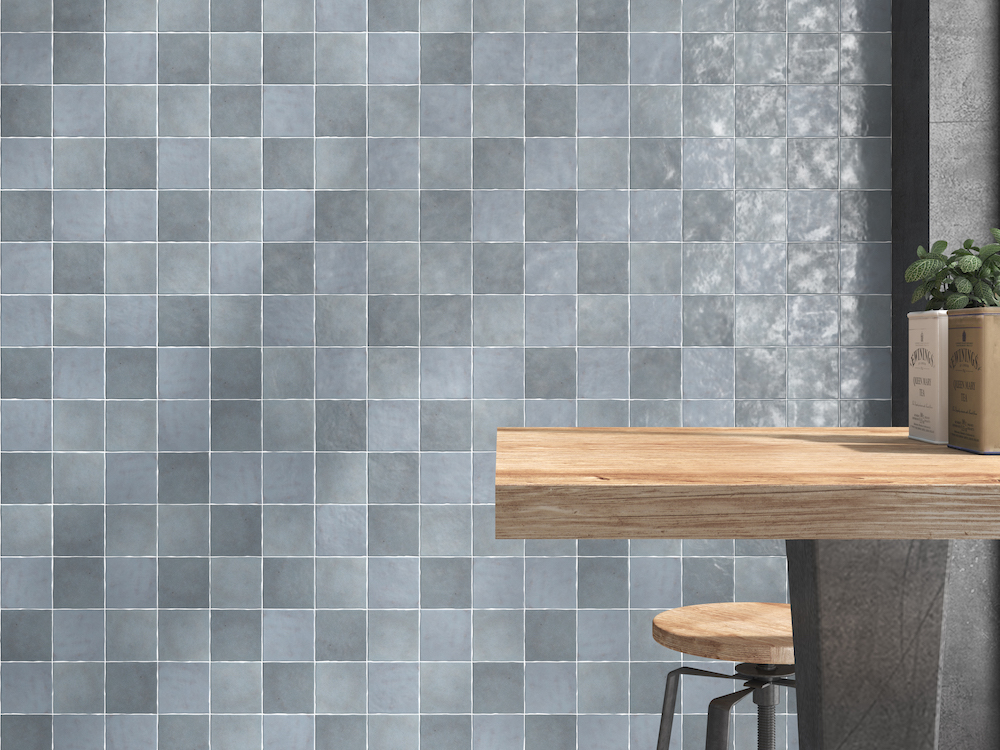
Image caption: Zelig from CTD Architectural Tiles
Another development has been the fusions of traditional ceramic techniques and new industrial design concepts. This is best captured in a range like Diesel Glass Blocks, where a 1950s style glass brick has been captured in ceramic tile using decade-old glazing techniques updated for the 2020s.
HK: What would you say is the biggest pitfall among designers when specifying wallcovering?
AS: With tiles, the biggest pitfall among designers is probably understanding that the tile is just one element of a system. Consideration needs to be given to the substrate the tile is being fixed to and how the area is tanked to mitigate water ingress and potential failure. CTDA work with both Schluter Systems and Jackon to offer the specifier peace of mind through provision of a wide range of wetroom and substrate solutions. From a design perspective, trying to replicate the popular brick bond or herringbone/parquet style of floor tile used on walls can cause a challenge when the room is fitted with spotlights. All of a sudden the lipping on the tiles, unevidenced on the floor becomes all too apparent.
HK: Why are surfaces within public areas more important now than ever before?
AS: The public areas are the key selling areas of the space – the face of the project – so an aspirational appeal is crucial. This appeal needs to married however with a floor surface that is safe to use to protect the client from slips and trips and the hotel from litigation or reputational damage. We have seen the adoption over recent years in the UK of the Pendulum Test as the acceptable measure of a tile’s slip resistance. The implication of this is that we are seeing public spaces being fitted with tiles that have a higher slip resistance than was previously the norm. Whilst this is great from a safety perspective, it does cause challenges with cleaning these spaces as the more textured surfaces are more attractive to dirt. We see therefore a move away from lighter tones (whites, creams and ivories) towards darker tones (grey and anthracites) where the floor does not reveal its secrets so easily.
HK: How sustainable are CTD Architectural Tiles’ products?
AS: There are many advantages to ceramic tiles against alternative materials. Made from water, clay and fire – these elements give rise to a natural and quality material which is free of toxic substances, making it a strong alternative to materials such as plastic laminates or vinyl. Ceramic also has a very long life cycle and is therefore sustainable from a longevity point of view. There also isn’t the need for excessive maintenance, which makes it more advantageous than wood or parquet flooring for example.
HK: How was nature used as inspiration in your latest collections?
AS: Launched earlier this year, our Amazonia collection is the epitome of how botanical influences are finding their way into the commercial and hospitality sector. A celebration and seamless marriage between rustic handmade influences and the trend for biophilic design, the Amazonia collection is versatile and unique. Combining botanical patterns with a pared-back, nature-inspired palette to enliven spaces of all sizes, the collection offers endless opportunities to combine and mix distinctive tiles.
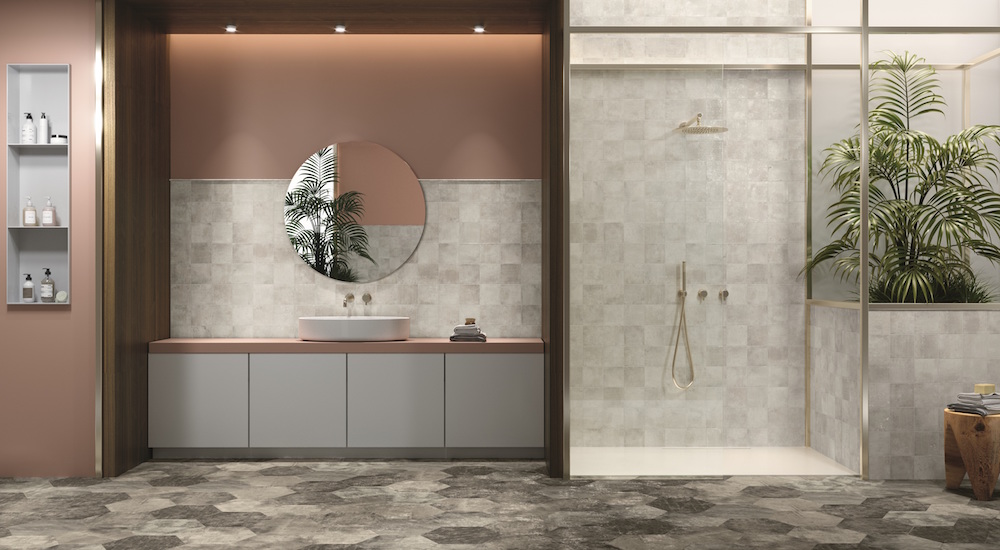
Image caption: Amazonia Grey Hexagon from CTD Architectural Tiles
For a more floral take on the botanical trend, ranges such as Maiora’s Custom Décor’s offer the possibility to create true feature walls with over-sized tiles – see p36 in this catalogue.
HK: How is technology allowing you to create more immersive products?
AS: One of our key launches this year was our 20mm-thick Porcelain Pavers collection, which is a testament to the advances in technology having a direct impact on the options that are available. The Porcelain Pavers collection is made up of 22 different tile ranges and each and every product meets all the technical and design requirements for exterior applications as well as indoor applications. The 20mm thickness means that it is extremely durable and resistant to breaks and scratches as well as being fade and frost resistant. Boasting a +36PTV (wet) slip-resistant structured surface, the tiles are also extremely low maintenance thanks to their exceptionally low porosity.
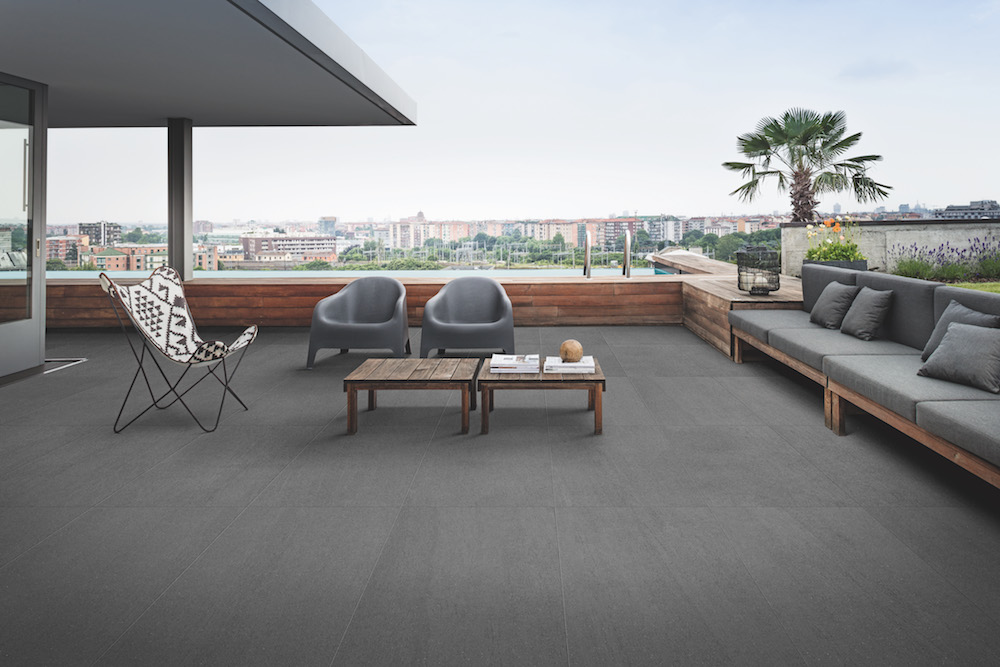
Image caption: Porcelain Pavers from CTD Architectural Tiles
Offering the added benefit of easy installation, the 20mm ranges can be installed in a number of different formats depending on the environment and project requirements. Providing the ultimate flexibility, the products can even be loose laid onto gravel, sand or pedestals, making them both accessible and re-usable.
Advances in technology and production have also led to the introduction of a more diverse product portfolio in terms of styles, colours, patterns and designs. One of our most recent collections, Venice Villa, delivers the beauty of terrazzo captured in porcelain. The terrazzo look originates from using left over marble chippings into cement as a way to use excess product. A reinterpretation of this famous look, the Venice Villa collection is an exquisite contemporary twist on the traditional terrazzo trend, combining the appearance of crushed marble fragments with the excellent properties of fully body porcelain stoneware. Available in eight colourways in a polished, natural or structured finish, from monochrome Silver, Grey, Zinc and White to the more colourful options of Earth, Beige, Graphite and Ivory, the Venice Villa tiles offer an intriguing combination of colours that capture and reflect light, enhancing commercial spaces of all types. Expressing the beauty of the material that inspired the collection, the porcelain surfaces of the tiles combine the traditional look with modern materials making a surface that is easy to maintain and clean.
To find out more about CTD Architectural Tiles, please click here.
Main image credit: CTD Architectural Tiles