To launch the next few weeks putting Technology under the spotlight, Mark Tucknutt, the owner of specialist security consultancy Toren Consulting Ltd, breaks down some of the cyber security issues the design, architecture and hospitality sector will face in the Roaring 20s…
It’s pretty hard to resist a technology forecast at the turn of the decade, and when you misspent your teenage years playing ‘Cyberpunk 2020’ its nigh on impossible.
I run a boutique security design consultancy, supporting developers and architects in designing hotels that meet the security requirements of planning authorities, hotel brands and hotel guests. While we’re not living in the dystopian tech-obsessed 2020 that 13 year old me was promised in the early 1990s, we are living in interesting times for the hotel sector, for technology and for security risks.
Most commentators agree that one of the key technology trends for the 2020s is going to be the continued rolloout of 5G networks. Here are a few ways that I believe that may impact on hotel security and allow ‘security’ devices to better support hotel business operations.
Distributed Video Analytics
We all know from the mainstream media that 5G is coming, and that it will bring huge increases in bandwidth and speed over mobile networks. The impact of 5G on hotels, with their transient users and geographically dispersed properties, is going to be significant. Of course, I’m not talking about the ability of guests to download a movie more quickly, as exciting as that might be. 5G is going to enable hotel chains to make use of a wide range of intelligent devices, and I predict that some of the most valuable will be video surveillance cameras.
5G networks will increase the ability of business systems to make decisions based on information from edge devices. For traditional security cameras monitored by a human operator, the reduced latency isn’t really a factor; fibre optic latency is already a tiny factor compared to human decision-making speeds. But when we’re talking about automated business systems, that faster response is going to enable lots of interesting processes. 5G will allow hotel brands and operators to reliably use video analytics to monitor and react in real-time to AI-based alerts from a global hotel portfolio, for example about queue lengths, unusual patterns of behaviour in the lobby or recognition of a VIP guest.
More devices, fewer wires and more integration
Security systems have been, somewhat belatedly, moving to a cloud-based architecture during the last few years. 5G is going to accelerate that development so that access control panels and servers and video surveillance recorders located on the premises will be consigned to history.
Video surveillance cameras will finally become truly wireless for data transmission. The increased reliability of 5G will give hotels the confidence to deploy wireless cameras throughout hotels, rather than only in hard to reach locations. Instead of ‘wireless’ guestroom locking connecting to wired hubs (often several in each guest corridor), guestroom locks will make use of 5G’s reduced latency to become truly wireless, also improving the guest experience by reducing the time taken to unlock the door.
5G will therefore lead to reduced security installation costs for new hotels by removing network cabling, switches, wireless access control hubs, network video recorders etc from construction. New locks and cameras will become quicker, easier and cheaper to deploy.
Mobile app guestroom locking comes of age
The capabilities of 5G phones are going to make mobile phones even more ubiquitous, and hotel guests even more comfortable with expecting to use phones for secure tasks.
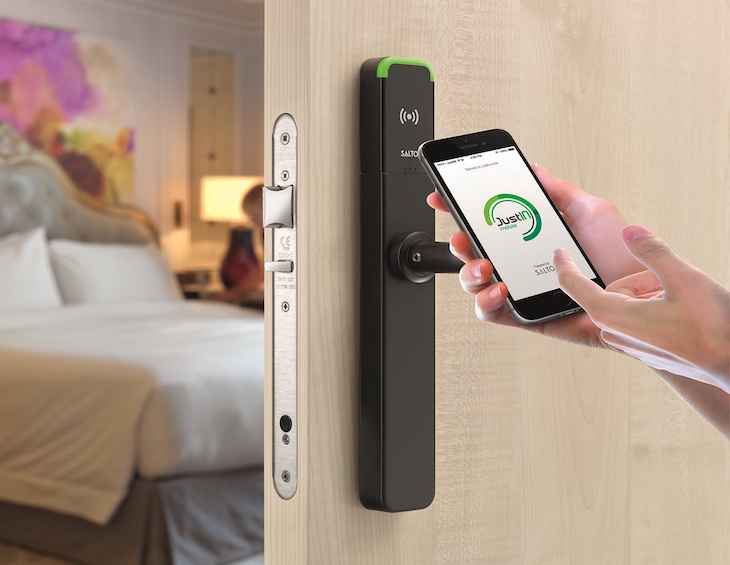
The use of mobile phones for guestroom locking ‘keys’ has existed for a while now, but adoption hasn’t been as strong as it might have been. I’m predicting that as the technology matures, and integrations between locking systems, guest apps and booking systems become more open, that 2020 is the year that we finally see mobile phones take over from plastic RFID cards as the de facto guest room access control device.
While there is still a concern that guests will be reluctant to download a new app for each hotel stay, the major guestroom locking providers are at least now offering integration to not just a hotel’s own app development but to the main third-party hospitality app providers. This means that just as smaller hotel chains can now ‘white-label’ a guest app solution from a third-party (such as HotelBird or AeroGuest), those apps are now likely to be integrated with a guestroom locking product (such as Salto XS4 or Vingcard Essence).
Main image credit: Salto