Designer Peter Mance, who the director of MAAPS Design and Architecture, takes a thorough look at why design in hospitality will change post-pandemic…
Me: “Alexa, define ‘hospitality’.”
Alexa: “The definition of hospitality is the friendly and generous reception and entertainment of guests, visitors, or strangers.”
A new viral guest is in our midst, and I’m wondering how we address this invisible and disruptive reality. COVID–19, and the attendant fear it has spawned, will not disappear easily. A whole new level of trust and confidence will be necessary for hotel owners, operators, developers and their guests. What will we need to do to remove hostility from hospitality?
For the design community, some of these issues raised will be the very antithesis of the methods we have used to design in the past. Those carefully nurtured public spaces of “blurred permeability”, the vibrant blending of social and co-working use will need to be “de-tuned” for a while.
In the absence of government directives and guidance, what should we be considering as our new rules? Below, I’m going to venture some thoughts and questions of my own in order to understand how we may behave when we are sanctioned to open our doors and welcome guests again.
The arrival experience
- Will our default still be a warm greeting and our guests simply assume “business as usual” or will new modes of caution and protocol be required?
- Will travel and booking documents be sent ahead to demonstrate “cleared to travel” status?
- Will some type of Orwellian biological implant, electronic tag or a Smartphone App be adopted as the standard to signal a guest’s viral status on arrival?
- Does the near-future hotel have to provide an air-locked refuge with Hazmat suits discarded at the door; or perhaps a quick sanitising spritz at the entrance and handwashing while masked attendants carrying out temperature scans while verifying travel papers?
- What happens and what protocols are required if the arriving guest presents with a temperature?
- Do we need to establish a quarantine zone within the hotel or have an agreement in place with Hotel “Nightingale” for any self-isolating travellers?
- Should we provide our guests with new gloves, new masks, wipes and protective clothing each time they enter the hotel?
- How does any “health-check” equipment integrate with an elegant lobby, and do we invest this with the hospitality message we wish to convey?
- How do we reassure our guests, and will the previous tropes/conventions of a welcome cocktail, chocolates in the room, or warm cookies be deemed enough?
- And perhaps finally, we will have the opportunity to design sexy and attractive hand sanitiser dispenser we’ve wanted to see.
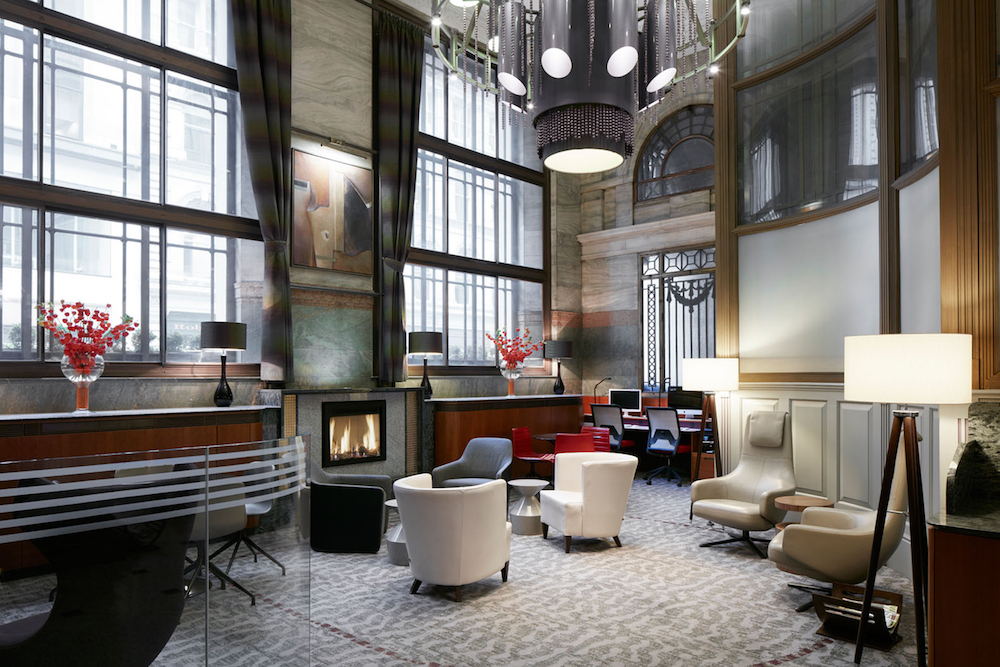
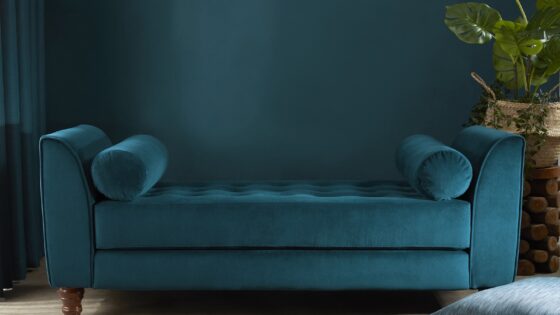
Image caption: Living Room inside Club Quarters Hotel, San Francisco
In the same way that past acts of terrorism brought hastily improvised metal detectors and bag checks to the front door, the reality of the post-pandemic world will necessitate some type of intervention to ensure that staff, guests and reputations can be protected.
Hopefully, these will not be the ugly, ad-hoc installations, which were imposed for sound security reasons, that outwardly signal exclusion and fear.
Hotels have prided themselves on being sanctuaries for travellers. With great and inspired design they, have carefully curated the ambience, experience and style of hospitality they offer. The industry has made huge strides to dissolve boundaries and transform hotels into locally connected, bustling hubs of social engagement.
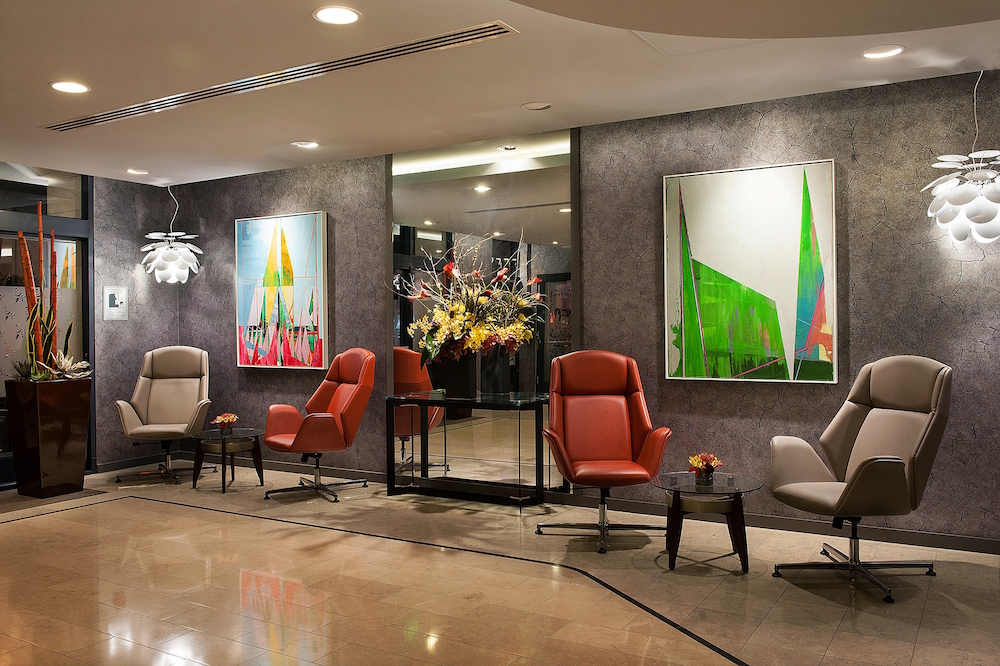
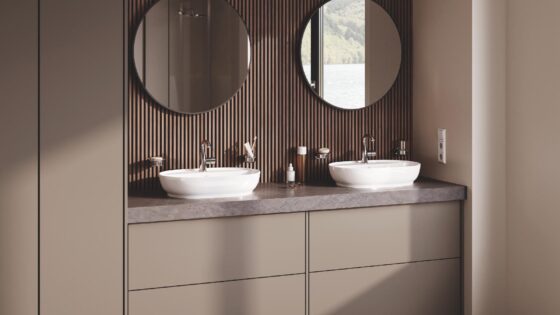
Image caption: The lobby, inside Club Quarters Hotel, San Francisco
Guest check-in and the lobby
For the road-weary business traveller, the previous advances of self-check-in and the keyless mobile app independence will be shunned. The traveller will not be allowed to pass unobtrusively to their guestrooms. My suspicion is that not only the hotel operator, but also our various government agencies, will wish to know all guest movements and interactions. It will be in the interest of everyone to be much more inquisitive and intrusive. So, what will be necessary for the new digital/human interface during check-in?
Within hotel lobbies, I can envisage that solo seats will enjoy a welcome return. And with greater social distance perhaps, there is an up-side in that we will have the mental space and aural stillness, to again reconnect with our inner landscapes. It will be a chance to appreciate our surrounding, their design and to reflect more on the purpose for travel – whether for business or pleasure.
Corridor and guestrooms
- Will the superficial re-selection of fabrics for inherent biological resistance, non-porous surfaces, and disinfectant fogging be all that is required to purge and protect guests?
- Do we now have to designate a set of rooms converted into daily isolation suites?
- What are our new questions to the MEP consultants?
- What level of air filtration and recirculation will be acceptable in our viral future? Particularly pertinent considering the lessons learned from recent Cruise ship experience.
- What hygiene improvements must we demonstrate in our already high standard of room cleaning?
- Will we come value and prioritise the efficient and simplicity of layout as a virtue in guest rooms design?
- Will a curfew be imposed with guests confirmed to rooms to ensure social distancing?
- How will room service adapt, and will we now demand active in-room monitoring of our guests?
- Will the nightly turn-down service include taking our guests temperature and fulfil other health-check procedures?
- Will we designating long-stay quarantine rooms and what provision for beside equipment, room evacuation, or health care staff may be required>
- How will two-metre distancing be implemented within our typical corridors? Perhaps as simple as adding a passing space, as we seen in narrow country lanes.
- What will be our new lift/elevator etiquette?
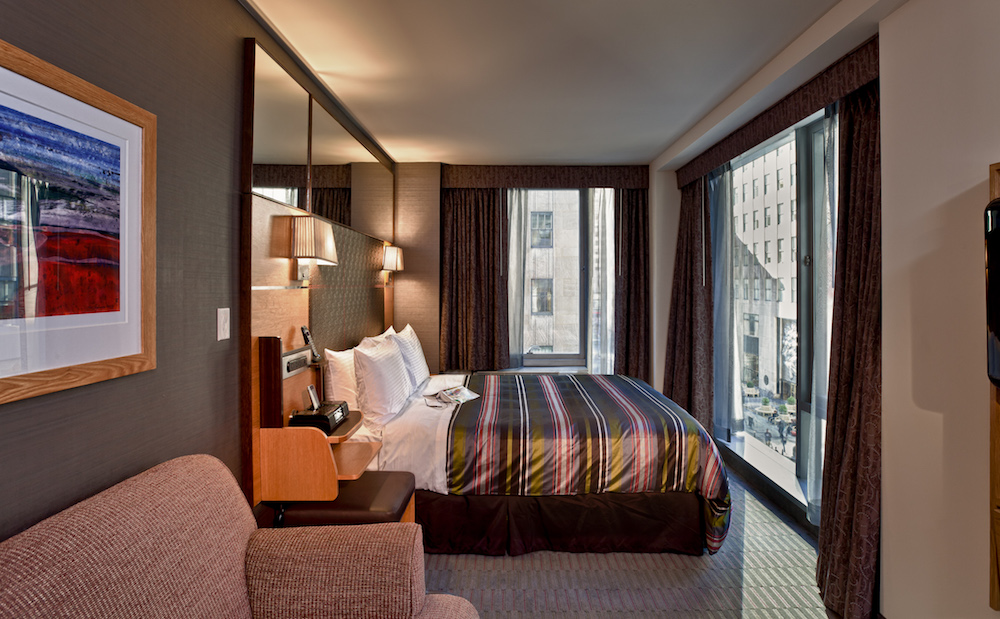
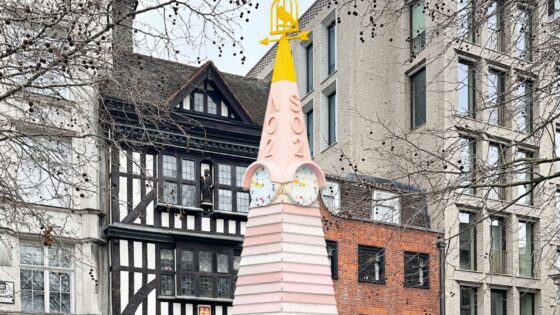
Image caption: Guestroom inside The Jewel Hotel New York
In the short term I suspect we will all be looking to learn a lot from our colleagues in Health Care. Adopting many of their routine approaches to hygiene as our new standard. We will be looking at the selection of fabrics and surfaces, the use of inherent micro-bacterial defences, improved air filtration and a great deal more observation of guest’s welfare.
“I strongly believe that good design can help in re-establishing the inherent trust and meaning expressed by the word “hospitality”.” – Peter Mance, Director, MAAPS Design and Architecture.
My sense is that the returning traveller will be acutely sensitive to their environment and will appreciate the safe refuge and assurance which hotels can provide. We can all readily recognise that our reasons for travel, for whatever purpose, has the potential to be disproportionately risky, both for us as individuals and the hotels. While we can be certain that our inveterate desire to travel will return, our guests will be highly concerned for their own wellbeing, as well as conscientious on behalf of their colleagues, family, friends and wider communities.
Guests will want to be assured that the behaviours and operations of hotels are confident, safe, detailed and robust. Trust will be paramount for all brands. I strongly believe that good design can help in re-establishing the inherent trust and meaning expressed by the word “hospitality”. Gently at first, cautiously breaking down barriers and carefully communicating to our guests that we have their welfare at our heart and the right precautions and procedures in place.
We can reasonably anticipate as a business and community that we’ll successfully adapt. The ingenuity of humankind a huge advantage, and it responds so well to adversity. We’ll discover the blessings and opportunities that this global reset will offer – perhaps an even more resonate connection with our local communities.
We will continue to appreciate the attentive care and hospitality offered by hotels, and we will continue to travel to experience the wonders of our planet. Business will be done, and the value of face-to-face encounters will remain important. We instinctively thrive on curiosity and trust and will acutely appreciate the value of such interactions.
Design will continue to act as an intrinsic intermediary link between the traveller and host, helping set the scene to convey the values and brand essence of our hotels.
Our work as designers remains primarily concerned with guest interaction and experience. Underscored, as always, with a thorough understanding of the hotels operational, functional and experiential ethos. Added to this will be the new concerns of hygiene, security and protection.
For newly commissioned and refurbished hotels, we can expect that thoughtful and embedded demonstrations of sustainability along with a deep, genuine connection to the local community will be implicit.
For all the gloom and fear this pandemic has instilled, our present physical reality remains remarkably familiar. Ironically, our natural environment appears to be thriving and enjoying this imposed worldwide pause. Once again skies are clear, stars sparkle, and nature gently and effortlessly reasserts itself.
Within this present hostile environment, our hospitality instincts remain generous and hospitable. We are an ingenious and resourceful community. We will adapt and we will prevail.
MAAPS Design and Archtiecture is one of the brands that has taken advantage of our Industry Support Package. To keep up to date with supplier news, click here. And, if you are interested in also benefitting from this three-month editorial package, please email Katy Phillips by clicking here.
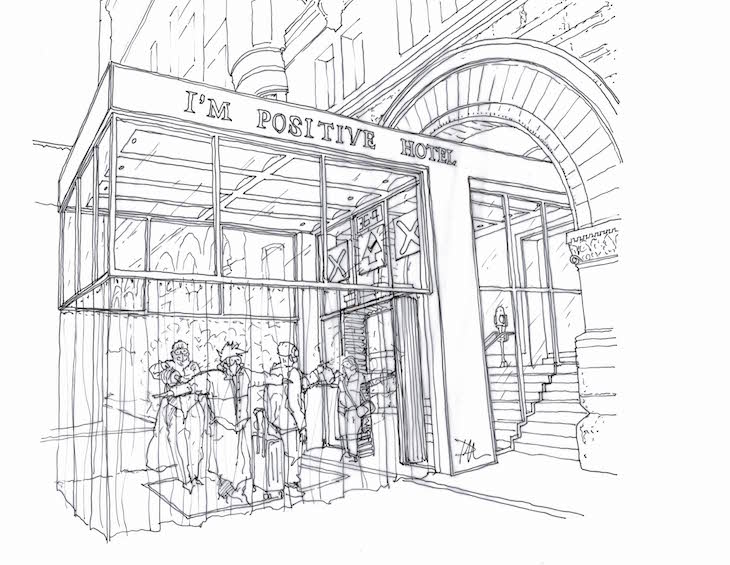
Main image caption: Sketch by Peter Mance derived from the courtyard entrance canopy of Trump’s Washington DC hotel, which remains open as it is “designated as an essential business” |
Main image credit: MAAPS Design and Architecture