










As designers move beyond fixed forms, Northern Lights explores how negative space, materiality and suspension are redefining lighting across hospitality, residential and workplace interiors…
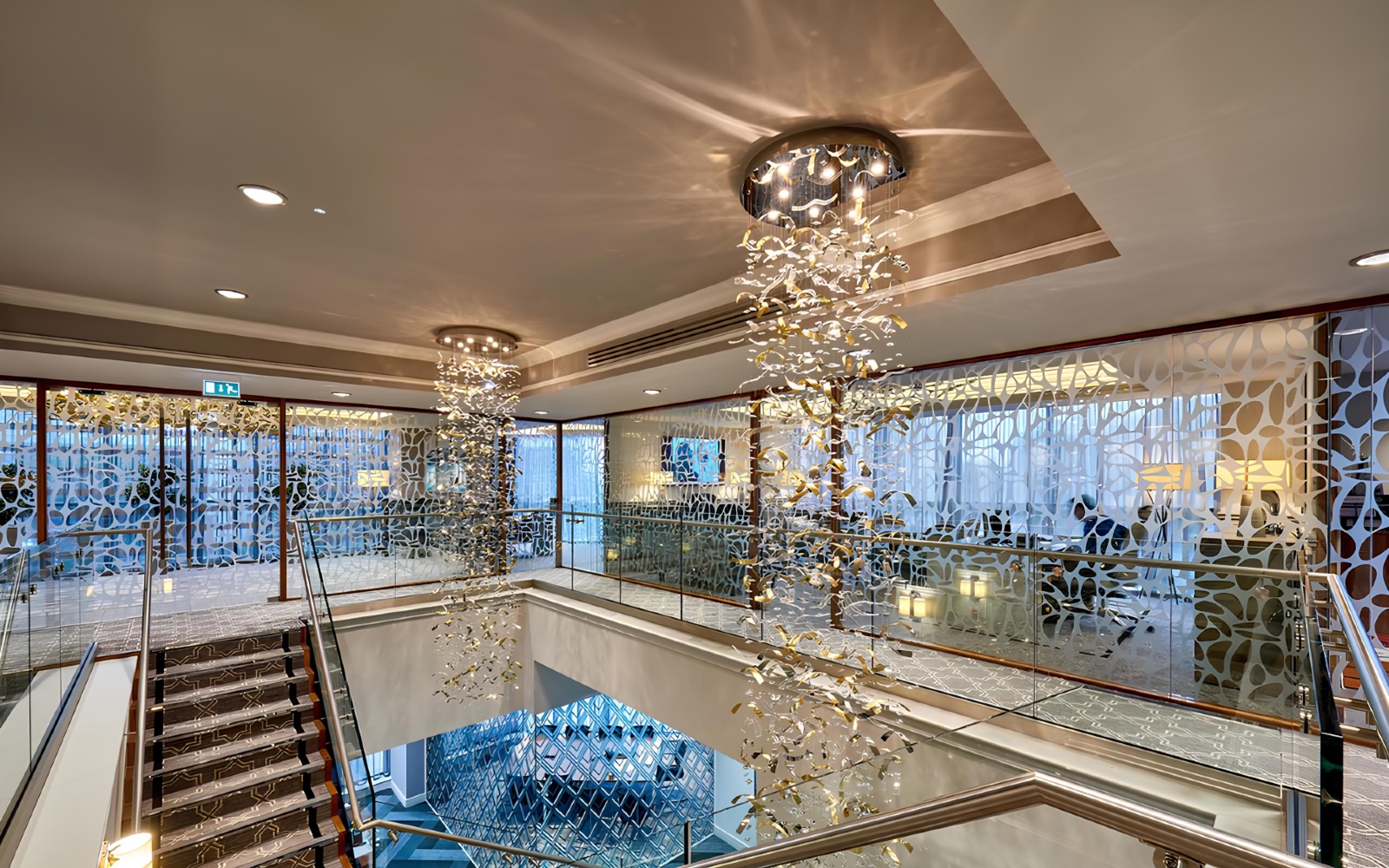
Sculptural lighting behaves differently when it is constructed through spacing, suspension and material weight rather than defined as a fixed form. Across hospitality, residential and workplace environments, designers are increasingly specifying fluid chandelier forms that respond directly to architecture, circulation and vertical volume – particularly within double-height spaces, atriums and transitional thresholds.
Speaking to lighting specialists Northern Lights, a consistent shift is evident in how these installations are being approached. Rather than selecting predefined objects, lighting is conceptualised as part of the broader spatial composition – where form, spacing and material behaviour are resolved in parallel with architectural intent.
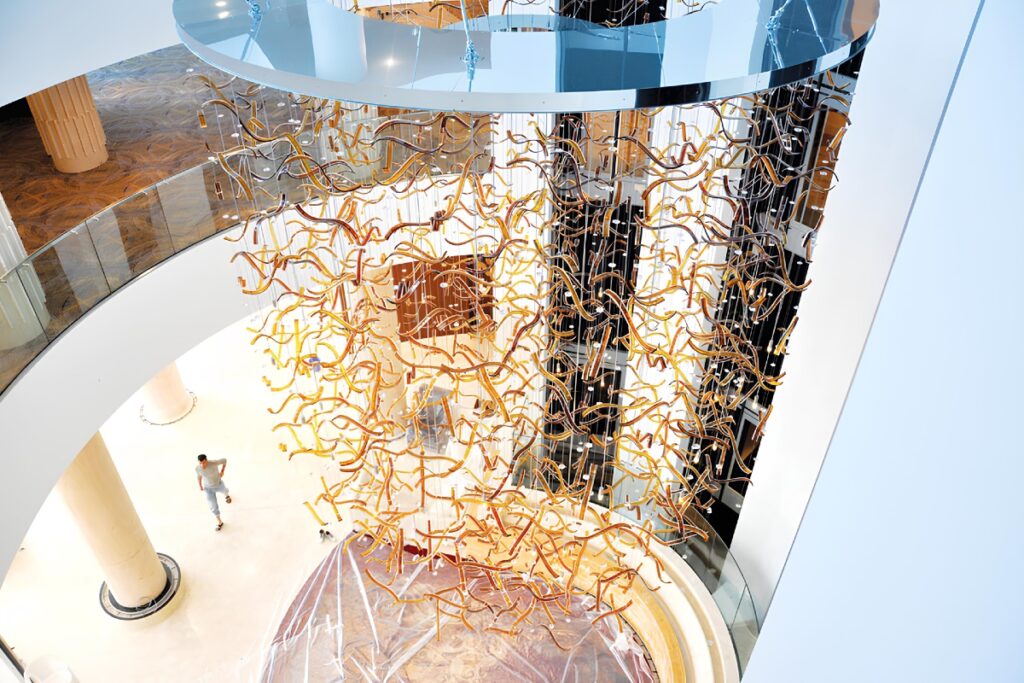
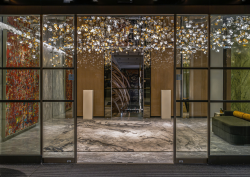
Custom installation for Hilton Baku by Northern Lights | Image credit: Northern Lights
“Impact is no longer determined by formal scale, colour temperature or ornamentation alone, but by the distribution of elements within a volume,” explained Michael Jackson, Head of Design at Northern Lights. “Density, suspension strategy and negative space define how a piece is experienced. Sculptural chandeliers are designed to connect vertical space rather than occupy it – introducing rhythm and fluid continuity.”
What distinguishes this approach is the increasing importance of fabrication logic within the design process. Small adjustments in construction – the spacing between suspended components, the weight of individual elements, or how materials are cut, formed and layered – have a direct impact on how light behaves within space. These decisions are no longer secondary technical considerations, but fundamental to the design outcome.
Northern Lights’ work highlights how material exploration underpins this shift. Glass remains a key area of expertise, informed by heritage techniques such as kiln slumping, fusing and controlled colouring. These processes allow glass to be formed into precise yet organic geometries, altering curvature, opacity and light diffusion at a micro level. The result is not simply decorative variation, but a change in how light is distributed through space.
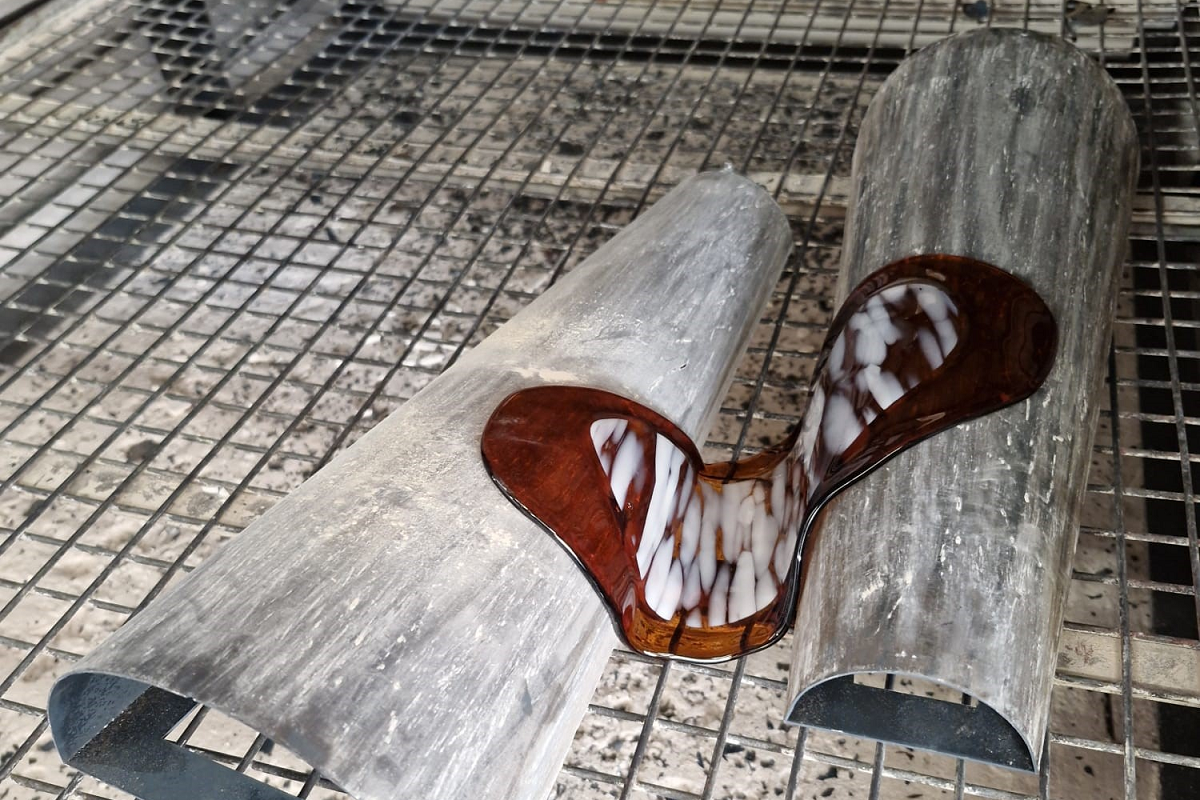
shaping glass over ‘formers’ | Image credit: Northern Lights
Alongside glass, precision laser-cut metals introduce structure, repetition and controlled shadow play. Depending on configuration, these can produce either dense, sculptural clusters or lighter, delicate formations. Mesh can be tensioned and finished to create cloud-like volumes that retain structure while appearing visually light. Additional materials like alabaster, ceramics, and coloured acrylics extend this vocabulary further. Increasingly, these materials are combined within a single installation, using contrast between opacity, reflection and translucency as an active design tool.
The recently launched Veil chandelier from Northern Lights demonstrates this approach with hand-cut glass leaves, each kiln-slumped for subtle curvature before being suspended in layered formations. The fine suspension wires and spacing between components is deliberately varied, allowing the installation to shift in perception depending on viewing angle, density and scale. In tighter compositions it reads as a continuous veil of light; in looser configurations it dissolves into fragments of reflection and movement. Rather than a fixed product, Veil operates as a configurable framework, adaptable to different spatial requirements, materials and forms.
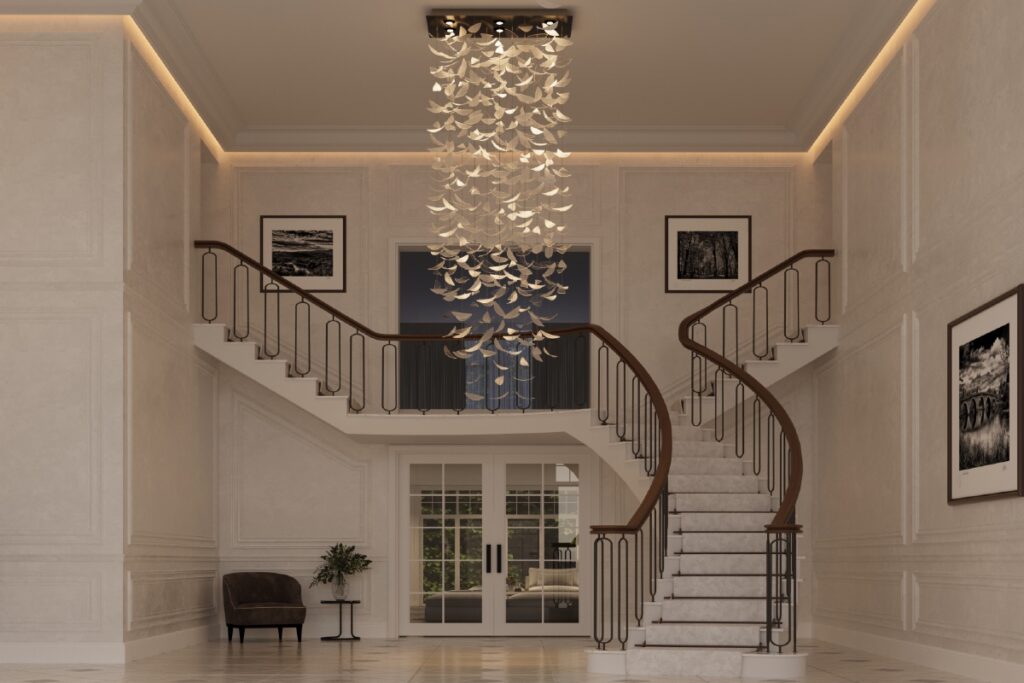
Veil chandelier | Image credit: Northern Lights
Designers are working more closely with fabrication specialists to resolve arrangement, material and structure simultaneously, enabling greater control over proportion, transparency and spatial interaction.
While this approach is not new, it has been progressively embedded through bespoke commissions across sectors. These compositions introduce translucency, movement and depth – animating spaces through shifting light and shadow. In hospitality environments, this takes the form of multi-storey glass installations using suspended, handcrafted elements within atriums, and laser-cut metal structures that use pattern and void to create changing reflections and spatial rhythm.
In workplace and retail settings, mixed-material installations combining metal, crystal and acrylic have been used to connect multiple floors, creating visual continuity while maintaining openness. In residential projects, similar principles are applied at a more intimate scale, where layered forms introduce softness and movement without overwhelming the architecture.
Across these applications, a consistent principle emerges: lighting is not applied to space, but resolved within it. The final outcome is determined as much by fabrication decisions as by initial design intent.
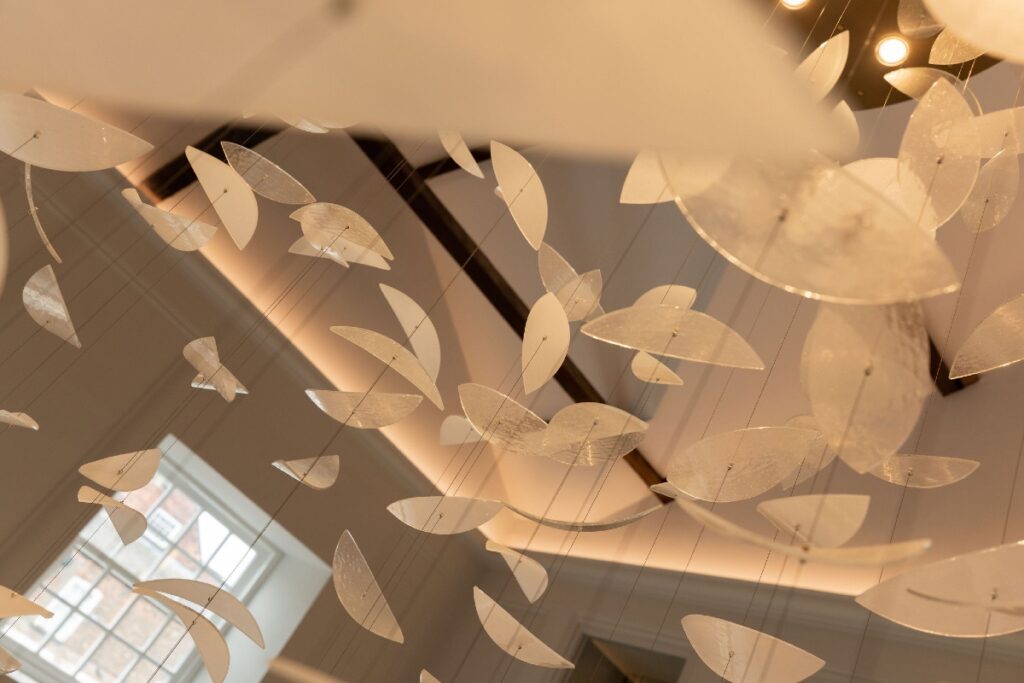
Glass Leaves chandelier close up | Image credit: Northern Lights
For designers, this shift opens up a greater degree of creative control over how lighting behaves within a scheme. Access to a broad material palette, combined with the ability to manipulate form, scale and suspension strategy, allows concepts to be developed with precision from early stages. Visits to Northern Lights’ Derbyshire facility offer further insight into this process, providing an opportunity to explore how material experimentation and fabrication techniques translate directly into built outcomes.
Northern Lights is one of our Recommended Suppliers and regularly features in our Supplier News section of the website. If you are interested in becoming one of our Recommended Suppliers, please email Katy Phillips.
Main image credit: Northern Lights