
Health expert Ali Howe awakens how thoughtful hotel design can lead to a better night sleep for both your business as well as your guests…
Around 60 million Americans are affected by sleeping disorders every year, a fact which affects physical and mental wellbeing to varying degrees. Sleep deprivation is linked to daytime drowsiness and fatigue, but also to serious long-term illnesses such as heart disease, obesity, and Type 2 diabetes.
At the same time, the travel industry is continuing to grow exponentially. The Global Business Travel Association pegs the number of business trips taken annually in the US at 488 million, and that means that many people on the move are sleeping away from home. New environments are known to be added stressors when it comes to sleep. So, how can good design help clients enjoy a great night’s sleep, even when they are sleeping in a hotel for the first time?
Quality sleep is key
We know that the majority of people aren’t getting the recommended seven hours of sleep a night, yet research shows that we shouldn’t just be worrying about quantity, but also about quality. In order to feel truly refreshed when they wake up, people need to enjoy between 1.5 and 1.8 hours of deep sleep (or delta sleep) per night. Achieving good quality deep sleep depends on a number of factors, which the National Sleep Foundation lists as follows: sleeping at least 85 per cent of the time in a bed, falling asleep in half an hour or less, waking up no more than once a night, and spending no more than 20 minutes in wakefulness after initially falling asleep.
In contemporary hotels, gradient panel systems can work well to create total darkness
Let in the darkness
To improve delta sleep, complete darkness and quiet are key for most people. Hotel interior designers should therefore design rooms in such a way that natural light is allowed during the day but blocked out at night. In traditional or classical rooms, this can be achieved through blackout curtains. In contemporary hotels, gradient panel systems can work well to create total darkness. Gradient panel systems are motorised, with individual panels moving independently of each other thanks to a central axis pivot. They can be fully closed (to completely block light out) during the night, but they can rotate during the day to either let in direct sun or to provide interiors with indirect light. This savvy system works well in high-end hotels, since discerning clients can program the system themselves to adjust the amount of light entering to their desired preference.
Soundproofing guestrooms
One only needs to consult popular travellers’ forums to see one of the most frequent guest complaints is noise. When designing rooms, allow for the space reduction necessitated by soundproofing. The use of soundproofing boards (or laminated glass to dampen sound vibration of windows) can reduce external noise by around 95 per cent, which is great news for early sleepers – and those who are jet lagged – who are easily bothered by the sound of people talking in halls and in adjacent rooms.
When deciding on color schemes, avoid loud contrasts between walls, furniture and flooring
Calming hues
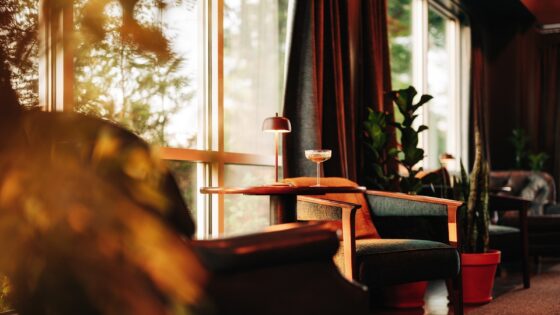
Shades of grey, blue, or green are known to create a calming effect. Studies have shown that these colors can reduce stress and anxiety, as well as make a room seem more expansive. When deciding on color schemes, avoid loud contrasts between walls, furniture and flooring, opting for complementary rather than contrasting color schemes. You don’t need to forego artistry. Hand-painted wallpapers or paint effects can still be used to add touches of creativity; just opt for muted rather than primary shades and consider the use of natural elements such as wood, which help instill a sense of tranquility.
For many people who already struggle to get a good night’s sleep, spending one or more nights at a hotel can be challenging, especially if light and noise are an issue. To balance the room’s interiors with human circadian rhythms, create spaces that are completely dark at night and ensure guests enjoy complete silence. Finally, create soothing ambiences and consider installation of sound systems that play ambient music, white noise, or sounds of nature, which many people find to be effective at reducing stress and anxiety.
Main image credit: Bruno van der Kraan | Unsplash