











A GUIDE TO HOTEL DESIGN PT 95:
Diana Goderich, Brand Strategist at WeWantMore talks us through the reality of retreats and rejuvenation, while exploring the opportunities this wellness boom is presenting to the hospitality industry.

Open a magazine, scroll through Instagram, and chances are your feed will tempt you with a new wellness escape: sleep retreats promising to reset your body clock, digital detox camps offering freedom from screens, night-time-only programs designed to harness circadian rhythms. Wellness travel is booming, and wellness trips are predicted to grow by 14.7% by 2027 (Global Wellness Institute 2024). It’s hard not to be seduced by its promise because there seems to be something perfectly designed just for you – no matter whether you identify as a gym rat or a skincare devotee.

Image caption: Diana Goderich, Brand Strategist, WeWantMore | Image credit: WeWantMore
The appeal is undeniable. At its best, wellness travel offers rejuvenation, an escape from everyday stressors, the churn of daily demands, and the looming threat of burnout. But once we’ve acknowledged its potential, we also need to ask the harder question: what does the culture of wellness say about our lifestyles, and what role do brands play in creating and supporting it?
Escaping the Everyday Churn
Today, we are spending thousands and flying to far-flung parts of the world to address our basic human needs: to rest, breathe, and unplug. Yet these things are all freely available at home – at least in theory. The reality is that overwork, stress, and pervasive hustle culture drown them out. According to Mercer, 82% of employees worldwide are at risk of burnout (Global Talent Trends 2024). So we are travelling to repair what daily life has broken.
Siripan Deesilatham, visiting lecturer at Royal Holloway University of London, notes in a 2024 study that the reasons behind wellness travel – stress, overwork, lack of rest – are closely tied to quality of life and lifestyle constraints. It is paradoxical that we buy packages that promise balance, when it is our own lifestyles – hyper-accelerated, over-connected, relentlessly optimised – that push us so far from equilibrium in the first place.
Retreats tackle sleep because our everyday rhythms deny it, and technology exacerbates the effects. In the US, over 75% of people (AASM 2023) report losing sleep because of digital distractions. So we seek solutions, signing up for programs to help us disconnect from devices that have colonised our free time.
But is wellness travel less about access to resources and more about the inability to claim them in everyday life? Are we actually addressing and healing unhelpful habits, or just putting a temporary patch over a systemic issue? While studies show that wellness travel provides relief and a reset, the effects are temporary and there is little evidence of sustained impact (Frontier 2023).

Image credit: Alex Bertha / Unsplash
The Productivity Trap
Ironically, the pursuit of wellness can generate its own anxiety. As wellness culture continues to grow and permeate every aspect of our lives, its shadow side becomes ever more apparent. Instead of offering relief, wellness culture can feel like indulgent navel-gazing, leaving people with a sense of failure rather than improvement. The very act of seeking care becomes another area for stress and comparison—not liberating and empowering, but debilitating. Holidays, once a reprieve from routine, risk becoming yet another productivity exercise. Rest itself is understood through metrics and performative signalling.
A digital detox not only becomes a recovery from anxiety-inducing tech, but also a badge of honour – proof of discipline and moral elevation. The practice of quantifying biological functions is already underway. Sleep specialists have coined the term orthosomnia to describe the stress caused by worrying about your own sleep quality. Yet sleep retreats promise measurable improvements. Biohacking camps package longevity as a competitive advantage. Digital detox camps market themselves as a few days of liberation from technology but can create guilt and inadequacy when participants struggle to disconnect. Even when done properly, many report feelings of anxiety and isolation during such retreats (Salepaki et al. 2025).
In this discourse, wellness travel itself feels like both a part of the solution and a symptom of the underlying societal condition. It promises respite but reinforces the very logic we’re trying to escape: a culture that struggles with one iota of unproductive time.
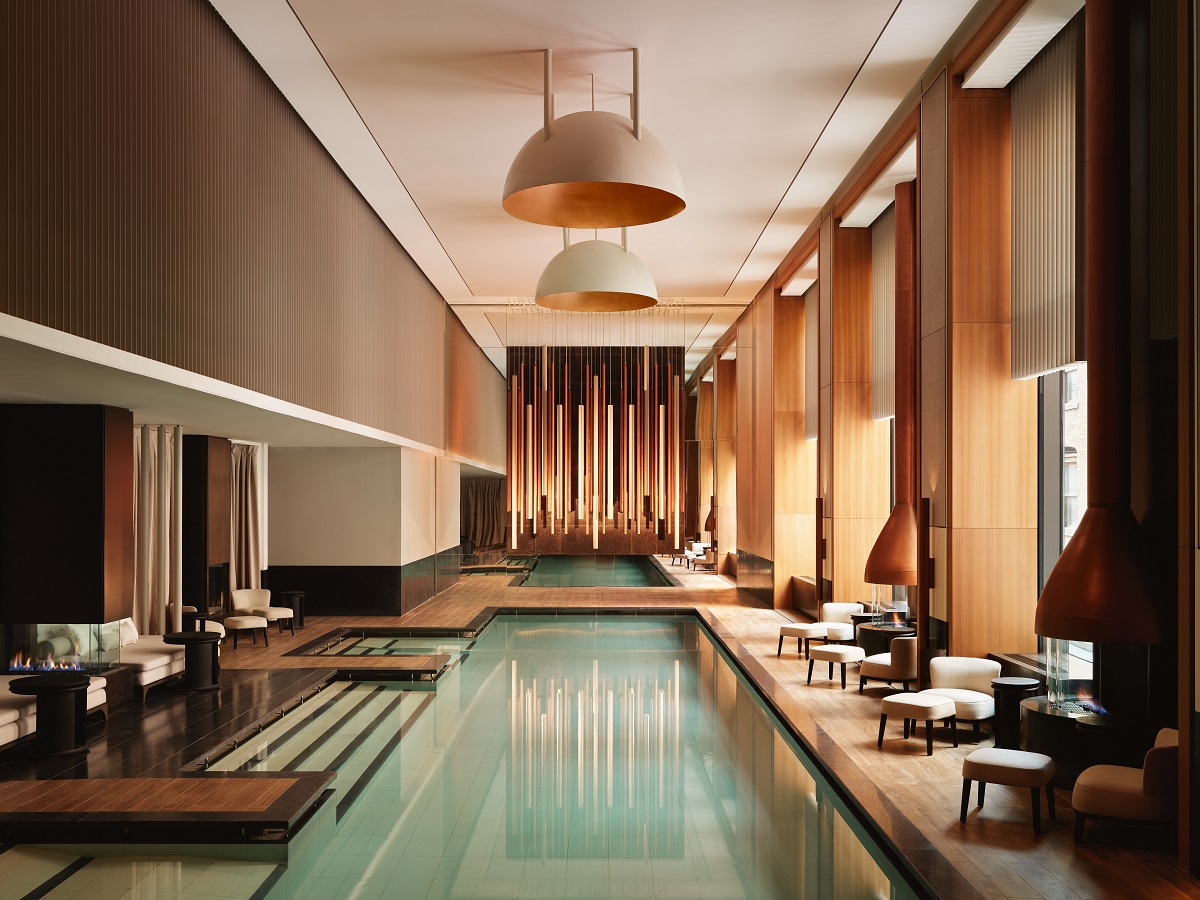
Image credit: Aman New York
Some destinations push back against this trend. Places like Eremito in Italy or wellness programming at Aman position their offering not just around quantifiable optimisation but around treating symptoms more deeply. Their programs follow a mind-body-soul approach, combining multiple modalities with immersion in the physical setting and local culture. By blending traditional practices with the surrounding environment, they create unique ‘pathways to longevity.’ Exceptions like these further highlight how unusual it has become to seek wellness simply for its own sake – and not as part of a productivity checklist.
The Sustainability Paradox
If we think about the sustainability of wellbeing, we discover a clear contradiction between what we are told is best and what is happening. Travelling halfway across the world to “detox” undermines the wider notion of wellbeing we claim to pursue. With tourism overall – especially flights – accounting for roughly 9% of global carbon emissions (Nature Communications 2024), what does it mean to talk about balance, care, and repair while simultaneously fuelling carbon-intensive behaviours that threaten planetary health?
So is wellness travel, as a category, harming the very notion it claims to protect: sustainable living and planetary wellbeing?
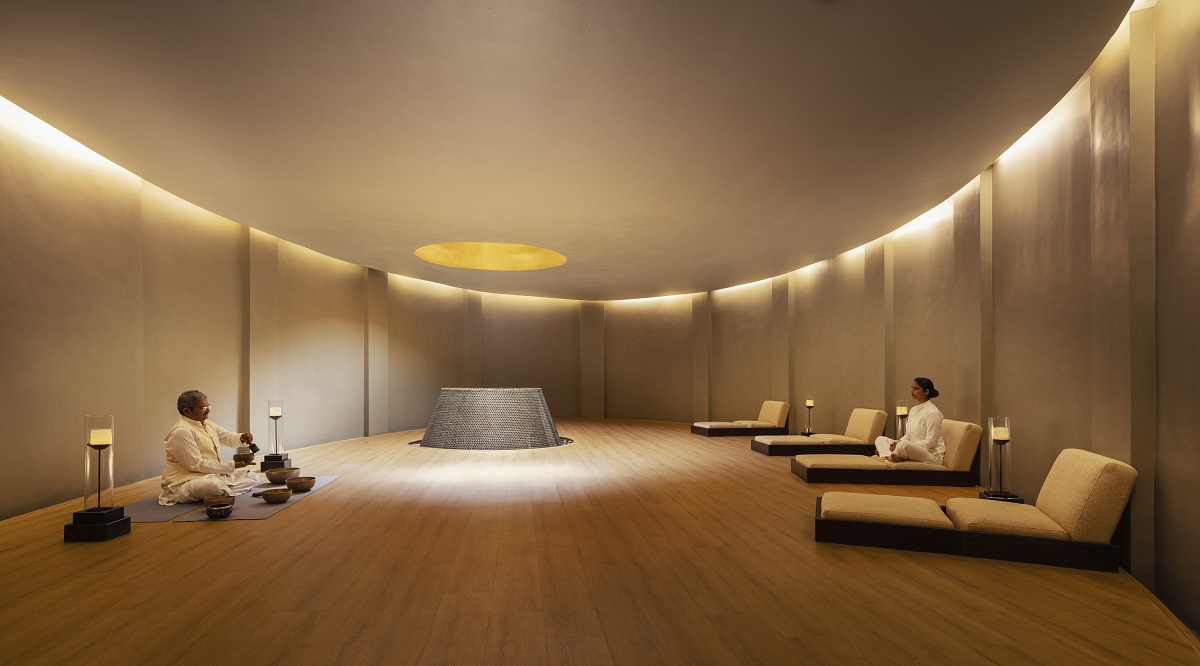
Image credit: Dharana at Shillim
The Opportunity for Hospitality Brands
The category continues to grow exponentially – valued at 651 billion US dollars in 2022 and projected to reach 1.4 trillion by 2027 (Global Wellness Institute 2024) – and the stakes could not be higher. But there is an opportunity to shift the narrative away from quick fixes and checklist-style optimisation toward experiences that genuinely nurture sustainable rhythms of living. It can reimagine wellness not as a one-off fix but as something continuous: an ongoing practice of care that outlives the retreat itself.
For travellers, this means reframing the purpose of wellness escapes—not as luxury commodities to repair the damage of unsustainable routines, but as catalysts for lasting and ongoing change. For brands, it means resisting the lure of gimmicks and leaning into design principles that encourage real restoration—the kind that extends beyond the retreat and builds enduring relationships.
There are already examples showing this is possible. Evolute Institute in the Netherlands offers psychedelic/psilocybin retreats combined with professional coaching. Programs include preparatory sessions to define the focus of the retreat, followed by a two-month integration phase to process and embed learnings into daily life—expanding the impact well beyond the program. Kripalu Center for Yoga & Health in Massachusetts offers time for slowness and reflection, as well as choice in participation, rather than a rigid schedule. One of the available workshops, ‘Integration: Taking Kripalu Home,’ is aimed specifically at planning how to bring insights, practices, and learnings back into daily life.

Image credit: Sparcstudio
Things for brands to consider:
– Design for slowness: Create environments that prioritise unstructured time and quiet, without layering on excessive programming.
– Integration over interruption: Equip travellers with practices they can carry into everyday life, rather than offering one-off detoxes whose effects vanish on return.
– Beyond luxury framing: Position wellness experiences as accessible and ongoing human needs, not elite indulgences.
– Long-term journeys: Encourage repeated connections, whether by returning to the same place or curating linked experiences across locations, to sustain benefits over time.
These opportunities go beyond luxury wellness stays. They create possibilities for hospitality, travel, and booking companies to integrate wellness into their offerings, take proactive steps themselves, and support people’s wellbeing journeys across different places and moments in time.
Reclaiming the Meaning of Travel and Care
In the end, wellness travel reflects both our hunger for restoration and our inability to claim it. Some of us genuinely need the container of travel and structured time away to break the patterns that feel impossible to shift at home. But unless we challenge the deeper dynamics – the commodification of care, the productivity logic disguised as healing—we risk reducing wellness travel to another industry of pressure.
Hospitality brands are uniquely positioned to bridge this gap. They are in a prime position to redefine wellness travel – not as a brief escape for temporary recovery, but as a sustainable way of life that integrates into daily living. For brands bold enough to step away from the checklist, and for travellers willing to reimagine the purpose of their journeys, the opportunity lies in creating rhythms of life that no longer need fixing.
Main image credit: Roberto Nickson / Unsplash