










GTHD
Every guestroom is, in the end, arranged around a bed. From its position in the room to the base, mattress, headboard, bedding and bedside controls, Hotel Designs looks at how to create a bed that works for the guest, the interior and the realities of hotel operation.

Guests experience much of a guestroom while lying down. The bed determines where the eye lands, how guests move through the room, what they can reach without getting up and, most importantly, how well they sleep.
That makes hotel bed design about much more than choosing a mattress. Position, proportion, base, bedding, headboard, lighting and bedside services all need to work as one system, while housekeeping, accessibility and long-term maintenance influence many of those decisions from the outset.
The place to begin is with the room itself – and what the guest should experience from the bed.

Image credit: six Senses Xala
Position the bed around the guest experience
Where the bed sits establishes much of the guestroom plan. Its relationship with the entrance, bathroom, windows and circulation routes determines how naturally the rest of the room falls into place, from bedside tables and wardrobes to seating and luggage storage.
Comfort should shape that decision too. Corridor noise, external sound, daylight, glare and privacy all change depending on where the sleeping zone is positioned. A bathroom or entrance lobby can provide useful separation from a busy corridor, while placing the bed away from the noisiest external wall may help protect the sleeping environment. For a deeper look at those considerations, explore our guide exploring the architecture of sleep.
Then there is the view from the pillow. What does the guest see when they first wake up, or when they are lying in bed at the end of the day? Window position, outlook, artwork, ceiling treatment and even the location of the television all become part of that perspective.
At Morea House in Camps Bay, Cape Town, the guestrooms and suites are designed in relation to their outlook – mountain, ocean or sand – while woven works by artist Julia Pepler add another layer of character to the wall above the bed.
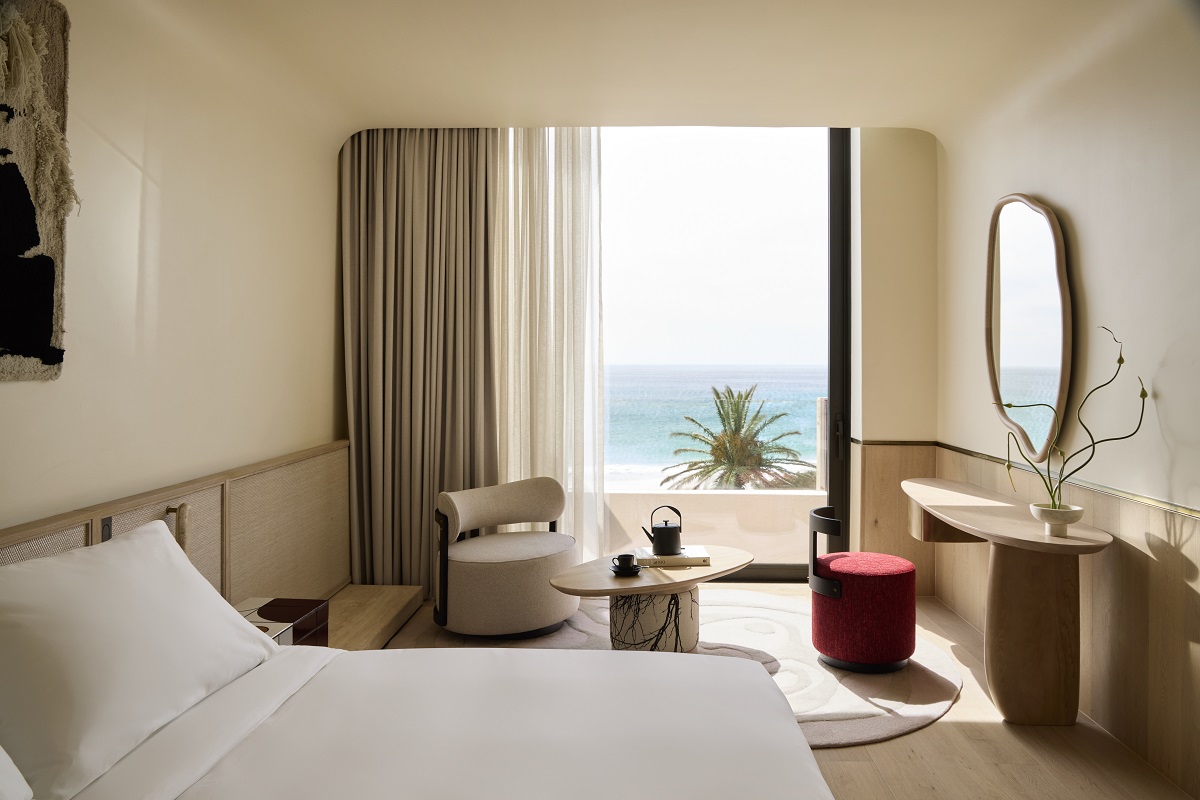
Image credit: Morea House
At Dexamenes Seaside Hotel in Greece, the eight new Seaview Terrace Suites take the idea further. From the bed, the view resolves into little more than sky and the Ionian Sea.
Neither offers a formula. The point is to consider the room from the position in which the guest will spend a significant part of their stay, rather than treating the bed as something fitted into the plan afterwards.
Once that position is established, attention can turn to the bed itself.
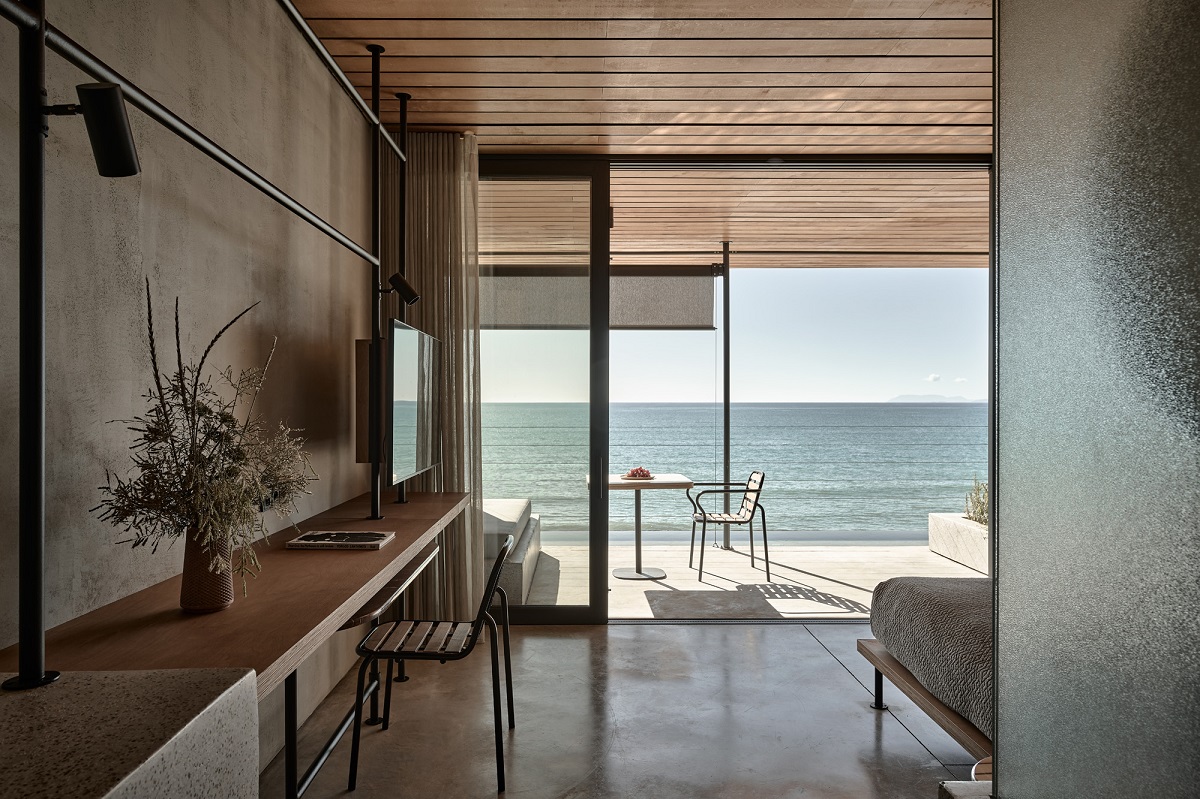
Image credit: Claus Brechenmacher & Reiner Baumann
Design the bed as a complete system
A hotel bed is not a single specification. Base, mattress and topper combine to determine its finished height, proportions, comfort and visual weight within the room.
The configuration will depend on the property. A divan can offer a different appearance and degree of flexibility from a slatted or platform bedstead, while zip-and-link arrangements allow some rooms to move between twin and larger bed configurations. Whatever the approach, dimensions need to be coordinated across the full build-up rather than considered component by component.
The base has a practical role too. It affects how the mattress performs, how easily housekeeping can work around the bed and how much clearance remains underneath. That last point becomes particularly important when equipment such as a mobile hoist needs to fit beneath or alongside the bed.
Mattress and topper selection then brings comfort into the equation. Support and firmness matter, but so do temperature, breathability, moisture management and the way materials perform over repeated nights of use.
Broad labels can be misleading here. ‘Natural’ does not automatically mean more comfortable, just as ‘synthetic’ does not automatically mean less breathable. The more useful questions are how the complete combination performs, what evidence supports those claims and how well the materials will withstand the property’s laundering and maintenance regime.
Fire performance also forms part of the same specification. Mattresses, bases and upholstered elements need to meet the requirements relevant to the project, with supporting evidence confirmed for the exact construction being supplied. It is another reason to resolve the bed as a complete system rather than assemble individual products in isolation.
The headboard then connects the bed back to the wider room.

Image credit: Moggi Photography / El Fenn
Make the headboard work harder
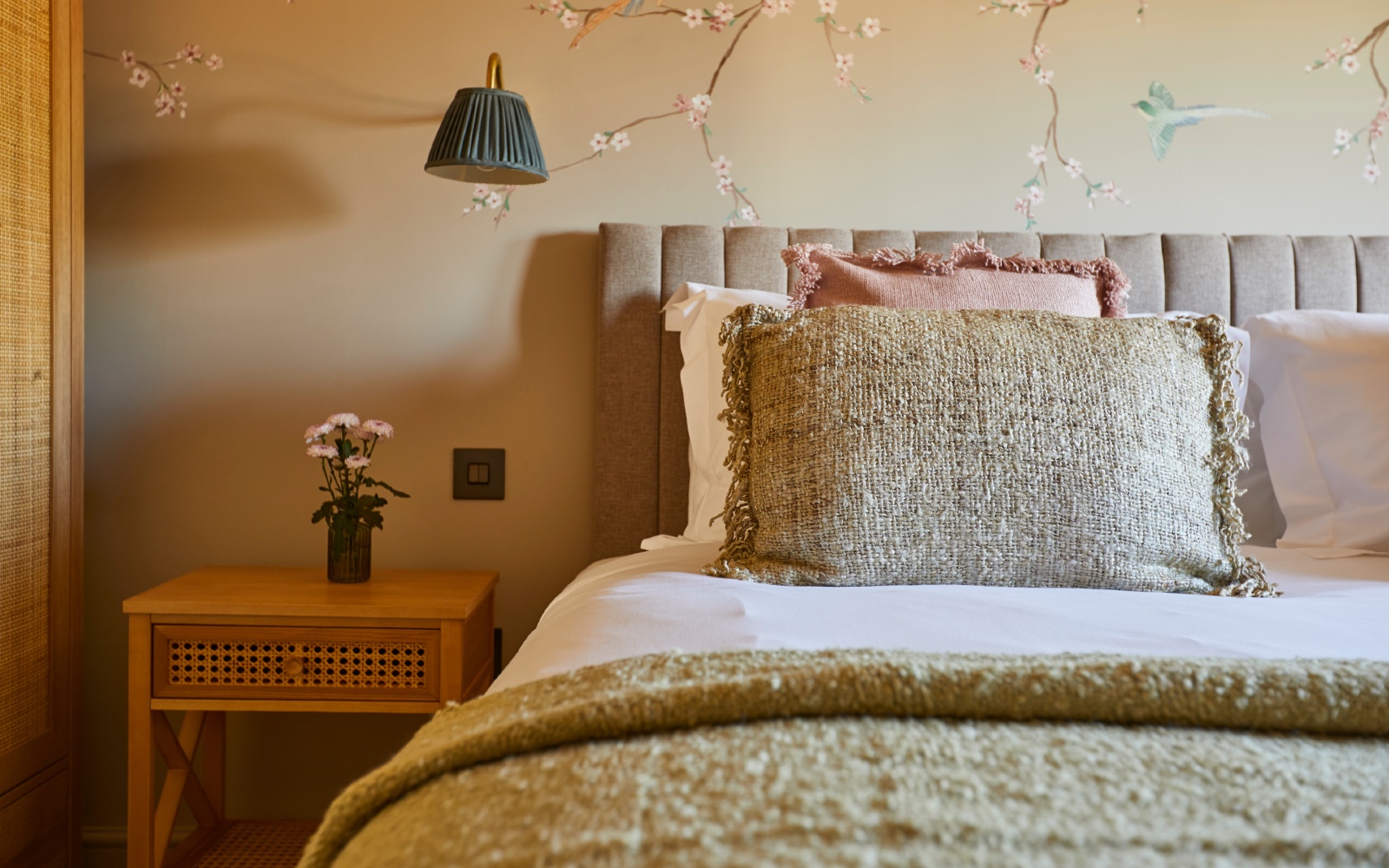
The headboard is often where the bed becomes part of the wider interior. Its width and height help establish the proportion of the bed wall, while material, colour and detailing can give the sleeping zone its own identity within the room.
A headboard might frame the bed closely or extend across much of the wall to bring bedside tables, lighting and finishes into a single composition. Upholstery can add tactility and softness, particularly in rooms dominated by harder surfaces, although any measurable acoustic-performance claim should be supported rather than assumed from the material alone.
The headboard increasingly has a functional role as well. Reading lights, switches, sockets, charging points and room controls all need to sit where guests can understand and reach them instinctively.
That requires early coordination. Bed width, bedside tables, headboard dimensions, electrical positions and lighting cannot be resolved independently if everything is expected to align when the room is installed.
Flexibility adds another consideration. Where a room needs to accommodate both twin and larger bed configurations, lighting and controls should remain usable in both layouts rather than making one arrangement feel like a compromise.
With the architecture and services around the bed resolved, the next layer is the one the guest actually touches.

Image credit: Alice Casenave / Babel
Layer the bed for comfort and operation
Sheets, duvets, pillows, toppers and decorative layers determine much of the finished character of the bed. They also determine how easily the bed can be stripped and remade, and how its components are laundered and maintained.
That makes bedding both a design and an operational choice. A more layered bed can create a generous, residential feel, while a simpler approach may better suit a property built around quick room turnaround. Neither is inherently right; the visual ambition has to work with the service model behind it.
Pillows deserve the same attention. Different sizes, densities and arrangements affect both comfort and the appearance of the made bed. Where a hotel offers pillow menus or spare bedding, those options also require nearby storage and a practical replenishment routine.
Runners, cushions and throws can bring colour, texture and pattern into the scheme, but every additional layer creates another maintenance question. If decorative items follow a different cleaning cycle from the bed linen, their fabric, construction and frequency of use need to reflect that reality.
Housekeeping also needs room to work. A bed pushed tightly into a corner may make efficient use of the floor plan, but it can make changing linen and cleaning around it unnecessarily difficult. Solid plinths and complex frames can create similar issues where access has not been considered early.
The finished bed therefore has to work both when the guest arrives and when the room is being turned around for the next one.
Those same dimensions and clearances also affect how accessible the room is.
Image credit: The Carlton, Milan
Design for every guest
Accessibility starts with the relationship between the bed and the space around it. A room may have an accessible entrance and generous circulation, but that means little if a guest cannot comfortably approach, transfer onto or use the bed itself.
Clearance beside the bed needs to reflect how the room will be used. Where mobile hoists form part of the operational strategy, sufficient manoeuvring space and under-bed clearance also need to be provided, which can make some solid platform bases unsuitable.
Finished bed height is equally important because it is created by the complete build-up. A base may appear appropriate in isolation, only for a deep mattress and topper to raise the final sleeping surface significantly.
That is why dimensions need to be checked once the base, mattress and topper have been selected together.
Other features can make the room work for a wider range of guests. Height-adjustable bases may support different transfer needs, while a supportive edge can make sitting on the side of the bed easier. Lights, switches, sockets and other bedside controls should also be reachable without requiring unnecessary movement.
Inclusion extends beyond mobility. Light levels, noise, temperature and the tactile qualities of bedding and upholstery can all affect how comfortable the sleeping environment feels for guests with different sensory needs.
These are themes explored throughout Hotel Designs’ Accessible Design Talks series, which brings lived experience into the design conversation. No single product makes a guestroom accessible; the more useful starting point is understanding who will use the bed and how.
The Tawny Hotel – The Owlets | Image credit: Hypnos
Plan for performance beyond opening day
A hotel bed has to survive far more than its opening photographs. Nightly use, housekeeping, commercial laundering and repeated cleaning all put pressure on components that may be expected to remain in service for years.
Durability therefore belongs in the specification from the beginning. Guarantee periods, care instructions and recommended maintenance should be understood alongside comfort and appearance rather than discovered after installation.
Firmness and comfort should also be treated as different questions. A technical measure of mattress hardness can help compare products, but it cannot predict how every guest will experience the bed. The specification needs to balance measurable performance with the level and type of comfort the property wants to offer.
Care regimes need to be achievable too. If a mattress requires turning or rotation, housekeeping needs enough physical space to do it and a realistic schedule for keeping track of the work. Removable or replaceable components can make future maintenance simpler and help extend the useful life of the bed.
Eventually, every mattress will need replacing. That makes end-of-life planning part of the specification rather than simply a disposal issue.
Take-back schemes, products designed for disassembly and clearer information about material composition can all help designers and operators consider what happens when a bed leaves the guestroom. The same scrutiny should be applied to environmental claims: terms such as ‘natural’ and ‘sustainable’ should prompt questions about materials, evidence, certification and lifecycle rather than being taken at face value.
For designers beginning that research, the Hotel Designs hotel suppliers resource offers a starting point for exploring contract bed manufacturers and suppliers.

Image credit: Jon Day / Naturalmat
Design from the pillow out
The strongest hotel beds are designed from the guest experience outward.
Position determines what the guest sees, hears and feels from the pillow. The base, mattress and topper establish comfort and proportion. The headboard connects the bed to the architecture and services around it, while bedding brings together tactility, appearance and the realities of housekeeping.
Accessibility, durability and maintenance then determine whether those decisions continue to work after the first night.
No single element needs to make a statement on its own. The design comes from resolving them together, so that the centrepiece of the guestroom feels as considered in use as it does on arrival.
For more practical guidance on hospitality interiors and architecture, explore the Guide to Hotel Design. The conversation continues at Hotel Designs’ events, bringing designers, architects, hoteliers and suppliers together to discuss the ideas shaping hospitality design.
Main image credit: Banyan Group