









Accessible Design Talk: Designing for our future selves
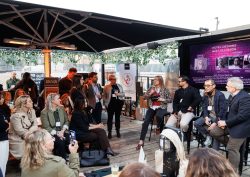
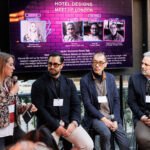
For the first time at MEET UP London, Hotel Designs brought a live panel to the event, with Editor Sophie Harper shining a light on what the future might look like for us all and what we should consider when designing for an ageing population…
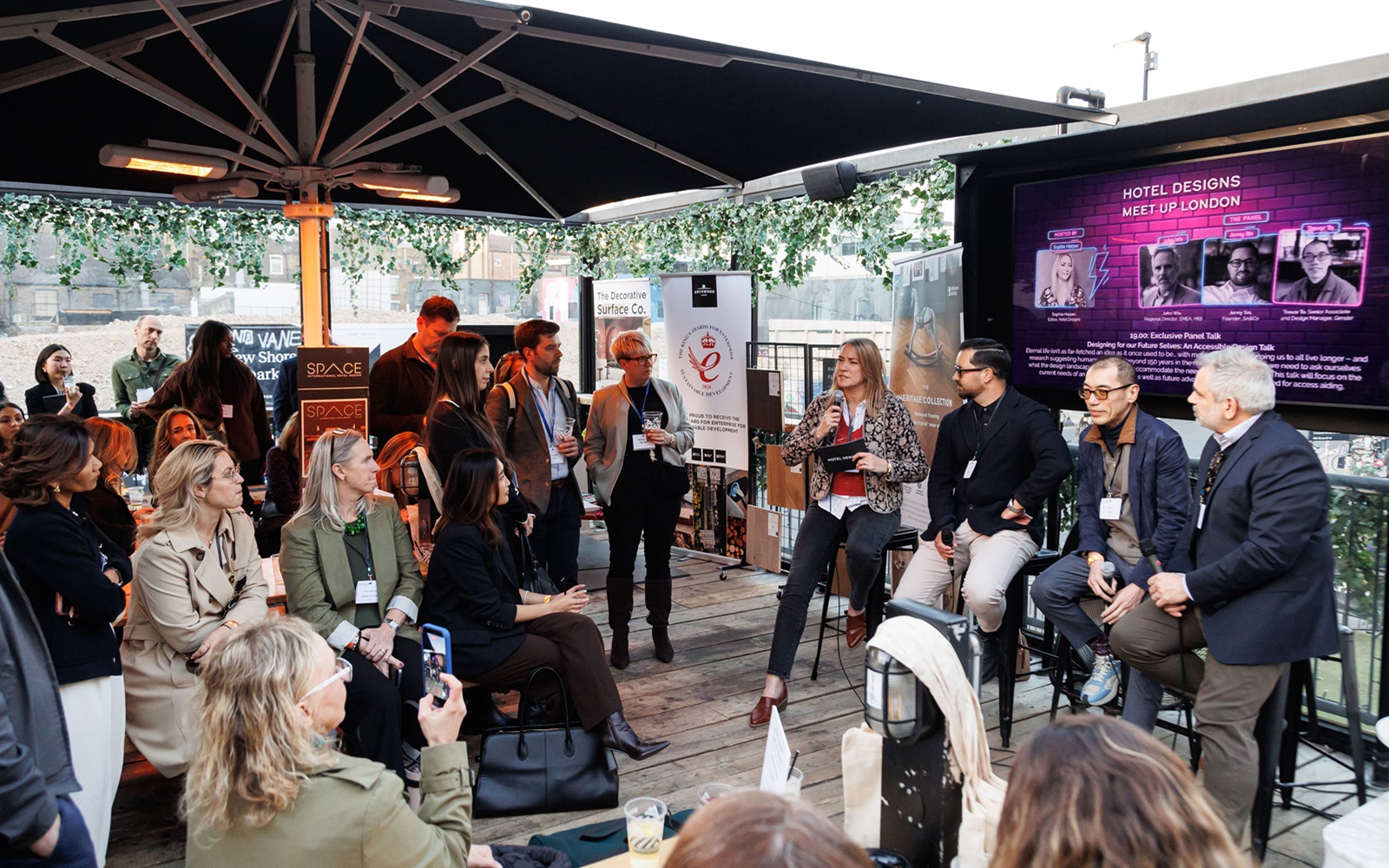
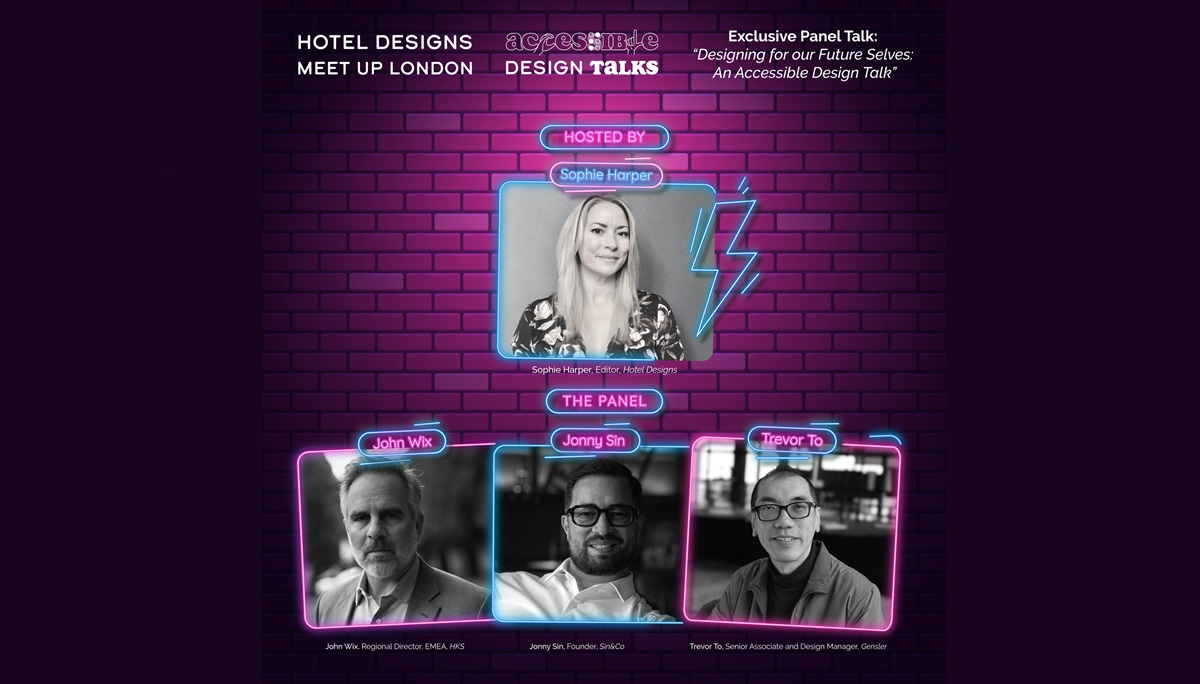
Hotel Designs’ Accessible Design Talks series was launched to shine a light on the gaps in accessibility within hospitality design. Having previously explored accessibility through the lens of neurodivergence, the talk at MEET UP London moved the conversation on to a demographic the panel argued the industry still underserves: older guests.
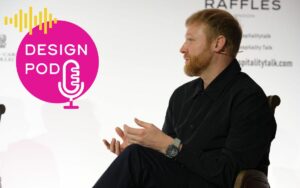
On the panel this time were: John Wix, Regional Sector Director, EMEA & Principal, HKS; Jonny Sin, Founder & Managing Director, Sin & Co; and Trevor To, Design Manager & Senior Associate, Gensler.
Opening the discussion, Sophie Harper set the tone: “We’re all ageing, and are privileged to do so… but we want to understand what’s missing from the hospitality industry at the moment – to help aid the more senior population, in order to help improve their experience. Older people are the biggest spenders in luxury travel, yet we’re not accommodating their needs very well.”
Not a tick-box exercise
For the panel, the starting point was reframing accessibility altogether. John Wix argued that designers shouldn’t approach the subject as a compliance exercise: “We kind of have to start from a place where we don’t really think about ticking a box or fulfilling some sort of accessibility requirement… it’s really thinking about tourism for all.”
Jonny Sin pushed back on the assumption that accessible design begins and ends with wheelchairs. “A lot of people think about accessible design as only being for wheelchairs and level access. And there’s so much more to that as well,” he said, pointing out that only around 10% of older guests use a wheelchair, while roughly one in three live with some form of mobility issue, alongside visual impairment and other hidden needs.
Trevor To linked this back to the fundamentals of hospitality: “The most important thing is to think about what the guests need before they realise they need it… it’s about applying that same logic of serving your guests and anticipating their needs.”
Sophie summed up the underlying principle: “Not every disability is visible. And I think it’s really important to factor that in when you’re talking about designing for different age groups… we’re designing for all people, from all walks of life.”
Retrofitting history
Much of hospitality’s stock is historic, and the panel discussed the particular challenge of adapting older buildings without accessibility built in from the outset. Jonny Sin described working around structural constraints on a hotel bar project, where installing a platform level proved impossible: “We looked at another alternative of running the bar across. So, people on the upper tier can actually access the bar in addition to the people below… it was about creating inclusivity within the hotel.”
John Wix acknowledged that retrofitting is rarely straightforward, and often comes down to cost and timing. “From a regenerative standpoint, it’s the best thing to do… but from a cost standpoint, sometimes it’s a killer,” he said. “You just really have to think in that way to try to create those solutions. But it’s a place to start.” He was clear that the earlier the conversation happens, the better: “If you’re thinking about it, then you can have the conversation. If you try to shoehorn it in later, forget about it.”
Trevor To agreed, stressing the value of bringing in specialist input early and often informally: “Do you want to help us to get some ideas and have a look? Because that’s the only way you can put a convincing solution forward to the client.” He described how access consultants help teams triage interventions into different tiers, “so that helps the optioneering to get the decision quicker.”
Jonny Sin illustrated just how far that specialist input can go, recounting the accessibility challenge posed by a 10-metre, 30-tonne Antony Gormley sculpture installed at the Beaumont Hotel, where the artist wanted an unconventional break in the handrail. The access consultant brought onto the project, who had a disability himself, built a full-scale mock-up and demonstrated the solution to building control in person. “There was no better demonstration than the access consultant doing it himself, which then approved the scheme that we had,” he said. “It was very educational for me as well being part of that process.”
Beyond the guest room
The conversation turned to public spaces, with Sophie noting that accessibility efforts often concentrate on guest rooms while communal areas can be overlooked. “Not everyone that’s using the hotel is going to be staying there necessarily,” she said. “So, how do we approach making bars, restaurants, lobby space, more accessible to people with additional access needs?”
Trevor pointed to subtler, sensory-led solutions such as acoustic tuning to soften noise in a corner of a busy space, and even scent as a wayfinding tool: “The smell can indirectly guide you to something, even different programming, so, in the spa, you will smell something different than when you are in the restaurant or in the bar.”
Sin identified wayfinding as a personal frustration, arguing that guests shouldn’t need to think hard about where they’re going. “One of my biggest pet peeves is wayfinding… it’s so frustrating… why don’t you create a loop around the corridor instead of someone actually going back on themselves.” Distinctive, memorable junctions, he said, help guests navigate more intuitively than uniform corridors ever could.
Sophie agreed this was a universal design issue rather than one specific to older guests: “All spaces should be intuitive as well, right? So, I mean, regardless of age or accessibility, everyone needs to be in a space that they know where things are… I’ve been in situations where I’ve struggled to find my hotel room. And it’s pretty stressful and it makes you feel stupid, which is not how any hotel guest should be made to feel. ”
Wellness, autonomy and dignity
The panel also connected accessible design to the wider rise of wellness and health tourism in hospitality. John was unequivocal about the trend’s staying power, drawing on his experience working on wellness resort developments on Saudi Arabia’s Red Sea Coast: “It’s already here. It’s here to stay… you don’t need to be a 22-year-old footballer recovering from a knee injury to go to these places. It’s the 60-year-old that ran the London Marathon last weekend that needs to go recover.”
Jonny agreed that wellness has become an expectation rather than an add-on for luxury guests: “It’s not enough to have just a swimming pool and a sauna… it needs to be embedded into the offering. And a lot of our clients are considering that now as a benchmark moving forward.”
On technology, Trevor argued that innovation should give older guests more independence rather than replace human service, describing branded voice assistants as an alternative to generic smart-home tools: “Trying to give people more autonomy so that they can make things happen within their guest room. They don’t always have to call somebody to ask for help.”
Jonny highlighted discreet sensor technology as a less intrusive alternative to CCTV for monitoring vulnerable guests, alongside a broader wish for more adaptable furniture across the board: “If they have a rapid fall, it can trigger the staff to go and check that movement… I would like to see more adaptable furniture in the future, to allow for different uses.” He was candid about how easily good intentions can go wrong on comfort, recalling a stylish hotel chair that turned out to be unbearably uncomfortable after half an hour. For older guests in particular, he argued, the stakes of getting furniture wrong are about more than comfort: “When they have to ask for help, they lose their independence. And that’s what you want to remove, and give them back their dignity.”
John added that designing for older guests also means designing for the people they travel with, who may have entirely different needs: “I might not have the same needs that my wife has, right? So you’re catering to different things… you need to keep that in mind.”
Designing for a core market, not a niche
Closing out the discussion, Sophie asked the panel to imagine themselves 30 years from now, checking into a hotel. John said the priority was consistency of experience: “I don’t want to feel compromised… I want to feel like the same level of service and enjoyment and experience is there for me that is there for the me when I was 20.” Trevor echoed the sentiment: “I want to feel like I don’t need to worry about whether or not I can still do this.”
For Jonny, it came down to choice: “I think just doing all the things that give you the choice to choose what you want to do, I think that’s the most important thing as you gradually age… that’s what inclusive design is really all about.” He was clear that this isn’t a fringe concern for the industry: “One in five are travelling over 65. It’s not a niche market.”
Sophie closed the talk with the commercial case for taking the topic seriously, noting that older travellers – particularly baby boomers aged 60 to 78 – are among the most powerful demographics in global luxury travel, with the accumulated wealth, time and motivation to consistently outspend every other age group on premium hotels. “This isn’t a small market sector,” she said. “It’s the market sector that you need to be catering to.”
Want to join the next accessible design conversation?
The next Accessible Design Talk is taking place at the Independent Hotel Show London, on 5th October at London Olympia. Hosted by Hotel Designs, Editor Sophie Harper will be leading a conversation on the demand for luxury hospitality within the disabled community, which will address the lack of opportunities available for luxury accessible travel. Register for your IHS 2026 ticket.